
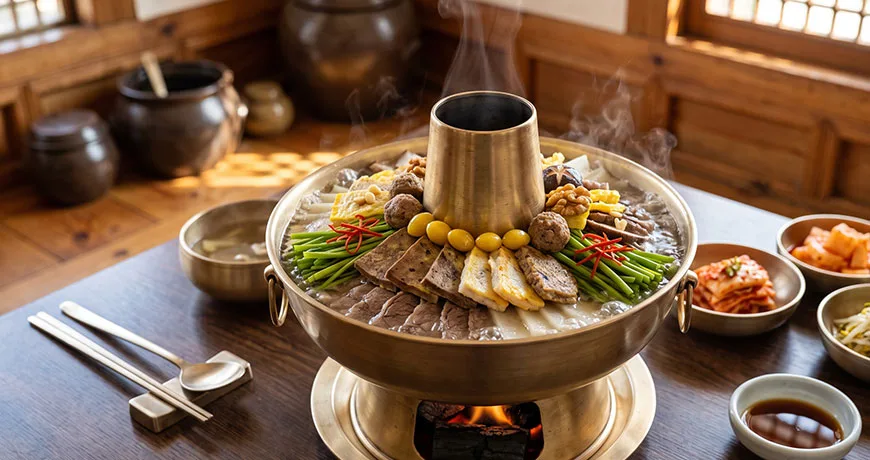
Sinseollo is not merely a dish; it is a microcosm of harmony resting within a vessel of fire. Often referred to as “Yeolgujatang” (a soup that delights the mouth), this masterpiece of the Joseon Royal Court transcends ordinary hot pots to become a noble, edible work of art. Beneath a mirror-clear, slow-simmered beef consommé lies a profound architectural assembly of land, sea, and sky, guided by the philosophy of Obangsaek (the five traditional Korean colors). The gentle, enduring heat radiating from the glowing charcoal in the central chimney slowly extracts the essence of every ingredient. The moment it graces your palate, the varied textures and elegant umami conduct a flawless, unforgettable culinary symphony.
- ⏱️ Total Time: 3–4 Hours | Prep: 2.5 Hours (Broth clarification and Obangsaek mise en place) | Cook: 30 Mins (Architectural layering and chimney heating)
- 🍳 Difficulty: Extreme (Requires impeccable knife skills, diverse pan-frying techniques, and the extraction of a crystal-clear broth)
- 🌶️ Profile: A highly dimensional, non-aggressive umami born from the harmonious melding of meat, seafood, and vegetables in a pristine beef broth
- 🍚 Core Process: Broth Clarification, Obangsaek Preparation, Architectural Layering, Chimney Heating
- 🍶 Pairing: Premium Cheongju (refined rice wine) with subtle floral notes, delicate royal dumplings, creamy pine nut porridge
Physicochemical & Sensory Matrix
- Baseline Salinity: 0.8% ~ 1.0% (An elegant, restrained salinity guided by traditional soup soy sauce that respects natural flavors)
- Thermal Dynamics: A steady 80~90°C maintained by the central charcoal chimney, ensuring optimal flavor extraction without denaturing delicate proteins
- Textural Harmony: A symphonic contrast between the soft yielding of pan-fried jeon, the crispness of vegetables, and the resilient chew of beef and mushrooms
- Umami Density: 9.8 / 10 (The ultimate culinary synergy of beef inosinate, mushroom guanylate, and seafood glutamate melding in a clear broth)
- Aroma Profile: Pristine Beef Consommé | Toasted Sesame Esters | Subtle, Elegant Smokiness from the Charcoal
Ingredients (Yields 1 Traditional Sinseollo Hot Pot)
- Base Broth & Foundation Matrix: 300g Beef Brisket (Yangji), 200g Korean Radish, 1 Scallion, 3 Cloves Garlic, 2 tbsp Traditional Soup Soy Sauce (Guk-ganjang), Salt to taste
- Protein Garnishes: 100g White Fish Fillet (Pollack or Croaker), 100g Minced Beef (for meatballs), 50g Soaked Sea Cucumber, 1 Whole Abalone
- Obangsaek Vegetables & Mushrooms: 3 Eggs (separated and pan-fried as yellow/white sheets), 50g Water Dropwort (Minari), 2 Soaked Shiitake Mushrooms, 3 Sheets Rock Tripe (Seogi), 50g Carrot
- Nut Garnish: 1 tbsp Pine Nuts, 10 Ginkgo Nuts, 3 Walnuts
Allergy Information
- Contains: Egg, Beef, Seafood (Abalone, Sea Cucumber, Fish), Tree Nuts (Walnut, Pine Nut, Ginkgo), Soy, Wheat (inherent in soy sauce)
Equipment Traditional Sinseollo Vessel (Brass hot pot with a central chimney), White Charcoal (Baektan), Stainless Steel Saucepan, Frying Pan, Fine Mesh Strainer and Cheesecloth
Cooking Instructions
- Broth Clarification: In a pot, gently simmer the beef brisket, radish, scallion, and garlic over low heat to extract a deep, resonant base. Once the beef and radish are tender, remove and slice them flat. Strain the remaining liquid through a fine cheesecloth to remove all impurities and fat. Season this pristine, mirror-clear consommé with soup soy sauce and a pinch of salt. This forms the absolute foundation of the dish.
- Preparation of Obangsaek Garnishes: Separate the egg yolks and whites, frying them into paper-thin sheets (Jidan). Thinly slice the shiitake, rock tripe, and carrot. Skewer the water dropwort and pan-fry it lightly. Form the minced beef into tiny, elegant meatballs, and pan-fry the white fish fillets. With absolute precision, cut all these garnishes into uniform, rectangular pieces (approx. 2x4cm) specifically sized to fit the width of the vessel.
- Architectural Layering: Line the bottom of the Sinseollo vessel with the sliced boiled brisket and radish to build a solid flavor foundation. Add a middle layer of the heavier ingredients: fish jeon, water dropwort jeon, and meatballs. For the top surface, meticulously arrange the yellow and white egg strips, shiitake, rock tripe, and carrot in a radiating pattern, ensuring the five colors alternate brilliantly.
- Nut Garnish: Scatter the delicately roasted ginkgo nuts, pine nuts, and walnuts over the vibrant tapestry to provide visual depth and a delightful crunch.
- Awakening with Fire: Carefully pour the hot, clear beef broth into the vessel, taking care not to disturb the meticulously arranged garnishes. Fill the central chimney with glowing, premium white charcoal. As the broth begins to bubble gently from the radiant heat, releasing a symphony of aromas, carry this majestic vessel to the center of the dining table.
💡 Professional Culinary Tips
- 1. Thermal Control for Clarity: If the broth is boiled too aggressively, the fats and proteins will emulsify, turning the liquid cloudy. A gentle simmer and meticulous straining through cheesecloth are paramount for achieving the mirror-clear broth that defines the dignity of Royal Court cuisine.
- 2. Mise en Place Precision: Sinseollo is a geometric masterpiece where diverse ingredients are arranged radially within a circular vessel. Slicing dozens of garnishes to millimeter-perfect uniformity is the most direct testament to a chef’s skill, discipline, and devotion to the ingredients.
- 3. The Breath of Charcoal: Only the highest quality white charcoal (Baektan) should be used in the chimney, as it burns cleanly without spitting or producing harsh smoke. The far-infrared heat radiating from the charcoal maintains the broth at an optimal temperature, while a faint, elegant smokiness seamlessly unites the complex flavors of the land and sea.
🍶 Gastronomic Pairing
- A Flawless Marriage of Temperature and Aroma: The Sinseollo broth begins clear and light, but as it bathes in the gentle heat of the charcoal, it transforms. It slowly absorbs the savory oils from the jeon and the umami of the garnishes, becoming profoundly rich and intoxicating. Pair this evolving broth with a premium Cheongju (traditional refined rice wine) that features subtle floral and yeast notes. The warm soup comforts the body, while the chilled rice wine elegantly cleanses the palate, recreating a timeless royal banquet right at your table.
Nutrition Facts (Estimated)
Total Content : Approx. 250g (1 Serving)
Calories : 280 kcal (High-density proteins and healthy nut fats)
– Sodium : 750mg (Restrained salinity via clear broth)
– Total Carbohydrate : 12.0g
– Sugar : 2.0g
– Total Fat : 14.5g
– Saturated Fat : 3.5g
– Cholesterol : 180mg (Derived from egg, seafood, and beef)
– Protein : 24.0g (Harmonious proteins from land, sea, and sky)
– Dietary Fiber : 3.0g
*Daily Values are based on a 2,000 calorie diet and standard Korean nutritional reference values.
**Nutritional values are calculated based on original ingredients; substitutions may alter specific macronutrients.
Origins and Food Culture of Royal Hot Pot (Sinseollo)
1. “Yeolguja-tang” (悅口子湯) and the Legend of Jeong Hui-ryang’s Taoist Immortality
- The formal historical title of Sinseollo is Yeolguja-tang (悅口子湯), which translates poetically to “a soup that brings profound delight to the mouth.” In the 10th-month section of Hong Seok-mo’s 1849 seasonal almanac Dongguk Sesigi, it is recorded: “Simmering sliced beef, pork, radishes, and water parsley in seasoned broth inside a charcoal-burning brass pot is called Yeolguja-tang, and the specialized pot itself is called Sinseollo (神仙爐).”
- Folk tradition attributes the invention of the vessel to the Joseon Neo-Confucian scholar and poet Jeong Hui-ryang (호 虛菴 Heo-am, 1469–?), a disciple of Kim Jong-jik. Foreseeing the bloody Muo Literati Purge of 1498 during the turbulent reign of Yeonsangun, he abandoned public office and retreated into remote mountain sanctuaries such as Mount Jiri and Mount Myohyang. Living as a mountain recluse, he fashioned a portable brass brazier to cook wild mountain greens and gathered provisions, wandering freely like a Taoist immortal (Sinseon 神仙) until his mysterious disappearance. In his honor, generations of cooks designated the brazier pot and its comforting banquet contents as Sinseollo (“the Brazier of the Taoist Immortal”).
2. The Thermodynamic Engineering of Bangja-Yugi and Charcoal Stack Convection
- The Sinseollo vessel represents a remarkable historical feat of culinary thermal engineering, featuring an annular cooking moat encircling a hollow, vertical draft chimney (tong 筒) integrated atop a perforated pedestal base.
- Hand-hammered from traditional Korean bronze alloy (bangja-yugi, precisely 78% copper and 22% tin), the metal provides exceptional thermal conductivity and antimicrobial properties. Placing lump hardwood charcoal (baektan) inside the central chimney triggers the thermodynamic stack effect, drawing cool oxygen continuously through bottom air ports to sustain clean, steady combustion. The charcoal radiates heat horizontally through the bronze wall, warming the surrounding broth evenly so it remains above 80°C throughout long banquets without scorching or needing an external stove.
3. Cosmological Harmony: The Five Elements (五行) and Joseon Dynastic Protocol
- Sinseollo served as the central culinary centerpiece of formal Joseon royal ceremonies, including Jinyeon and Jinchan (palace banquets celebrating dynastic jubilees and honoring royal elders) and diplomatic feasts for visiting Qing emissaries. The dish was extensively codified in 19th-century palace records (Uigwe 儀軌), Lady Yi’s Gyuhap Chongseo (1809), and the late Joseon culinary manuscript Siuijeonso.
- The presentation reflects the Taoist and Confucian philosophy of Yin-Yang and the Five Elements (陰陽五行), visualized through the Five Cardinal Colors (五方色 / Obangsek): Blue/Green (Wood/East – water parsley, scallions), Red (Fire/South – chili, carrots, beef), Yellow (Earth/Center – egg yolk, ginkgo), White (Metal/West – egg white, white fish, radish), and Black (Water/North – shiitake, rock-tripe, sea cucumber). By gathering the diverse bounties of the sky, land, and deep sea into a single radiant vessel, Sinseollo symbolized cosmic harmony, seasonal balance, and the enduring prosperity of the kingdom.
Encircling a Central Brazier Chimney Glowing with White-Hot Charcoal, Assembling an Ornate Mandala of Land, Sea, and Sky Through the Five Cardinal Colors of Pan-Fried Fritters, and Bathing the Geometric Mosaic in Crystal-Clear Beef Consommé: A Refined Portrait of Traditional Sinseollo
Sinseollo (Royal Hot Pot, historically celebrated as Yeolgujatang, the “Soup That Delights the Mouth”) represents the grandest, most intellectually intricate summit within Korean Joseon Dynasty royal court gastronomy. Centered upon a burnished brass or bronze vessel featuring a hollow vertical brazier flue rising from a doughnut-shaped moat, this banquet centerpiece bridges the philosophical ideals of Taoist hermetic balance and royal Confucian ceremony. Legend traces its origin to Jeong Hee-ryang, a Joseon scholar-official who retreated into the mist-shrouded peaks of Mount Jiri during the Muo literati purge, subsisting like an enlightened Taoist immortal (sinseon) by simmering gathered mountain roots and greens within a portable charcoal brazier—lending the vessel its evocative name, Sinseollo. Later elevated to the Joseon royal banqueting table, it was rechristened Yeolgujatang to honor its ability to deliver profound sensual pleasure to the palate. The dish is assembled through rigorous geometric discipline: a subterranean foundation of shredded radish, braised beef brisket, stewed tripe, and plump reconstituted sea cucumber is overlaid with a radial mosaic of precision-cut rectangular tiles. Silvery fish fillets, rich beef liver, and tripe—each egg-battered and pan-fried into delicate jeon—alternate symmetrically with ivory and gold egg jidan, crimson carrots, vibrant water dropwort ties (minari-ganghoe), and obsidian-dark rock tripe mushrooms. Crowned with toasted pine nuts, ginkgo nuts, and meatballs (wanja), this culinary mandala is bathed in boiling, clear beef consommé right at the banqueting table.
Lifting the ornate brass lid reveals a column of fragrant chimney vapor curling upward into the air as the clear broth bubbles gently in its annular brass basin. Approaching the vessel, the comforting, malty depth of aged Joseon soy sauce and simmering beef shank is brightened by the toasted richness of egg-battered fritters, the briny mineral whisper of braised sea cucumber, and the resinous, piney perfume of fresh pine nuts and roasted ginkgo. Ladling a portion into a porcelain bowl introduces an extraordinary sensory dialogue: the crystal-clear broth delivers an immediate impression of pristine purity, yet as it washes over the tongue, it unlocks an astonishingly dense, multi-layered wave of pure umami. Chewing through the mosaic yields a kaleidoscopic textural progression: the velvety, pillowy surrender of cod fillet jeon, the dense, iron-rich chew of liver fritters, the resilient, rubbery snap of sea cucumber, and the crisp herbal pop of water dropwort all harmonize seamlessly across the teeth. The minute traces of egg lipids and sesame glaze dissolve into the simmering broth, imparting a silk-like body that warms the throat without an ounce of greasy heaviness. The cultural identity of Sinseollo lies in the royal philosophy that sought cosmic harmony upon a single plate, uniting the five cardinal elements (Ohaeng) through color, texture, and flavor. By balancing the fierce fire (Hwa) of radiant charcoal, the clear fluid (Su) of alpine broth, the refined metal (Geum) of brasscraft, the forest herbs (Mok) of mushrooms and roots, and the pottery-borne earth (To) of aged soy, Sinseollo stands as an enduring monument to royal banqueting refinement
Editor’s Review
1. Radial Brass Thermal Conduction and Chimney Draft Fluid Dynamics
Sinseollo functions as a self-sustaining thermodynamic apparatus engineered for table-side precision:
- Uniform Radial Heat Transfer: Constructed from high-conductivity brass (a copper-zinc alloy), the vessel rapidly diffuses intense radiative and conductive heat generated by hardwood charcoal in the central chimney across the annular basin. This eliminates hot spots, preventing localized scorching of the submerged ingredients while promoting continuous, gentle toroidal fluid convection.
- Draft-Induced Gentle Simmering: The vertical chimney utilizes the natural stack effect (buoyancy-driven draft) to draw fresh combustion air through lower air inlets. This maintains steady, controlled charcoal combustion that stabilizes the broth within a sub-boiling temperature envelope of 85–92°C. This specific thermal window prevents violent cavitation and the turbulent dispersion of insoluble cellular fragments, ensuring the broth remains transparent throughout dining.
2. Proteinaceous Hydrocolloid Barriers in Jeon and Solute Retention Kinetics
The structural integrity of the colorful mosaic relies on the protective properties of pan-fried egg coatings:
- Albumin-Lecithin Barrier Membrane: Pan-frying ingredients coated in wheat flour and beaten egg (jeon) forms a consolidated protein-lipid film via the thermal denaturation of ovalbumin and the emulsifying power of yolk lecithin. This semi-permeable hydrocolloid skin shields delicate fish proteins and fragile liver tissues from disintegrating into mush during prolonged boiling.
- Controlled Flavor Infusion via Surface Emulsification: Bound surface lipids and Maillard reaction compounds from the fried coatings gently hydrate into the simmering broth. This provides a clean lipid body and rounded mouthfeel without generating thick oil slicks, softening the salinity of the broth while locking in the structural colors of the tiles.
3. Tri-Modal Umami Synergy (IMP-GMP-Glutamate) and Marine Mucopolysaccharide Rheology
Sinseollo achieves exceptional savory depth through the simultaneous activation of multiple taste receptors:
- Allosteric Receptor Potentiation: The broth unites free 5′-inosine monophosphate (5′-IMP) from long-simmered beef brisket, free L-glutamate from traditional clear soy sauce (cheongjang) and simmered radishes, and 5′-guanosine monophosphate (5′-GMP) leached from dried shiitake and rock tripe (seogi) mushrooms. This three-way molecular synergy alters the conformational state of oral T1R1/T1R3 umami receptors, magnifying perceived savory intensity far beyond the additive sum of individual components.
- Mucopolysaccharide Textural Buffering: Rehydrated sea cucumber and abalone contribute chondroitin sulfate and marine collagen to the matrix. In sub-boiling broth, these macromolecular biopolymers release trace gelatinous fractions that lower fluid surface tension, imparting a velvety, lubricating rheology that glides smoothly across the oral mucosa.