
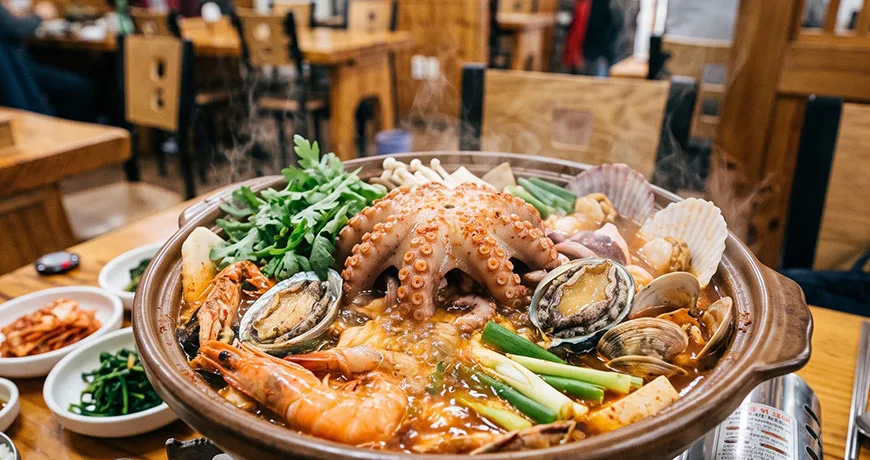
Haemullakjijeongol is a majestic culinary symphony that brings the raw, untamed energy of the ocean directly to the dining table. The profound, sweet depth of blue crabs and shrimp, combined with the pure succinic acid released by fresh clams, collides spectacularly with the fiery heat of red chili flakes. At the center of this bubbling, volcanic red sea, a live or fresh octopus is introduced at the very last moment. Through a fleeting, momentary poach, the octopus achieves the absolute zenith of tender, bouncy texture. The orchestrated, sequential extraction of flavors from these diverse marine ingredients creates an overwhelming, multi-dimensional umami that elevates spiciness from a mere sensation into a profound culinary depth.
- ⏱️ Total Time: 1.5 Hours | Prep: 40 Mins (Purging seafood, cleaning, and maturing the spice matrix) | Cook: 20 Mins (Broth extraction and table-side flash poaching)
- 🍳 Difficulty: High (Requires masterful timing in managing the extreme cooking differentials of various marine proteins)
- 🌶️ Profile: A piercing, deeply refreshing, and fiery broth exploding with the natural, savory sweetness of the ocean
- 🍚 Core Process: Oceanic Cleansing, Maturing the Spice Matrix, Sequential Extraction, Table-side Flash Poaching
- 🍶 Pairing: An ice-cold ‘Somaek’ (a crisp blend of Soju and a clean lager like Terra), fresh Kal-guksu (knife-cut noodles) to finish
Physicochemical & Sensory Matrix
- Baseline Salinity: 1.5% ~ 1.8% (A robust initial salinity calibrated to balance the massive influx of natural moisture from the seafood)
- Thermal Dynamics: A fierce 100°C boil to forcefully extract crustacean flavors, contrasted by a delicate 40-second thermal shock for the octopus
- Textural Harmony: The firm chew of clams, the flaking sweetness of crab meat, and the percussive, snappy bounce of the flash-poached octopus
- Umami Density: 9.7 / 10 (A vast spectrum of umami driven by crustacean amino acids, bivalve succinic acid, and cephalopod taurine)
- Aroma Profile: Vibrant Capsaicin Heat | Roasted Marine Astaxanthin | Refreshing Herbaceous Crown Daisy
Ingredients (Yields 1 Large Hot Pot, Serves 3-4)
- Marine Matrix: 2 Fresh or Live Small Octopuses (Nakji), 1 Blue Crab, 4 Large Shrimp, 300g Purged Littleneck Clams or Mussels
- Broth & Vegetable Matrix: 4 Cups Anchovy-Kelp Stock, 150g Korean Radish, 1/3 Zucchini, 1 Bunch Enoki Mushrooms, 1 Scallion, 50g Crown Daisy (Ssukgat), 2 Cheongyang Green Chilies, 1 Red Chili
- Spicy Yangnyeom Catalyst: 3 tbsp Fine Red Chili Flakes (Gochugaru), 2 tbsp Traditional Soup Soy Sauce, 2 tbsp Minced Garlic, 2 tbsp Mirin, 0.5 tsp Fermented Soybean Paste (Doenjang – for deodorization), Black Pepper
Allergy Information
- Contains: Crustacean (Crab, Shrimp), Mollusc (Octopus, Clam), Soy, Wheat (inherent in soy sauce and Doenjang)
Equipment Shallow Cast Iron or Stainless Steel Hot Pot (Jeongol-nabe), Mixing Bowl, Kitchen Shears and Tongs, Portable Tabletop Stove
Cooking Instructions
- Maturing the Spice Matrix: In a bowl, thoroughly mix the Gochugaru, soup soy sauce, minced garlic, mirin, Doenjang, and black pepper. Let it rest for at least 30 minutes. This allows the chili flakes to hydrate and bloom, rounding off their sharp, aggressive edges into a deep, resonant heat.
- Oceanic Cleansing: Scrub the crab, remove the gills, and quarter it. Snip the antennas of the shrimp and remove the veins. Scrub the clams vigorously with coarse salt. For the octopus, avoid salt; instead, massage it generously with all-purpose flour to gently lift away the mud and slime without tearing the skin. Rinse thoroughly and keep the octopus whole.
- Architectural Assembly: Line the bottom of the hot pot with thinly sliced radish. Arrange the crab, shrimp, and clams over the radish. Artfully tuck the zucchini, enoki mushrooms, and scallion around the seafood. Place the matured red spice matrix directly in the center.
- The Volcanic Boil: Pour the anchovy-kelp stock over the arrangement and place the pot over high heat. Boil fiercely for about 10 minutes until the crustaceans turn a brilliant, fiery red (astaxanthin release) and the clams pop open, releasing their milky, savory juices into the broth.
- The Fleeting Poach: Once the broth is deeply infused with marine flavor and the spicy kick of the chilies fills the air, place the hot pot on the dining table. While it is at a rolling boil, plunge the whole octopus into the center. The moment the tentacles curl up and turn a vivid purplish-red (about 40 seconds to 1 minute), reduce the heat to a simmer. Use scissors to cut the octopus into bite-sized pieces, top with fresh crown daisy, and serve immediately.
💡 Professional Culinary Tips
- 1. Dynamics of Sequential Extraction: Dumping all the seafood into the pot at once is a culinary disaster. The robust, heavy base must first be built by boiling the radish and the hard-shelled crabs and clams. The most fragile protein—the octopus—must only be introduced at the very end as a table-side flash poach. This sequential cooking guarantees textural perfection across the board.
- 2. The Hidden Role of Doenjang: Concealing a microscopic amount (0.5 tsp) of Doenjang (fermented soybean paste) in the spicy matrix is a closely guarded secret in high-end Korean dining. While its specific flavor remains undetectable, its fermented amino acids brilliantly mask any complex fishy odors and provide a massive, underlying structural body to the fiery broth.
- 3. Protecting Texture via Flour Cleansing: Using salt to scrub octopus triggers an osmotic reaction that draws out cellular moisture, rendering the flesh tough and rubbery. Utilizing the fine, powdery particles of flour acts as a gentle, highly effective abrasive that binds to impurities, flawlessly preserving the creature’s natural, bouncy hydration.
🍶 Gastronomic Pairing
- A Crisp Strike to Quench the Heat: A fiery, intensely complex seafood broth demands a beverage with absolute crispness and profound carbonation. A perfectly proportioned ‘Somaek’—a golden-ratio blend of Soju and a clean, effervescent lager like Terra—is the ultimate companion. As the volcanic, spicy broth heats your palate, an ice-cold glass of Somaek cuts through the richness with a thrilling, electrifying snap, completely refreshing the senses. Once the seafood is devoured, tossing fresh Kal-guksu (knife-cut wheat noodles) into the concentrated, thickened broth to finish the meal is an absolute necessity.
Nutrition Facts (Estimated)
Total Content : Approx. 400g (1 Serving, including seafood and broth)
Calories : 250 kcal (Healthy calories from a low-fat, high-protein marine ecosystem)
– Sodium : 950mg (Inherent marine salinity combined with the spicy broth)
– Total Carbohydrate : 14.0g
– Sugar : 4.0g
– Total Fat : 2.5g
– Saturated Fat : 0.5g
– Cholesterol : 220mg (Taurine-accompanied sterols derived from shrimp, crab, and octopus)
– Protein : 38.0g (Premium complex marine protein with a high amino acid score)
– Dietary Fiber : 4.0g (Abundant mushrooms and vegetables)
*Daily Values are based on a 2,000 calorie diet and standard Korean nutritional reference values.
**Nutritional values are calculated based on original ingredients; substitutions may alter specific macronutrients.
Origins and Food Culture of Seafood and Octopus Hot Pot (Haemullakjijeongol)
1. Peninsular Maritime Heritage and Historical Treatises: Jasan Eobo and Nanho Eomokji
- Encircled by the sea on three sides, the Korean peninsula has long maintained a culinary culture of boiling coastal catches—crabs, bivalves, and cephalopods—inside earthenware vessels, serving as an everyday source of marine protein since antiquity.
- In his pioneering 1814 marine biology manual Jasan Eobo, Joseon scholar Jeong Yak-jeon famously recorded of the mudflat octopus: “Feeding five or six octopuses to a fallen, emaciated cow will cause it to regain its feet and strength immediately,” documenting its revered status as a restorative tonic. Furthermore, Seo Yu-gu’s 1820 ichthyological compendium Nanho Eomokji cataloged coastal traditions across the Yellow and Southern Seas, where blue crabs, prawns, and assorted shellfish were simmered in chili and fermented soybean pastes to create restorative broths. Over the 20th century, these coastal stews merged with refined banqueting traditions to yield the modern Haemullakjijeongol.
2. The Science of Oceanic Umami: Bivalve Succinic Acid and Segmented Heat Control
- Unlike finfish-based fish stews (maeuntang), which rely heavily on dissolved lipids and gelatin from fish heads and collars, Haemullakjijeongol derives its profile from the tart, crystalline clarity of bivalve-derived succinic acid married to the sweet free amino acids of crustaceans and cephalopods.
- Recognizing that fragile cephalopod proteins toughen under prolonged boiling, traditional tavern cooks developed a sequential boiling method. Cooking hard-shelled mollusks and crustaceans first releases savory juices and minerals into the broth; the whole octopus is then layered on top at the dining table and poached gently in the bubbling soup, achieving a dual harmony of broth depth and succulent meat texture.
3. From Portside Taverns to the Shared Modern Tabletop Feast
- During the economic expansion of the 1970s and 1980s, bustling fishing ports and seafood trading hubs—including Gunsan, Incheon, Mokpo, and Boryeong—popularized hearty, communal seafood cauldrons using daily catches brought straight off fishing vessels.
- While single-portion seafood soups were served in stone bowls (ttukbaegi), Haemullakjijeongol evolved into an interactive centerpiece for communal gatherings and celebratory banquets. Diners gather around the wide pan to watch the vibrant sea harvest cook together. After harvesting the succulent shellfish and tender octopus, tradition calls for simmering thick handmade wheat noodles (kalguksu) or stir-frying seasoned rice with chopped water parsley and roasted seaweed in the remaining reduced broth, reflecting a dining ethos that honors every drop of the ocean’s bounty.
The Energetic Vitality of Fresh Octopus Harvested from Mudflats Colliding with Blue Crabs, Clams, and Aromatic Herbs Inside a Crimson Cauldron of Boiling Chili Broth: A Refined Portrait of Traditional Haemullakjijeongol
Haemullakjijeongol (Spicy Seafood and Long-Arm Octopus Hot Pot) stands as an exhilarating, structurally magnificent summit within Korea’s maritime hot pot gastronomy. Centered on live long-arm mud octopus (nakji)—plucked fresh from the tidal currents of the western and southern coasts—this banquet centerpiece gathers a diverse fleet of seasonal seafood: roe-laden blue swimming crabs, sweet prawns, tight-lipped Manila clams, sea mussels, briny squirts (mideodeok), and tender squid rings. Arranged inside a broad, shallow vessel alongside radishes, crisp bean sprouts, mushrooms, wild water dropwort (minari), and crown daisy (sukgat), this vibrant mosaic is bathed in an anchovy-kelp stock spiked with sun-dried red chili flakes, crushed garlic, and fermented seasonings, brought to a violent, rolling boil directly tableside. Unlike the inland serenity of beef-rib and octopus stews (Gallakjeongol), Haemullakjijeongol celebrates the untamed, unadorned clash of marine phyla. The culinary triumph hinges on absolute thermodynamic precision: balancing the widely differing protein denaturation thresholds of shelled mollusks, crustaceans, and cephalopods so that the star octopus yields maximum tenderness without turning stringy or rubbery. Introduced into the rolling boil just as the clams open their pearl-white valves and the crabs blush crimson, the octopus blossoms into a radiant lilac bloom within minutes, sealing ocean juices beneath a tender surface.
Lifting the lid from the bubbling vessel tableside releases a swirling column of aromatic steam that transports the senses to a bustling coastal wharf. The comforting, malty sweetness of crab and shrimp carapaces mingles with the briny perfume of cracked bivalves, the iodine richness of sea squirts, and the sharp, piney bouquet of wild dropwort. Lifting a tender, violet-tinted octopus tentacle with tongs and testing it between the teeth reveals an immediate tactile reward: a springy, yielding elasticity (yadul-yadul) that gives way under dental pressure with an audible, succulent snap, discharging cool marine juices across the palate. Snapping into a sweet crab leg reveals succulent white meat that flakes effortlessly along the grain, while puncturing a plump sea squirt triggers an explosion of concentrated ocean nectar. Ladling the crimson bouillon into a bowl and taking a deep sip unlocks a profound sensation of siwonhan-mat—an untranslatable Korean concept of deep, clarifying refreshment: the crisp, tongue-tingling acidity of shellfish succinic acid melds with the savory umami of kelp and anchovy, while the clean burn of red pepper washes through the throat, cleansing systemic fatigue in a wave of warmth.
The cultural identity of Haemullakjijeongol lies in the communal ingenuity that orchestrated the varied denizens of the deep through tableside thermodynamic discipline. By balancing delicate textural elasticity with intense aromatic clarity, this communal hot pot remains an enduring monument to coastal foraging, cellular preservation, and the exuberant hospitality of the Korean table.
Editor’s Review
1. Differential Marine Protein Denaturation, Cephalopod Paramyosin Shear Control, and Bivalve Adductor Relaxation
Haemullakjijeongol coordinates the varied thermal requirements of cephalopods, crustaceans, and bivalves within a single simmering environment:
- Cephalopod Paramyosin Thermal Suppression: Octopus arm musculature is woven from obliquely striated actomyosin sheathing dense paramyosin cores. Prolonged exposure to temperatures above 65°C induces rapid myofibrillar aggregation and thermal syneresis, forcing out intracellular moisture and yielding an unyielding, rubbery texture. Adding the live octopus into the boiling broth (95–100°C) tableside for a brief interval flash-poaches the outer protein layer while keeping the core hydrated, securing a tender, springy fracture (hydraulic snap) under tooth shear.
- Bivalve Adductor Collagen Cleavage and Gaping: The posterior adductor muscles holding the shells of Manila clams and mussels closed are anchored by heat-sensitive collagen fibers. Once thermal energy penetrates the shell, this connective tissue denatures and relaxes, allowing the valves to spring open. This release discharges mineral-rich intravalvular fluids directly into the surrounding broth.
- Crustacean Myofibrillar Consolidation: The muscle fibers of crabs and prawns undergo thermal gelation, consolidating into a firm, moist 3D protein network that flakes cleanly along the connective myosepta without disintegrating into the boiling soup.
2. Quad-Partite Marine Umami Synergy (Succinate-Glutamate-IMP-Betaine) and Hydraulic Tunic Cavitation
The deep, mouth-watering savor of the broth is governed by multi-component taste receptor cross-potentiation:
- Four-Dimensional Umami Network: Succinic acid leached from clams provides an agile, salivation-inducing maritime savor. This pairs with free L-glutamate from kelp, radishes, and bean sprouts, 5′-inosine monophosphate (5′-IMP) from the dried anchovy base, and free osmolytes (glycine, alanine, betaine, and taurine) from octopus and crab tissues. Together, they trigger an allosteric stimulation of oral T1R1/T1R3 umami receptors, generating an intense, lingering savory profile.
- Hydraulic Fluid Dynamics of Tunicate Tunics: The leathery cellulosic tunic of sea squirts (mideodeok / Styela clava) encases a pressurized pocket of concentrated ocean minerals and sulfurous volatiles. When bitten, dental shear causes sudden hydrodynamic failure of the tunic wall, expelling a high-velocity jet of briny fluid that contrasts dynamically with the tender textures of fish and octopus.
3. Open-Vessel Convective Volatile Stripping and Astaxanthin Micro-Emulsion Dynamics
The bright color and clean aromatic finish of Haemullakjijeongol rely on open-air evaporation and carotenoid solubility:
- Azeotropic Evaporation of Trimethylamine (TMA): Simmering the hot pot in an open, wide basin maximizes the surface-to-volume ratio, facilitating convective steam escape. Volatile alkaline amines (such as fishy TMA) co-evaporate with the rising water vapor, purging muddy off-notes from the broth.
- Thermal Astaxanthin Liberation: In raw crabs and prawns, the red carotenoid astaxanthin is bound to crustacyanin proteins, reflecting dull blue-green tones. Thermal denaturation breaks these bonds, releasing free astaxanthin. This lipophilic pigment dissolves into surface lipid micro-droplets alongside chili capsaicinoids, creating a glistening, scarlet micro-emulsion across the surface of the soup.
- Botanical Terpene Masking: Monoterpenes (alpha-pinene, myrcene) from water dropwort and crown daisy, combined with diallyl sulfides from crushed garlic, complex with and mask residual fish odors, finishing the broth with crisp, herbal clarity.