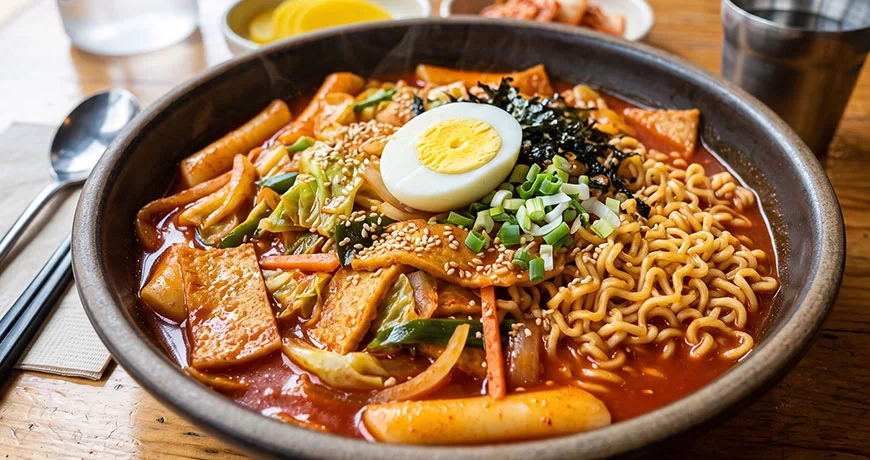
A legendary Korean street food and beloved casual snack widely enjoyed by people of all ages, especially favored by women and children as an afternoon treat. The dish is a brilliant mash-up of classic Tteokbokki (simmered rice cakes) and Ramyeon (instant noodles). Chewy rice cake cylinders, flat fish cakes, and crinkly ramen noodles are boiled together with plenty of vegetables in a bubbling, sweet, and fiery gochujang (Korean chili paste) broth. As the starchy noodles cook, they absorb the deeply savory sauce, creating an irresistibly rich and carb-heavy comfort food.
⏱️ Total: 20 mins | Prep: 5 mins | Cook: 15 mins | 🍳 Easy | 🍜 Iconic Street Snack | 🌶️ Sweet, Spicy & Chewy
Ingredients (2-3 servings)
- Main Ingredients: 1 pack plain instant ramen noodles (discard the soup packet), 200g cylinder rice cakes (tteokbokki-tteok), 2 sheets flat fish cake (eomuk, sliced into triangles)
- Vegetables & Aromatics: 2 cups cabbage (chopped into bite-sized squares), 1/2 yellow onion (sliced), 1 stalk green onion (chopped)
- Spicy Rabokki Sauce: 2 tbsp gochujang (Korean chili paste), 1.5 tbsp Korean red pepper flakes (gochugaru), 1.5 tbsp soy sauce, 2 tbsp sugar, 1 tbsp rice syrup (mulyeot) or corn syrup, 1/2 tbsp minced garlic, 3 cups water or anchovy-kelp broth
- Garnish: 1 hard-boiled egg (halved), 1 tsp toasted sesame seeds
Allergy Information
- Contains: Wheat (Noodles, Soy sauce, Fish cake, Gochujang), Soy (Soy sauce, Gochujang, Fish cake), Fish (Fish cake, Anchovy broth)
Equipment
- Wide Frying Pan or Wok, Kitchen Tongs, Wooden Spoon / Ladle, Knife, Cutting Board
Cooking Instructions
- Preparing the Base: In a wide pan or wok, whisk together the water (or broth) with the gochujang, gochugaru, soy sauce, sugar, rice syrup, and minced garlic. Bring the mixture to a rolling boil over medium-high heat.
- Simmering the Rice Cakes: Once boiling, add the rice cakes, chopped cabbage, and sliced onions. Reduce the heat slightly to medium and simmer for 3–4 minutes until the rice cakes begin to soften and plump up.
- Adding Fish Cakes & Noodles: Push the ingredients to the sides and place the dry instant ramen noodles right in the center. Scatter the sliced fish cakes around the noodles.
- Reducing the Sauce: Cook for another 3–4 minutes, gently lifting and separating the noodles with tongs as they soften. Continue stirring so the rice cakes don’t stick to the bottom, letting the sauce reduce and thicken into a glossy glaze.
- Finishing & Serving: Turn off the heat just before the noodles are fully cooked (they will continue to soften in the hot sauce). Toss in the chopped green onions, garnish with a hard-boiled egg and toasted sesame seeds, and serve immediately straight from the pan.
💡 Cooking & Pairing Tips / Health Benefits
- Ramen & Green Vegetables Synergy (Food Pairing): Combining instant ramen noodles with abundant green vegetables, such as cabbage or scallions, is a highly recommended pairing. Vegetables are rich in potassium, a nutrient that helps offset the effects of sodium and suppresses blood pressure spikes caused by salty broths. This addition perfectly supplements the nutritional gaps of the noodles while softening the overall flavor profile.
- Timing the Noodles: Ramen noodles absorb liquid incredibly fast. It is crucial to add them last and remove the pan from the heat while they are still slightly al dente (chewy) to prevent them from turning mushy.
- Adding Natural Sweetness: Using plenty of cabbage not only adds essential dietary fiber to a carb-heavy meal but also imparts a deep, natural sweetness to the broth without the need for excessive processed sugar.
- Perfect Food & Beverage Pairing: Complements classic Korean Bunsik (snack food) sides like crispy deep-fried seaweed rolls (Gimmari), stuffed fried dumplings (Yaki-mandu), or classic Tuna Kimbap. A cold glass of sweet plum tea (Maesil-cha) pairs wonderfully to soothe the spicy heat.
Nutrition Facts (Estimated)
- Total Content : Approx. 350g (1 serving)
- Calories : 485 kcal
– Sodium : 1,150mg
– Total Carbohydrate : 82.5g
– Sugar : 14.2g
– Total Fat : 11.5g
– Saturated Fat : 4.5g
– Cholesterol : 25.0mg
– Protein : 12.8g
– Calcium : 45.0mg
– Dietary Fiber : 4.2g
(Daily Values are based on a 2,000 calorie diet and standard Korean nutritional reference values)
A Captivating Variation of Two Carbohydrates Blooming in a Crimson Glaze
Rabokki (Tteokbokki with Ramen Noodles) is arguably the most brilliant and sensual crossover born from Korea’s vibrant Bunsik (street and snack food) culture. When deep-fried, wavy ramen noodles—acting as culinary vacuums for flavor—crash into the fiery, gochujang-based ecosystem traditionally dominated by the dense, chewy gravity of rice cakes, this everyday snack evolves into a dish with an explosive spectrum of textures.
As the crimson chili sauce vigorously bubbles, the rice starch from the tteok and the wheat starch from the noodles gradually leach and intertwine, transforming the broth into a uniquely viscous, provocative glaze that bridges the gap between stew and stir-fry. When this sweet and fiery sauce perfectly coats every curly contour of the bouncy noodles, the diner reaches the absolute zenith of primal, intuitive pleasure that refined carbohydrates can offer.
True gastronomy is sometimes found not in meticulously calculated formalities, but in the explosive guilty pleasures woven from familiar ingredients. Clearing away this piping-hot, ruby-red plate—much like the days spent huddled over a shared pan with friends after school—acts as a magical culinary time machine. It momentarily lifts the heavy burdens of modern life, transporting us back to a time of pure, vibrant youth and unbridled joy.
Editor’s Review
1. A Multi-Dimensional Sensory Feast of Curly Noodles, Dense Rice Cakes, and Savory Fish Cake
The moment the slurpy, gochujang-soaked ramen noodles playfully whip against the palate, they are immediately followed by the dense, satisfyingly resilient chew of the rice cakes, orchestrating a brilliant textural disruption. Interspersed with the savory, oceanic umami of thinly sliced fish cakes and the residual sweet crunch of cabbage, the dynamic interplay of slurping and chewing delivers an endlessly engaging, multi-layered rhythm of pure gastronomic pleasure.
2. Dual-Starch Gelatinization and Lipid Release Mechanics Driving Natural Sauce Thickening
Rabokki represents a masterclass in natural culinary thermodynamics. The amylopectin-rich rice starch from the cakes and the wheat starch from the noodles undergo simultaneous high-heat gelatinization, naturally transforming a watery broth into a velvety, clinging sauce. Concurrently, the savory lipids released from the porous structure of the deep-fried noodles seamlessly emulsify with the sharp capsaicin and sugars, creating a flawless, glossy glaze that coats every ingredient without the need for synthetic thickeners.
3. Vibrant Solace and the Joyful Nostalgia of a Bustling Neighborhood Snack Shop
Shared over clinking forks and chopsticks at a cramped table in a lively neighborhood Bunsik shop, a steaming pan of rabokki serves as an emotional haven where social formalities dissolve into comfortable laughter. Scraping the bottom of the pan with friends, completely unbothered by the red sauce smudged on the lips, washes away the daily grind—granting a timeless sanctuary of cheerful vitality, deep-rooted camaraderie, and the warming innocence of youth.