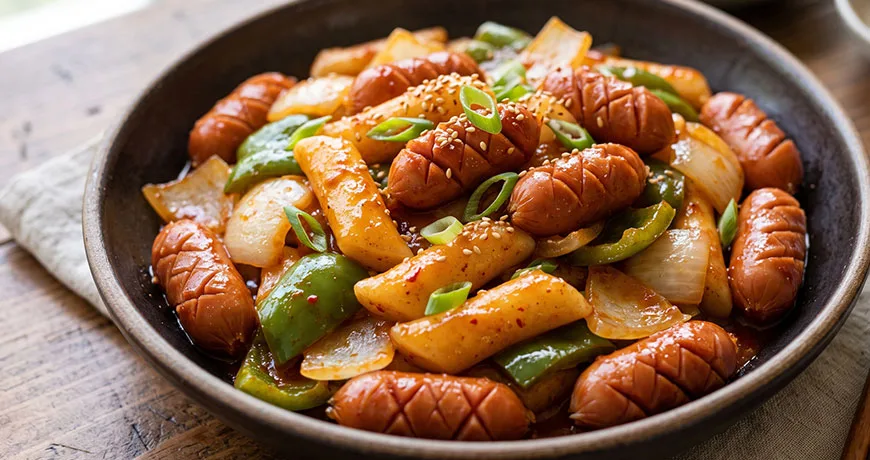
Tteokbokki is a masterpiece of carbohydrate engineering. It utilizes thermodynamic kinetic energy and osmotic pressure to force a highly viscous, fiery capsaicin-peptide emulsion directly into a dense matrix of amylopectin (rice cakes). The core objective is reversing the starch retrogradation of cold, hardened rice cakes through a boiling aqueous solvent, completely restoring their highly prized viscoelasticity (chewiness). Unlike cheap street food versions made with plain water, this recipe constructs a profound umami foundation using an anchovy-kelp solvent (IMP and Glutamate). As the starch leaches from the rice cakes into the broth, it exponentially increases the fluid’s rheological viscosity, transforming the watery broth into a thick, clinging sauce. Finished with a precise coating of polysaccharide corn syrup for a glossy sheen, this dish perfectly balances the aggressive heat of Gochujang with the natural reducing sugars extracted from cabbage and leeks.
- ⏱️ Total: 30 mins | Prep: 10 mins (Warm water starch hydration) | Cook: 20 mins
- 🍳 Difficulty: Low (Requires constant agitation to prevent starch sticking and precise control of sauce viscosity)
- 🌶️ Profile: Deeply Fiery, Sweet, with an Addictive, Heavy Viscoelastic Chew
- 🍚 Focus: Starch Gelatinization, Osmotic Sauce Penetration, & Viscosity Control
Ingredients (2–3 servings)
- High-Density Amylopectin Matrix: 400g Tteokbokki Rice Cakes or Wheat Cakes (MUST be soaked in 40°C warm water for 10 minutes prior to cooking to initiate hydration and remove excess surface starch powder)
- Surimi Protein Matrix: 2 sheets Premium Rectangular Fishcakes (Eomuk – minimum 70% fish content, cut into bite-sized triangles or rectangles)
- Aqueous Umami Solvent: 600ml Anchovy-Kelp Broth (Plain water is strictly prohibited; broth is the structural backbone of the umami profile)
- Capsaicin-Peptide Binder: 2.5 tbsp Aged Gochujang (Korean Chili Paste – for viscosity and fermented depth), 1.5 tbsp Fine Gochugaru (Chili Flakes – for sharp heat and vivid color), 1 tbsp Soy Sauce (for salinity and Maillard depth), 1.5 tbsp White Sugar, 1.5 tbsp Corn Syrup (Polysaccharide gloss agent applied at the very end)
- Reducing Sugar & Aromatic Catalyst: 1/8 head Cabbage (cut into large chunks), 1 stalk Green Onion (halved and cut into 5cm lengths)
Allergy Information Contains: Soy, Wheat (from Gochujang, Soy Sauce, Fishcake, Wheat cakes if selected), Fish (Fishcake, Anchovy Broth)
Cooking Instructions
- Starch Hydration & Solvent Heating: Soak the hardened rice cakes in warm water for 10 minutes. In a wide, shallow pan, pour the anchovy broth and turn the heat to high. Before it boils, whisk in the Gochujang, Gochugaru, soy sauce, and white sugar until complete dissolution is achieved, constructing the red capsaicin-peptide solvent.
- Reducing Sugar Extraction: Once the solvent reaches a rolling boil, drop in the rigid cabbage chunks. Boil for 2–3 minutes. The thermal hydrolysis will collapse the cabbage’s cellular walls, leaching its natural, sweet reducing sugars into the spicy broth.
- Critical Gelatinization & Osmosis: Drain the soaked rice cakes and add them to the boiling solvent. The amylopectin inside the cakes absorbs the thermal energy and expands (gelatinization), while osmotic pressure forces the spicy, salty broth deep into the starch matrix. Reduce heat to medium and stir continuously for 5–7 minutes to prevent the starches from scorching on the bottom of the pan until the cakes become incredibly soft and buoyant.
- Surimi Hydration & Viscosity Increase: Once the rice cakes are fully gelatinized, introduce the fishcakes and green onions. Fishcakes suffer from syneresis (turning to mush) if boiled too long, so they must be added late. At this stage, the starches leaching from the rice cakes will rapidly increase the rheological viscosity of the liquid, thickening it into a heavy sauce.
- Polysaccharide Coating Finish: When the sauce becomes thick and clings heavily to the rice cakes, swirl the 1.5 tbsp of corn syrup over the surface. The high-molecular polysaccharides create a brilliant, mouth-watering glossy glaze over the matrix. Turn off the heat immediately and serve.
💡 Professional Culinary Tips
- Physics of Rice (Ssal-tteok) vs. Wheat (Mil-tteok): Rice cakes are almost 100% amylopectin, yielding a profoundly dense, heavy chew, but they resist absorbing sauce. Wheat cakes contain a gluten protein structure that makes them porous; they aggressively swell when boiled and vacuum the sauce deep into their core. Choose your matrix based on texture preference, but if using rice, the warm water pre-soak is a non-negotiable step to prevent splitting.
- Timing of Corn Syrup (Mulyeot): Sugar must be added early so the sweetness penetrates the rice cakes via osmosis. However, corn syrup must only be added in the final 10 seconds. Adding it too early causes the sugars to degrade under high heat, dulling the flavor. Applying it at the end creates a molecular seal that prevents moisture loss and provides the iconic street-food shine.
- The Chemical Support of Broth: Making Tteokbokki with plain water leaves the flavor profile hollow, forcing reliance on artificial MSG. The natural free amino acids (IMP and glutamate) extracted from anchovies and kelp bond with the fermented peptides of the Gochujang, creating a robust “umami floor” that elevates the dish from a simple snack to a complex culinary matrix.
🍶 Gastronomic Pairing
- Biochemical Palate Cleansing: When the heavy, sticky amylopectin and the intense red capsaicin emulsion aggressively coat your oral mucosa, pair this street-food titan with a bowl of ice-cold, Unpasteurized Traditional Makgeolli (Korean Rice Wine). The living yeast, natural carbonation, and lactic acid in the Makgeolli act as a physical and chemical solvent. They brilliantly shear through the dense capsaicin and starch barrier clinging to your tongue, offering a flawlessly refreshing reset that compels you to take the next bite.
Nutrition Facts (Estimated)
Total Content : Approx. 350g (1 serving)
Calories : 450 kcal (High-density carbohydrate matrix)
– Sodium : 980mg (Attributed to Gochujang, Soy Sauce, and Fishcake)
– Total Carbohydrate : 85.0g (Highly concentrated starches from rice cakes and polysaccharide syrups)
– Sugar : 15.0g (Added sugars for capsaicin balance and cabbage reducing sugars)
– Total Fat : 3.5g (Trace amounts from the fishcake)
– Saturated Fat : 0.8g
– Cholesterol : 10.0mg
– Protein : 14.0g (Myofibrillar proteins from fishcake and trace plant proteins)
– Dietary Fiber : 4.0g
*Daily Values are based on a 2,000 calorie diet and standard Korean nutritional reference values.
**Nutritional values are calculated based on original ingredients; substitutions may alter specific macronutrients.
Origins and Food Culture of Stir-fried Rice Cake (Tteokbokki)
1. Joseon Royal Court Lineage: Siuijeonso, Suunjapbang, and Aristocratic Soy Sauce “Gungjung Tteokbokki”
- Contrary to the ubiquitous red version of modern times, Tteokbokki originated as an elite royal banquet dish (Gungjung Tteokbokki) where white rice cakes were stir-fried with minced beef, shiitake mushrooms, carrots, and water dropwort in aged artisanal soy sauce (ganjang) and toasted sesame oil.
- The late-19th-century royal culinary compendium Siuijeonso (是議全書) documents the dish under the historical names “Tteokjjim” and “Tteokbokki,” describing a method of slicing white cylinder cakes, braising them with tender beef, and seasoning them delicately. Similar preparations in early Joseon treatises such as Suunjapbang prove its centuries-old heritage as a nutritious, mild restorative delicacy formulated to stimulate the appetite and replenish the vitality of royal princes and noble scholar (yangban) families.
2. The Culinary Science of Starch Gelatinization and Viscoelastic Sauce Reduction
- The textural mastery of Tteokbokki relies on controlling the thermal phase transitions of starch—specifically the shift from retrograded (crystalline) beta-starch to gelatinized (amorphous) alpha-starch.
- Stored cold, cylindrical rice cakes are firm and brittle; submerging them in boiling broth allows water molecules to hydrate the starch chains, restoring their signature chewy, viscoelastic bounce. As the rice cakes simmer, microscopic amylose granules slough into the broth, binding with the lipids of gochujang and the glucose of grain syrup. This spontaneous starch gelatinization naturally thickens the sauce into a glossy glaze without added cornstarch, ensuring maximum flavor adherence with every bite.
3. The 1953 Sindang-dong Breakthrough, Pojangmacha Culture, and Global K-Food Stardom
- The modern incarnation of fiery red gochujang Tteokbokki was born in 1953 in the Sindang-dong neighborhood of central Seoul through the ingenuity of Grandma Ma Bok-rim, who accidentally dropped a piece of celebratory rice cake into a bowl of black bean sauce (jajangmyeon) and subsequently pioneered simmering rice cakes in a hybrid sauce of gochujang and fermented soybean paste.
- During the rapid urbanization of the 1970s and 1980s, Sindang-dong blossomed into an iconic hub of “instant tabletop Tteokbokki” (Jeukseok Tteokbokki) complete with live DJ booths, while ubiquitous red-cloth street carts (pojangmacha) and school-gate snack stalls cemented the dish as the universal comfort food of youth, camaraderie, and nostalgia. Today, having evolved into innovative styles—from creamy Rosé and scorched Gireum Tteokbokki to Mala Tteokbokki—it stands as a globally celebrated culinary ambassador and an immortal cultural monument to Korean street gastronomy.
The Viscoelastic Resurgence of Hydrothermally Extruded Rice Cylinders, the Incandescent Glaze of Fermented Capsaicin and Maltose, and the Street-Corner Alchemy of Sindang-dong: A Refined Portrait of Tteokbokki
Tteokbokki (Stir-fried Rice Cake) stands as the dynamic, intensely comforting, and culturally universal summit of Korea’s everyday street-food (bunsik) gastronomy. Centered upon pristine cylindrical rice or wheat cakes (garae-tteok)—mechanically milled into fine flours, steam-gelatinized under high pressure, and extruded through calibrated nozzles to establish an elastic carbohydrate network—the preparation begins with disciplined broth extraction. Evaporated and refreshed in cold water to remove loose surface starches, the rice cakes are cut into bite-sized cylinders and submerged into a foundational oceanic broth slow-simmered from dried silver anchovies, thick sheets of sun-dried kelp (dasima), and scallion roots. Into this bubbling liquid is dissolved an assertive seasoning paste: aged sun-dried red chili paste (gochujang), fine red pepper powder (gochugaru), artisanal soup soy sauce, and high-maltose rice syrup (ssal-jocheong) or starch syrup. Layered with thinly sheeted Busan-style fried fishcakes, sweet flat cabbage, and diagonally sliced scallions, the mixture is brought to an aggressive boil over high heat. As wooden spatulas guide convective currents to prevent scorching, micro-fractions of amylose leach from the simmering rice cakes to intertwine with the fermented polysaccharides of the chili paste and caramelizing sugars, transforming the thin broth into a glossy, clingy, deep-vermilion sauce. Often customized with hard-boiled eggs, fried dumplings, or chewy noodles and reduced tableside over open burners, this dish represents a masterclass in street-side carbohydrate engineering. Transcending the restrained aristocratic elegance of historic soy-braised court cakes, modern Tteokbokki binds the sharp thermal strike of capsaicin, the rich baseline of marine amino acids, and the velvety sheen of maltose into a high-viscosity matrix that restores vitality and brings uninhibited comfort to the modern soul.
Approaching the wide, shallow pan as dense scarlet bubbles burble vigorously around plump, sauced-sheathed rice cylinders, lifting a steaming piece on the tines of a fork releases an immediate, deeply electrifying olfactory charge: the toasted, spicy pungency of sun-dried red chili paste mingles seamlessly with the honeyed warmth of caramelizing maltose, the sweet allium aroma of wilted scallions, and the rich, fried-oil perfume of braised fishcakes. Taking the first bite delivers an extraordinary textural revelation: fully gelatinized through hydrothermal cooking, the rice cake resists tooth pressure with a buoyant, viscoelastic chew (jjolgit) before parting cleanly to release concentrated cereal sweetness. The thick, fiery-sweet sauce coats the oral mucosa like liquid velvet, followed instantly by the assertive strike of capsaicin that awakens the oral cavity, warms the throat, and beads the brow with revitalizing perspiration. The simmered fishcake ribbons yield with a tender, bouncy chew that discharges savory marine proteins, counterbalanced by the succulent, watery crunch of braised sweet cabbage. Crushing a hard-boiled egg yolk into the residual vermilion glaze yields an opulent, lipid-rich paste that soothes sensory heat, transforming each bite into an unforgettable ritual of metabolic renewal, nostalgic warmth, and profound gastronomic catharsis.
The enduring majesty of Tteokbokki lies in its remarkable socio-historical journey—first recorded in the late 19th-century culinary compendium Siui Jeonseo as Tteokbok-i, an aristocratic court delicacy braised gently with minced beef, shiitake mushrooms, water dropwort, toasted sesame oil, and aged soy sauce. Its modern incarnation was born in 1953 amid the ruins of post-war Seoul, when culinary matriarch Ma Bok-rim improvised by tossing leftover rice cakes into a spicy-sweet mixture of Chinese sweet-bean sauce (chunjang) and Korean chili paste in the bustling market alleys of Sindang-dong. Catalyzed by the influx of relief wheat flour under the U.S. PL 480 program and government-sponsored flour consumption campaigns throughout the 1960s and 70s, affordable wheat-based tteokbokki became the definitive national after-school comfort food. Evolving from a courtly banqueting tonic into an iconic centerpiece of global Korean street cuisine, a steaming plate of spicy rice cakes remains an irreplaceable monument of working-class resilience, communal joy, and brilliant Korean culinary craftsmanship.
Editor’s Review
1. A Dynamic Harmony of Hydrothermal Starch Viscoelasticity, Bouncy Surimi Resistance, Crisp Brassica Fracture, and Frictionless Chili-Emulsion Coating
The structural architecture inside the vessel delivers an extraordinary, four-tiered choreography between extruded grain starch hydrogels, heat-denatured marine surimi protein sheets, hydrated plant leaf cell walls, and an ultra-high-viscosity aqueous sugar-starch suspension. Subjected to sustained convective simmering, the extruded cylindrical rice cakes hydrate completely, allowing their branched amylopectin matrix (or dense gluten networks in wheat cakes) to achieve complete gelatinization, yielding an energetic, non-sticky viscoelastic chew (jjolgit-taenggeul) that resists tooth pressure with satisfying bounce. Interspersed ribbons of fried fishcake supply an unctuous, toothsome resilience that discharges savory juices, while the briefly braised cabbage and scallions retain enough cellular turgor to fracture with an audible, refreshing snap. Crucially, amylose polymers leaching from the rice cakes thicken the sweet-spicy chili liquid into a cohesive, clinging glaze that coats oral tissues with zero friction, ensuring an impeccably balanced, non-fatiguing mouthfeel from the first steaming bite to the last.
2. Amylose-Amylopectin Gelatinization Thermodynamics, Capsaicin TRPV1 Endorphin Cascade, High-Maltose Glass Transition Viscosity, and IMP-Glutamate Umami Synergism
Tteokbokki represents an exacting study in cereal carbohydrate physics, non-Newtonian fluid mechanics, and sensory neurobiology. The short-grain rice starch comprising the cakes consists of roughly 80% branched amylopectin and 20% linear amylose; upon exceeding their gelatinization threshold (>65°C), the starch granules absorb water, swell dramatically, and lose crystalline structure. Linear amylose molecules leach into the surrounding aqueous phase, forming an entangled polymer network that functions as a natural thickening hydrocolloid. Concurrently, the maltose and long-chain oligosaccharides from the starch syrup undergo thermal concentration, shifting the fluid’s rheological behavior toward a pseudoplastic shear-thinning fluid that clings tightly to solid ingredients while shearing smoothly across the palate. Savor and sensory excitement are governed by the interaction of lipophilic capsaicin with peripheral TRPV1 receptor ion channels on oral sensory neurons; this activates pain pathways that signal the central nervous system to trigger the release of endogenous opioid neuropeptides (beta-endorphins) and dopamine, producing the quintessential euphoric relief associated with spicy cuisine. Broth savor is driven by a profound cross-kingdom nucleotide synergy: inosine monophosphate (5′-IMP) from the dried anchovies converges with natural free glutamates from the dried kelp, fermented soy proteins in the gochujang, and surimi peptides, triggering an exponential activation across human oral T1R1/T1R3 umami heterodimers. Furthermore, allyl sulfides from the scallions thermally degrade into sweet propyl sulfides, rounding off harsh spice edges with clean, natural sweetness.
3. Joseon Royal Court Lineage, the 1953 Sindang-dong Street Revolution, and the Sovereign Apex of Korean Bunsik Gastronomy
Tracing an extraordinary trajectory from the aristocratic banqueting halls of the Joseon Dynasty—where it was prized as a delicate, soy-glazed beef braise—to the communal street-cart stalls of post-war Sindang-dong, Tteokbokki stands as the quintessential emblem of culinary democratization in Korean food history. Transforming humble relief flours and fermented pastes into a globally celebrated street masterpiece that comforts school children, late-night commuters, and international epicures alike, this vibrant, vermilion-glazed classic captures the very soul of modern Korean urban vitality, standing as an enduring sanctuary of domestic comfort, cultural resilience, and brilliant culinary artistry.