
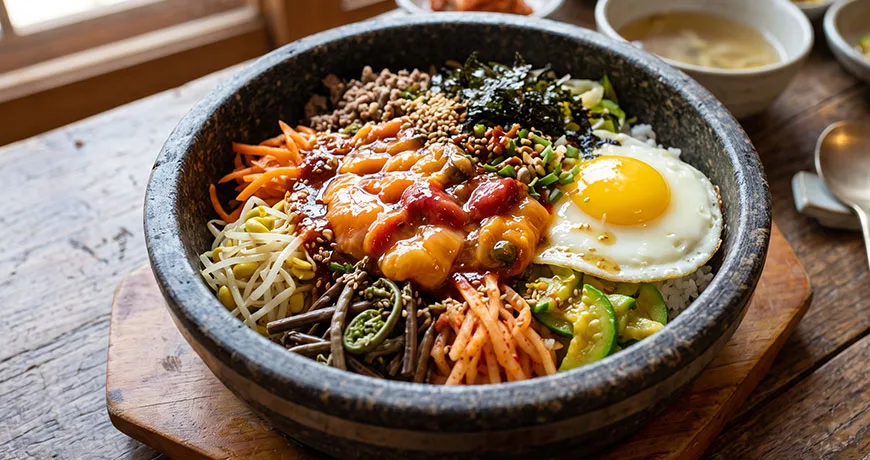
Meonggebibimbap is the ultimate olfactory gastronomic dish, engineered to extract the highly concentrated glycogen and the unique, volatile aromatic compound “cynthiaol” from the raw flesh of the sea pineapple (a marine tunicate) without any thermal degradation. Slicing through the tough outer tunic and flawlessly removing the orange flesh without bruising it or losing its briny juices requires the precise, analog touch of an artisan’s blade. Because cynthiaol is highly susceptible to heat, the thermodynamic kinetic heat of freshly cooked rice must be intentionally lowered before assembly. Rather than paralyzing the taste receptors with harsh capsaicin (Gochujang), the warm amylopectin starches of the rice are gently emulsified using only the unsaturated lipids of toasted sesame oil and the water-soluble amino acids of soy sauce. When combined with the acoustic turgor of crisp vegetables and the savory sea salt of roasted seaweed, every mastication bursts the microscopic marine cell walls, flooding the oral and nasal cavities with an explosive, cooling oceanic aerosol.
⏱️ Total: 15 mins | Prep: 15 mins | Cook: 0 mins (Raw Assembly) | 🍳 Difficulty: Low (Requires strict cynthiaol preservation and isotonic washing) | 🌶️ Profile: Piercingly Briny, Refreshing, and Sweet | 🍚 Focus: Cynthiaol Preservation, Isotonic Purging, & Lipid Emulsification | 🍶 Pairing: Chilled, fruit-forward traditional clear Cheongju (Rice Wine)
Ingredients (2 servings)
- Biochemical Marine Matrix: 150g Fresh Sea Pineapple (Meongge – delicately washed in a 3% isotonic saltwater bath to purge mud and viscera)
- Amylopectin Matrix: 2 bowls cooked White Rice (allowed to cool slightly to prevent thermodynamic damage to the aromatics)
- Turgor & Cellulose Matrix: 1 handful Baby Greens (Saessak-chaeso), 1/4 Cucumber (thinly julienned)
- Lipid & Umami Emulsifier (Sauce): 2 tbsp Toasted Sesame Oil, 1.5 tbsp Brewed Soy Sauce, 1 tbsp Toasted Sesame Seeds (Gochujang strictly forbidden)
- Aromatic Seaweed Binder: A generous handful of Roasted Seaweed flakes (Gim)
Allergy Information Contains: Marine Tunicate/Seafood (Meongge), Soy, Wheat (from soy sauce), Sesame
Equipment Cutting Board, Knife, Mixing Bowl (for isotonic washing)
Cooking Instructions
- Tunic Cleavage & Osmotic Purging: Slice open the hard, leathery tunic of the sea pineapple and carefully scoop out the orange flesh. Washing it under hypotonic tap water will cause osmotic rupture, destroying the cells. Submerge the flesh in a 3% saltwater solution (isotonic to seawater) and use your fingertips to delicately brush away any mud or dark viscera.
- Mechanical Cleavage: Lightly drain the excess moisture from the cleaned flesh. Chop it coarsely into 1.5cm pieces to ensure a distinct, bouncy textural bite upon mastication.
- Thermodynamic Cooldown: Place the hot, freshly cooked rice into bowls and let it sit for 2–3 minutes to release its surface thermal energy. Near-boiling temperatures will instantly evaporate the delicate cynthiaol compounds, destroying the signature aroma.
- Structural Assembly: Layer the baby greens and julienned cucumbers over the temperature-stabilized amylopectin matrix (rice) to establish a crunch (turgor) layer. Heap the raw sea pineapple generously in the exact center and surround it with roasted seaweed flakes.
- Emulsification & Aromatic Finish: Just before consuming, drizzle the sesame oil, soy sauce, and sesame seeds over the bowl. Agitate gently with chopsticks so the marine juices and sesame lipids form a creamy emulsion that coats the starches without crushing the delicate sea pineapple cells.
💡 Professional Culinary Tips
- Thermodynamic Vulnerability of Cynthiaol: The distinct, refreshing ocean-breeze aroma of sea pineapple comes from cynthiaol, a highly volatile compound that vaporizes upon contact with heat. Placing raw sea pineapple over steaming hot rice causes the radiant heat to completely obliterate the aroma, leaving behind only an unpleasant fishiness. Letting the rice cool slightly is a mandatory physical control to trap this aerosol between the rice grains.
- Biochemistry of Isotonic Washing: Vigorously scrubbing this marine organism in fresh tap water causes a catastrophic osmotic imbalance; water rushes into the cells, flushing out the precious glycogen and amino acids, turning the flesh mushy. Gently swirling it in a 3% saline solution preserves the cellular integrity and its signature bouncy viscoelasticity.
- Exclusion of Capsaicin & Lipid Coating: The aggressive capsaicin in Gochujang swells the taste receptors, effectively paralyzing your ability to taste the delicate sweetness (glycogen) and aroma of the sea pineapple. By coating the rice grains strictly with the unsaturated fatty acids of sesame oil and soy sauce, the lipid-soluble aromatic compounds can strike the olfactory nerves unhindered.
🍶 Gastronomic Pairing
- Biochemical Palate Cleansing: When the concentrated oceanic aerosol and heavy sesame lipids coat your mouth, pair this dish with a thoroughly chilled, traditional Cheongju (Clear Rice Wine). The delicate organic acids and highly refined ethanol molecules sharply slice through the lingering marine lipids, cleanly resetting your mucosal membranes and brilliantly amplifying the natural sweetness of the sea pineapple’s glycogen for perfect sensory balance.
Nutrition Facts (Estimated)
Total Content : Approx. 400g (1 serving)
Calories : 340 kcal
– Sodium : 750mg (Variable depending on natural marine salinity and soy sauce)
– Total Carbohydrate : 58.0g (Primarily amylopectin from white rice)
– Sugar : 2.0g
– Total Fat : 8.0g (Unsaturated lipids from sesame oil and seeds)
– Saturated Fat : 1.0g
– Cholesterol : 45.0mg (From sea pineapple)
– Protein : 10.0g
– Dietary Fiber : 4.0g
*Daily Values are based on a 2,000 calorie diet and standard Korean nutritional reference values.
**Nutritional values are calculated based on original ingredients; substitutions may alter specific macronutrients.
Origins and Food Culture of Sea Pineapple Bibimbap (Meonggebibimbap)
1. Historical Lineage: Maritime Heritage of Tongyeong, Geoje, and the Ascidian Shorelines
- Centered along the temperate, plankton-rich waters of the Hallyeohaesang National Park along the southern coast—predominantly Tongyeong and Geoje—which supply the vast majority of South Korea’s sea squirts, elevating the colloquial coastal dialect term Meongge into an officially recognized standard Korean moniker alongside Ureongswoengi.
- Rooted in the daily resourcefulness of southern port divers (haenyeo) and inshore fishermen, who routinely cracked open freshly dredged sea pineapples on rocky outcrops or boat decks, dropping the slippery, vibrant orange morsels directly into bowls of warm barley or white rice with a single drizzle of sesame oil for a fast, fortifying harbor meal.
2. The Aesthetic of Restraint: Omitting Gochujang and the Science of Salt-Cured “Gan-meongge”
- Unlike typical Korean raw fish rice bowls (hoedeopbap) that rely on pungent, fiery vinegar-chili paste (chogochujang), authentic southern Meonggebibimbap strictly excludes heavy red pepper pastes, whose aggressive capsaicin and alliums would obliterate the delicate, volatile C8-alcohols that define the sea squirt’s signature bouquet.
- While fresh, raw sea pineapple is widely celebrated, traditional culinary bastions in Tongyeong and Geoje often employ gan-meongge—freshly shucked meat lightly salted and chilled inside earthenware crocks for several days. This controlled autolytic aging breaks down structural proteins into free glutamic and aspartic amino acids, removing residual fishiness while concentrating an intense, silky sweetness.
3. The Emblem of Springtime Maritime Gastronomy and Coastal Travel Culture
- Flourishing as a distinct regional restaurant specialty during the 1980s and 1990s around Geoje’s historic enclaves and Tongyeong’s bustling coastal markets (Seoho and Jungang Markets), it has evolved into a celebrated pilgrimage dish for food travelers nationwide.
- Serving as the premier harbinger of spring that dispels winter lethargy with the crisp, briny freshness of the southern sea, Meonggebibimbap represents an enduring monument to Korean maritime gastronomy, honoring nature by presenting the pure, unmasked essence of the ocean in a humble bowl of rice.
The Primal Ozone Resonance of Vermilion Tunicates and the Bittersweet Nectar of Marine Glycogen: A Refined Portrait of Meonggebibimbap
Meonggebibimbap (Fresh Sea Pineapple Bibimbap) stands as the arresting, intensely aromatic, and biologically thrilling summit of Korea’s southern coastal raw (saengsik) gastronomy. Freshly harvested sea squirt (meongge or wureongswoengi—Halocynthia roretzi), flourishing along the rocky reefs and pristine tidal currents of the southern rias coast (principally Tongyeong and Geoje), is split open to harvest its vibrant vermilion-orange flesh. Rinsed gently in clean sea brine and sliced into plump morsels—or lightly salted and cured to concentrate its volatile essence—it is placed atop a bed of steaming white rice alongside toasted seaweed shreds, thinly julienned kelp, fragrant water parsley, wild crown daisy, and crisp cucumber batons. Delicately finished with a drizzle of cold-pressed toasted sesame oil and roasted sesame seeds, this dish strictly banishes thick, sweet-and-sour red chili paste (chogochujang). Instead, it elevates the unmasked, pristine interaction between warm grain starches, rich plant lipids, and the bracing marine terpenes of raw tunicates into an exquisite state of thermodynamic equilibrium.
Confronting a wide ceramic bowl overflowing with radiant coral-hued sea squirt and deep emerald sea vegetables releases an immediate, electrifying sensory charge: the rich, nutty perfume of toasted sesame oil mingles with the crisp, cold scent of ocean ozone, iodine spray, and pine needles. The first spoonful, lifted carefully to preserve the structure of the ingredients, delivers an extraordinary sensory awakening. As the warmth of the rice meets the cool, tender sea squirt flesh, trapped aromatic volatiles are set free; sinking your teeth into the tunicate reveals a delicate, cushiony elasticity that ruptures with a burst of cool, mineral-dense marine liquor. The initial, therapeutic medicinal bitterness across the palate shifts abruptly into a lingering, honeyed flood of natural glycogen sweetness and bioavailable amino acids. The crisp, auditory snap of water parsley and cucumber offsets the oceanic potency, while the thin lipid sheen of sesame oil wraps each grain of rice in smooth comfort, leaving a crystalline finish that echoes like a brisk sea breeze along the throat.
The enduring majesty of Meonggebibimbap lies in its maritime heritage—born on the pitching fishing vessels and harbor quays of the southern archipelago, where divers and coastal laborers tossed freshly shucked tunicates straight into bowls of barley or rice for immediate sustenance. Rejecting the heavy, masking veil of chili sauces to celebrate the raw, untamed terroir of the southern waters, a bowl of sea pineapple bibimbap remains an irreplaceable cultural monument of coastal resourcefulness, minimalist reverence, and the dazzling brilliance of Korean seafood gastronomy.
Editor’s Review
1. A Dynamic Harmony of Hydrated Gelatinous Tunicate Elasticity, Crisp Botanical Fractures, and Warm Starch-Lipid Fluidity
The textural landscape inside the bowl delivers an extraordinary, multi-layered choreography between raw invertebrate tissue, crisp terrestrial greens, and warm steamed grains. Retaining its native intracellular moisture, the sea squirt’s mantle muscle offers a supple, gel-like resistance that yields easily to tooth pressure, bursting with cool cellular fluids. This tenderness is dynamically framed by the sharp, water-dense crunch of fresh cucumber and the fibrous snap of water parsley. The light coating of cold-pressed sesame oil acts as an organic boundary lubricant, preventing the grains from clumping while ensuring an effortless, frictionless glide across oral tissues from the first bite to the last.
2. Cynthianol-Unsaturated Octenol Volatilization, Glycogen-Taurine Sweetness Kinetics, and Triglyceride Lipid-Masking Dynamics
Meonggebibimbap represents an exacting study in marine natural product chemistry, flavor volatility kinetics, and sensory biophysics. The signature herbal, ozone-like scent of Halocynthia roretzi is governed by complex unsaturated aliphatic alcohols and ketones, predominantly cynthianol and (E,Z)-1,5-octadien-3-ol. When exposed to the thermal convection of warm rice (50–60°C), the vapor pressure of these compounds rises sharply, releasing an intense sinonasal marine aroma. Furthermore, the tunicate’s muscle tissue contains extraordinarily dense concentrations of glycogen, free glycine, alanine, and taurine. Following an initial trigeminal astringency, these compounds stimulate human sweet and umami heterodimers (T1R2/T1R3 and T1R1/T1R3), creating a delayed, long-lasting crest of rich natural sweetness on the back of the palate. Concurrently, the hydrophobic triglycerides within cold-pressed sesame oil encapsulate harsh, metallic iodine notes, smoothing the edges of the volatile alcohols into a balanced, luxurious savor.
3. The Southern Rias Archipelago Terroir and the Sovereign Summit of Non-Chili Marine Bibimbap
Harvested during late spring and early summer when marine glycogen reserves reach their annual biological peak, Meonggebibimbap represents a landmark departure from common Korean chili-heavy raw fish bowls (hoedopbap). Trusting entirely in the intrinsic aromatic power and complex savory-sweet balance of pristine raw tunicates, this unmasked masterpiece stands as an enduring sanctuary of environmental authenticity, marine stewardship, and brilliant culinary restraint.
충무집
#굿모닝대한민국 #맛있는녀석들 #미식클럽 #생방송오늘저녁 #생방송투데이 #생생정보통 #식객허영만의백반기행 #찾아라맛있는TV #2TV생생정보