
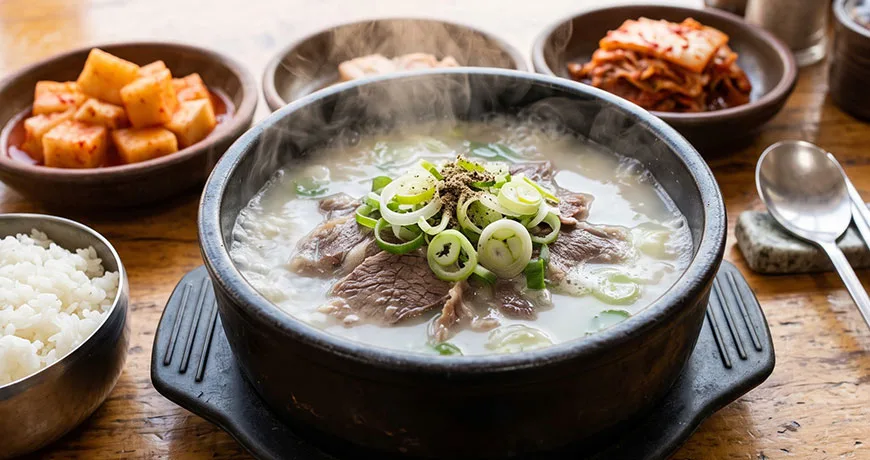
Gomtang is a high-end meat consommé achieved by the precise, prolonged thermal hydrolysis of massive mammalian myofibrils and connective tissues (brisket, shank, and tripe) at a critical sub-boiling temperature (90–95°C). Unlike Seolleongtang, which employs a violent, 100°C+ rolling boil to forcefully emulsify bone marrow lipids into a cloudy, milky suspension, Gomtang strictly represses aggressive convection. This thermodynamic control, combined with relentless manual lipid clarification (skimming), prevents emulsion and yields a crystalline, golden amino-acid matrix. The dense fascia of the shank and the thick tissue of the beef stomach absorb hours of thermal energy, transforming into sticky, yielding gelatin. Finished simply with a massive dose of finely chopped scallions—whose volatile allyl sulfides slice through the heavy meat broth with sharp, refreshing clarity—this is the pinnacle of minimalist molecular gastronomy.
- ⏱️ Total: 5 hrs | Prep: 2 hrs (Osmotic blood/impurity purging of meat and offal) | Cook: 3 hrs
- 🍳 Difficulty: Extreme (Requires relentless lipid clarification and thermal control to prevent milky emulsification)
- 🌶️ Profile: Profoundly Deep, Crystalline Meat Umami
- 🍚 Focus: Meat-based Thermal Hydrolysis, Continuous Lipid Clarification, & Collagen Gelatinization
- 🍶 Pairing: Chilled, highly refined traditional Cheongju or aged distilled Soju
Ingredients (4–5 servings)
- High-Density Myofibrillar & Collagen Matrix: 500g Hanwoo Beef Brisket (Yangji), 500g Beef Shank (Satae), 300g Cleaned Beef Tripe (Kkanyang – submerged in cold water for 2+ hours to osmotically purge myoglobin, bone dust, and impurities)
- Aqueous Umami Solvent: 5L Purified Water
- Odor Adsorption & Pectin Matrix: 1/2 whole Daikon Radish, 1 whole Onion, 10 whole Unpeeled Garlic Cloves, 1 tbsp Whole Black Peppercorns
- Aromatic & Allyl Catalyst: 3 stalks Green Onions (sliced as thinly as possible in large quantities)
- Ionized Sodium: High-quality Sea Salt to taste (Added strictly at the table, NEVER during cooking)
Allergy Information Contains: Beef
Equipment Massive High Thermal Mass Stainless Steel Stockpot, Fine Skimmer, Heavy Cutting Board, Sharp Knife
Cooking Instructions
- Initial Coagulation & Purging: Submerge the osmotically purged meat and tripe in aggressively boiling water for 10 minutes. Water-soluble myoglobin and impurities inside the muscle fibers will thermally coagulate and erupt as dark foam. Discard all the water and vigorously scrub the meat and offal under running cold water. This physical purging determines 90% of the final broth’s optical clarity.
- Critical Temp Thermal Hydrolysis: Place the cleaned meats, radish, onion, garlic, and peppercorns into a large stockpot and add 5L of purified water. Bring to a boil over high heat, then immediately leave the lid off and reduce to medium-low (90–95°C). Maintain a gentle simmer—where only tiny bubbles break the surface—and extract the umami for exactly 3 hours.
- Lipid Clarification & Collagen Denaturation: Throughout the 3-hour kinetic extraction, relentlessly use a fine mesh to skim off the yellow animal lipids pooling on the surface. This grueling clarification process is what prevents the broth from turning milky, preserving its golden, crystalline nature. Once the tough connective tissues of the shank and tripe yield into soft gelatin, remove and discard the radish and aromatics.
- Morphological Slicing: Remove the meat and tripe and let them rest at room temperature for 30 minutes. Slicing them while piping hot will cause the protein structures to disintegrate. Once cooled and structurally stabilized, slice the brisket and shank thinly against the grain, and cut the tripe into bite-sized pieces.
- Allyl Fusion & Serving: Place the sliced meats in a pre-warmed brass bowl (Nogreut) or earthenware pot (Ttukbaegi). Pour the boiling, golden consommé over the meat. At the table, heap a massive amount of scallions into the broth to release volatile allyl compounds, and calibrate the final sodium ion concentration with sea salt.
💡 Professional Culinary Tips
- Hydrodynamics: Gomtang vs. Seolleongtang: Gomtang is an extraction of meat (muscle); Seolleongtang is an extraction of bone (marrow). Seolleongtang requires a violent rolling boil to force bone lipids to emulsify with water, creating a milky white broth. Gomtang requires the exact opposite: gentle thermodynamic control (simmering) to extract inosinate without emulsifying the fat. If Gomtang boils too aggressively, the water and fat mix, destroying the crystalline clarity and resulting in a greasy, muddy mouthfeel.
- Thermodynamics of Salt Timing: Adding salt directly into the boiling stockpot creates a hypertonic osmotic environment. This violently draws moisture out of the meat cells, transforming the brisket and shank into tough, rubbery masses. Salt must strictly be added at the table, post-extraction, to preserve the ultimate tenderness of the myofibrils.
- Biochemical Texture of Tripe: A Gomtang using only brisket is texturally monotonous. The bovine first stomach (Tripe) consists of dense smooth muscle and villi. When subjected to 3+ hours of thermal hydrolysis, it imparts a profound gelatinous body to the solvent and provides an elastic, kinetic tension to the chew, completely rounding out the dish’s textural spectrum.
🍶 Gastronomic Pairing
- Biochemical Palate Cleansing: When the heavy inosinate of the golden consommé and the rich gelatin rendered from the shank and tripe completely coat your oral mucosa, pair this dish with a shot of high-proof dry traditional distilled Soju (chilled in the freezer to increase its viscosity). The highly refined, high-concentration ethanol acts as a surgical solvent, sharply slicing through the dense collagen barrier on your tongue. This flawlessly resets your taste receptors, geometrically amplifying the crystalline, savory beef umami of the very next spoonful.
Nutrition Facts (Estimated)
Total Content : Approx. 700g (1 serving)
Calories : 450 kcal (Excluding rice)
– Sodium : 1,200mg (Dependent entirely on table salt calibration)
– Total Carbohydrate : 0.0g (A pure 0% carb meat matrix)
– Sugar : 0.0g
– Total Fat : 22.0g (High-quality natural beef lipids remaining after clarification)
– Saturated Fat : 9.5g
– Cholesterol : 110.0mg (Derived from high-density protein and offal)
– Protein : 58.0g (Ultra-dense myofibrillar protein and gelatin extracted from brisket, shank, and tripe)
– Dietary Fiber : 0.0g
*Daily Values are based on a 2,000 calorie diet and standard Korean nutritional reference values.
**Nutritional values are calculated based on original ingredients; substitutions may alter specific macronutrients.
Origins and Food Culture of Beef Bone Soup (Gomtang)
1. Historical Roots: Joseon Culinary Compendiums, “Goeum” (膏飮), and Royal Banquets
- The etymology of Gomtang originates from the native Korean verb Goda (to boil or simmer slowly over extended heat to extract rich essences), historically documented in Hanja as Goeum (膏飮, meaning “rich marrow broth”) or Gomguk.
- The late-19th-century traditional Korean cookbook Siuijeonso (是議全書) records a detailed recipe for Goeum, noting that “shank, tripe, oxtail, lungs, small intestines, and ribs are simmered in a large cauldron with abundant water over a gentle fire until the flavor becomes exceedingly rich and deep.” Furthermore, Heo Jun’s 1613 Dongui Bogam emphasizes that broths decocted from beef flesh and bones nourish the five internal organs, replenish marrow, and fortify bodily deficiencies, confirming its centuries-old status as an elite restorative tonic served at royal banquets and aristocratic scholar (yangban) tables.
2. The Thermodynamics of Gentle Extraction and Clear Consommé (Cheongtang) vs. Milky Broth (Baektang)
- While Seolleongtang relies on rolling, turbulent boiling to emulsify bone marrow lipids into a chalky, milky-white broth (Baektang), traditional Gomtang prioritizes premium muscle cuts (brisket, shanks) simmered alongside select bones over gentle, steady heat to preserve a clear, amber-tinted consommé (Cheongtang).
- Master kitchens continuously skim off surface foam and coagulated impurities during simmering. Once cooked, the stock is thoroughly chilled so that every trace of solidified white beef tallow can be lifted away, achieving an unctuous, crystal-clear soup rich in dissolved gelatin and nucleotides without greasy heaviness.
3. The Temperature Science of Brass-Bowl Toryeom and the Dual Lineages of Seoul and Naju
- The authentic consumption of Gomtang avoids scalding earthenware pots in favor of heavy forged brass bowls (bangjja yugi), brought to life through the ritual of Toryeom: ladling hot broth over cold rice and sliced meat multiple times and pouring it back into the cauldron. This heats the rice grains to the ideal tasting temperature (65–70°C) without overcooking them into mush, ensuring the broth remains transparent while optimizing the palate’s sensitivity to umami.
- Modern Korean gastronomy celebrates two illustrious lineages: the refined Seoul-style Gomtang, immortalized since 1939 by Hadongkwan in Suha-dong with its clear broth of brisket, shanks, and honeycomb tripe; and the Naju-style Gomtang, born from the 5-day livestock markets of Jeollanam-do, which simmers deboned beef head meat and brisket with radish into a crystal-clear broth crowned with golden egg ribbons (jidan). Together, they stand as enduring monuments to Korean nose-to-tail culinary ingenuity, artisanal patience, and soulful banquet hospitality.
The Amber Clarity of Simmered Indigenous Beef Muscle, the Resilient Gelatin of Bovine Rumen, and the Restorative Breath of Scallion Alliums: A Refined Portrait of Gomtang
Gomtang (Clear Simmered Beef Soup) stands as the aristocratic, crystalline, and biologically elegant summit of Korea’s whole-beef (tangban) gastronomy. Rooted etymologically in the classical Korean verb goda—denoting the prolonged, patient extraction of bioavailable essences over low convective heat—the dish begins by selecting prime cuts of indigenous Korean cattle, including brisket (yangji), beef shank (satae), ribs, and ox tail, alongside precious offal such as the honeycombed first stomach (rumen or yang). Steeped in cold spring water for hours to leach residual hemoglobin and cellular debris, the pristine meats and aromatics—sweet winter radish, alliums, garlic, and fresh ginger—are submerged in fresh spring water within an iron cauldron. Unlike the turbulent, high-shear boiling that fractures marrow bones into the milk-white emulsion of Seolleongtang, Gomtang is governed by precise thermal discipline, maintaining a gentle convective simmer (85-90°C) to yield a shimmering, amber-tinted clear broth (cheongtang). Once tender, the meat is carved into thin ribbons and gently seasoned with artisanal soup soy sauce, sesame oil, and garlic, while the cooled stock undergoes meticulous surface defatting to remove hardened bovine tallow. Assembled within a heavy earthenware pot or glistening bronzeware bowl (bangjja yugi) over a bed of warm white rice tempered through the ritual of to-ryeom (repeated ladle-scalding), the soup is ladled over the carved beef, crowned with freshly sliced scallions, and seasoned transparently with aged solar salt. Bypassing fiery chilies, heavy pastes, or turbid emulsions, Gomtang celebrates the pure, unmasked amino acids of simmered beef in absolute thermodynamic equilibrium.
Confronting the gleaming bronzeware bowl as delicate, golden-hued steam curls upward to reveal thinly sliced beef brisket and honeycomb tripe, lifting a deep spoonful releases an immediate, deeply comforting olfactory charge: the clean, roasted perfume of slow-simmered beef muscle mingles seamlessly with the brisk, sulfurous brightness of fresh scallions and the deep, bready savor of aged artisanal soy sauce. Taking the first sip delivers an unadorned revelation across the oral mucosa: devoid of greasy surface tension, the clarified broth, laden with dissolved gelatin and free amino acids, glides over the palate with silk-like softness. Washing down the esophagus, it dispels bodily exhaustion and infuses an empty stomach with deep, serene warmth. Parting the brisket slices with the tongue reveals meat whose connective fibers have relaxed into cloud-like tenderness, fracturing along delicate grain lines to discharge sweet, concentrated beef juices. Concurrently, the simmered honeycomb tripe provides an unctuous, springy chew (taenggeul) that resists tooth pressure with a clean, elastic bounce. The ladle-scalded rice grains, having absorbed the savory stock without releasing excess surface starches, deliver a smooth, frictionless mouthfeel that pairs impeccably with a crisp cube of aged radish kimchi (kkakdugi), completing an unforgettable ritual of metabolic renewal and quiet gastronomic transcendence.
The enduring majesty of Gomtang lies in its noble heritage—codified as Goeum (膏飮) in the 19th-century aristocratic compendium Siuijeonseo—where literati families simmered beef cuts for royal banquets and scholarly convalescence. This refined tradition converged with the democratic vitality of southern cattle markets, most famously in Naju, where market cauldrons simmered native beef for itinerant merchants and townspeople. Standing in stark philosophical contrast to the opaque, bone-dominant cauldrons of everyday laborers, Gomtang remains an irreplaceable monument of bovine culinary refinement, maternal solace, and brilliant Korean gastronomic craftsmanship.
Editor’s Review
1. A Dynamic Harmony of Silken Brisket Tenderness, Viscoelastic Rumen Elasticity, Scalded Rice Fluidity, and Frictionless Broth Lubrication
The structural architecture inside the vessel delivers an extraordinary, high-register choreography between mammalian skeletal muscle fibers, heat-denatured gastrointestinal smooth muscle, and gelatinized cereal starch matrices. Sliced into delicate sheets, the brisket and shank separate along perimysial boundaries with effortless ease, releasing trapped moisture with minimal chewing effort. In vivid structural contrast, the simmered bovine rumen (yang) exhibits an energetic, viscoelastic chew that pushes back against the teeth with a resilient spring before yielding cleanly. The traditional to-ryeom process—repeatedly bathing the cooked rice in hot broth—rinses away loose amylose starches from the grain surface, preventing cloudiness while allowing each grain to hydrate internally with the savory stock. This ensures a frictionless, lubricating oral transit where beef, grain, and clear broth harmonize without starch-induced heaviness.
2. Gentle Convective Simmering (85-90°C) for Actomyosin Syneresis Mitigation, Type I Collagen Hydrolysis, IMP-Glutamate Nucleotide Synergy, and Non-Emulsified Broth Rheology
Gomtang represents an exacting study in mammalian muscle thermal kinetics, connective tissue histology, and flavor volatile preservation. Unlike Seolleongtang, which relies on violent rolling boiling (>100°C) to induce mechanical shearing that disperses marrow lipids into an opaque oil-in-water (O/W) emulsion, Gomtang employs a gentle simmering window (85-90°C). This suppresses rapid lipid emulsification, allowing free tallow to rise to the surface where it can be mechanically skimmed during post-cook chilling (defatting) to secure low dynamic viscosity and pristine optical transparency. Thermodynamically, keeping the fluid below boiling prevents severe thermal contraction of myofibrillar actomyosin, mitigating water expulsion (syneresis) and maintaining high Water Holding Capacity (WHC) in the brisket. Concurrently, insoluble Type I collagen densely concentrated within the perimysium, tendon sheaths, and tripe walls undergoes slow hydrothermal cleavage into water-soluble gelatin polypeptides, endowing the broth with a subtle, lip-clinging body. Broth savor is driven by a profound nucleotide synergy: muscle-derived inosine monophosphate (5′-IMP) converges with the free glutamates of the aged soup soy sauce and simmered alliums, triggering an exponential synergy across human oral T1R1/T1R3 umami heterodimers. Fresh scallion allicin volatiles chemically bind trace lipid aldehydes, securing an immaculate, pure bovine aromatic profile.
3. The Aristocratic Siuijeonseo Lineage, Naju Cattle Market Heritage, and the Sovereign Apex of Clear Beef Tangban
Reflecting the culinary philosophy of the Joseon noble class, who revered clear, unadorned consommés as the highest expression of meat cookery, Gomtang stands as the supreme achievement of Korean clear beef broths. Harmonizing the refinement of courtly Goeum with the abundant energy of provincial livestock markets, this serene, amber-tinted centerpiece illustrates how rigorous temperature control and respect for animal protein can transform simple water and beef into an enduring sanctuary of restorative sustenance, domestic grace, and brilliant culinary artistry.