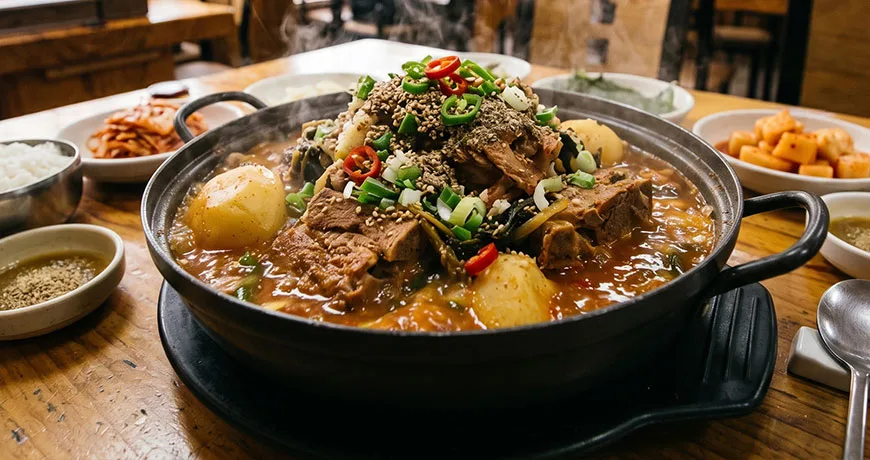
Gamjatang is an extreme meat-based thermodynamic matrix engineered to completely break down the dense fascia and highly concentrated collagen intervertebral discs of a massive mammalian spinal column into sticky gelatin through prolonged thermal hydrolysis. As the bone marrow lipids and inosinate (IMP) leach from the cross-sections of the severed spine, they violently emulsify with the aqueous solvent under a 100°C rolling boil. The introduction of highly porous cellulose from dried cabbage leaves (Ugeoji) acts as a microscopic sponge, absorbing these heavy animal lipids, while the slow gelatinization of whole potato amylopectin physically thickens the broth. In its final moments, a massive suspension of peeled perilla seed powder is introduced, creating an explosive botanical Omega-3 colloidal emulsion. Crowned with volatile perillaldehyde from perilla leaves to elegantly mask any heavy porcine aromatics, this stew is a masterclass in biochemical fusion.
- ⏱️ Total: 3 hrs 30 mins | Prep: 1 hr (Osmotic blood purging & blanching) | Cook: 2 hrs 30 mins
- 🍳 Difficulty: High (Requires prolonged thermal hydrolysis of spinal collagen and stabilization of perilla lipid emulsion)
- 🌶️ Profile: Profoundly Heavy, Earthy (Perilla & Pork Marrow), and Viscous Umami
- 🍚 Focus: Spinal Thermal Hydrolysis, Amylopectin Gelatinization, & Colloidal Lipid Suspension
- 🍶 Pairing: Ice-cold Somaek (Soju + Beer bomb) engineered with a highly carbonated light lager like Terra
Ingredients (3–4 servings)
- Spinal Collagen & Marrow Matrix: 1.5kg Pork Spine (submerged in cold water for 1+ hours to osmotically purge myoglobin and blood proteins)
- Porous Cellulose Sponge Matrix: 300g Boiled Ugeoji or Siraegi (Dried radish/cabbage leaves – torn lengthwise to maximize lipid absorption surface area)
- Starch Gelatinization Matrix: 3 Whole Potatoes (peeled, edges rounded to prevent disintegration)
- Omega-3 Lipid Suspension: 5 tbsp Peeled Perilla Seed Powder (Deulkkae-garu)
- Peptide & Capsaicin Binder: 4 tbsp Gochugaru (Chili Flakes), 2 tbsp Traditional Doenjang (crucial for chemical masking of oxidized porcine lipids), 2 tbsp Soup Soy Sauce, 3 tbsp minced garlic, 1 tbsp minced ginger, 2 tbsp Rice Wine (Cheongju)
- Aromatic & Terpene Catalyst: 15 Perilla Leaves (Kkaennip – torn into large pieces), 2 stalks Green Onion (diagonally cut), 1 pack Enoki mushrooms, 3 Cheongyang green chilies
Allergy Information Contains: Pork, Soy, Wheat (from Doenjang, Soy Sauce)
Equipment Massive High Thermal Mass Cauldron or Stockpot, Wide Serving Pot (Jeongol pan), Fine Skimmer, Cutting Board, Knife
Cooking Instructions
- Thermal Coagulation & Blanching: Submerge the osmotically purged pork spines in aggressively boiling water for 10 minutes. The myoglobin trapped within the spinal canal and bone marrow will thermally coagulate, erupting as dark scum. Discard this water entirely and physically scrub the coagulated proteins off the bone under running cold water.
- Spinal Hydrolysis & Masking: In a large heavy pot, combine the cleaned spines, 3L of purified water, and the Doenjang. Bring to a boil, then reduce to a steady medium simmer for 1.5 hours. The fermented peptides in the Doenjang chemically bind to and mask the oxidized porcine aromas, while the sustained kinetic energy thermodynamically breaks down the rigid spinal fascia into sticky, yielding gelatin.
- Cellulose & Capsaicin Fusion: In a bowl, vigorously knead the Ugeoji with the chili flakes, soy sauce, garlic, and ginger. Once the meat shows signs of easily separating from the bone (after 1.5 hours), introduce this seasoned cellulose matrix and the whole potatoes. Simmer for an additional 40 minutes. The cabbage absorbs the heavy animal lipids like a sponge, while the potato starch slowly gelatinizes, building the broth’s rheological viscosity.
- Colloidal Suspension Construction: Once the potatoes are perfectly tender, transfer the bones and broth to a wide serving pot. Bring to a rapid boil and heavily dust the surface with 5 tablespoons of perilla seed powder. This instantly transforms the clear broth into a hyper-dense, creamy colloidal emulsion.
- Terpene Finish: Just before cutting the heat, crown the matrix with green onions, chilies, enoki mushrooms, and a massive heap of torn Perilla leaves. Turn off the heat immediately. The radiant heat gently wilts the leaves without degrading the volatile perillaldehyde, leaving a crisp, botanical coating over the heavy red broth.
💡 Professional Culinary Tips
- Rheological Breakdown of Fascia: The silvery connective tissues encasing the porcine spine are overwhelmingly dense blocks of collagen. Breaking them down requires immense patience. At atmospheric pressure (100°C), it takes a minimum of 2 hours of continuous thermal hydrolysis for this tough matrix to absorb water and transform into sticky gelatin. The resulting texture—where the meat effortlessly crumbles off the bone with chopsticks—is the direct result of uncompromised thermodynamic control.
- Molecular Role of Cabbage & Potato: In a stew that omits artificial thickeners or Gochujang, the profound viscosity of Gamjatang relies entirely on the natural amylopectin leaching from the potatoes and the porous structure of the Ugeoji. These two matrices act as natural emulsion stabilizers, trapping the heavy pork lipids and preventing unsightly phase separation (grease pooling).
- Prevention of Perilla Degradation: Boiling the botanical Omega-3 lipids of perilla seed powder for two hours will aggressively oxidize the fats, creating severe bitter off-notes. The powder must be introduced at the very end of the cooking process during the final boil to preserve its pristine, nutty suspension.
🍶 Gastronomic Pairing
- Biochemical Palate Cleansing: When the massive dose of porcine lipids, sticky spinal gelatin, and the heavy density of the perilla colloid thickly saturate your oral mucosa, pair this overwhelming dish with an ice-cold Somaek (Soju and Beer bomb) utilizing a highly carbonated light lager like Terra. The aggressive, coarse effervescence of the Terra lager combined with the refined ethanol of Soju acts as a violent surgical solvent. It explosively shears through the heavy lipid and capsaicin coating on your tongue, providing a brilliant fluid-dynamic contrast to the sticky meat matrix and flawlessly resetting your palate for the next bite.
Nutrition Facts (Estimated)
Total Content : Approx. 850g (1 serving, excluding bone weight)
Calories : 620 kcal (Excluding rice)
– Sodium : 1,550mg
– Total Carbohydrate : 32.0g (Potato amylopectin and Ugeoji polysaccharides)
– Sugar : 4.0g
– Total Fat : 38.0g (Heavy bone marrow lipids and ultra-dense botanical Omega-3 from perilla)
– Saturated Fat : 14.0g
– Cholesterol : 115.0mg
– Protein : 48.0g (High bioavailability myofibrils and spinal collagen peptides)
– Dietary Fiber : 9.0g (Massive plant cellulose from Ugeoji)
*Daily Values are based on a 2,000 calorie diet and standard Korean nutritional reference values.
**Nutritional values are calculated based on original ingredients; substitutions may alter specific macronutrients.
Origins and Food Culture of Pork Back-bone Stew (Gamjatang)
1. Historical Roots: Baekje Agricultural Traditions, Incheon Port Opening, and Railway Laborers
- Historical folklore traces the earliest lineage of simmering pork bone stews to the ancient kingdom of Baekje in the southwestern Jeolla plains, where pigs were widely raised as agricultural protein staples and their bones were boiled into restorative broths with seasonal roots and greens.
- The modern commercial foundation of Gamjatang crystallized during the late 19th century with the opening of Incheon Port (1883) and the construction of the Gyeongin Railway (1899). To provide affordable, calorically dense sustenance for the thousands of manual laborers gathered from across the nation, open-air tavern cooks simmered discarded, inexpensive pork vertebrae in giant cauldrons with red chili paste, soybean paste, field potatoes, and dried greens, establishing it as the quintessential working-class stamina food that later spread to Seoul’s Majang-dong and Yeongdeungpo slaughterhouse districts.
2. The Etymological Mystery of “Gamja” and the Thermodynamics of Collagen Hydrolysis
- The culinary name remains the subject of a beloved gastronomic debate: while modern diners intuitively associate the dish with the round tuber “potato” (gamja, Solanum tuberosum) simmered in the pot, an enduring folk tradition asserts that the spinal bone segment of the pig was historically known among traditional butchers as the “gamja-bone” (gamja-ppyeo), suggesting the soup was named for the bone cut itself.
- Because the porcine spinal column features intricate vertebrae bound by dense ligaments, periosteum, and connective tissue, authentic master kitchens execute an arduous process: soaking the bones for hours to purge coagulated blood, parboiling to scrub off bone dust, and simmering gently over medium heat for upwards of three hours. This slow hydrothermal extraction allows the meat to become so tender that it falls away from the crevices with minimal effort, while marrow lipids gently emulsify into a rich, full-bodied broth.
3. The 24-Hour Urban Sanctuary and the Soul of Communal Dining
- Following the deregulation of midnight curfews in the 1980s and 1990s, 24-hour Gamjatang establishments spread rapidly across Korean university towns, entertainment districts, and taxi driver dining strips, becoming an immortal urban sanctuary where night-shift workers, weary students, and late-night revelers found warm, non-judgmental solace at any hour.
- While served individually as a single-portion bowl known as Ppye-haejangguk (bone hangover soup) for solo diners, Gamjatang prepared in a wide tabletop casserole embodies Korea’s vibrant communal dining spirit: friends gather around the flame to share meat, drop in chewy hand-torn dough flakes or ramen noodles, and crown the banquet with seasoned fried rice scraped crisp from the pan, cementing its status as Korea’s ultimate restorative soul food.
The Torrential Extraction of Porcine Spinal Marrow, the Deep Savor of Fermented Soybean Paste, and the Earthy Embrace of Dried Radish Greens and Roasted Perilla: A Refined Portrait of Gamjatang
Gamjatang (Spicy Pork Back-bone Stew) stands as the colossal, unapologetically hearty, and deeply restorative summit of Korea’s composite porcine (tangban) gastronomy. Centered upon the dense, marrow-rich vertebral columns and cervical neck bones of the pig, the heavy bones undergo prolonged steeping in running cold spring water to thoroughly leach deep-bone hemoglobin and residual myoglobin. Subjected to an initial rolling blanch in boiling water infused with whole garlic, ginger, scallions, refined rice wine, and traditional soybean paste (doenjang) to purge surface coagulants and trace off-notes, the structural bones are transferred into a massive cauldron of fresh water. Simmered over alternating vigorous and gentle convective heat across hours, the connective tissues relax as deep spinal marrow liquefies into the boiling liquid. Layered into this foundation is an abundant mass of siraegi (sun-dried radish greens) or blanched cabbage leaves seasoned by hand with aged artisanal doenjang, sun-dried red chili powder (gochugaru), crushed garlic, and minced ginger, alongside whole-peeled waxy potatoes (gamja). Reassembled inside a wide casserole or earthenware cauldron, the stew is crowned with a generous mound of roasted dehulled perilla seed powder (deulkkaegaru), fresh wild perilla leaves (kkaennip), and scallions before being brought to an aggressive tableside simmer. Transcending the delicate restraint of clear pork broths, Gamjatang unites paraspinal meat fibers, bone gelatin, plant starches, and essential lipid emulsions in absolute thermodynamic equilibrium.
Confronting the boiling cauldron tableside as vibrant crimson-and-amber bubbles froth around massive porcine vertebrae releases an immediate, deeply comforting olfactory charge: the rich, savory perfume of slow-extracted pork marrow mingles seamlessly with the deep, bready savor of fermented doenjang, the toasted nuttiness of crushed perilla seeds, and the brisk, herbal fragrance of wild perilla leaves. Taking the first sip delivers an opulent revelation across the oral mucosa: the velvety broth, dense with dissolved bone gelatin, suspended perilla lipids, and vegetable juices, coats oral membranes with zero greasy cloying. Gliding effortlessly down the esophagus, it dispels physical exhaustion and infuses an empty digestive tract with deep, enduring heat. Grasping a heavy spinal section with both hands to pry apart the vertebrae reveals an extraordinary structural tenderness: having relaxed along its muscular grain, the succulent paraspinal meat pulls away from calcified crevices with zero resistance, discharging concentrated torrents of rich, umami-laden juices. Extracting the rich, soft marrow directly from the porous bone channels offers a primal gastronomic delight, beautifully cushioned by the braised siraegi, which yields with a melting chew that releases sweet vegetable hydration. Savoring the broth-soaked, floury potato, slurping bouncy wheat noodles, and concluding with crisped fried rice prepared directly in the remaining reduced sauce transforms the meal into an unforgettable ritual of metabolic restoration, communal indulgence, and profound gastronomic catharsis.
The enduring majesty of Gamjatang lies in its working-class heritage—rooted in the late 19th-century construction of the Gyeongin Railway (1899) and the opening of Incheon Port, where migrant laborers gathered around simmering cauldrons of inexpensive pork bones to replenish their stamina. Evolving through iconic urban enclaves such as Seoul’s Eungam-dong and Majang-dong meat market alleys, this unpretentious stew sustained generations through demanding shifts and frosty winter nights. Transforming humble skeletal remnants and discarded autumn greens into an iconic centerpiece of collective vitality, a steaming cauldron of pork back-bone stew remains an irreplaceable monument of sustainable whole-carcass utilization, maternal generosity, and brilliant Korean culinary craftsmanship.
Editor’s Review
1. A Dynamic Harmony of Fall-Apart Paraspinal Meat Tenderness, Viscoelastic Cartilage Elasticity, Spongy Braised Greens, and Velvety Potato-Perilla Colloidal Lubrication
The structural architecture inside the vessel delivers an extraordinary, multi-tiered choreography between dense mammalian skeletal muscle fibers, heat-denatured fibrocartilage, hydrated botanical cell walls, and a high-viscosity colloidal suspension. Sustained hydrothermal simmering completely cleaves the dense fascial sheets encasing the porcine spine, allowing the paraspinal muscle bundles to separate along natural grains with effortless, cloud-like tenderness. Framing this meat, the intervertebral fibrocartilaginous discs and spinal cord tissues provide an unctuous, viscoelastic chew that offers dynamic structural resistance. The braised siraegi absorbs the savory stock like an organic sponge, yielding with a tender, juicy bite that cushions the rich meat. Simultaneously, the dissolved potato starches and finely milled roasted perilla seeds elevate the dynamic viscosity of the continuous aqueous phase, coating oral membranes with a velvety fluid layer that ensures an impeccably balanced, non-fatiguing mouthfeel from the first steaming sip to the last.
2. Porcine Vertebral Type I/II Collagen Hydrothermal Gelatinization, Actomyosin Syneresis Mitigation, IMP-Glutamate Nucleotide Synergy, Marrow O/W Micro-Emulsification, and Perillaldehyde/Allicin Deodorization Kinetics
Gamjatang represents an exacting study in mammalian skeletal histology, lipid colloid thermodynamics, and flavor volatile mitigation. Insoluble Type I collagen, heavily concentrated within the periosteum and ligaments of the porcine vertebrae, alongside Type II collagen within the intervertebral disc cartilage, undergoes thermal denaturation between 85°C and 95°C. This cleavage of triple-helical hydrogen bonds yields soluble gelatin polypeptides, lowering structural adhesion between bone and muscle while endowing the broth with a lip-clinging dynamic viscosity. Concurrently, regulating thermal currents prevents violent boiling that would otherwise cause excessive myofibrillar actomyosin contraction and fluid syneresis. Neutral triglycerides leached from the cancellous bone and marrow cavities are dispersed by convective currents, while bone gelatin peptides, perilla seed phospholipids, and plant pectins act as natural amphiphilic stabilizers, forming an oil-in-water (O/W) micro-emulsion that imparts a rich, opaque body without surface grease pooling. Broth savor is driven by a powerful biochemical synergy: muscle-derived inosine monophosphate (IMP) converges with natural free glutamates from the sun-dried chili, aged doenjang, and simmered greens, triggering an exponential activation across human oral T1R1/T1R3 umami heterodimers. Trace pork-specific volatiles—principally lipid oxidation aldehydes (hexanal) and boar taint compounds (skatole, androstenone)—are chemically captured, bound, and masked by perillaldehyde from fresh perilla leaves, alkylpyrazines from roasted perilla powder, allicin from garlic, and gingerols from ginger. Furthermore, amylose starch leached from the simmering potatoes undergoes thermal gelatinization, stabilizing the fluid suspension and preventing phase separation.
3. Incheon Port Gyeongin Railway Lineage, Seoul Eungam-dong Heritage, and the Sovereign Apex of Working-Class Korean Tangban
By taking discarded porcine vertebral bones and harmonizing them with fermented soybean paste, nutrient-dense perilla, and sun-dried autumn greens, Gamjatang stands as the undisputed benchmark of democratic nourishment in Korean modern culinary history. Evolving from an industrial-era laborer’s lifeline into a beloved multi-generational tableside feast, this steaming crimson centerpiece captures the enduring resilience of the Korean working class, standing as an enduring sanctuary of whole-animal respect, communal generosity, and brilliant culinary artistry.