
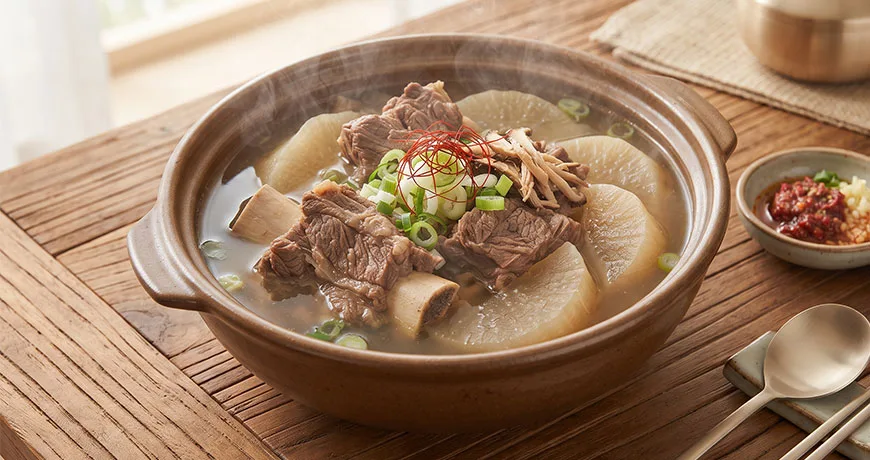
Galbitang is a highly refined thermodynamic consommé matrix designed to meticulously disassemble the bones, marrow, and tough fascia of mammalian short ribs. Unlike Seolleongtang, which applies a violent rolling boil to forcefully emulsify bone marrow into a milky suspension, Galbitang utilizes precise thermal hydrolysis at a critical sub-boiling temperature (90–95°C). This tranquil kinetic environment prevents the marrow lipids and aqueous solvent from mixing, allowing for rigorous and relentless lipid clarification (skimming). The result is a crystalline, golden amino-acid solution, completely devoid of cloudy emulsion. The reducing sugars released by the collapsing pectin walls of daikon radish softly buffer the heavy inosinate (IMP) of the beef. At the base of the serving bowl, hydrated sweet potato starch noodles (Dangmyeon) absorb the kinetic heat of the broth, undergoing rapid gelatinization to provide a chewy textural contrast to the flawlessly tenderized, gelatinous meat.
- ⏱️ Total: 3 hrs 30 mins | Prep: 1 hr (Osmotic blood purging & myoglobin extraction) | Cook: 2 hrs 30 mins
- 🍳 Difficulty: High (Requires relentless lipid clarification and critical convection control to prevent emulsification)
- 🌶️ Profile: Crystalline Clear, Deeply Savory, and Restorative Beef Umami
- 🍚 Focus: Rib Collagen Thermal Hydrolysis, Continuous Lipid Clarification, & Amylopectin Gelatinization
- 🍶 Pairing: Chilled, high-proof traditional distilled Soju (40%+ ABV)
Ingredients (3–4 servings)
- Mammalian Collagen Matrix: 1.2kg Hanwoo Beef Short Ribs (submerged in cold water for 1+ hours to osmotically purge myoglobin and water-soluble blood proteins)
- Pectin & Reducing Sugar Matrix: 250g Daikon Radish (sliced into large chunks to impart a clean, cooling sweetness)
- Aqueous Umami Solvent: 4L Purified Water
- Odor Adsorption Catalyst: 1 whole Onion, 2 white stalks of Green Onion, 10 cloves Garlic, 1 tbsp Whole Black Peppercorns
- Ionized Sodium Binder: 1.5 tbsp Soup Soy Sauce (Guk-ganjang), Coarse Sea Salt to taste (used for final salinity to preserve optical clarity)
- Starch Gelatinization & Allyl Finish: 50g Glass Noodles (100% sweet potato starch – hydrated in cold water for 30 mins), 2 green stalks of Green Onion (finely chopped), 1 Egg (separated and pan-fried for Hwangbaek Jidan garnish – optional)
Allergy Information Contains: Beef, Soy, Wheat (from Soy Sauce), Egg (garnish)
Equipment Massive High Thermal Mass Stainless Steel Stockpot, Fine Skimmer, Earthenware Serving Pot (Ttukbaegi), Cutting Board, Knife
Cooking Instructions
- Thermal Coagulation & Blanching: Submerge the osmotically purged short ribs in aggressively boiling water for 10 minutes. The myoglobin trapped deep inside the bone marrow and muscle fibers will thermally coagulate, violently erupting as dark foam. Discard all the water entirely and rigorously scrub the coagulated protein clumps off the cut bones under running cold water. This physical purging is absolute law for achieving a clear broth.
- Critical Temp Thermal Hydrolysis: Place the cleaned ribs, 4L of purified water, radish, onion, scallion whites, garlic, and peppercorns into a large stockpot. Bring to a rapid boil, then immediately leave the lid slightly ajar and reduce the heat to medium-low (90–95°C). Maintain a gentle simmer—where only tiny bubbles break the surface—and kinetically extract the umami for 1.5 to 2 hours.
- Lipid Clarification & Salinity: Throughout the boiling process, relentlessly use a fine mesh to skim off the yellow animal lipids pooling on the surface. Once the dense collagen fascia denatures into yielding gelatin, allowing the meat to easily separate from the bone, discard all aromatic vegetables. Slice the cooked radish into squares and return to the broth. Calibrate the final sodium ion concentration strictly with soup soy sauce and sea salt.
- Starch Gelatinization & Assembly: Place a portion of the hydrated glass noodles at the bottom of a pre-heated Ttukbaegi. Arrange the ribs and radish over the noodles, then pour the boiling, crystalline consommé over the top. The sudden application of thermal energy forces the sweet potato amylopectin into rapid gelatinization.
- Allyl Finish: Garnish the matrix heavily with chopped scallions for a volatile allyl sulfide punch, and crown with the thermally coagulated egg ribbons.
💡 Professional Culinary Tips
- Hydrodynamic Control for Clarity: The thermodynamic distinction between Galbitang and Seolleongtang is profound. Applying a closed-lid, 100°C rolling boil forces the beef lipids and water into a stable macro-emulsion, resulting in a milky, cloudy broth. To extract the signature crystalline, golden liquid of authentic Galbitang, you must maintain a tranquil 90–95°C convection environment while obsessively skimming the fat.
- Physical Purging of Myoglobin: During the initial blanching phase, dark, coagulated blood clots will adhere to the marrow cavities of the cut bones. If these are not manually scrubbed away under cold water, they will oxidize during the main simmer, injecting severe gamey off-notes and muddying the visual clarity of the consommé.
- Separation of Gelatinization: Never boil the glass noodles directly in the main stockpot. The 100% sweet potato starch will leach into the solvent, ruining its pristine clarity and turning the broth into a viscous paste. Hydrating the noodles in cold water and flash-cooking them at the bottom of the serving bowl with boiling broth ensures perfect chewiness while preserving the matrix’s optical purity.
🍶 Gastronomic Pairing
- Biochemical Palate Cleansing: When the heavy inosinate, the sticky gelatin rendered from the ribs, and the gelatinized starch completely coat your oral mucosa, pair this dish with a shot of high-proof dry traditional distilled Soju (40%+ ABV), chilled in the freezer to increase its viscosity. The highly refined ethanol acts as a surgical solvent, sharply slicing through the dense collagen and lipid barrier on your tongue. This flawlessly resets your taste receptors, geometrically amplifying the crystalline, savory beef umami of the very next spoonful.
Nutrition Facts (Estimated)
Total Content : Approx. 750g (1 serving, excluding bone weight)
Calories : 450 kcal (Excluding rice)
– Sodium : 1,200mg (Dependent entirely on table salt calibration)
– Total Carbohydrate : 16.0g (Reducing sugars from radish and starch polysaccharides)
– Sugar : 4.0g
– Total Fat : 22.0g (High-quality natural beef lipids remaining after clarification)
– Saturated Fat : 9.5g
– Cholesterol : 95.0mg
– Protein : 46.0g (Ultra-dense myofibrillar protein and collagen peptides)
– Dietary Fiber : 3.0g
*Daily Values are based on a 2,000 calorie diet and standard Korean nutritional reference values.
**Nutritional values are calculated based on original ingredients; substitutions may alter specific macronutrients.
Origins and Food Culture of Short Rib Soup (Galbitang)
1. Historical Lineage: Goryeo Royal Banquets and Siuijeonso’s Classical “Garitang”
- The historical roots of Galbitang trace back to the late Goryeo Dynasty, where beef ribs were slow-simmered for aristocratic state banquets, and continued through the Joseon Dynasty as recorded in royal banquet protocols (Uigwe) such as the Wonhaeng Eulmyo Jeongni Uigwe and Jinchan Uigwe.
- The late-19th-century culinary compendium Siuijeonso (是議全書) documents the dish under the historical name “Garitang (嘉里湯)” (from gari, the archaic Korean term for rib), detailing: “Chop beef ribs into pieces, add abundant water, simmer slowly over a gentle fire, skim away the fat, and season clearly with scallions, garlic, and black pepper.” This confirms its centuries-old heritage as an elite, crystal-clear restorative soup served to royal dignitaries and noble scholar (yangban) households.
2. The Culinary Science of Blood Leaching, Gentle Simmering, and Defatting
- Unlike Sagolugeojigalbitang or Seolleongtang, which incorporate leg marrow bones boiled at high turbulence to yield a cloudy broth, authentic Galbitang prioritizes the pristine clarity of Cheongtang (clear consommé).
- Master kitchens soak the ribs for hours to purge coagulated blood, parboil them briefly to eliminate surface impurities, and simmer them over low-to-medium heat to trap moisture inside the meat fibers. Chilling the resulting broth allows rendered white tallow to solidify into a firm crust that is cleanly removed, yielding an unctuous, golden broth rich in dissolved gelatin and free nucleotides without greasy heaviness.
3. The Quintessential Wedding Banquet Feast and the Spirit of Hospitality
- In traditional Korean agrarian society where cattle were vital agricultural assets, tender bone-in beef short ribs were regarded as the supreme luxury cut; consequently, Galbitang became the mandatory centerpiece for celebratory feasts, such as weddings, 60th birthday banquets (hwangap), and first-birthday parties (doljanchi).
- The custom remains so deeply rooted that the traditional Korean phrase for announcing an upcoming wedding—”I will treat you to a warm bowl of Galbitang”—still serves as a cultural idiom for celebration. Serving a steaming, generous bowl of Galbitang symbolizes the host’s prosperity, heartfelt gratitude, and highest esteem for their guests, reigning as an enduring monument to Korean celebratory dining and hospitable warmth.
The Amber Clarity of Simmered Bovine Rib Marrow, the Silk-Tender Flaking of Bone-In Beef, and the Festive Resonance of Golden Consommé: A Refined Portrait of Galbitang
Galbitang (Short Rib Soup) stands as the aristocratic, crystalline, and biologically quintessential summit of Korea’s celebratory bovine clear-broth (cheongtang) gastronomy. Centered upon select bone-in short ribs—short cut, chuck, and flanken cuts prized for their dense marbling and thick periosteal sheaths—the preparation begins with extensive desanguination, steeping the cut ribs in cold running spring water for hours to leach deep-bone hemoglobin and residual myoglobin. Following an initial flash-blanch in boiling water infused with whole garlic, fresh ginger, scallions, black peppercorns, and refined rice wine to purge coagulated surface albumins and impurities, the structural ribs are gently transferred into a foundation of fresh spring water within an iron cauldron alongside thick discs of sweet winter radish, onions, and allium roots. Simmered over a gentle, disciplined convective flame (85–90°C) across hours, the skeletal connective tissues slowly relax as bone minerals and rich marrow liquefy into the broth. Once tender, the ribs and radish are lifted and trimmed, while the broth is chilled to mechanically strip away the solidified surface tallow, yielding a diamond-clear, amber-tinted consommé. Reassembled inside a heavy earthenware pot (ttukbaegi) or glistening bronzeware bowl (bangjja yugi) over a foundation of hydrated sweet potato glass noodles (dangmyeon), the soup is mounded with the tender short ribs and radish, bathed in hot broth, crowned with delicate yellow-and-white egg ribbons (jidan) and freshly sliced scallions, and seasoned transparently with artisanal soup soy sauce, solar sea salt, and white pepper. Bypassing fiery chilies or heavy bean pastes, Galbitang extracts the pure, unmasked amino acids of terrestrial beef bone and muscle through sheer thermodynamic minimalism, delivering an austere masterclass that purifies the palate and soothes the internal organs with radiant warmth.
Confronting the steaming bowl as delicate, amber-hued steam curls upward to reveal towering bone-in ribs, golden egg ribbons, and emerald scallions, lifting a deep spoonful of the broth releases an immediate, deeply calming olfactory charge: the clean, buttery perfume of slow-extracted bovine marrow mingles seamlessly with the honeyed vegetable sweetness of simmered winter radish, the brisk sulfurous brightness of fresh scallions, and the warm, woody nuance of cracked white peppercorns. Taking the first sip delivers an unadorned revelation across the oral mucosa: devoid of any greasy surface tension, the clarified amino acid broth floods the tongue with silk-like softness, gliding effortlessly down the esophagus to soothe fatigued tissues and infuse the body with deep, serene warmth. Grasping a rib reveals meat whose intramuscular collagen has completely melted into liquid silk; the beef pulls away from the bone with effortless tenderness, discharging concentrated torrents of sweet, oleic-rich juices. In delightful contrast, the translucent sweet potato glass noodles supply a slippery, viscoelastic snap (elasticity) that enriches oral friction, while the braised radish yields with a succulent, juicy chew. Dipping the succulent rib meat into sharp mustard-spiked vinegar soy sauce awakens the palate with zesty acidity, and steeping a bowl of warm white rice into the amber broth alongside a crisp cube of aged radish kimchi (kkakdugi) completes an unforgettable ritual of physical rejuvenation, festive joy, and quiet gastronomic transcendence.
The enduring majesty of Galbitang lies in its historical lineage—descended from the Joseon royal banquet records and aristocratic culinary texts such as the Jinchan Uigwe and Siuijeonseo, where it was recorded as Garitang (加里湯, gari being the archaic Korean term for rib). In an agrarian society where draft cattle were sacred agricultural pillars and slaughter was strictly regulated, consuming rich bovine ribs in a clear, golden broth was a luxury reserved exclusively for courtly banquets, matrimonial celebrations, and milestone feasts (hwagabyeon). Evolving into the definitive ceremonial centerpiece of traditional Korean weddings, a steaming cauldron of beef short rib soup remains an irreplaceable monument of agricultural reverence, festive hospitality, and brilliant Korean culinary craftsmanship.
Editor’s Review
1. A Dynamic Harmony of Fall-Off-The-Bone Rib Tenderness, Slippery Glass Noodle Snap, Succulent Radish Give, and Frictionless Consommé Fluidity
The structural architecture inside the vessel delivers an extraordinary, four-tiered choreography between dense mammalian skeletal muscle fibers, hydrated starch hydrogels, braised root vegetable matrices, and an ultra-low-viscosity aqueous matrix. Sustained hydrothermal simmering completely dissolves the tough collagenous sheaths encasing the rib bones, allowing the succulent beef fibers to separate along natural perimysial grains with cloud-like ease and minimal tooth resistance. This delicate chew is dynamically counterbalanced by the sweet potato glass noodles, which drink in the savory broth to deliver a slippery, viscoelastic snap that diversifies oral friction. Sliced winter radish absorbs the broth like an organic sponge, yielding with a tender, juicy bite, while the completely defatted, clear consommé forms a frictionless lubricating fluid layer across oral membranes, ensuring an impeccably balanced, non-fatiguing mouthfeel from the first steaming sip to the last.
2. Rib Periosteal Type I Collagen Gelatinization, Gentle Convective Temperature Control (85–90°C) for Actomyosin Syneresis Mitigation, IMP-Glutamate Nucleotide Synergy, and Tallow Defatting Rheology
Galbitang represents an exacting study in vertebrate skeletal histology, muscle thermal mechanics, and flavor volatile preservation. Insoluble Type I collagen, densely woven within the rib periosteum, tendons, and intramuscular perimysium, undergoes thermal denaturation between 85°C and 90°C, cleaving its tight triple-helix hydrogen bonds into water-soluble gelatin polypeptides that soften the meat and endue the broth with a subtle, lip-clinging dynamic viscosity. Crucially, sustaining a rolling boil above 100°C would trigger aggressive actomyosin contraction, causing cellular moisture expulsion (syneresis) and leaving the meat dry and stringy; regulating the thermal currents within a gentle convective simmering window (85–90°C) preserves myofibrillar Water Holding Capacity (WHC), ensuring deep moisture retention. Broth savor is driven by a profound nucleotide synergy: muscle-derived inosine monophosphate (5′-IMP) converges with natural succinic acid from the braised radish and free glutamic acid (Glutamate) leached from aged artisanal soup soy sauce, triggering an exponential synergy across human oral T1R1/T1R3 umami heterodimers. Post-cook refrigeration solidifies surface tallow into a crystalline wax layer, allowing 100% mechanical removal (defatting) to preserve pristine broth transparency and low dynamic viscosity. Furthermore, allicin-derived organosulfur volatiles (allyl sulfides) from scallions and piperine from white peppercorns chemically sequester and mask trace lipid aldehydes, yielding an immaculate, aristocratic bovine aroma.
3. The Joseon Garitang Court Heritage, Nuptial Feast Symbolism, and the Sovereign Apex of Celebratory Korean Tangban
Recorded in Joseon court banquet protocols as the ultimate expression of hospitality and refined meat cookery, Galbitang stands as the foundational archetype of Korean clear beef broths. Preserving its status across centuries as the premier wedding feast soup (gyeolhonsik galbitang) and the gold standard of milestone banquets, this unmasked, amber-tinted centerpiece illustrates how rigorous temperature control and respect for prime animal protein can transform simple water and beef ribs into an enduring sanctuary of restorative sustenance, familial celebration, and brilliant Korean culinary artistry.