
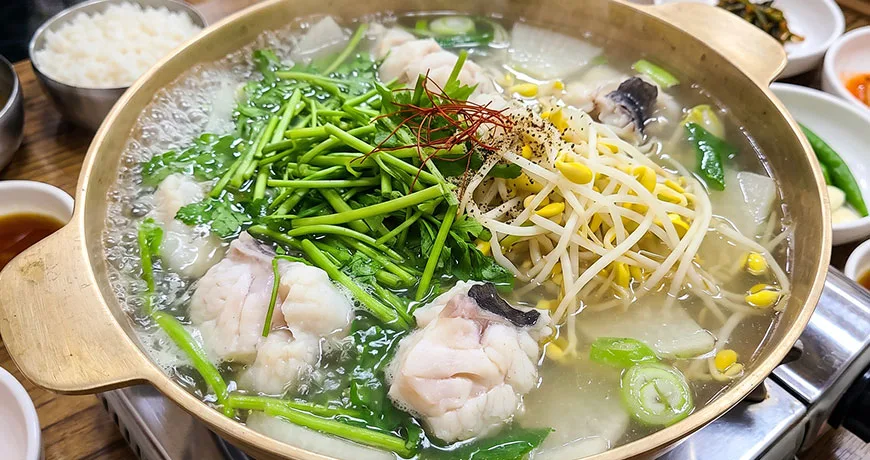
Bokmalgeuntang is a hyper-minimalist biochemical matrix built upon the absolute prerequisite of profound physical toxin isolation—specifically, the mechanical extraction of organs containing tetrodotoxin (TTX), a lethal voltage-gated sodium channel blocker. Unlike standard white fish, the myofibrillar structure of pufferfish features extreme collagen cross-linking, akin to mammalian tissue. This unique cellular architecture allows the fish to withstand boiling kinetic energy without structurally disintegrating, offering an unmatched chewy, viscoelastic texture. The hyper-clean umami is extracted by introducing osmotically purged pufferfish into a baseline solvent enriched with kelp glutamate and radish reducing sugars. Strictly omitting capsaicin-heavy spices, the matrix is finalized with a massive application of water dropwort (Minari), coating the clear consommé with volatile terpene compounds. This results in the ultimate crystalline recovery broth, delivering profound flavor clarity without heavy lipid interference.
- ⏱️ Total: 40 mins | Prep: 15 mins (Osmotic blood purging of professionally prepped fish) | Cook: 25 mins
- 🍳 Difficulty: Extreme (Requires handling of TTX-purged matrix, complete blood removal, and crystalline broth clarification)
- 🌶️ Profile: Crystalline Clear, Hyper-Clean Umami, with a Bright Terpene Finish
- 🍚 Focus: Myofibrillar Integrity Retention, TTX-Free Extraction, & Terpene Layering
- 🍶 Pairing: Hot, savory Hire-zake (Sake infused with roasted puffer fin) or ultra-premium dry Cheongju
Ingredients (2 servings)
- TTX-Free High-Density Protein Matrix: 500g Culinary Pufferfish (Bok-eo – MUST be strictly prepared by a legally certified professional with all TTX-bearing organs removed. Soaked in ice water to purge residual blood)
- Pectin & Reducing Sugar Matrix: 150g Daikon Radish (sliced into squares), 100g Soybean Sprouts (heads and tails removed for pure aspartic acid extraction)
- Aqueous Umami Solvent: 1.2L Kelp Broth or Purified Water
- Ionized Sodium Binder: Coarse Sea Salt to taste (Soy sauce is omitted to preserve optical clarity)
- Aromatic & Terpene Catalyst: 2 handfuls Water Dropwort (Minari), 1 stalk White Green Onion (diagonally sliced), 3 cloves Garlic (sliced)
- Organic Acid (For Serving): Ponzu sauce or Lemon juice (used as a chemical dip to cut the dense collagen texture)
Allergy Information Contains: Fish (Pufferfish)
Equipment High Thermal Mass Pot or Ttukbaegi, Fine Skimmer, Cutting Board, Knife
Cooking Instructions
- Osmotic Blood Purging: Submerge the professionally prepared pufferfish pieces in ice water for at least 30 minutes. This utilizes osmotic pressure to thoroughly flush out any residual myoglobin and blood from the micro-capillaries. Even a drop of blood will undergo thermal coagulation during boiling, turning the pristine broth cloudy and introducing metallic off-notes.
- Baseline Solvent Extraction: Place the kelp broth, square-cut radish, and soybean sprouts into the pot and apply high kinetic heat. Once boiling, remove the kelp immediately. Calibrate the baseline sodium ion concentration strictly with coarse sea salt.
- High-Density Myofibrillar Hydrolysis: As the clear solvent rolls at a violent boil, drop in the purged pufferfish chunks and sliced garlic. Leave the lid open to allow volatile off-odors to vaporize. Relentlessly use a skimmer to remove the thermally coagulated protein foam rising to the surface. Boil over medium heat for 10–15 minutes to extract the inosinate (IMP) from the dense skeletal structure.
- Aromatic Terpene Coating: Once the pufferfish meat has contracted into its signature firm, chewy state, heap the green onions and Minari into the pot right before turning off the heat. Turn off the heat within 10 seconds to prevent the thermal degradation of the volatile terpenes, ensuring a crisp, forest-fresh coating on the broth surface.
- Acidic Fusion (Serving): Serve the clear broth, tender greens, and firm fish. Dip the dense myofibrillar meat into a citrus-based Ponzu sauce, allowing the organic citric acids to chemically brighten the heavy protein texture.
💡 Professional Culinary Tips
- Thermal Stability of TTX: Tetrodotoxin is exceptionally heat-stable. Prolonged boiling at 100°C does absolutely nothing to destroy its molecular structure. Thermodynamic cooking processes cannot detoxify this neurotoxin; therefore, prior physical isolation by a licensed professional is the unyielding law of this dish.
- Hydrodynamics of Cross-linked Muscle: While delicate fish like croaker crumble in boiling water, pufferfish boasts dense collagen cross-linking that tightens into a firm, highly viscoelastic structure when heated. This architectural density is what gives Bok-eo its prized, almost meaty chew factor.
- The Biochemical Truth of Minari: Traditionally, it was a widespread myth that adding Minari (water dropwort) to pufferfish stew helped “neutralize” the venom. Scientifically, this is entirely false. However, it is a culinary masterpiece of flavor engineering: the crisp terpenes flawlessly mask any trace of marine ammonia, while its rich potassium content counterbalances the high sodium of the broth.
🍶 Gastronomic Pairing
- Biochemical Palate Cleansing: Pair this ultra-clean, crystalline umami broth with Hire-zake (hot Sake infused with a heavily roasted pufferfish fin). The Maillard reaction compounds from the charred fin dissolve into the hot ethanol, creating a homogenous, savory synergy that perfectly mirrors the deep, clean extraction of the soup.
Nutrition Facts (Estimated)
Total Content : Approx. 600g (1 serving, excluding bone weight)
Calories : 160 kcal (Excluding rice, ultra-low calorie)
– Sodium : 1,150mg
– Total Carbohydrate : 6.0g (Reducing sugars from radish and sprouts)
– Sugar : 2.5g
– Total Fat : 0.5g (Extreme lean protein with virtually zero lipid content)
– Saturated Fat : 0.0g
– Cholesterol : 45.0mg
– Protein : 32.0g (Ultra-dense myofibrillar protein and collagen)
– Dietary Fiber : 3.5g
*Daily Values are based on a 2,000 calorie diet and standard Korean nutritional reference values.
**Nutritional values are calculated based on original ingredients; substitutions may alter specific macronutrients.
Origins and Food Culture of Puffer Fish Soup (Bokmalgeuntang)
1. Classical Medical Treatises: The Dongui Bogam, Jasanoebo, and Su Dongpo’s Feat
- Puffer fish has been consumed along the Korean peninsula since the Neolithic era, as evidenced by blowfish skeletal remains discovered in prehistoric shell mounds (paechong).
- The legendary Northern Song dynasty poet Su Dongpo famously declared puffer fish to be “a flavor worthy of death itself (據其味, 真是但一死兒),” establishing its status as the supreme epicurean thrill of East Asia. Documented in Heo Jun’s 1613 Dongui Bogam under the Hanja name Hadon (河豚, “river pig”), the fish was recorded as “warm in nature, sweet, and possessing poison… effectively nourishing deficiency, dispelling internal dampness, and strengthening the waist and legs.” Furthermore, Jeong Yak-jeon’s 1814 Jasanoebo recorded it as Huyo (鯸魚), detailing its anatomy and seasonal culinary properties, confirming centuries of therapeutic culinary reverence.
2. The Knife Master’s Detoxification and the Science of Water Dropwort & Vinegar
- Puffer fish dining is fundamentally anchored in the precision of seasoned knife masters, whose practiced strokes meticulously extract toxic organs and repeatedly rinse the flesh in cold running water to eliminate every trace of blood.
- Pairing the pure white fish with abundant heaps of fresh water dropwort (minari)—traditionally celebrated for clearing internal heat and toxins—and finishing the scalding broth with drops of vinegar to tighten the protein fibers and volatilize trace amines exemplifies an ancient, instinctive mastery over dangerous ingredients to yield a pure wellness elixir.
3. The 1970 Busan Earthenware Revolution and Masan’s Historic Bok-guk Alleys
- While influenced by Japanese clear pot dishes (chiri / fugu nabe) during the early 20th century, the dish underwent a revolutionary domestic evolution in 1970 when Geumsubokguk in Haeundae, Busan, first began serving individual portions inside heat-retaining Korean earthenware pots (ttukbaegi), transforming it into an accessible, beloved Korean national staple.
- Anchoring historic maritime hubs such as the Odong-dong Bokguk Alley in Masan and the fish markets of Yeongdo and Jagalchi in Busan, Bokmalgeuntang served as the ultimate morning restorative for dawn fishermen, dockworkers, and late-night revelers. Remaining completely free of red chili paste, it reigns supreme as the undisputed crown jewel of Korea’s “White Hangover Relief” (baeksaek haejang) culinary culture.
The Pristine Purity of Meticulously Carved Pufferfish White Meat, the Razor-Sharp Clarity of Mineral Bone Nectar, and the Electrifying Brightness of Acetic Acid: A Refined Portrait of Bokmalgeuntang
Bokmalgeuntang (Clear Pufferfish Soup, widely celebrated as Bokjiri) stands as the crystalline, unadorned, and biologically astonishing summit of Korea’s marine clear-broth (cheongtang) gastronomy. Centered upon apex tetraodontid species—such as tiger puffer, panther puffer, and grass puffer—which harbor potent tetrodotoxin within their ovaries, liver, intestines, blood, and gills, the fish requires exacting knife work to excise every toxic margin. Purged through continuous running water rinses to strip away all residual hemoglobin, the dense white fillets, collagen-rich vertebrae, and gelatinous skins are arrayed in a heavy earthenware pot or gleaming casserole. Anchored upon a refreshing bed of thinly sliced winter radish and de-tailed soybean sprouts, the pot is bathed in cold spring water or a gossamer sheet-kelp infusion alongside crushed garlic and scallions. Brought to an explosive, rolling boil over high heat, topped generously with crisp wild water parsley (minari), and finished tableside with a splash of brewed vinegar, this creation firmly rejects red chili pastes, thick soybean mashes, and animal lipids. It extracts the raw, unmasked amino acids and bone minerals of an ultra-lean aquatic organism (possessing less than 1% fat) through sheer thermodynamic minimalism, delivering an austere masterclass that purifies the palate and internal organs with incandescent clarity.
Confronting the boiling vessel as clear, diamond-bright steam ascends between emerald ribbons of water parsley and translucent ivory broth, lifting a deep spoonful releases an immediate, electrifying sensory charge: the pristine, iodine-clean perfume of deep-sea minerals mingles seamlessly with the brisk, pine-fresh herbal aroma of water parsley and the vaporous, palate-awakening flash of vaporized acetic acid. Taking the first sip delivers an unadorned revelation across the oral mucosa: devoid of any greasy surface tension, the crystalline amino acid broth floods the tongue with zero resistance, gliding down the esophagus to soothe alcohol-inflamed tissues and awaken dormant perspiration in an exhilarating wave of what Korean gastronomy reveres as siwonhan mat—the sensation of profound, soul-cleansing lightness. Sinking your teeth into the poached pufferfish meat reveals an extraordinary structural surprise: unlike the delicate flakes of common white fish, the flesh exhibits a dense, springy, and muscular resilience reminiscent of tender poultry breast, fracturing cleanly under tooth pressure to release concentrated sweet proteins. Concurrently, the simmered skin offers a buoyant, viscoelastic chew (jjondeuk) dense with bioavailable gelatin. Dipping the firm meat into citrus-spiked soy sauce awakens the palate with zesty acidity, while the crisp snap of soybean sprouts and water parsley cleanses lingering marine notes, transforming the meal into an unforgettable ritual of physical rejuvenation, metabolic renewal, and quiet gastronomic transcendence.
The enduring majesty of Bokmalgeuntang lies in its legendary East Asian lineage—celebrated by the Song Dynasty poet Su Shi, who famously declared that the divine flavor of pufferfish (hadon) was “worthy of a man’s death,” and codified in Heo Jun’s 17th-century medical text Dongui Bogam as a warming, sweet restorative capable of dispelling chronic fatigue and purging alcohol toxicity. By mastering a hazardous wild creature through ancestral carving discipline and converting it into the supreme restorative tonic of the peninsula, a steaming pot of clear pufferfish soup remains an irreplaceable monument of zero-fat marine stewardship, knife precision, and dazzling Korean culinary craftsmanship.
Editor’s Review
1. A Dynamic Harmony of Poultry-Like Fish Muscle Density, Viscoelastic Skin Gelatin, Crisp Botanical Turgor, and Frictionless Crystalline Broth Fluidity
The structural architecture inside the vessel delivers an extraordinary, high-contrast choreography between dense teleost muscle bundles, partially gelatinized dermal connective tissue, crisp vegetable cell walls, and an ultra-low-viscosity aqueous matrix. Possessing virtually zero intramuscular lipids, the pufferfish muscle fibers contract under convective heat into a firm, springy matrix that resists tooth pressure with a clean, poultry-like bounce rather than disintegrating into soft flakes. This toothsome density is complemented by the simmered fish skin, whose dense dermal layer yields with a supple, viscoelastic snap. Flash-wilted soybean sprouts and water parsley maintain rigid cellular turgor, introducing a brisk, auditory snap that provides structural friction. Meanwhile, the zero-fat, mineral-rich broth glides across oral tissues with frictionless smoothness, ensuring an impeccably balanced, non-fatiguing mouthfeel from the first steaming sip to the last.
2. Sub-1% Lipid Actomyosin Thermal Network Density, Dermal Type I Collagen Gelatinization, IMP-Glutamate-Taurine Triple Umami Synergy, and Acetic Acid pH Depletion / TMA Salification Mechanics
Bokmalgeuntang represents an exacting study in marine vertebrate histology, solution thermodynamics, and sensory neurochemistry. Unlike sedentary white fish, tetraodontid species possess a low moisture content in their white musculature, characterized by densely packed actomyosin myofibrils and an exceptionally low lipid profile (consistently under 1%). When exposed to hydrothermal simmering above 85-90°C, the protein chains undergo tight intermolecular cross-linking without structural flaking, creating its signature bouncy, resilient mouthfeel. The thick dermis, composed predominantly of insoluble Type I collagen, undergoes partial denaturation into water-soluble gelatin, imparting an unctuous, springy chew to the blanched skin. Broth savor is driven by a powerful biochemical synergy: muscle-derived inosine monophosphate (IMP) converges with natural free glutamates from the kelp and winter radish, alongside dense reserves of endogenous taurine, activating human oral T1R1/T1R3 umami heterodimers with razor-sharp intensity. Crucially, the tableside addition of acetic acid (vinegar) lowers the broth’s pH into a mildly acidic range (pH 4.5-5.5). This protonates trace basic fish amines—principally volatile trimethylamine (TMA)—converting them into non-volatile ammonium acetate salts, thereby eliminating fishy off-odors. Furthermore, the acidic shift excites oral acid-sensing ion channels, stimulating salivary flow and heightening the sensitivity of neighboring taste buds to make the underlying marine umami taste extraordinarily sharp, vivid, and clean.
3. The Classical Hadon Literati Heritage, Carving Mastery, and the Sovereign Summit of Korean Hangover Gastronomy
Subduing the fatal threat of tetrodotoxin through generations of empirical knife discipline, Bokmalgeuntang stands as a testament to transformative culinary craftsmanship. Evolving from an aristocratic restorative into the undisputed high-water mark of contemporary Korean hangover culture, this unmasked, diamond-bright soup demonstrates the ultimate power of culinary subtraction, standing as an enduring sanctuary of ancestral technique, physiological renewal, and brilliant Korean culinary artistry.