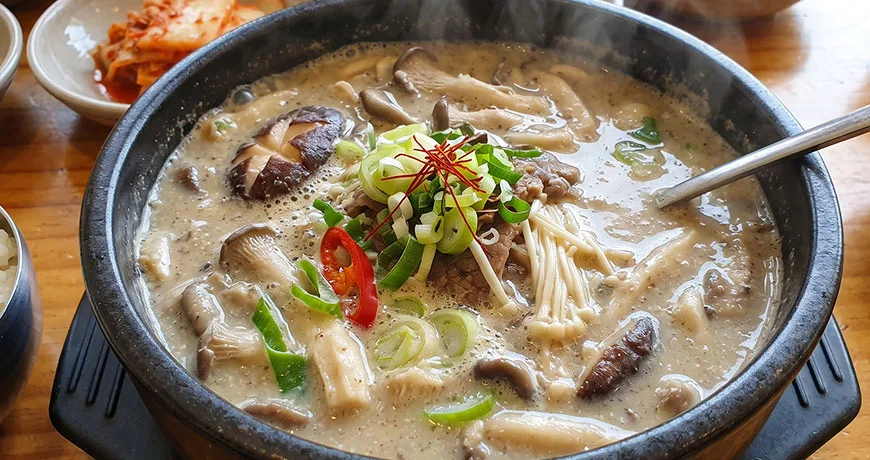
Beoseotdeulkkaetang is a highly advanced botanical colloidal suspension matrix, achieved by stabilizing the massive alpha-linolenic acid (Omega-3) lipid output of ground perilla seeds within the gelatinized amylopectin network of glutinous rice flour. While raw perilla lipids naturally undergo phase separation in an aqueous solvent, the thermal gelatinization of the rice starch traps these fatty molecules in a dense, viscoelastic gel, resulting in a perfectly emulsified, cream-like body. Into this dense suspension, the rigid chitin cell walls of shiitake and oyster mushrooms are thermodynamically degraded, violently releasing guanosine monophosphate (GMP). This GMP chemically collides with the glutamic acid of the kelp broth to trigger an exponential umami synergy. Entirely devoid of animal protein, this stew relies purely on molecular botanical integration to deliver an overwhelming rheological viscosity, deep earthy aromas, and an intense savory resonance.
- ⏱️ Total: 35 mins | Prep: 15 mins (Mushroom chitin hydration & slicing) | Cook: 20 mins
- 🍳 Difficulty: Medium (Requires precise starch gelatinization and thermal control of omega-3 lipids to prevent emulsion breakage)
- 🌶️ Profile: Deeply Nutty, Earthy, Viscous, and Intense Botanical Umami
- 🍚 Focus: Colloidal Lipid Suspension, GMP-Glutamate Synergy, & Amylopectin Gelatinization
- 🍶 Pairing: Crisp, high-acidity traditional Yakju (Clear Rice Wine) or a dry, mineral-driven White Wine
Ingredients (3–4 servings)
- Chitin & Guanylate Matrix: 3 Fresh Shiitake Mushrooms (stems removed, sliced), 150g Oyster Mushrooms (torn along the fibers), 1 pack Enoki Mushrooms (bases trimmed)
- Omega-3 Lipid Matrix: 5 tbsp Peeled Perilla Seed Powder (Deulkkae-garu – finely ground without the tough outer hulls)
- Amylopectin Stabilizer: 2 tbsp Glutinous Rice Flour (Chapssal-garu) mixed with 3 tbsp Purified Water (prepared as a slurry)
- Aqueous Glutamate Solvent: 1L Kelp and Radish Broth (baseline solvent for umami synergy)
- Ionized Sodium Binder: 2 tbsp Soup Soy Sauce (Guk-ganjang), 1 tbsp minced garlic, Coarse Sea Salt to taste
- Aromatic Lipid Finish: 1 stalk Green Onion (diagonally sliced), 1 tbsp Fresh Raw Perilla Oil (added off-heat)
Allergy Information Contains: Soy, Wheat (from Soy Sauce) / Caution for those with specific fungi sensitivities
Equipment High Thermal Mass Earthenware Pot (Ttukbaegi) or Cast Iron Dutch Oven, Cutting Board, Knife, Whisk
Cooking Instructions
- Umami Extraction & Chitin Breakdown: Pour the kelp broth into a pot and heat over high flame. Once boiling, add the minced garlic and soup soy sauce to establish the baseline osmotic pressure. Introduce the sliced shiitake and oyster mushrooms. The thermodynamic kinetic energy systematically dismantles the tough fungal chitin walls, explosively releasing trapped GMP and lenthionine aromatic compounds into the solvent.
- Lipid Suspension Introduction: As the mushrooms soften and release their internal moisture, reduce the heat to medium-low (approx. 80°C). Introduce the peeled perilla seed powder into the broth, whisking gently to disperse the dense alpha-linolenic acid lipids evenly throughout the aqueous solution.
- Amylopectin Gelatinization & Stabilization: Once the perilla powder is incorporated, slowly pour the prepared glutinous rice flour slurry into the pot while stirring in a circular motion. The amylopectin in the rice starch immediately absorbs heat and water, triggering rapid gelatinization. This sol-gel transition transforms the watery broth into a heavy, viscous, cream-like matrix, physically trapping the perilla lipids and preventing any phase separation.
- Textural Layering: Once the broth has achieved its signature thick viscosity, introduce the highly delicate enoki mushrooms and green onions. Simmer for precisely 1–2 minutes to preserve their crisp cellular turgor. Calibrate final salinity with sea salt.
- Aromatic Lipid Coating: Completely remove the pot from the heat source. Drizzle 1 tablespoon of raw perilla oil over the surface. This final lipid coating maximizes the volatile nutty aromatics of the dish while strictly avoiding the bitter oxidation that occurs if perilla oil is actively boiled.
💡 Professional Culinary Tips
- GMP-Glutamate Biochemical Synergy: The reason this vegan stew explodes with a savory depth rivaling heavy meat broths lies in molecular synergy. When the glutamate molecules from the kelp and soy sauce hit the tongue’s taste receptors (T1R1/T1R3) simultaneously with the GMP molecules from the mushrooms, the perceived intensity of the umami is magnified exponentially (roughly 8 to 10 times stronger than either compound alone).
- Prevention of Lipid Degradation: The ultra-pure botanical Omega-3 lipids in perilla seeds are highly susceptible to thermal degradation. Vigorously boiling the perilla powder at 100°C for extended periods forces the fats to oxidize, generating unpleasant bitter off-notes. The powder must be introduced at a reduced heat (80°C) and simmered gently for a short duration.
- Preventing Emulsion Breakage via Amylopectin: Omitting the glutinous rice flour (or wheat flour alternative) will result in a disastrous phase separation, where the heavy seed particles sink and the extracted oils float in an oily slick on the surface. The high-viscosity amylopectin gel mechanically binds the fat droplets into a stable suspension, which is the defining engineering principle of a creamy Deulkkaetang.
🍶 Gastronomic Pairing
- Biochemical Palate Cleansing: When the heavy, viscous amylopectin gel and the rich Omega-3 botanical lipids thickly coat your oral mucosa like a dense cream, pair this stew with a chilled glass of traditional Yakju (clear rice wine) or a dry, mineral-driven White Wine. The refined ethanol and tartaric acid act as a chemical astringent, sharply slicing through the lipid barrier on your tongue. This flawlessly resets your palate, geometrically amplifying the earthy, nutty umami of the very next spoonful.
Nutrition Facts (Estimated)
Total Content : Approx. 500g (1 serving)
Calories : 320 kcal (Excluding rice)
– Sodium : 850mg (Variable depending on soy sauce and salt calibration)
– Total Carbohydrate : 28.0g (Mushroom polysaccharides and rice amylopectin)
– Sugar : 4.0g
– Total Fat : 21.0g (Dominated by highly concentrated alpha-linolenic acid / Omega-3 from perilla)
– Saturated Fat : 2.0g
– Cholesterol : 0.0mg (100% Botanical Matrix)
– Protein : 11.0g (Fungal and soy proteins)
– Dietary Fiber : 9.5g (High-density chitin and plant cellulose)
*Daily Values are based on a 2,000 calorie diet and standard Korean nutritional reference values.
**Nutritional values are calculated based on original ingredients; substitutions may alter specific macronutrients.
Origins and Food Culture of Mushroom and Perilla Seed Stew (Beoseotdeulkkaetang)
1. The Pinnacle of Buddhist Temple Cuisine (Sachal Eumsik) and Meditative Wellness
- Deeply rooted in the ancient monastic culinary traditions of Korean Buddhist temples, where strict adherence to non-violence (Ahimsa) forbade meat, fish, and dairy, while meditative focus prohibited the consumption of the five pungent alliums (Osinchae: garlic, green onions, wild chives, Korean leeks, and asafoetida).
- To maintain muscular stamina and withstand freezing Himalayan-like sub-zero winters during silent three-month retreats (Dong-angeo), temple cooks gathered wild oak mushrooms from mountain slopes and pureed nutrient-dense perilla seeds to craft a rich, restorative “vegetable bone broth.”
- Representing the highest philosophical ideals of Korean meditative dining (Seon-sik), this restorative preparation proves that profound culinary indulgence and physiological rejuvenation can be achieved entirely through pure, plant-based harvesting, reigning worldwide as a quintessential icon of authentic Korean vegan gastronomy.
2. The Culinary Science of Seed Dehulling (Geopi) and Starch Sol-Gel Stabilization
- The hallmark of authentic preparation lies in the rigorous technique of dehulling (geopi): soaking raw perilla seeds in water, gently milling away the tough, dark outer seed coats, and finely sifting the ivory kernels into an ultra-fine, snow-white powder to eliminate bitterness and rough mouthfeel.
- When boiling pureed perilla seeds, the natural lipids tend to separate from the water, resulting in an unappealing oily sheen; master cooks resolve this by blending hydrated glutinous rice flour (chapssalpul) into the simmering stock. The thermal gelatinization of rice starches stabilizes the colloidal lipid droplets, creating an impeccably smooth, cohesive texture reminiscent of an artisanal French velouté, yet achieved purely through ancestral Korean plant mechanics.
3. The Agrarian Autumn Harvest Legacy and the “Milk of the Earth” Comfort Heritage
- Celebrating the vibrant late-autumn harvest season, when agrarian farming communities bundled and threshed freshly dried perilla stalks along field borders and foraged the final flush of wild autumn mushrooms before the onset of the winter frost.
- In eras when cow’s milk and dairy butter were unobtainable luxury commodities reserved exclusively for royal medicinal confections, pureed perilla broth was revered by everyday folk as the “milk bestowed by the earth.” Simmered over gentle wood embers in rural kitchens and shared over warm ondol-heated stone floors, Beoseotdeulkkaetang remains an immortal monument to maternal comfort, agricultural frugality, and the wholesome slow-food spirit of Korean home cooking.
The Chitinous Elasticity of Forest Fungi, the Velvety Omega-3 Emulsion of Dehulled Perilla, and the Serene Harmony of Temple Flavors: A Refined Portrait of Beoseotdeulkkaetang
Beoseotdeulkkaetang (Mushroom and Perilla Seed Stew) stands as the tranquil, deeply comforting, and biologically ingenious summit of Korea’s plant-based and Buddhist temple (tangban) gastronomy. Centered upon an abundant harvest of forest and cultivated mushrooms—including deeply savory shiitake, fibrous oyster mushrooms, fleshy king oyster, delicate enoki, and velvety wood ear—the fungi are trimmed into bite-sized morsels and arranged inside an earthenware bowl (ttukbaegi). Submerged in a foundational clear kelp-vegetable broth (or a whisper of light dried anchovy stock), the pot is enriched with a rich, ivory suspension made from finely milled dehulled perilla seed powder (geopi deulkkae) blended with sweet glutinous rice flour. Simmered watchfully over low convective heat to prevent scorching, this dish strictly eschews fiery chili oils, heavy garlic pungency, and animal-derived lipids. Instead, it relies solely on the natural polysaccharides of mushrooms, the gentle thickening of gelatinized starches, and the silky emulsion of cold-pressed seed oils to achieve a velvety body that cocoons the digestive tract in deep, restorative peace.
Confronting the bubbling earthenware vessel as delicate ivory micro-bubbles crest its surface releases an immediate, deeply calming olfactory charge: the toasted, nutty perfume of dehulled perilla seeds mingles seamlessly with the deep forest humus and damp earth notes of simmered shiitake, brightened by the faint sweetness of sliced scallions. The first spoonful delivers an unadorned revelation across the tongue: the velvety, micro-particle suspension coats oral tissues with zero graininess, gliding down the esophagus to soothe a fatigued digestive system with warm, maternal solace. Sinking your teeth into the poached oyster and shiitake mushrooms reveals an extraordinary tactile joy: their dense, chitinous cell walls resist tooth pressure with a resilient, springy chew (jjolgit) before bursting with captured savory sap. The tender sheets of king oyster mushroom provide a succulent, juicy contrast, while the silky, broth-soaked rice cakes (joraeng-itteok) add an unctuous, toothsome give. Seasoned transparently with aged artisanal soup soy sauce to elevate the native sweetness of the seeds, every mouthful provides an unforgettable ritual of metabolic balance and serene gastronomic catharsis.
The enduring majesty of Beoseotdeulkkaetang lies in its sacred lineage within Korean Buddhist monastic cuisine (sachal eumsik), where taking sentient life is forbidden and cooks master the biological potential of wild mountains and forest clearings. Historically prepared during the crisp transitions of autumn to fortify meditating monks against the approaching winter chill, this dish unites the free nucleotide umami of edible fungi with the dense omega-3 lipids of harvest perilla seeds. Bypassing meat broths entirely while delivering magnificent satiety and structural opulence, a steaming cauldron of mushroom perilla stew remains an irreplaceable monument of sustainable plant stewardship, philosophical restraint, and dazzling Korean culinary craftsmanship.
Editor’s Review
1. A Dynamic Harmony of Springy Fungal Chitin Resilience, Velvety Perilla-Starch Colloidal Lubrication, and Chewy Rice Cake Give
The textural landscape inside the vessel delivers an extraordinary, tactile choreography between resilient fungal cell architectures, a high-viscosity lipid-starch hydrogel, and gelatinized cereal starches. Retaining their structural turgor under gentle convective heat, the shiitake and oyster mushrooms exhibit an energetic, springy chew that resists tooth pressure with a clean, elastic bounce before releasing savory fluids. Counterbalancing this botanical bite, the finely pulverized dehulled perilla particles and gelatinized sweet rice flour form a continuous, frictionless lubricating fluid layer that coats oral membranes with silk-like softness. The addition of spherical rice cakes (joraeng-itteok) introduces a playful, viscoelastic chew, ensuring an impeccably balanced, non-fatiguing mouthfeel from the first steaming sip to the last.
2. Perilla Alpha-Linolenic Acid (ALA) O/W Micro-Emulsification, Glutinous Rice Amylopectin Gelatinization Rheology, Guanylate-Glutamate Nucleotide Synergy, and Rosmarinic Acid Thermal Protection
Beoseotdeulkkaetang represents an exacting study in plant lipid colloid chemistry, starch suspension rheology, and nucleotide flavor mechanics. Dehulled perilla seeds consist of 40-45% lipids by weight, with over 60% dominated by the essential omega-3 fatty acid alpha-linolenic acid (ALA). Finely milling the dehulled seeds and simmering them with water liberates native plant globulins and soluble seed mucilage, which function as amphiphilic stabilizers that encapsulate lipid droplets into a durable oil-in-water (O/W) micro-emulsion. Concurrently, sweet rice flour undergoes thermal gelatinization between 65°C and 75°C; the swelling and partial dissolution of its highly branched amylopectin polymers sharply elevate the dynamic viscosity of the continuous aqueous phase, preventing phase separation and keeping perilla particles permanently suspended in a rich, creamy matrix. The broth’s umami architecture is governed by a profound nucleotide synergy: heat-activated enzymatic conversion in dried shiitake mushrooms yields high concentrations of 5′-guanosine monophosphate (5′-GMP), which converges with the free glutamic acid (Glutamate) of the dried kelp stock and aged soup soy sauce, triggering an exponential activation across human oral T1R1/T1R3 umami heterodimers. Furthermore, powerful natural polyphenol antioxidants within the perilla seed—principally rosmarinic acid and luteolin—inhibit thermal lipid autoxidation during simmering, completely suppressing rancidity and preserving a pristine, toasted nutty aroma.
3. Buddhist Monastic Culinary Lineage and the Sovereign Apex of Plant-Based Korean Gastronomy
Rejecting animal broths and pungent alliums (the five forbidden pungent roots) in favor of the pure symbiosis between foraged forest fungi and domestic field crops, Beoseotdeulkkaetang captures the pinnacle of Korean vegetarian sophistication. By utilizing the physical chemistry of seed emulsification and fungal extraction to construct a deeply satisfying, restorative tonic, this unadorned ivory-tinted stew stands as an enduring sanctuary of environmental reverence, holistic nourishment, and brilliant culinary craftsmanship.