
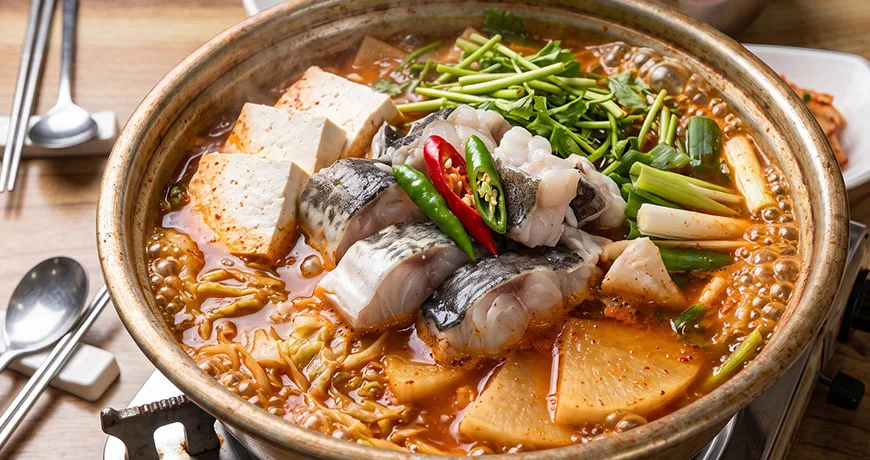
Bokmaeuntang is a high-end recovery matrix that combines the pure umami extracted from the highly cross-linked collagen of pufferfish with the sharp thermal receptor stimulation of capsaicin. The biochemical core of this dish lies in strictly omitting the heavy, starchy emulsion of traditional chili paste (Gochujang). Instead, it relies purely on chili flakes to create a crystalline capsaicin suspension within the clear broth. Even under the violent convection of 100°C boiling water, the extreme structural density of the pufferfish myofibrils prevents them from disintegrating, maintaining an unmatched chewy viscoelasticity. The reducing sugars leached from daikon radish act as a natural buffer against the aggressive spice. In the final seconds, a massive load of water dropwort (Minari) is added, laying down a thin, refreshing layer of volatile terpenes over the fiery broth.
- ⏱️ Total: 40 mins | Prep: 15 mins (Osmotic blood purging) | Cook: 25 mins
- 🍳 Difficulty: Extreme (Requires precision thermal control and TTX-free matrix handling)
- 🌶️ Profile: Fiery, Crystalline Umami, and Crisp Terpene Aromatics
- 🍚 Focus: Crystalline Capsaicin Emulsion, Myofibrillar Hydrolysis, & Temperature Control
- 🍶 Pairing: Ice-cold Somaek (Soju + Beer) engineered with a highly carbonated lager (e.g., Terra)
Ingredients (2 servings)
- TTX-Free Protein Matrix: 500g Culinary Pufferfish (Bok-eo – strictly prepped by a certified professional to remove all TTX-bearing organs, soaked in ice water to purge myoglobin)
- Pectin & Reducing Sugar Matrix: 150g Daikon Radish (sliced into squares), 100g Soybean Sprouts (heads and tails removed)
- Aqueous Umami Solvent: 1.2L Kelp Broth or Purified Water
- Hypertonic Clear Capsaicin Binder: 3 tbsp Gochugaru (Chili Flakes), 1.5 tbsp Soup Soy Sauce, 1 tbsp minced garlic, Coarse Sea Salt to taste (Gochujang is strictly prohibited)
- Aromatic & Terpene Catalyst: 2 handfuls Water Dropwort (Minari), 1 stalk Green Onion, 1 Cheongyang green chili
Allergy Information Contains: Fish (Pufferfish), Soy, Wheat (from Soy Sauce)
Equipment High Thermal Mass Pot, Fine Skimmer, Cutting Board, Knife
Cooking Instructions
- Osmotic Purging: Submerge the professionally prepared pufferfish in ice water to osmotically extract all residual blood from the micro-capillaries.
- Solvent Extraction: Place the kelp broth, square-cut radish, and soybean sprouts into a pot and apply high kinetic heat. Once boiling, dissolve the capsaicin binder (chili flakes, soy sauce, garlic) to establish a fiery, clear baseline.
- Critical Thermal Hydrolysis: As the red broth hits a violent rolling boil, introduce the purged pufferfish chunks. Leave the lid open to vaporize volatile off-odors. Boil over medium-high heat for 10–15 minutes, relentlessly skimming away any coagulated protein foam.
- Terpene Coating: Once the pufferfish meat tightens into a firm, chewy state, heap the green onions, chili, and Minari into the pot. Cut the heat within 10 seconds to preserve the crisp cellular turgor and fresh terpene aromatics of the greens.
💡 Professional Culinary Tips
- Technical Difficulty vs. Public Expectation: The primary drawback of this recipe is its high technical difficulty regarding precise temperature control and cooking timing. Because it deliberately omits the heavy starch of chili paste to preserve the delicate pufferfish umami, diners accustomed to the thick, salty, and aggressively heavy profile of popular commercial “Maeuntang” may find this refined, clear-spicy broth unfamiliar. However, this is a necessary molecular gastronomical choice to honor the delicate inosinate of the pufferfish.
- Thermodynamic Invariance of TTX: Tetrodotoxin is not destroyed by 100°C kinetic energy. The myth that spicy seasoning “neutralizes” the venom is fatal pseudoscience. Only physically detoxified pufferfish must be used.
🍶 Gastronomic Pairing
- Biochemical Palate Cleansing: When the chewy collagen and sharp capsaicin heavily stimulate your oral mucosa, pair this fiery matrix with a perfectly proportioned, ice-cold Somaek (Soju and Beer bomb) utilizing a crisp, highly carbonated lager like Terra. The effervescence and refined ethanol act as a surgical solvent, sharply slicing through the spice and instantly resetting your taste receptors.
Nutrition Facts (Estimated)
Total Content : Approx. 600g (1 serving, excluding bone weight)
Calories : 185 kcal (Excluding rice)
– Sodium : 1,350mg
– Total Carbohydrate : 9.0g
– Sugar : 3.0g
– Total Fat : 0.8g
– Saturated Fat : 0.0g
– Cholesterol : 45.0mg
– Protein : 33.0g
– Dietary Fiber : 4.5g
*Daily Values are based on a 2,000 calorie diet and standard Korean nutritional reference values.
**Nutritional values are calculated based on original ingredients; substitutions may alter specific macronutrients.
Origins and Food Culture of Spicy Puffer Fish Stew (Bokmaeuntang)
1. Classical Medical Treatises: The Dongui Bogam, Jasanoebo, and Port Fishermen Lineage
- Puffer fish has sustained coastal populations since prehistoric antiquity, as proven by skeletal remains unearthed in Neolithic shell mounds (paechong) across the southern shores of the Korean peninsula.
- Historically documented in Heo Jun’s 1613 Dongui Bogam under the Hanja name Hadon (河豚), the fish was lauded for its ability to “nourish bodily deficiency, dispel internal dampness, and invigorate the lower back and legs.” Furthermore, Jeong Yak-jeon’s 1814 marine compendium Jasanoebo recorded its morphology and seasonal properties as Huyo (鯸魚). Alongside the refined clear broths of scholar-nobles, coastal fishing ports across the southern Yeongnam and Honam coastlines embraced a heartier tradition: boiling bone-in catches with fermented soybean and red pepper pastes to warm fishermen returning from freezing, wind-whipped ocean voyages.
2. The Knife Master’s Detoxification and the Science of “Iyeol-chiyeol” Simmering
- Puffer fish dining is fundamentally anchored in the precision of seasoned knife masters, whose practiced strokes meticulously extract toxic organs and repeatedly rinse the flesh in cold running water to eliminate every trace of blood.
- While the clear soup (Bokmalgeuntang / Bokjiri) champions minimalist restraint with salt and vinegar, Bokmaeuntang embodies the dynamic Korean philosophy of Iyeol-chiyeol (以熱治熱)—dispelling inner heat and sluggishness through the cleansing burn of thermogenic red chili and savory doenjang. Simmering radish and bean sprouts first extracts a crisp botanical base before the fish is introduced over rapid heat, locking in the meat’s succulent moisture while preventing the muscle fibers from over-tightening.
3. Masan Odong-dong, Busan Jagalchi, and the Iconic “Red Hangover Relief” Heritage
- Anchoring historic maritime hubs such as the Odong-dong Bokguk Alley in Masan and the Jagalchi and Nampo-dong markets in Busan, Bokmaeuntang evolved into the quintessential morning restorative for dawn dockworkers, market vendors, and late-night revelers.
- The meal fostered unique communal dining customs, such as fishing out the braised bean sprouts and minari to toss them with vinegar-chili paste and sesame oil as a crunchy side dish (kongnamul-muchim), and concluding by scraping scorched fried rice from the bottom of the pan. Standing as the fiery counterpart to the clear version, Bokmaeuntang remains an enduring cultural monument to Korean maritime gastronomy, working-class resilience, and therapeutic soup heritage.
The Muscular Resilience of De-Toxified Pufferfish White Meat, the Incandescent Dynamic of Crimson Capsaicin Broth, and the Refreshing Snap of Water Parsley: A Refined Portrait of Bokmaeuntang
Bokmaeuntang (Spicy Pufferfish Stew) stands as the dynamic, biologically invigorating, and deeply restorative summit of Korea’s marine composite (tangban) gastronomy. Centered upon apex tetraodontid species—such as tiger puffer, panther puffer, and grass puffer—which harbor deadly tetrodotoxin within their ovaries, liver, intestines, and blood, the fish requires exacting knife discipline to completely excise every toxic margin. Purged through extensive fresh-water flushes to strip away residual hemoglobin, the dense white fillets, mineral-rich vertebrae, and gelatinous skins are arrayed in a shallow casserole or heavy earthenware pot. Anchored upon a refreshing bed of thinly sliced winter radish and crisp soybean sprouts to build a clean vegetable foundation, the broth is dissolved with an assertive seasoning paste of sun-dried red chili powder (gochugaru), a touch of aged red chili paste (gochujang), soup soy sauce, minced garlic, and ginger. Brought to an aggressive, rolling boil over high heat and crowned at the rolling climax with wild water parsley (minari), scallions, and sliced Cheongyang chilies, this dish presents a bold alternative to the austere minimalism of clear pufferfish soup (jiri). It transports an ultra-lean aquatic organism (possessing less than 1% fat) into the fiery kinetics of capsaicin, mastering fish volatiles while unlocking an exhilarating wave of deep marine umami.
Confronting the boiling vessel tableside as vibrant crimson bubbles froth around dense, snowy fillets of pufferfish releases an immediate, electrifying sensory charge: the spicy, roasted heat of chili and alliums mingles seamlessly with the clean, savory perfume of poaching fish bones and the brisk, pine-fresh herbal aroma of wild water parsley. Lifting a deep metal spoon for the first sip delivers an exhilarating revelation across the oral mucosa: the rich broth, fortified with the natural asparagine of crisp sprouts, sweet winter radish, and bone-leached amino acids, washes over the palate with zero greasy heaviness. It courses down the throat to unlock instant, soothing warmth, triggering revitalizing perspiration that swiftly dispels lingering fatigue and alcohol toxicity. Sinking your teeth into the poached pufferfish meat reveals an extraordinary structural surprise: unlike the fragile flakes of common white fish, the flesh exhibits a dense, springy, and muscular resilience reminiscent of tender poultry breast, fracturing cleanly under tooth pressure to release concentrated sweet proteins. Concurrently, the simmered skin offers a buoyant, viscoelastic chew (jjondeuk) dense with bioavailable gelatin. Dipping the firm meat into citrus-spiked soy sauce awakens the palate with zesty acidity, while the crisp snap of soybean sprouts and water parsley cleanses lingering notes, transforming the meal into an unforgettable ritual of metabolic restoration, physical renewal, and profound gastronomic catharsis.
The enduring majesty of Bokmaeuntang lies in its historical lineage—uniting the ancient mystique of the pufferfish (hadon) with Korea’s traditional culinary philosophy of sweating out toxins through fiery, restorative broths (sikchi). By taming a potentially lethal sea creature through ancestral knife craft and converting it into an electrifying, soul-reviving feast, a steaming cauldron of spicy pufferfish stew remains an irreplaceable monument of zero-fat marine stewardship, bold seasoning artistry, and dazzling Korean culinary craftsmanship.
Editor’s Review
1. A Dynamic Harmony of Poultry-Like Fish Muscle Density, Viscoelastic Skin Gelatin, Crisp Vegetable Snap, and Fluid Broth Dynamics
The structural architecture inside the vessel delivers an extraordinary, tactile choreography between dense teleost muscle bundles, partially gelatinized dermal connective tissue, and crisp botanical cell walls. Possessing virtually zero intramuscular lipids, the pufferfish muscle fibers contract under convective heat into a firm, springy matrix that resists tooth pressure with a clean, poultry-like bounce rather than disintegrating into soft flakes. This toothsome density is complemented by the simmered fish skin, whose dense dermal layer yields with a supple, viscoelastic snap. Flash-wilted soybean sprouts and water parsley maintain rigid cellular turgor amid the boiling currents, introducing a brisk, auditory snap that provides structural friction, ensuring an impeccably balanced, non-fatiguing mouthfeel from the first steaming sip to the last.
2. Sub-1% Lipid Actomyosin Thermal Network Retention, Dermal Type I Collagen Gelatinization, IMP-Glutamate-Taurine Triple Umami Synergy, and Capsaicin TRPV1 Thermoregulation
Bokmaeuntang represents an exacting study in marine vertebrate histology, solution thermodynamics, and sensory neurochemistry. Pufferfish musculature is characterized by tightly packed actomyosin myofibrils and an exceptionally low lipid profile (consistently under 1%). When exposed to hydrothermal boiling above 85-90도C, the protein chains form tight intermolecular cross-links without structural flaking, creating its signature bouncy, resilient mouthfeel. The thick dermis, composed predominantly of insoluble Type I collagen, undergoes partial denaturation into water-soluble gelatin, imparting an unctuous, springy chew to the blanched skin. Broth savor is driven by a powerful biochemical synergy: muscle-derived inosine monophosphate (IMP) converges with natural free glutamates from the sun-dried chili, radish, and alliums, alongside dense reserves of endogenous taurine, activating human oral T1R1/T1R3 umami heterodimers with intense depth. Furthermore, lipophilic capsaicin from the red pepper powder excites oral TRPV1 receptors, promoting peripheral vasodilation, gentle sweating, and gastrointestinal circulation, while taurine and asparagine accelerate hepatic alcohol clearance to complete an effective, restorative metabolic recovery mechanism.
3. The Hadon Medicinal Lineage, Knife Craft Heritage, and the Zenith of Vibrant Hangover Gastronomy
Subduing the fatal threat of tetrodotoxin through generations of empirical knife discipline and marrying it with Korea’s dynamic red-pepper broth culture, Bokmaeuntang stands as a triumphant expression of restorative cookery. Contrasting with the cool, austere restraint of clear jiri, this steaming, crimson centerpiece awakens vital energy and purges systemic fatigue through heat and spice, standing as an enduring sanctuary of ancestral technique, physiological renewal, and brilliant Korean culinary artistry.