
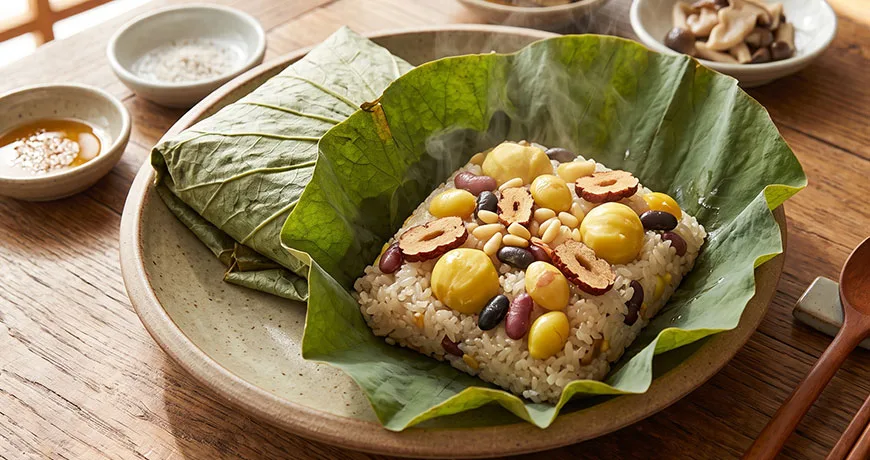
A healthy and aromatic Korean specialty dish where glutinous rice, beans, nuts, and dried fruits are wrapped inside a fresh lotus leaf and steamed to sticky, chewy perfection. The herbal, tea-like essence of the lotus leaf deeply infuses every grain of rice.
⏱️ Prep: 20 mins (plus soaking) | Cook: 45 mins | 🍳 Moderate | 🌿 Vegan | 🌾 High Fiber
Ingredients (2-3 servings)
- Main Ingredients: 2 cups glutinous rice (chapssal), 2–3 fresh lotus leaves, 4–5 peeled chestnuts, 3–4 dried jujubes (red dates), 6–8 ginkgo nuts, 1 tbsp pine nuts, 1/4 cup soaked beans (black beans or kidney beans)
- Liquid & Seasoning: 2 cups water (for initial rice cooking), 1/2 tsp salt, 1/2 tbsp sesame oil (optional)
Allergy Information
- Contains: Tree nuts (Chestnuts, Pine nuts), Soy (if using soybeans)
Equipment
- Rice Cooker, Steamer, Knife, Cutting Board, Frying Pan (for ginkgo nuts)
Cooking Instructions
- Soaking & Initial Cooking: Wash the glutinous rice and beans thoroughly, then soak in cold water for at least 2–3 hours. Drain and cook in a rice cooker with 1/2 tsp salt and slightly less water than usual to make a firm, slightly dry sticky rice (chalbap).
- Prepping Garnishes: Cut peeled chestnuts into bite-sized pieces. Deseed and slice or shape the jujubes. Lightly pan-roast the ginkgo nuts in a dry pan and peel off their inner papery skins.
- Wrapping in Lotus Leaves: Wash the lotus leaves cleanly and pat dry. Lay a leaf flat, place a portion of the partially cooked sticky rice in the center, and neatly arrange chestnuts, jujubes, ginkgo nuts, and pine nuts on top. Fold the edges of the lotus leaf inward tightly over the rice from all four sides to form a parcel.
- Steaming: Place the lotus leaf parcels into a pre-heated steamer. Steam over medium heat for 20 to 25 minutes, allowing the herbal leaf aroma to permeate the rice.
- Resting & Serving: Turn off the heat and let rest with the lid on for 5 to 10 minutes to finish steaming. Unfold the lotus leaf right before serving to enjoy the aromatic steam and rich flavors.
💡 Cooking & Pairing Tips
- Two-Stage Steaming for Maximum Aroma: Cooking the sticky rice slightly firm first before wrapping it in lotus leaves ensures that during the second steaming stage, the rice absorbs the lotus leaf’s fragrant oils and moisture without turning mushy.
- Convenient Freezer Meal: Fully steamed lotus leaf rice packets can be cooled down, wrapped tightly, and frozen. Simply re-steam or microwave directly from frozen for a freshly cooked taste anytime.
- Perfect Food & Beverage Pairing: Serves as a luxurious center for a temple-style or traditional Korean meal alongside grilled fish, seasoned wild mountain herbs (namul), and soybean paste soup (Doenjang-guk). Enjoy with a warm cup of lotus leaf tea or green tea.
Storage Instructions
- Store leftover wrapped lotus leaf rice in an airtight container in the refrigerator for up to 2 days, or freeze for up to 1 month. Reheat by steaming for 10–15 minutes or microwaving with a damp paper towel.
Nutrition Facts (Estimated)
- Total Content : Approx. 600g (2-3 servings total)
- Calories : 820 kcal total (approx. 137 kcal per 100g / 273 kcal per 1 serving)
– Sodium : 390mg (20%)
– Total Carbohydrate : 175g (54%)
– Sugar : 8g (8%)
– Total Fat : 6g (9%)
– Trans Fat : 0g – Saturated Fat : 1g (5%)
– Cholesterol : 0mg (0%)
– Protein : 18g (33%)
– Calcium : 70mg (7%)
Editor’s Review
1. A Subtle Green Fragrance and the Deep Resonance of Chewy Grains
The moment the warm, steaming lotus leaf unfurls, a subtle aroma steeped in notes of rich earth and lush greenery softly diffuses, captivating the senses in an instant. The glutinous rice grains—gently cradled within the leaf—absorb every drop of natural moisture and herbal essence, attaining a supple, silk-like chewiness. Crowned with sweet chestnuts, tender jujubes, buttery pine nuts, and slightly bitter ginkgo nuts, every single spoonful delivers an extraordinarily refined and sensual festival of flavor.
2. Aesthetics Forged by Two-Stage Steaming and Moisture Infusion
Yeonipbap stands as the epitome of Korean temple and restorative dining, uniting precise temperature control with moisture management that infuses water-soluble lotus essence deep into grain starches. Par-cooking the sticky rice until al dente before wrapping it tightly in lotus leaves for a second steam serves as the core technique—ensuring the grains retain elasticity without turning mushy. It is a flawless culinary balance where intrinsic grain nutrition meets the purifying essence of the leaf.
3. Serene Solace Encountered Within Nature’s Emerald Mantle
Emerging from the mud yet maintaining pristine purity, the lotus leaf tenderly folds around diverse harvests like a sacred cloth, holding the land’s innocence and ancient wisdom. Free from aggressive seasonings, this sticky rice honors the humble intrinsic flavors of each nut and seed, offering a tranquil, soothing peace to a soul exhausted by a noisy world. The simple act of unwrapping the green leaf becomes a gentle, purifying sanctuary—refreshing the spirit like a cool breeze sweeping through a bamboo grove.