
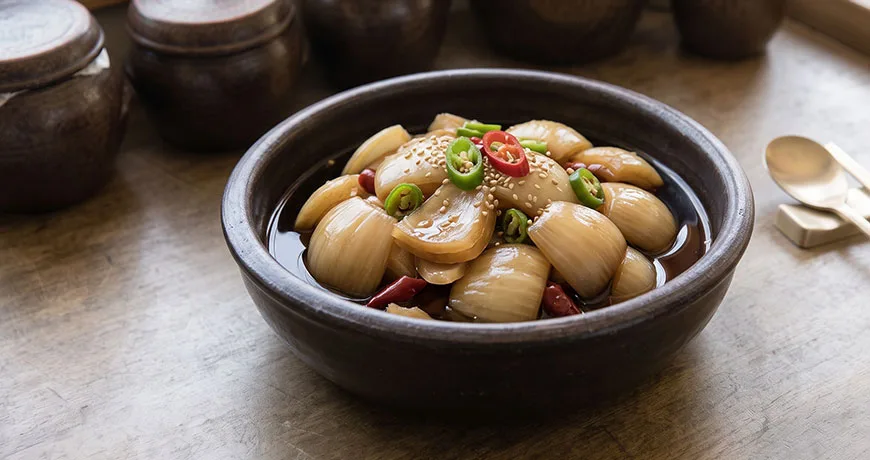
Yangpajangajji is a testament to the beauty of patience, where crisp, freshly harvested onions slowly embrace a carefully simmered, sweet and savory soy broth. The initially sharp and pungent bite of raw onion gracefully mellows over time, softened by the gentle acidity of vinegar and the deep warmth of brewed soy sauce. By pouring the broth while it is boiling hot—a technique of precise thermal infusion—the structural integrity of the onion is perfectly preserved, locking in a refreshing, musical crunch. It is an elegant, palate-cleansing companion that elevates rich, savory dishes, bringing a bright and sophisticated balance to the dining table across all seasons.
- ⏱️ Total: 3–5 Days | Prep: 20 Mins | Cook & Ferment: Slow-simmering and 3–5 Days Cold Aging
- 🍳 Difficulty: Low (Requires an understanding of flavor balance and the virtues of time)
- 🌶️ Profile: A lively, refreshing crunch yielding to a clear, elegant acidity and a gentle, natural sweetness
- 🍚 Focus: Slow-simmering Broth, Hot Infusion Technique, Time-honored Aging
- 🍶 Pairing: Charcoal-grilled beef ribs (Galbi), crispy savory pancakes (Jeon), and warm chicken noodle soup (Kalguksu)
Physicochemical & Sensory Matrix
- Baseline Salinity: 4.0% ~ 5.0% (A mild salinity that respects and preserves the vegetable’s natural juices)
- pH Equilibrium: 3.8 ~ 4.2 (A bright, refreshing acidic matrix formed by natural vinegar and onion sap)
- Textural Crunch Index: [■■■■□] (A vibrant, auditory crispness preserved through thermal shock)
- Umami Density: 7.5 / 10 (A deeply comforting base of brewed soy, subtly enhanced by kelp and shiitake)
- Shelf Stability: Peaks at 3 days; retains its graceful texture for 1–2 months refrigerated
- Aroma Profile: Gracefully Mellowed Onion Notes | Aromatic Brewed Soy | Clean Acetic Brightness
Ingredients (Yields 1 Medium Airtight Container)
- Primary Vegetable Matrix: 4 Firm, Fresh Onions, 1 Crisp Cucumber, 1 Red Chili, 2 Cheongyang Green Chilies
- Aromatic Broth Matrix: 1.5 Cups Brewed Soy Sauce, 1.5 Cups Purified Water, 1 Cup Unrefined Sugar, 1 Cup Naturally Fermented Vinegar (Apple or Brown Rice)
- Aromatic Catalyst: 1 Sheet Dried Kelp (10x10cm), 2 Dried Shiitake Mushrooms, 0.5 tsp Whole Black Peppercorns
Allergy Information
- Contains: Soy, Wheat (inherent in brewed soy sauce)
Equipment Stainless Steel Saucepan, Heat-resistant Glass Airtight Container, Strainer
Cooking Instructions
- Preparation of Vegetables: Peel the onions and cut them into bite-sized, elegant wedges, gently separating the natural layers. Slice the cucumber into thick, hearty rounds and the chilies diagonally. Arrange the vibrant vegetables beautifully in a heat-resistant glass container.
- Slow-simmering the Broth: In a saucepan, combine the water, soy sauce, sugar, kelp, shiitake mushrooms, and whole peppercorns. Bring to a gentle simmer over medium heat, allowing the deep, earthy flavors to emerge. Once the broth is fragrant, remove the kelp and turn off the heat.
- Preservation of Acidity: Immediately after turning off the heat, stir in the vinegar. Adding it at this exact moment prevents the volatile organic acids from evaporating, ensuring the broth retains a pristine, bright tang.
- Hot Infusion: Without hesitation, pour the boiling hot, fragrant broth over the prepared vegetables. This sudden embrace of heat gently sears the exterior of the onions, locking in their crisp vitality so they remain firm and fresh over time.
- Time-honored Aging: Allow the container to rest peacefully at room temperature until completely cool. Transfer to the refrigerator and age for 3 days. In the quiet chill, the broth and the natural juices of the vegetables exchange their essences, yielding a perfectly harmonious preserve.
💡 Professional Culinary Tips
- 1. Temperature Precision for Retaining Crispness: Pouring a near-boiling broth over raw vegetables is a delicate thermal technique, not merely a coating of flavor. This sudden heat causes the outer cell walls to contract slightly, effectively sealing the structural integrity of the onion. It ensures that rather than cooking and turning mushy, the onion retains an enduring, musical crunch.
- 2. Mellowing the Sharp Allium Notes: The raw, aggressive bite of fresh onion (allicin) gradually disperses during the cold aging process, tamed by the embrace of soy sauce and organic acids. Three days of patient waiting is the magic required to transform this pungent defense mechanism into a soft, elegant, and natural sweetness.
- 3. Balancing Acidity and Depth: Reserving the vinegar until the very end, off the heat, is a masterstroke in flavor preservation. It prevents the acetic acid from vaporizing, ensuring that the resulting acidity is not harsh or sharp, but rather a transparent, delicate brightness that elegantly lifts the entire flavor profile of the broth.
🍶 Gastronomic Pairing
- A Perfect Contrast of Temperature and Texture: Present this chilled preserve alongside deeply caramelized, charcoal-grilled beef ribs or a freshly pan-fried, crispy savory pancake. When the palate is enveloped by heavy, rich, and fatty flavors, a single piece of this cold, pickled onion delivers a burst of clear acidity and a resounding crunch, cleanly resetting the senses and beautifully preparing the diner for the next exquisite bite.
Nutrition Facts (Estimated)
Total Content : Approx. 30g (4-5 pieces with a little broth)
Calories : 15 kcal (Vegetable fiber and infused broth sugars)
– Sodium : 320mg (Mild, approachable salinity)
– Total Carbohydrate : 3.5g (Natural vegetable polysaccharides and sugar)
– Sugar : 2.5g
– Total Fat : 0.0g
– Saturated Fat : 0.0g
– Cholesterol : 0.0mg
– Protein : 0.4g
– Dietary Fiber : 0.6g
*Daily Values are based on a 2,000 calorie diet and standard Korean nutritional reference values.
**Nutritional values are calculated based on original ingredients; substitutions may alter specific macronutrients.
Origins and Food Culture of Pickled Onion (Yangpajangajji)
1. Late Joseon Open-Port Introductions and Integration into Jangajji Heritage
- The bulb onion (Allium cepa) was introduced to the Korean peninsula in the late 19th and early 20th centuries through international open ports, initially referred to as seoyang-pa (“Western scallion”) or simply yangpa. Peninsular cooks seamlessly absorbed this foreign bulb into their ancient tradition of Jangajji (vegetable preserves cured in soy sauce, bean paste, or chili paste), which had historically featured wild rocambole (dallae), garlic cloves, and scallions.
- Techniques recorded in classical Joseon compendiums such as the 1809 Gyuhap Chongseo and Siuijeonso—in which boiling-hot spiced soy sauce was cast over fresh radishes, cucumbers, and garlic—were naturally adapted to the newly cultivated onion crops in the mid-20th century, cementing Yangpajangajji as a cornerstone of modern domestic banchan.
2. The Culinary Science of Thermal Shock Brining and Pectin Preservation
- The hallmark craftsmanship of authentic Yangpajangajji lies in blending soy sauce, vinegar, sugar, and water in a golden ratio (traditionally 1:1:1:1 or 1:1:1:1.5) and pouring the infusion over raw onions while boiling hot.
- Pouring chilled brine draws water out too slowly via raw osmosis, resulting in tough, leathery outer skins and soft, soggy interiors. An instantaneous thermal shock above 90°C arrests cell-wall degradation enzymes before they can hydrolyze pectin bridges. The heat gently expands intercellular pores, allowing the savory, acidic brine to migrate inward while locking cellular water into a crisp, glassy matrix that retains its bite even after weeks of chilling.
3. The Sovereign Companion of Tabletop K-BBQ and Savory Jeon Culture
- Parallel to the nationwide boom of tabletop charcoal-grilled meats and pork belly (samgyeopsal) restaurants during the rapid industrialization of the 1980s, Yangpajangajji evolved from a rustic home side dish into an indispensable staple of commercial Korean barbecue culture.
- It performs a dual culinary role: cutting through the heavy animal fats of marbled beef and pork, and serving as a seasoned dipping condiment for oil-fried pancakes like pajeon and bindaetteok. Adapting an introduced agricultural crop through the ancestral science of fermented soy and vinegar pickling, Pickled Onion stands as a triumph of practical Korean food culture, marrying dynamic crunch with digestive harmony.
Subduing the Piercing Tears of Concentric White Scales with Boiling Soy-Vinegar Brine, Locking Cellular Turgor into a Shimmering Amber Snapshot: A Refined Portrait of Traditional Yangpajangajji
Yangpajangajji (Pickled Onions in Seasoned Soy Sauce) represents a swift, crystalline triumph of modern Korean table gastronomy. Prepared by cutting fresh, juicy onion bulbs into bite-sized wedges—frequently interlocked with piquant Cheongyang green chilies—and immediately dousing them with a boiling brine of brewed soy sauce, vinegar, sugar, and water, this quick-cured pickle captures an ingenious culinary pivot: the “hot-brine shock.” Bypassing the prolonged, meditative cellar aging of classic preserves, this sudden thermodynamic immersion thermally denatures the tears-inducing allium enzymes on contact, leaving the vegetable’s cellular turgor intact and sealing its brittle crunch inside an enduring amber glaze.
Lifting a translucent wedge of pickled onion with chopsticks reveals the fine veins of the fleshy scale leaves, tinted amber from the savory brine while holding their pristine, cool interior moisture. Approaching the nose, the deep, malty peptide aroma of brewed soy sauce is instantly pierced by the vibrant, volatile flight of acetic acid, underscored by the gentle, caramel-like sweetness of blanched onion rings. Clamping down between the teeth triggers an immediate, acoustic snap as the pressurized cell walls rupture, discharging trapped, icy juices across the tongue. The wild, tearful sting of raw allicin is gone; instead, the concentrated vegetal fructose of the onion unfolds alongside the sharp prick of vinegar and the rounded savor of soy. Stationed beside ribbons of sizzling pork belly, charcoal-marinated short ribs, or crisp seafood scallion pancakes (haemul pajeon), a single wedge of pickled onion slices through cloying grease with surgical clarity, cleansing the palate and restoring appetite for the next bite.
The cultural genius of Yangpajangajji lies in the intuitive adaptability of the Korean kitchen, which assimilated the Western onion (Allium cepa) introduced in the late 19th century directly into its ancient pickling canon. Shedding the heavy, salt-laden austerity of survival stores to embrace crisp, instant hydration, this humble bowl of pickled onions remains the most agile, indispensable guardian of the contemporary Korean barbecue table.
Editor’s Review
1. Concentric Scale Turgor Dynamics and High-Frequency Hydraulic Fracture
Yangpajangajji delivers a multi-dimensional mouthfeel rooted in the layered architecture of the allium bulb:
- Hydraulic Chamber Burst: The parenchyma cells within the fleshy scale leaves maintain high osmotic turgor pressure. Chewing fractures the cell walls abruptly rather than mashing them, producing an audible, crisp snap while releasing chilled, seasoned intracellular fluid into the oral cavity.
- Laminated Sheath Glide: The concentric, curved layers of the bulb slide against one another under dental pressure, providing dynamic mechanical resistance that prevents the pickle from feeling soggy or uniform.
2. Hot-Brine Thermal Shock: Alliinase Inactivation and PME Pectin Cross-Linking
The enduring snap and rounded sweetness of Yangpajangajji are dictated by precise thermal and enzymatic kinetics:
- Alliinase Inactivation: In raw onions, cellular damage releases the enzyme alliinase, which rapidly cleaves sulfoxide precursors into syn-propanethial-S-oxide (the lachrymatory factor) and harsh thiosulfinates. Pouring boiling brine (above 70°C) onto the cut vegetables immediately denatures alliinase, arresting sulfurous pungency while preserving natural sweetness.
- PME Activation and Calcium Pectate Stabilization: As the hot marinade cools through the 55–65°C range, it briefly activates pectin methylesterase (PME), which de-esterifies native cell-wall pectins. The liberated carboxyl groups chelate divalent metal cations (Ca2+, Mg2+) from the unrefined salt, forming an insoluble “egg-box” calcium pectate lattice that permanently protects structural crispness against softening.
- Osmotic Solute Diffusion: The steep osmotic gradient established by the soy-vinegar-sugar solution draws out excess water while infusing sodium, acetate, and free glutamates into the tissue, achieving harmonious sweet-sour-salty integration within 24 to 48 hours.
3. Lipid Emulsion Cleavage and Oral Deodorization
Yangpajangajji functions as an indispensable biological degreaser alongside pan-fried and grilled fare:
- Acidic Disruption of Hydrophobic Films: Saturated animal fats (pork lard, beef tallow) leave a hydrophobic lipid coating on the oral mucosa that desensitizes taste receptors. The low-pH acetic acid solution (pH 3.5–4.0) reduces interfacial tension and emulsifies this lipid film, swiftly flushing it from the palate.
- Synergistic Flavor Coupling: Trace organosulfur compounds in the onion combine with the free glutamates of the soy sauce to synergize with meat-derived inosine monophosphate (IMP), simultaneously mitigating heaviness and magnifying the inherent savory depth of grilled proteins.