
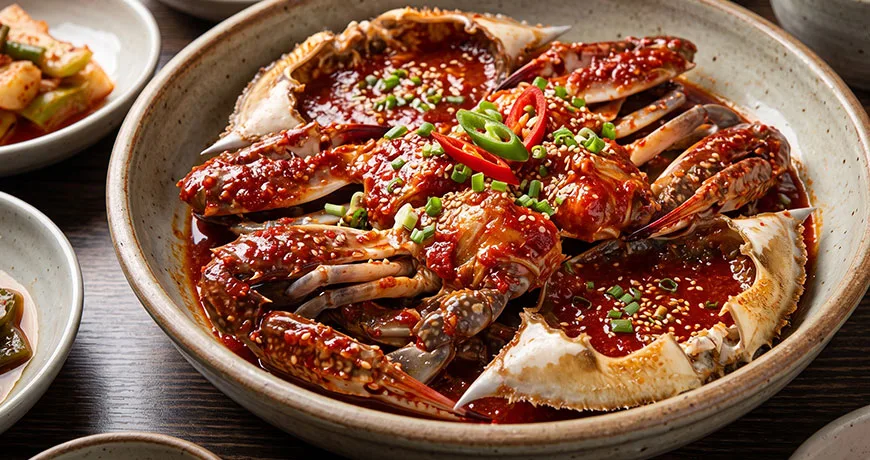
Yangnyeomgejang is a highly advanced, non-thermal seafood preparation that pairs the delicate, gel-like proteins of raw blue crab with a high-viscosity, intensely spicy Gochugaru paste. Because raw crabs are highly susceptible to rapid tissue degradation and melanosis (blackening) caused by autolytic enzymes, strict thermal control using sub-zero alcohol-brine baths is mandatory. By extracting surface moisture through a primary soy cure, the densely formulated, low-moisture spicy paste mechanically binds to the exposed crab meat. After 48 hours of cold aging, this engineered osmotic matrix transforms the crab into an explosive synergy of melt-in-your-mouth umami and fiery capsaicin.
- ⏱️ Total: 1–2 Days | Prep: 40 Mins (Ice-thawing and brine pretreatment) | Cook & Ferment: 24–48 Hours Cold Aging
- 🍳 Difficulty: Very High (Requires masterful control over crustacean enzymatic degradation, melanosis prevention, and paste rheology)
- 🌶️ Profile: A fierce, sweet-and-spicy initial strike yielding to the ice-cold, refreshing, gelatinous sweetness of raw crab meat
- 🍚 Focus: Enzyme-deactivating Pretreatment, Primary Soy Curing, High-viscosity Paste Binding
- 🍶 Pairing: Steaming hot white rice, toasted seaweed (Gim), a few drops of sesame oil, and clear clam soup
Physicochemical & Sensory Matrix
- Baseline Salinity: 3.5% ~ 4.5% (Lower salinity than soy-marinated crab, requiring rapid consumption)
- pH Equilibrium: 5.0 ~ 5.6 (Mildly acidic barrier formed by plum extract and garlic organic acids)
- Textural Crunch Index: [■■□□□] (Slippery, gel-like raw protein texture bursting from a rigid exoskeleton)
- Umami Density (T1R1/T1R3 Synergy): 9.0 / 10 (Synergy of naturally occurring crustacean glycine and brewed soy/anchovy amino acids)
- Shelf Stability: Must be consumed within 24–72 hours refrigerated (Absolutely unsuitable for long-term storage)
- Aroma Profile: Fiery Capsaicin & Allicin Punch | Fresh Marine Iodine | Subtle Fruity Fermentation (Plum)
Ingredients (Yields 1 Medium Airtight Container)
- Primary Crustacean Matrix: 1kg Blast-frozen Raw Blue Crabs (Male crabs preferred). Must be frozen at -20°C on the boat to ensure parasite destruction.
- Sanitation & Enzyme Control Wash: 1L Ice Water, 2 tbsp Coarse Sea Salt, 0.5 Cup Soju (or clear rice wine)
- Primary Curing Matrix: 3 tbsp Naturally Brewed Soy Sauce
- High-Viscosity Paste Matrix: 0.5 Cup Fine Red Chili Flakes (Gochugaru), 0.5 Cup Coarse Red Chili Flakes, 3 tbsp Anchovy Extract, 2 tbsp Brewed Soy Sauce, 3 tbsp Plum Extract (Maesil-cheong), 4 tbsp Rice Syrup (Jocheong)
- Aromatic Catalyst: 3 tbsp Minced Garlic, 1 tsp Minced Ginger, 3 Cheongyang Green Chilies (Minced), 1 Scallion (White part, Minced), 2 tbsp Toasted Sesame Seeds
Allergy Information
- Contains: Crustacean (Crab), Soy, Wheat (inherent in soy sauce), Fish (Anchovy extract)
Equipment Kitchen Shears, Stainless Steel Bowls, Ice, Sanitary Gloves, Large Airtight Container
Cooking Instructions
- Blast Freezing & Thaw Control: Thawing raw crabs at room temperature triggers autolytic enzymes that instantly dissolve the meat. You must thaw them rapidly in ice water (near 0°C) for under 30 minutes, scrubbing the shells clean with a brush.
- Preprocessing & Enzyme Deactivation: Remove the top carapace (shell), gills, sandbags, and mouthparts with shears. Trim the sharp tips of the legs. Cut the cleaned crab body into halves or quarters. Submerge the pieces in the prepared “Sanitation Wash” (ice water, salt, soju) for 5 minutes to neutralize fishy odors and thermally shock the exposed proteins.
- Primary Soy Curing: Drain the crabs from the ice bath and aggressively shake off all moisture. In a bowl, toss the crab pieces with 3 tbsp of soy sauce and let rest for 10 minutes. Osmosis will draw out excess free water from the exposed meat. Discard this accumulated soy-water mixture completely.
- Viscous Paste Binding: In a separate bowl, vigorously mix the chili flakes, anchovy extract, soy sauce, plum extract, rice syrup, minced garlic/ginger, chilies, and scallions to form a stiff, thick mud-like paste with zero added water. Add the cured, drained crab pieces to the paste and toss forcefully to coat every crevice.
- Cold Aging: Pack the seasoned crab tightly into an airtight container, leaving no air gaps, and sprinkle with sesame seeds. Press a sheet of plastic wrap directly onto the surface to block oxygen. Age in the refrigerator at 0–4°C for 24 to 48 hours. The dry chili flakes will absorb any remaining moisture, driving capsaicin deep into the flesh.
💡 Professional Culinary Tips
- 1. Melanosis & Autolytic Enzyme Control: Blue crabs have a very short rigor mortis phase and are highly susceptible to melanosis (blackening) caused by polyphenol oxidase (PPO). Furthermore, autolytic proteases will rapidly turn the flesh to mush if exposed to ambient heat. Utilizing blast-frozen crabs and executing the entire thawing and cleaning process in 0–4°C ice water is an absolute mandate to halt enzymatic activation, preserving the pristine, translucent, gel-like structure of the meat.
- 2. Primary Soy Curing for Aw Reduction: Briefly tossing the cleaned, raw crab pieces in a small amount of soy sauce before introducing the main paste is the critical technique in Yangnyeomgejang. This osmotic curing draws out the surface free water from the exposed meat. By discarding this extracted water, you drastically lower the water activity (Aw) at the flesh boundary. This prevents the spicy paste from diluting into a watery mess and sliding off the crab.
- 3. Rheological Binding of the Paste Matrix: The spicy paste must be meticulously engineered with extreme viscosity and minimal free moisture. By utilizing the sticky rheology of rice syrup and the intense water-absorbing properties of dry chili flakes, the resulting thick “mud” mechanically adheres to the dehydrated surface of the crab meat. This dense coating seals out oxygen to prevent spoilage and uses osmotic pressure to drive capsaicin and amino acids deep into the muscle fibers.
🍶 Gastronomic Pairing
- Extreme Carbohydrate Envelopment: Squeeze the shell with a gloved hand to extrude the ice-cold, fiery, gelatinous crab meat directly onto a bowl of steaming hot white rice. The violent temperature contrast between the icy marine protein and the hot, steaming starch forcefully awakens the palate. Wrapping a spoonful of this mixture in toasted seaweed with a drop of sesame oil mitigates the spicy fatigue while exponentially amplifying the umami payload.
Nutrition Facts (Estimated)
Total Content : Approx. 150g (1 crab portion including paste)
Calories : 185 kcal (High-protein marine matrix and paste sugars)
– Sodium : 820mg (Salinity from anchovy extract and primary soy cure)
– Total Carbohydrate : 16.5g (Polysaccharides and reducing sugars from rice syrup and plum extract)
– Sugar : 8.2g
– Total Fat : 2.0g (Crustacean lipids and unsaturated sesame oil fats)
– Saturated Fat : 0.4g
– Cholesterol : 85mg (Natural crustacean sterols)
– Protein : 24.5g (Ultra-dense crustacean muscle proteins)
– Dietary Fiber : 3.2g (Derived from chili flakes and garlic)
*Daily Values are based on a 2,000 calorie diet and standard Korean nutritional reference values.
**Nutritional values are calculated based on original ingredients; substitutions may alter specific macronutrients.
Origins and Food Culture of Spicy Marinated Crab (Yangnyeomgejang)
1. Classical Joseon Precedents: From Traditional Haejang to 20th-Century Gemuchim
- Historical preservation of crabs across the Korean peninsula dates back centuries, documented under titles like Haejang (蟹醬, soy-marinated crab) and Haehye (蟹醯, fermented crab pickle) in classical agricultural manuals including the 18th-century Jeungbo Sallim Gyeongje and Lady Yi’s 1809 Gyuhap Chongseo. Traditional households historically relied on deep salinity, rice wine, and long-term earthen jar curing.
- Modern Yangnyeomgejang evolved rapidly in the mid-20th century as commercial red pepper powder and grain syrups became widely available. Coastal households across Jeolla and Chungcheong provinces began tossing freshly caught autumn crabs in bold, fresh seasoning pastes similar to seasonal vegetable salads (geotjeori). This marked a transition from months-long preservation toward an immediate celebration of raw seafood freshness and punchy contemporary flavors.
2. The Food Chemistry of Flash Dressing and Blast-Freezing Enzyme Control
- The technical pinnacle of Yangnyeomgejang rests upon managing internal moisture loss and suppressing enzyme degradation.
- Tossing live, freshly butchered crabs directly into wet seasoning causes immediate osmotic water purge, leaving watery sauce and hollow shells. Modern practitioners resolve this through maritime blast-freezing (-30°C or below), which arrests enzymatic self-digestion. When dressed while partially frozen in a thick, sticky syrup-based marinade, the crab meat retains internal turgor pressure; as it slowly thaws, the exterior seasonings adhere tightly to the shell fractures, preventing moisture escape and creating a cohesive, velvety glaze.
3. The Sovereign Complement of Korean BBQ Culture and Universal Appeal
- During the rapid expansion of Korean charcoal-grilled rib (galbi) restaurants throughout the 1970s and 1980s, Yangnyeomgejang was embraced nationwide as the ultimate premium complimentary side dish (mitbanchan), celebrated for its ability to cut through rich, marbled animal fats.
- Accessible, vibrantly colored, and immediate in its sweet-spicy satisfaction, it captured the affection of diners who found the complex barnyard nuances of aged soy sauce crab challenging. Merging raw marine sweetness with fiery Korean seasoning arts, Spicy Marinated Crab remains an immortal cultural monument to peninsular coastal vibrancy, culinary speed, and bold gastronomic harmony.
Clothed in a fiery crimson armor of sun-dried chili and pungent aromatics, Yangnyeomgejang delivers a startling, mesmerizing clash between razor-sharp spice and the chillingly sweet, translucent flesh of raw blue crab.
Yangnyeomgejang is crafted by quartering fresh, live blue crabs and instantly tossing them in a thick, vibrant red paste composed of sun-dried chili flakes, minced garlic, ginger, grain syrup, fish sauce, and a finishing thread of toasted sesame oil, serving them either immediately or after a brief, 24-hour refrigeration. While its counterpart, ganjanggejang, relies on patient, measured soy-brine aging, Yangnyeomgejang is an exercise in speed, intuition, and high-impact sensory collision. The bright red seasoning clings tenaciously to the soft, gel-like protein of the raw crab, creating a striking visual contrast that explodes across the palate from the very first bite.
Pressing a crimson-coated crab segment between the fingers forces the velvety, translucent meat out of its shell, flooding the mouth with a wave of clean, chilled oceanic sweetness. The sharp, stinging heat of chili and the pungent warmth of raw alliums strike first, instantly followed by the melt-in-the-mouth richness of the raw crab protein, which cushions the spice in a smooth, luxurious embrace. Scraping the remaining tomalley and roe from the empty crab shell, tossing it with a spoonful of warm rice and a drop of sesame oil, delivers an unadulterated, deeply primal finale unique to the Korean table.
The true identity of Yangnyeomgejang lies in a bold culinary confidence—subduing the raw marine aromas of fresh crustacean through an aggressive wall of spice and aromatics. Harnessing the uncompromised freshness of live catch and transforming it into an explosive flavor experience, this fiery dish stands as a bold testament to the vibrant dynamism of the Korean hearth.
Editor’s Review
1. Raw Protein Melting Dynamics and Adhesive Glaze Adhesion
The texture of Yangnyeomgejang bypasses cooked firmness entirely, relying instead on the delicate, velvety breakdown of unheated crustacean muscle. Free from thermal coagulation, the crab meat melts smoothly across the tongue, while the high-viscosity chili and sugar glaze coats the soft flesh uniformly, ensuring that spice and protein arrive on the palate as a single unified sensation.
2. Allium-Mediated Amine Neutralization and Capsaicin Lipid Buffering
Managing raw crab requires an effective defense against volatile amine odors (trimethylamine). The abundant allicin from fresh garlic and gingerols from crushed ginger bind swiftly to these volatile compounds, neutralizing fishy notes. Simultaneously, the unctuous lipids of the finishing sesame oil encapsulate the lipophilic capsaicin molecules, transforming a sharp, needle-like burn into a rounded, enveloping warmth.
3. Short-Contact Kinetics and Freshness Preservation
Diverging from long-term fermented preserves, Yangnyeomgejang utilizes a brief, carefully controlled contact window. By limiting the curing period to under 24 hours, the recipe avoids over-proteolysis—which would otherwise liquefy the delicate flesh into mush—successfully locking in the clean, natural sweetness of the raw catch while distributing deep seasoning flavors instantly.