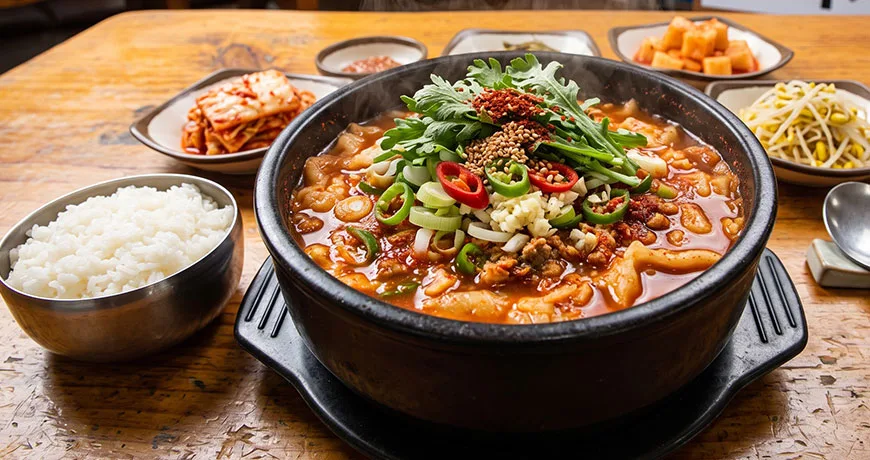
Ttugeoritang is the ultimate high-density biochemical matrix originating from the Gangwon-do region, utilizing the floating goby (Ttugeori), a small benthic fish traversing brackish and freshwaters. The core engineering of this stew requires boiling the fish until its micro-skeletal structure and collagen thermodynamically collapse, followed by a total physical maceration (grinding). This transforms the entire broth into a dense colloidal suspension packed with animal protein and highly bioavailable calcium. Because of the fish’s brackish habitat, complex earthy off-notes (geosmin) are aggressively neutralized through chemical masking, employing fermented peptides from traditional Doenjang and the heavy starch of Gochujang. Wheat flour (or Sujebi dough) and beaten eggs are introduced into the boiling solvent, triggering amylopectin gelatinization and protein coagulation. This crucial step exponentially increases the rheological viscosity, creating a dense three-dimensional network that keeps the heavy, ground fish particles perfectly suspended in the broth rather than sinking to the bottom. Crowned with volatile terpenes from Asian chives (Buchu) and the tingly punch of Sancho powder, it is a ferociously hearty, wild restorative stew.
- ⏱️ Total: 1 hr 10 mins | Prep: 20 mins (Salt-rubbing mucin purge) | Cook: 50 mins
- 🍳 Difficulty: High (Requires physical maceration of micro-skeletal structure and strict geosmin masking)
- 🌶️ Profile: Deeply Earthy, Thick, Savory, and Tingly (Sancho)
- 🍚 Focus: Micro-Skeletal Hydrolysis, Colloidal Suspension, & Geosmin Masking
- 🍶 Pairing: Ice-cold Somaek (Soju + Beer) engineered with a highly carbonated light lager like Terra
Ingredients (3–4 servings)
- Micro-Skeletal & Protein Matrix: 500g Fresh Floating Goby (Ttugeori – vigorously rubbed with coarse salt to osmotically purge the exterior mucin, then thoroughly rinsed)
- Suspension Stabilizer: 2 tbsp Wheat Flour (or a handful of Sujebi dough), 1 Egg (lightly beaten)
- Geosmin-Masking Solvent: 1.5L Rice Water or Anchovy Broth
- Peptide & Capsaicin Binder: 2 tbsp Gochujang, 2 tbsp Traditional Doenjang, 2 tbsp Gochugaru (Chili Flakes), 2.5 tbsp minced garlic, 1 tsp minced ginger
- Aromatic & Terpene Catalyst: 1 large handful Asian Chives (Buchu – cut to 4cm), 10 Perilla leaves, 1 stalk Green Onion, 2 Cheongyang green chilies, 1 tsp Sancho powder
Allergy Information Contains: Fish (Floating Goby), Soy, Wheat (from Gochujang, Doenjang, Flour), Egg
Equipment High Thermal Mass Cast Iron Pot or Earthenware, Blender or Fine Sieve, Whisk, Coarse Salt
Cooking Instructions
- Osmotic Mucin Purging: Coat the fresh gobies in coarse salt and vigorously rub them. The osmotic pressure forcefully extracts the slimy surface mucin—a primary carrier of earthy geosmin. Rinse meticulously under cold water.
- Initial Thermal Hydrolysis: Place the cleaned fish in a pot with just enough water to cover them. Boil over high heat for 20 minutes. This thermodynamic energy melts the collagen binding the micro-skeletal structure, rendering the bones and flesh utterly soft.
- Physical Maceration: Transfer the boiled fish and its liquid into a blender and pulse until roughly macerated (alternatively, press through a fine sieve to remove larger spine fragments). This paste forms the hyper-dense protein core of the stew.
- Colloidal Suspension Construction: In a wide pot, combine the macerated fish paste with the rice water. Dissolve the Gochujang, Doenjang, chili flakes, garlic, and ginger. Once it hits a violent boil, gradually whisk in the wheat flour (or add Sujebi dough). As the amylopectin undergoes gelatinization, the broth rapidly thickens into a viscous suspension, permanently trapping the ground fish particles so they do not phase-separate.
- Egg Coagulation & Terpene Finish: Drizzle the beaten egg in a circular motion to form delicate, coagulated protein ribbons. Turn off the heat and instantly heap the Buchu, perilla leaves, green onions, chilies, and a final critical dusting of 1 tsp Sancho powder to chemically override any residual freshwater scent.
💡 Professional Culinary Tips
- Nutrition of Micro-Skeletal Hydrolysis: Dishes that macerate whole small fish are biochemically the ultimate natural calcium supplements. The prolonged thermal degradation softens the micro-bones to a state where, upon hitting human stomach acid, they rapidly ionize, maximizing biological absorption.
- Preventing Phase Separation via Starch & Egg: Heavy, ground fish particles naturally want to sink, separating from the water. Introducing wheat starch and coagulated egg proteins creates a highly viscous, three-dimensional physical network within the broth. This engineering stabilizes the colloidal suspension, ensuring every spoonful has a uniform, creamy density.
- Olfactory Collision of Sanshool and Geosmin: The dense, muddy geosmin aroma of brackish fish cannot be boiled away. It must be chemically outcompeted. Delivering a strike of hydroxy-alpha-sanshool (from Sancho powder) at the very end directly stimulates the TRPA1 receptors in the nasal cavity, brilliantly masking the earthy notes and resetting the olfactory palate.
🍶 Gastronomic Pairing
- Biochemical Palate Cleansing: When the gritty texture of micro-bones, the thick Doenjang/Gochujang colloid, and the intense tingle of Sancho entirely coat your oral mucosa, pair this untamed stew with a highly engineered, ice-cold Somaek (Soju and Beer bomb). Using an aggressively carbonated lager like Terra ensures that the sharp, violent effervescence and refined ethanol dynamically shear away the sticky, heavy suspension from your tongue, providing a brilliant fluid-dynamic contrast to the rustic matrix.
Nutrition Facts (Estimated)
Total Content : Approx. 650g (1 serving)
Calories : 370 kcal (Excluding rice)
– Sodium : 1,480mg (Elevated due to massive Doenjang/Gochujang masking requirements)
– Total Carbohydrate : 32.0g (Starch from flour, rice water, and Gochujang)
– Sugar : 4.5g
– Total Fat : 8.0g (Egg lipids and natural fish fats)
– Saturated Fat : 2.0g
– Cholesterol : 110.0mg (Derived from whole fish and egg yolk)
– Protein : 36.0g (High-density whole fish protein and organic calcium complex)
– Dietary Fiber : 6.0g
*Daily Values are based on a 2,000 calorie diet and standard Korean nutritional reference values.
**Nutritional values are calculated based on original ingredients; substitutions may alter specific macronutrients.
Origins and Food Culture of Spicy Floating Goby Stew (Ttugeoritang)
1. The Pristine Waters of Yangyang’s Namdaecheon and the Folklore of “Kkukjeogu”
- Originating in the pristine gravel riverbeds of the Yeongdong region in Gangwon-do—most famously along the Namdaecheon River in Yangyang and the Yeongokcheon River in Gangneung—where clean mountain waters meet the East Sea, creating an ideal habitat for native benthic freshwater gobies.
- Known scientifically as Gymnogobius urotaenia, the fish earned its colloquial title from a celebrated Joseon-era legend: when noted scholar Song Si-yeol (or a visiting provincial governor) stopped at a riverside tavern and praised the deeply restorative soup, he asked for the name of the fish. The tavern keeper replied that it was a fish found “kkuk bakyeo inneun gogi” (tucked tightly inside the gravel crevices), giving rise to the formal Korean name Kkukjeogu, while local residents historically preserved their indigenous dialect name: Ttugeori.
2. The Culinary Science of Whole-Fish Sieving and Fermented “Makjang”
- Because small stream gobies possess spiny dorsal fins and firm bones, authentic kitchens avoid boiling them whole directly into a stew; instead, they execute an arduous two-stage preparation: simmering the whole fish until tender, then meticulously mashing the catch through a fine woven sieve (eremi) to isolate smooth flesh, collagen, and dissolved marrow while discarding coarse vertebral husks.
- Unlike western peninsular soups that rely on conventional red pepper paste, authentic Ttugeoritang utilizes Gangwon-do’s native Makjang—a quick-fermented paste made of crushed soybean bricks and steamed barley—which provides a deep, slightly sweet umami that completely neutralizes freshwater gaminess. Combining this with potato starch and hand-torn dough flakes thickens the broth into an unctuous, starchy stew reminiscent of artisanal porridge.
3. The Yeongdong Counterpart to Southern Chueotang and River Foraging (Cheonlyeop) Heritage
- Just as the southern provinces take pride in pureed mudfish soup (Namdo Chueotang) and the inland valleys honor freshwater fish noodle stew (Eotang-guksu), the Yeongdong coastline of Gangwon-do has long revered Ttugeoritang as its quintessential native restorative bowl.
- Deeply tied to the community tradition of Cheonlyeop (river foraging), where village youths gathered with hand-nets (jokdae) along rocky shallows to catch gobies and boil them over riverside wood fires, Ttugeoritang remains an immortal culinary monument to Gangwon-do’s pristine aquatic ecology, rural resilience, and heartfelt slow-food comfort.
The Whole-Body Mineral Extraction of Clear-Rapid Floating Gobies, the Earthy Resonance of Aged Gangwon Makjang, and the Restorative Solace of Mountain Potatoes: A Refined Portrait of Ttugeoritang
Ttugeoritang (Spicy Floating Goby Stew) stands as the rustic, biologically pure, and profoundly comforting summit of Korea’s Yeongdong freshwater (tangban) gastronomy. Centered upon the floating goby (Gymnogobius urotaenia or Kkukjeogu, regionally celebrated as Ttugeori)—a small freshwater gobiid that thrives exclusively within the gravel shoals and pristine first-grade currents of the Namdaecheon River in Yangyang, where snowmelt from Mount Seorak flows into the East Sea—the live catches are thoroughly purged in clear water. Bypassing any gutting or deboning, the tiny fish are either stewed whole or simmered until tender and pulverized through a fine metal sieve, yielding a rich, calcium-dense whole-fish suspension. Anchored upon a bedrock of thickly sliced indigenous Gangwon potatoes that provide a soothing starch foundation, the broth is dissolved with an assertive paste of aged rustic soybean mash (makjang), traditional fermented paste (doenjang), sun-dried red chili flakes, crushed garlic, and ginger. Brought to a rolling boil and layered with paper-thin hand-pulled wheat dough flakes (sujebi), mounds of fresh garlic chives (buchu), scallions, and wild enoki mushrooms, this dish occupies a distinctive culinary space apart from the heavy silt of southern loach stews (chueotang). It captures the pristine, mud-free sweetness of rapid-dwelling river gobies within the deep, microbial savor of regional fermented grain pastes, achieving absolute thermodynamic harmony between mountain hearth comfort and riverine vigor.
Confronting the bubbling earthenware cauldron (ttukbaegi) as deep amber froth crests across its surface releases an immediate, deeply soothing olfactory charge: the earthy, nutty perfume of long-aged fermented makjang mingles seamlessly with the clean, savory aroma of poached freshwater gobies, brightened by the crisp, sulfurous freshness of tender garlic chives and wild alliums. Taking the first sip delivers a restorative revelation across the oral mucosa: the dense broth, enriched with whole-skeleton bone marrow, leached calcium, and suspended micro-particles of sweet fish meat, coats oral membranes like warm velvet. Gliding effortlessly down the esophagus, it dispels internal chills and infuses an exhausted digestive tract with deep, enduring warmth. The hand-torn sujebi dough flakes supply an unctuous, viscoelastic chew (jjolgit) that drinks in the savory paste broth, while the tender potatoes yield with a soft, floury chew that releases sweet plant starches. Concurrently, the flash-wilted garlic chives introduce a brisk, auditory snap that cleanly balances the broth’s density. Steeping a bowl of warm white rice into the bubbling stock and crowning each spoonful with crisp Gangwon radish kimchi transforms the meal into an unforgettable ritual of metabolic rejuvenation, rustic solace, and profound gastronomic catharsis.
The enduring majesty of Ttugeoritang lies in its historical and ecological lineage—rooted in the estuarine life of Yangyang’s Namdaecheon basin, where coastal villagers relied on seasonal river runs to fortify bodily vitality. Local folklore recalls that during the early Joseon Dynasty, scholar-official Jeong Cheol tasted these delicate fish and marveled at their lip-clinging richness, asking their name; when told they were simply “fish that hide under the bottom stones (jeogu, 底狗),” the phonetic name Kkukjeogu was born. Consuming the entire anatomical matrix of the fish without a single trace of waste, a steaming pot of floating goby stew remains an irreplaceable monument of zero-waste riverine stewardship, maternal generosity, and brilliant Korean regional craftsmanship.
Editor’s Review
1. A Dynamic Harmony of Silken Whole-Goby Micro-Suspension, Fluffy Potato Give, Viscoelastic Sujebi Elasticity, and Crisp Chive Snap
The structural architecture inside the vessel delivers an extraordinary, four-tiered choreography between pulverized whole-fish muscle and bone particles, hydrated tuber starches, a cohesive wheat gluten matrix, and crisp vegetable cell walls. Because the whole goby is simmered and strained through a fine mesh, its micro-particulate muscle fibers and melted connective tissues form an unctuous, silky suspension in the liquid phase that coats oral membranes with zero chalkiness. Anchoring this fluid texture, the braised potatoes collapse into soft, pillowy cushions that flood the mouth with sweet starch hydration, while the thin sheets of hand-pulled sujebi supply an elastic, toothsome bounce. The brief blanching of raw garlic chives preserves their cellular turgor, imparting a crisp, audible snap that provides structural friction, ensuring an impeccably balanced, non-fatiguing mouthfeel from the first steaming sip to the last.
2. Whole-Carcass Demineralization and Type I Collagen Gelatinization, Makjang Melanoidin Adsorption, IMP-Glutamate Nucleotide Synergy, and Allyl Sulfide Volatile Masking
Ttugeoritang represents an exacting study in small-teleost whole-body biochemistry, fermented colloid thermodynamics, and flavor volatile extraction. Simmering the entire goby—including cranial cartilage, vertebral column, viscera, and dermal layers—liberates insoluble Type I collagen, which undergoes irreversible thermal denaturation between 85°C and 95°C into soluble gelatin polypeptides, elevating the broth’s dynamic viscosity and creating a lip-clinging mouthfeel. Concurrently, the skeletal matrix undergoes hydrothermal demineralization, releasing bioavailable calcium, phosphate, and magnesium ions directly into the stock. The regional makjang (a rapid-fermented paste crafted with roasted barley or corn and aged soybeans) provides abundant high-molecular-weight melanoidin polymers and colloidal soy peptides that chemically and physically adsorb trace volatile basic nitrogen compounds (TMA) and lipid oxidation products. Broth savor is driven by a powerful biochemical synergy: muscle-derived 5′-inosine monophosphate (5′-IMP) from the gobies converges with the abundant free glutamic acid (Glutamate) leached from the aged fermented paste, triggering an exponential synergy across human oral T1R1/T1R3 umami heterodimers. Furthermore, organosulfur volatiles (allyl sulfides) from garlic chives and scallions, paired with fresh gingerols, chemically bind residual riverine off-odors, creating an immaculate, restorative flavor architecture.
3. The Yangyang Namdaecheon Terroir and the Sovereign Summit of Gangwon Fermented Broth Gastronomy
Harnessing the pristine ecological purity of gravel-bed mountain torrents meeting the sea, Ttugeoritang represents the undisputed high-water mark of Gangwon-do’s Yeongdong culinary culture. By synthesizing whole freshwater fish with the ancient microbial alchemy of local barley-fermented soybean paste and starchy mountain potatoes, this iconic creation illustrates how geographical isolation fostered profound culinary ingenuity. Standing as an enduring sanctuary of environmental authenticity, ancestral sustenance, and brilliant Korean culinary artistry, Ttugeoritang remains one of the most distinctive masterpieces in the Korean tangban canon.