
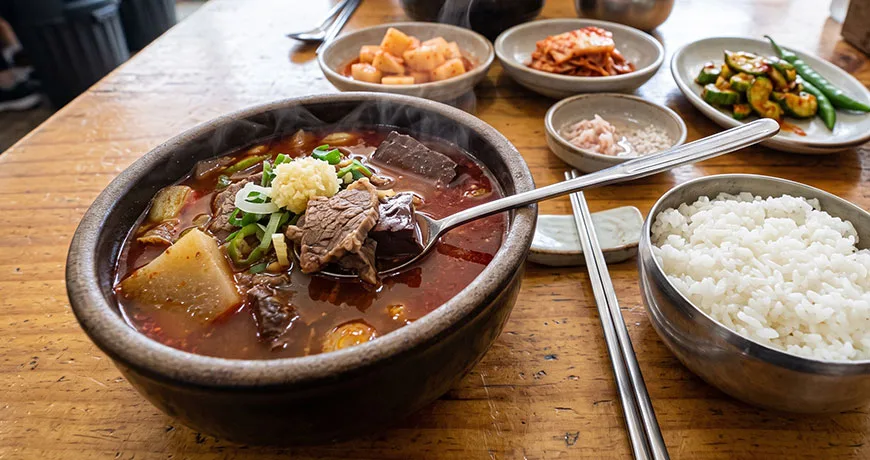
Ttarogukbap is a texture-preserving culinary construct engineered around the concept of “physical isolation.” By serving the starch matrix (rice) and the highly kinetic colloidal solvent (hot soup) in separate vessels—hence the name Ttaro (separate)—it prevents the premature over-gelatinization of the amylopectin. This strict rheological control ensures the rice maintains its structural integrity and chewiness, while the broth remains perfectly fluid and unclogged by dissolved starches. The broth itself is a heavy micro-emulsion formed by subjecting beef bones to extreme thermal hydrolysis for over 12 hours, extracting marrow lipids and gelatin. When this milky colloidal base is combined with a hypertonic red chili paste, thinly sliced beef proteins, and a massive volume of leeks and radishes (the solid Geonji), the plant fibers structurally collapse under the heat, releasing natural reducing sugars that biochemically balance the intense, spicy animal fat.
⏱️ Total: 12 hrs 30 mins (includes bone broth extraction) | Prep: 20 mins | Cook: 12+ hrs | 🍳 Difficulty: High (Requires prolonged thermal hydrolysis and starch isolation) | 🌶️ Profile: Fiery, Deeply Savory, and Richly Textured | 🍚 Focus: Physical Starch Isolation, Thermal Hydrolysis, & Aqueous Sugar Extraction
Ingredients (2–3 servings)
- Colloidal Umami Solvent: 1kg Beef Bones (soaked to osmotically remove blood), 3L water (boiled violently for 12+ hours and reduced to 1.5L of milky emulsion)
- Protein Matrix: 300g Beef Brisket or Shank (boiled in the broth to thermo-coagulate, then sliced thinly)
- Fiber & Aromatic Matrix (Geonji): 3 large stalks Asian leeks/green onions (cut into long strips), 1/3 Radish (cut into squares)
- Hypertonic Spice Emulsion: 3 tbsp Gochugaru (chili flakes), 2 tbsp soup soy sauce, 2 tbsp minced garlic, 1 tbsp sesame oil or chili oil, a pinch of black pepper
- Isolated Starch Matrix: 2 bowls of warm, cooked white rice (served in completely separate bowls)
Allergy Information Contains: Beef, Soy, Wheat (from soy sauce)
Equipment High Thermal Mass Large Stockpot, Ttukbaegi (Korean earthenware pots), Skimmer, Knife, Cutting Board
Cooking Instructions
- Prolonged Thermal Hydrolysis: Place the cleaned beef bones in a large stockpot with water. Bring to a rolling boil, then reduce to medium-low and boil continuously for at least 12 hours. This immense kinetic energy hydrolyzes the collagen and forces the bone marrow lipids to physically emulsify with the water, creating a milky, heavy colloidal suspension.
- Protein Coagulation & Cleavage: During the boiling process, drop the block of beef brisket into the broth for 1 to 2 hours until tender. Remove, allow it to cool, and slice it extremely thinly against the muscle grain (mechanical cleavage) to negate any tough chewing resistance.
- Aromatic Emulsification: In a Ttukbaegi, lightly sauté the sliced radish, chili flakes, minced garlic, soy sauce, and oil. This thermodynamic blooming extracts the fat-soluble capsaicin and aromatic compounds. Pour the rich bone emulsion over the spices.
- Aqueous Sugar Extraction: As the broth boils, plunge the massive volume of cut leeks into the soup. The kinetic heat breaks down the tough pectin and cellulose in the leeks, vaporizing the harsh sulfur compounds while extracting their stored fructose into the broth. This adds a profound, natural sweetness that balances the heat.
- Physical Isolation Plating: Add the thinly sliced beef to the boiling Ttukbaegi and serve immediately. Do not put the rice into the soup. The warm white rice must be served in a separate, isolated vessel, empowering the diner to completely control the rate of starch hydration.
💡 Professional Culinary Tips
- The Rheology of Physical Isolation: If rice is submerged in a boiling broth before serving (as in standard Gukbap), the amylopectin on the surface of the grains absorbs kinetic moisture past its breaking point. This is called over-gelatinization. The grains rupture, releasing starch into the solvent, which spikes the viscosity and turns a sharp, fiery broth into a cloudy, muddy paste. Keeping them “Ttaro” (separate) is a scientific method to preserve the precise fluid dynamics of the soup and the elastic bite of the rice.
- Thermodynamics of 12-Hour Bone Boiling: A quick boil only extracts water-soluble amino acids. Subjecting beef bones to a 12-hour thermal onslaught is required to melt the deeply embedded marrow fats and mineral calcium. The dissolved gelatin acts as a chemical stabilizer, permanently locking the oil and water molecules together into a heavy emulsion that gives this dish its iconic, lip-smacking “body.”
- Pectin Collapse in Leeks: Ttarogukbap features an unusually high ratio of solid ingredients (Geonji), primarily leeks. When leeks are boiled extensively, their structural pectin collapses entirely. They transform from a rigid, pungent fiber into a soft, sweet mass, naturally neutralizing the aggressive capsaicin of the chili flakes without requiring any artificial refined sugars.
Nutrition Facts (Estimated)
Total Content : Approx. 700g (1 serving, including rice)
Calories : 620 kcal
– Sodium : 1,100mg
– Total Carbohydrate : 78.0g
– Sugar : 6.0g
– Total Fat : 20.0g (Rich in bone marrow lipids)
– Saturated Fat : 8.0g
– Cholesterol : 85.0mg
– Protein : 32.0g
– Dietary Fiber : 5.0g
*Daily Values are based on a 2,000 calorie diet and standard Korean nutritional reference values.
**Nutritional values are calculated based on original ingredients; substitutions may alter specific macronutrients.
Origins and Food Culture of Rice and Soup (Ttarogukbap)
1. Korean War Wartime Refuge in Daegu and the Aristocratic Separation of Tangban
- Departing from Korea’s centuries-old marketplace tangban tradition—where rice was routinely pre-steeped (toryeom) directly into boiling broth—this dish originated in Daegu by serving the soup and rice in distinct, separate bowls (ttaro).
- During the Korean War (1950–1953), when aristocrats, scholars, and displaced families fled south to the temporary wartime haven of Daegu, many fastidious diners disliked having their rice become soggy and starchy in communal broth; pioneering Daegu establishments like Gukil Ttarogukbap honored their requests by serving the bowls separately, establishing the historic moniker Ttarogukbap.
2. The Culinary Science of 12-Hour Bone Extraction and Stewed Welsh Onions
- The hallmark of authentic preparation lies in boiling cattle marrow bones, joints, and brisket in massive cauldrons over rolling heat for more than 12 hours to achieve an intensely savory, full-bodied broth seasoned with fiery chili oil and red pepper flakes.
- Generous mounds of coarsely cut Welsh onions (daepa) are simmered until their natural plant sugars break down, imparting a velvety, natural sweetness that balances the fiery broth and rich beef solids without requiring added sugar or artificial flavorings.
3. Tailored Dining Rituals and the Crown Jewel of Daegu’s “Ten Flavors”
- Diners enjoy full autonomy over their meal: dipping spoonfuls of dry rice into the broth, savoring the tender beef and vegetables first, or folding the rice into the soup halfway through to govern starch distribution and eating pace.
- Honored as the premier culinary masterpiece among the renowned “Daegu 10 Flavors” (Daegu Simmi) and revered nationwide as an indispensable early-morning hangover remedy (haejang-guk), Ttarogukbap remains a vibrant monument to regional resilience, culinary practicality, and generous Korean hospitality.
The Twelve-Hour Alchemy of Simmered Ox Bones and the Fiery Resonance of Chili-Lacquered Scallions: A Refined Portrait of Ttarogukbap
Ttarogukbap (Simmered Beef Bone Soup with Rice Served Separately) stands as the dynamic, aristocratic, and fiercely independent summit of Korea’s celebrated tangban (soup-and-rice) gastronomy. Ox leg bones and marrow-rich joints are simmered in heavy cauldrons for over twelve continuous hours to extract an unctuous, deeply restorative milky elixir. Thinly shaved ribbons of tender beef brisket and shank are simmered within this broth alongside massive cuts of sweet Welsh onions (daepa), Korean radish, minced garlic, coarse red chili powder, and crimson chili oil. Diverging decisively from the centuries-old tradition of toryeom—where cooked rice is submerged and warmed repeatedly in the boiling broth—this dish serves steaming, fluffy white rice and scalding-hot spicy soup in completely separate vessels. This deliberate separation preserves the buoyant elasticity and natural sugars of the rice grains, granting the diner absolute autonomy over hydration, texture, and seasoning.
As the sizzling earthenware pot arrives swathed in a brilliant crimson sheen of chili oil and aromatic steam, lifting a spoonful of the piping-hot broth delivers an immediate sensory charge. The intoxicating perfume of rich rendered beef tallow mingles with the pungent warmth of browned garlic and the caramelized botanical nectar of simmered scallions. Sinking your teeth into the first mouthful reveals an astounding depth of body: the twelve-hour gelatinous marrow extraction coats the tongue in a velvety embrace, instantly followed by a bold, radiant chili heat that gives way to profound bovine savoriness. The thinly shaved beef ribbons dissolve with silken tenderness, while the slow-braised scallions melt effortlessly against the palate, releasing cascades of natural vegetal sweetness. Dipping a spoonful of firm, fragrant white rice into the fiery broth sparks a magnificent dialogue between sweet starch and piquant broth, sending waves of restorative heat straight to the core of the body.
The enduring brilliance of Ttarogukbap lies in its historical synthesis—born in the wartime crucible of 1950s Daegu, where fleeing aristocrats (yangban), intellectuals, and resilient laborers converged. Bridging aristocratic dining etiquette, which eschewed soggy submerged rice, with the working-class demand for fast, high-calorie revitalization, this crown jewel of the “Daegu 10 Flavors” (Daegu 10-mi) remains a timeless monument of dignified individuality, culinary perseverance, and heartwarming gastronomic comfort.
1. A Dynamic Harmony of Independent Starch Firmness, Twelve-Hour Bone Broth Viscosity, and Melting Braised Alliums
The structural separation of starch and broth elevates the textural resolution of the meal to an extraordinary level. The rice kernels maintain their buoyant chew and cellular integrity, never collapsing into a starchy porridge, while the concentrated ox-bone broth provides a rich, glossy lubricant that glides across the tongue. The paper-thin beef slices offer a delicate, tender bite that yields immediately, contrasting gracefully with the soft, velvety collapse of slow-cooked scallions and radishes to ensure complete satisfaction without palate fatigue.
2. Twelve-Hour Collagen Thermal Hydrolysis, Bovine Tallow-Capsaicin Emulsion Stabilization, and Osmotic Starch Protection
Ttarogukbap represents an exacting study in connective tissue biophysics, lipid colloid chemistry, and carbohydrate mechanics. Sustaining ox bones at a rolling simmer for over twelve hours drives the irreversible thermal denaturation of triple-helical Type-I collagen into water-soluble gelatin, dramatically increasing broth viscosity. Concurrently, rendered bovine marrow lipids naturally entrap hydrophobic capsaicinoids from the chili powder and oil, creating a micro-emulsion that rounds out the fiery heat across oral heat receptors. By keeping the rice separate (“ttaro”), the dish prevents the high-temperature, hypertonic broth from inducing premature starch over-swelling and excessive amylose leaching, keeping the soup crystal-clear in its density while preserving the firm, distinct bite of each rice grain.
3. The Korean War Crucible of Daegu and the Aristocratic Evolution of Deconstructed Tangban Dining
Originating during the Korean War when Daegu served as a temporary haven for citizens from all walks of life, Ttarogukbap captures a pivotal evolutionary leap in modern Korean foodways. By accommodating both the refined pride of aristocrats who demanded separate bowls and the urgent physical hunger of wartime society, this regional masterpiece redefined the humble marketplace soup. Serving broth and rice as equals honors a legacy of resilience, culinary precision, and deeply satisfying gastronomic warmth.