
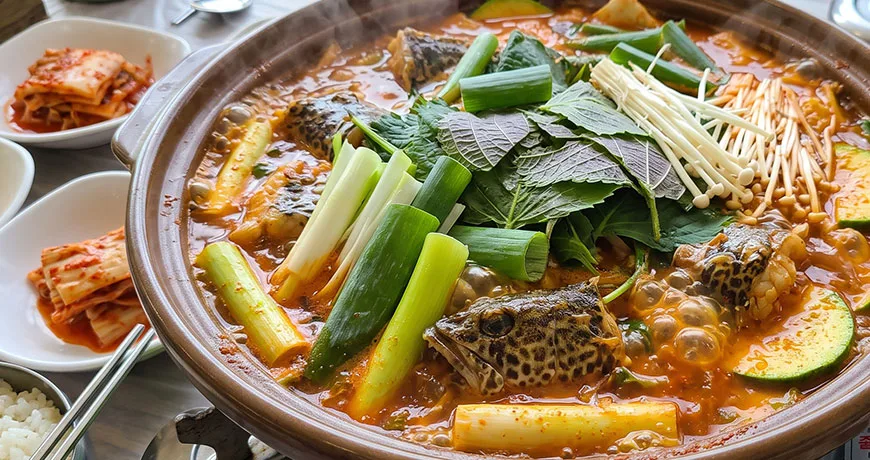
Ssogarimaeuntang is a premium freshwater biochemical matrix that harnesses the extraordinary cross-linked myofibrillar structure of the Mandarin fish (Ssogari), the undisputed apex predator of Korean rivers. Unlike common freshwater fish whose cellular structures disintegrate into mush under thermodynamic kinetic energy, the Ssogari’s dense muscle fibers rival those of marine reef fish or crustaceans, retaining an incredible, chewy viscoelasticity even after prolonged boiling at 100°C. The central engineering challenge of this dish is the absolute neutralization of geosmin and 2-methylisoborneol (2-MIB)—the compounds responsible for the muddy aromatics of freshwater fish. This is achieved through a three-stage chemical masking process: physical purging of the skin’s mucin, establishment of a dense capsaicin and fermented peptide (Doenjang) emulsion, and a final, overwhelming volatile aromatic strike using perillaldehyde from perilla leaves (Kkaennip) and terpenes from water dropwort. Deliberately more viscous than clear marine fish stews, this hyper-savory broth coats the palate, physically blocking any residual earthy notes while highlighting the majestic texture of the fish.
- ⏱️ Total: 55 mins | Prep: 25 mins (Geosmin & mucin physical purging) | Cook: 30 mins
- 🍳 Difficulty: High (Requires strict physical purging of mucin and chemical masking of freshwater geosmin)
- 🌶️ Profile: Deeply Earthy, Fiery Capsaicin Heat, and Complex Botanical Aromatics
- 🍚 Focus: Geosmin Chemical Masking, Cross-linked Myofibril Coagulation, & Perillaldehyde Finish
- 🍶 Pairing: Ice-cold Somaek (Soju + Beer bomb) engineered with a highly carbonated light lager like Terra
Ingredients (3–4 servings)
- High-Density Freshwater Matrix: 1–2 Fresh Mandarin Fish (Ssogari – approx. 800g. The slimy surface mucin MUST be rigorously scrubbed off with coarse salt, and all bloodlines/gills completely purged before chopping into steaks)
- Pectin & Starch Matrix: 200g Daikon Radish (sliced into squares), 1/3 Zucchini, 100g Wheat Flour Dough (Sujebi – optional, for starch gelatinization)
- Geosmin-Masking Solvent: 1.5L Anchovy-Kelp Broth
- Peptide & Capsaicin Binder: 3.5 tbsp Gochugaru (Chili Flakes), 1 tbsp Gochujang (Chili Paste), 1 tbsp Traditional Doenjang (Soybean Paste – critical for neutralizing geosmin), 2 tbsp Soup Soy Sauce, 2 tbsp minced garlic, 1 tsp minced ginger
- Aromatic Botanical Catalyst: 15 Perilla Leaves (Kkaennip – absolutely mandatory), 1 handful Water Dropwort (Minari), 1 stalk Green Onion, 2 Cheongyang green chilies, 0.5 tsp Sancho powder (optional)
Allergy Information Contains: Fish (Mandarin Fish), Soy, Wheat (from Doenjang, Gochujang, Soy Sauce, Sujebi Dough)
Equipment Wide High Thermal Mass Pot, Fish Scaler, Coarse Salt (for scrubbing), Fine Skimmer, Cutting Board, Knife
Cooking Instructions
- Mucin & Geosmin Physical Purging: After scaling the Ssogari, rigorously scrub the exterior skin with coarse salt to physically strip away the slimy mucin layer. This slime, along with the dark bloodline against the spine, holds the highest concentration of muddy geosmin compounds and must be eradicated completely.
- Solvent & Peptide Base: Combine the broth and radish in a wide pot and bring to a rolling boil over high heat. Dissolve the Doenjang, Gochujang, Gochugaru, garlic, and ginger into the solvent. The fermented peptides and volatile allyl compounds immediately establish a chemical masking barrier in the liquid.
- High-Density Coagulation: As the viscous, red broth violently boils, introduce the purged Ssogari chunks. Leave the lid open to allow volatile off-odors to vaporize. Boil over medium heat for 15–20 minutes. The exceptional cross-linked myofibrils of the Ssogari will not disintegrate but will instead coagulate into a firm, lobster-like texture.
- Starch Gelatinization: When the fish is halfway cooked, tear small, thin pieces of the Sujebi (wheat dough) into the boiling broth and add the zucchini. The starch leaches from the dough, increasing the overall rheological viscosity of the stew.
- Perillaldehyde Finish: Just as the Sujebi turns translucent, and precisely 1 minute before turning off the heat, crown the stew with green onions, chilies, Minari, and roughly torn Perilla leaves (Kkaennip). The perillaldehyde releases instantly upon hitting the radiant heat, creating a potent aromatic canopy that completely obliterates any remaining freshwater scent.
💡 Professional Culinary Tips
- Chemical Neutralization of Geosmin: The earthy flavor (geosmin) of freshwater fish is notoriously difficult to remove. Because adding acid (like vinegar) ruins a stew, Korean gastronomy relies on a strict 3-step masking protocol: osmotic destruction of the mucin layer, adsorption of off-odor molecules via Doenjang’s fermented peptides, and overwhelming the olfactory receptors with perillaldehyde (perilla leaves) and terpenes. Skipping any of these steps results in a biochemically flawed dish.
- Thermodynamic Specialty of Ssogari Myofibrils: Standard freshwater fish (like catfish or carp) suffer from weak protein binding; boiling them for 10 minutes at 100°C turns their flesh into mush. Ssogari, however, possesses extreme muscular density adapted for swimming against violent river currents. Even after 20 minutes of boiling, the meat retains an astonishingly firm, chewy viscoelasticity.
- Hydrodynamics of Marine vs. Freshwater Broths: Unlike marine fish stews (e.g., Cod or Pollack soup) which strive for a thin, crystal-clear consommé, freshwater stews intentionally utilize Gochujang and wheat starch to increase viscosity. This thickened emulsion physically coats the palate, creating a mechanical barrier that prevents the tongue from detecting microscopic traces of mud.
🍶 Gastronomic Pairing
- Biochemical Palate Cleansing: When the exceptionally dense protein of the Ssogari, the thick capsaicin emulsion, and the heavy botanical aromatics of the perilla leaves coat your oral mucosa, pair this intense matrix with an ice-cold Somaek (Soju and Beer bomb). Utilizing a highly carbonated, crisp light lager like Terra as the base is critical; the aggressive effervescence and refined ethanol molecules act as a surgical scalpel, sharply slicing through the heavy freshwater lipids and capsaicin. This flawless mechanical and chemical wash instantly resets your taste receptors.
Nutrition Facts (Estimated)
Total Content : Approx. 700g (1 serving, excluding bone weight)
Calories : 340 kcal (Excluding rice, including Sujebi)
– Sodium : 1,450mg (Elevated due to the necessity of Doenjang/Gochujang masking)
– Total Carbohydrate : 25.0g (Wheat starch and radish polysaccharides)
– Sugar : 4.5g
– Total Fat : 4.0g (Ultra-lean freshwater protein)
– Saturated Fat : 0.8g
– Cholesterol : 85.0mg
– Protein : 48.0g (Ultra-dense myofibrillar protein)
– Dietary Fiber : 5.5g
*Daily Values are based on a 2,000 calorie diet and standard Korean nutritional reference values.
**Nutritional values are calculated based on original ingredients; substitutions may alter specific macronutrients.
Origins and Food Culture of Spicy Mandarin Fish Stew (Ssogarimaeuntang)
1. Joseon Aristocratic “Gweol-eo” Heritage and Classical Treatises
- Prized for its elegant leopard rosettes and pristine flavor, the mandarin fish was historically known in Hanja as Gweol-eo (鱖魚) or Geum-rin-eo (錦鱗魚, “brocade-scaled fish”), holding an elite status as a prized tribute delicacy presented to the royal court of the Joseon Dynasty.
- Documented in Heo Jun’s 1613 Dongui Bogam, the fish was lauded for its ability to “harmonize the spleen and stomach, invigorate vital qi (益氣力), eradicate intestinal parasites, and nourish severe debility.” Similarly, late Joseon scholar Seo Yu-gu’s Jeoneoji praised it as “the supreme jewel among all freshwater species, possessing white, exceptionally firm flesh of unrivaled savor,” proving that scholar-nobles (yangban) revered it as the pinnacle of medicinal freshwater dining during scenic river outings.
2. The Culinary Science of Actomyosin Density and Freshwater Shrimp (Toha) Synergy
- While bottom-dwelling freshwater species like catfish and carp soften rapidly upon boiling, the mandarin fish’s life as a fast-current predator creates exceptionally tight actomyosin muscular bundles; this enables the meat to maintain its structural integrity and flakiness even under extended boiling.
- Master kitchens elevate the broth by incorporating generous heaps of wild freshwater shrimp (minmul-saewu / toha); the chitinous shells and free glycine of the shrimp combine with the inosinic acid of the fish, eliminating any residual river odor while amplifying the stew’s savory sweetness into a profound, multi-dimensional bouillon.
3. The River Bastions of Danyang, Chuncheon, and the Apex of “Cheonlyeop” Gastronomy
- Deeply anchored along scenic, rocky river valleys—such as the upper Namhan River in Danyang, Lake Soyang in Chuncheon, and the Seomjin River in Gokseong—where line fishermen and foragers perfected the art of catching and preparing live catches.
- Due to its rarity, wild habits, and steep market price, Ssogarimaeuntang reigned as the uncontested luxury king of the peninsular freshwater table. Boiling the stew tableside and sharing hand-torn wheat dough flakes (sujebi) directly from the communal pot embodies Korea’s ancient Cheonlyeop (river foraging) tradition in its most lavish, warmhearted, and celebratory form.
The Dense Resilience of Rapid-Forged Mandarin Fish Muscle, the Pure Extraction of Freshwater Skeletal Marrow, and the Fiery Dynamic of Simmered Alliums: A Refined Portrait of Ssogarimaeuntang
Ssogarimaeuntang (Spicy Mandarin Fish Stew) stands as the aristocratic, biologically pristine, and deeply exhilarating summit of Korea’s riverine freshwater (tangban) gastronomy. Centered upon the apex freshwater predator—the Korean leopard mandarin fish (Siniperca scherzeri or Ssogari), celebrated across centuries as the “leopard of the mountain torrents” and the sovereign emperor of inland waters—the fish thrives exclusively in crystal-clear, rock-strewn rapids, hunting live minnows. After meticulous trimming of the spiny fins, head, and firm torso, the whole carcass is arrayed within a heavy earthenware pot or wide casserole. Anchored upon a bedrock of thinly sliced winter radish, scallions, and soybean sprouts to establish an immaculate vegetable foundation, the stew is bathed in a foundational dried kelp and anchovy broth dissolved with an assertive seasoning paste of sun-dried red chili powder (gochugaru), a touch of red chili paste (gochujang), soup soy sauce, crushed garlic, and fresh ginger. Brought to an aggressive tableside boil, layered with paper-thin hand-pulled wheat dough flakes (sujebi), and crowned at the rolling climax with wild water parsley (minari), aromatic crown daisy (ssukgat), and green chilies, this dish completely bypasses the muddy, earthy notes typical of common river fish. It preserves the crystalline, muscular flakes of an elite perciform predator within the fiery kinetics of convective boiling, delivering profound physiological warmth and deep restorative umami.
Confronting the boiling vessel tableside as vibrant crimson chili bubbles froth around thick white fillets of mandarin fish releases an immediate, electrifying sensory charge: the spicy, roasted heat of chili and alliums mingles seamlessly with the clean, sweet perfume of poaching river fish and the brisk, pine-fresh aroma of wild water parsley and crown daisy. Lifting a deep metal spoon for the first sip delivers a revelation across the tongue: the rich broth, fortified with sweet vegetable juices and natural bone gelatin, washes over the palate with zero greasy heaviness or murky river smell. It courses down the throat to unlock instant, soothing warmth, triggering revitalizing perspiration that swiftly banishes bodily fatigue. Parting the mandarin fish meat with a spoon yields dense, snowy flakes that exhibit a remarkable, tooth-resisting springiness reminiscent of sea bass or young capon, fracturing cleanly to release pure, uncorrupted marine-like sweetness. Concurrently, the hand-torn sujebi dough flakes provide a buoyant, viscoelastic chew that enriches the mouthfeel, beautifully framed by the brisk, auditory crunch of flash-wilted water parsley. Steeping a bowl of warm rice into the remaining crimson soup and topping it with crisp kimchi transforms the meal into an unforgettable ritual of metabolic restoration, structural indulgence, and profound gastronomic catharsis.
The enduring brilliance of Ssogarimaeuntang lies in its distinguished dynastic heritage—revered in Joseon literature and royal banquet records as Gweol-eo (鱖魚), a prized tribute fish presented to the royal court and immortalized in classical landscape paintings. Historically savored along the rocky currents of the Namhan, Bukhan, and Geum Rivers during riverside excursions (cheonlyeop), this unadorned classic elevates humble riverbank picnicking into an iconic emblem of refined nourishment. Uniting the cold river vitality of native predatory fish with the bold clarity of fermented red-pepper seasoning, a steaming cauldron of spicy mandarin fish stew remains an irreplaceable monument of freshwater ecology, maternal warmth, and brilliant Korean culinary craftsmanship.
Editor’s Review
1. A Dynamic Harmony of Resilient Perciform Muscle Flakes, Viscoelastic Sujebi Snap, Melting Radish Sponginess, and Herbaceous Crunch
The structural architecture inside the vessel delivers an extraordinary, tactile choreography between dense predatory teleost muscle fibers, a gelatinized wheat gluten network, and crisp vegetable cell walls. Unlike bottom-dwelling freshwater species, the rapid-forged white meat of the mandarin fish retains high structural density under convective boiling, resisting tooth pressure with an energetic, poultry-like bounce (taenggeul) rather than collapsing into soft mush. This firm chew is cushioned by the thin sheets of hand-torn sujebi dough, which supply a slippery, viscoelastic give that absorbs the savory stock. Meanwhile, the thickly sliced radish yields with a succulent, juicy bite, framed by the brisk, auditory snap of briefly wilted water parsley and crown daisy, ensuring an impeccably balanced, non-fatiguing mouthfeel from the first steaming sip to the last.
2. Perciform Actomyosin Thermal Network Density, Ecological Geosmin Absence, Bone Type I Collagen Gelatinization, IMP-Glutamate Umami Synergism, and Capsaicin TRPV1 Thermoregulation
Ssogarimaeuntang represents an exacting study in freshwater fish histology, environmental bio-volatiles, and sensory neurochemistry. Because Siniperca scherzeri inhabits fast-flowing, oxygen-rich gravel shoals and preys exclusively on live aquatic life, its tissues are biologically devoid of geosmin and 2-methylisoborneol (2-MIB)—the muddy terpene compounds produced by blue-green algae and actinomycetes in stagnant silt. Its myofibrillar actomyosin network possesses high protein density and low baseline lipid content, allowing it to undergo clean thermal denaturation between 85°C and 90°C without excessive syneresis, preserving cellular hydration and structural firmness. Insoluble Type I collagen, densely woven into the cranial bones, operculum, and spinal column, hydrolyzes into water-soluble gelatin polypeptides, endowing the broth with a velvety dynamic viscosity. Muscle-derived inosine monophosphate (IMP) converges with natural free glutamates from the sun-dried chili, braised radish, and alliums, triggering an exponential synergy across human oral T1R1/T1R3 umami heterodimers. Furthermore, lipophilic capsaicin from the red pepper excites oral TRPV1 receptors, promoting peripheral vasodilation, gentle sweating, and gastrointestinal circulation, while allicin from garlic and volatile monoterpenes from water parsley mask trace volatile amines, completing a flawless, restorative flavor architecture.
3. The Joseon Royal Gweol-eo Tribute Heritage and the Sovereign Apex of Korean Freshwater Gastronomy
Distinguished as the only freshwater fish whose flesh is virtually free of riverine off-odors and as firm as premium marine catches, the mandarin fish occupies an exalted pedestal in Korean gastronomic history. Transcending the rustic nature of mixed-fish stews through the harmonious balance of clean river terroir and fiery seasoning, Ssogarimaeuntang stands as the ultimate expression of Korean freshwater cookery—an enduring sanctuary of environmental authenticity, ancestral craftsmanship, and brilliant culinary artistry.