
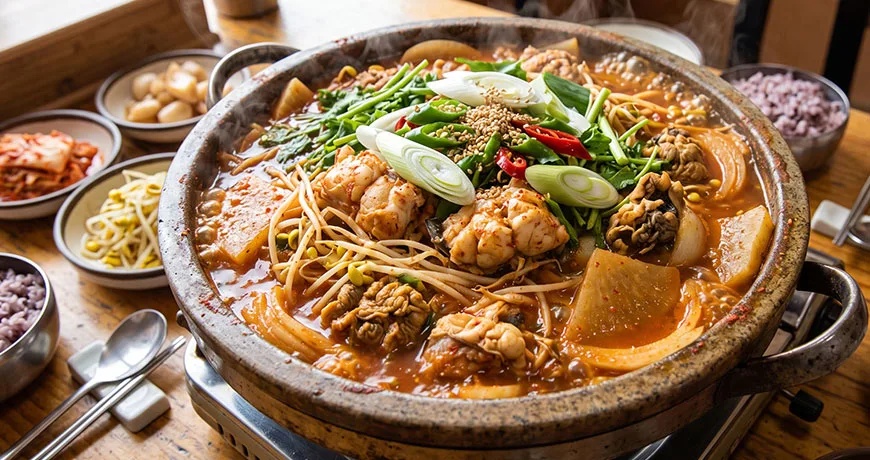
A deeply refreshing and spicy Korean seafood soup featuring tender, springy monkfish, savory sea squirts (mideodeok), crisp soybean sprouts, and fragrant water parsley (minari) simmered in a rich kelp broth. Celebrated for its light, clean taste and restorative qualities.
⏱️ Prep: 20 mins | Cook: 25 mins | 🍳 Moderate | 🌶️ Spicy | 🐟 High Protein
Ingredients (4 servings)
- Main Ingredients: 1 medium monkfish (agwi, cleaned and chopped into bite-sized pieces), 400g sea squirts (mideodeok)
- Vegetables: 200g soybean sprouts (kongnamul, heads and roots trimmed), 1/2 Korean radish (mu), 100g water parsley (minari), 1 onion, 2 stalks green onion, 2 green chili peppers, 2 red chili peppers
- Broth & Liquids: 5 cups kelp broth (dashima-yuksu), 1 tbsp mirin (cooking wine, for finishing), salt, black pepper, soy sauce to taste
- Spicy Seasoning Paste (Dadaegi): 1/2 cup kelp broth, 3 tbsp red pepper flakes (gochugaru), 1 tbsp mirin (cooking wine), 1 tbsp minced garlic, 1 tbsp minced green onion, a dash of ginger juice, crushed sesame seeds
Allergy Information
- Contains: Fish (Monkfish), Shellfish / Tunicates (Sea squirts), Sesame
Equipment
- Large Pot, Knife, Cutting Board, Strainer, Mixing Bowl, Ladle
Cooking Instructions
- Prepping Vegetables: Wash all vegetables thoroughly. Trim the heads and roots of the soybean sprouts. Slice the radish and onion into bite-sized pieces. Chop the green onions, water parsley, and chili peppers into lengths similar to the sprouts.
- Prepping Monkfish & Sea Squirts: Remove internal organs from the monkfish, wash thoroughly under cold running water, and chop into bite-sized chunks. Clean the sea squirts under running water.
- Arranging the Pot: Lay the sliced radish and onion at the bottom of a large pot. Layer the prepared monkfish chunks and sea squirts on top, then pour in 5 cups of kelp broth and set over medium-high heat.
- Mixing & Adding Seasoning Paste: In a small bowl, combine 1/2 cup kelp broth, 3 tbsp red pepper flakes, 1 tbsp mirin, minced garlic, minced green onion, ginger juice, and crushed sesame seeds into a smooth paste. Once the pot comes to a boil, stir in the paste to season the broth and give it a vibrant color.
- Adding Fresh Greens & Chilies: Once boiling rapidly, add the soybean sprouts, water parsley, green onions, and red/green chili peppers to infuse crisp, refreshing flavors into the soup.
- Finishing & Seasoning: Once all ingredients are cooked through and deep flavors have developed, drizzle in 1 tbsp mirin to eliminate any lingering seafood odor and tenderize the fish meat. Season with salt or soy sauce to taste, then turn off heat and serve hot.
💡 Cooking & Pairing Tips
- Preserve Vegetable Crunch: Do not overcook the soybean sprouts and water parsley; adding them near the end keeps their refreshing crunch intact and prevents minari from losing its delicate herbal aroma.
- Prep Sea Squirts Safely: Puncturing sea squirts slightly with a toothpick before cooking prevents hot liquid trapped inside from bursting unexpectedly when eaten!
- Perfect Food & Beverage Pairing: Exceptional as a hangover recovery meal or main dish alongside warm white rice, dipping soy sauce with wasabi, and Korean side dishes (banchan). Pairs brilliantly with chilled soju or clear rice wine (cheongju).
Storage Instructions
- Best enjoyed fresh after cooking. Leftovers can be stored in an airtight container in the refrigerator for up to 1–2 days. Reheat on the stovetop over medium heat until bubbling hot. Avoid over-boiling to keep monkfish meat springy and water parsley crisp.
Nutrition Facts (Estimated)
- Total Content : Approx. 1,600g (4 servings total)
- Calories : 720 kcal total (approx. 45 kcal per 100g / 180 kcal per 1 serving)
– Sodium : 1,150mg (58%)
– Total Carbohydrate : 28g (9%)
– Sugar : 8g (8%)
– Total Fat : 8g (12%)
– Trans Fat : 0g
– Saturated Fat : 1.2g (6%)
– Cholesterol : 210mg (70%)
– Protein : 130g (236%)
– Calcium : 180mg (18%)
– Calcium : 180mg (18%)
Editor’s Review
1. Chewy Monkfish Flesh and the Sensual Burst of Ocean Freshness
The moment you bite into the plump, tender monkfish, the chewy collagen of its skin pairs exquisitely with the soft, delicate white meat on the tip of the tongue. The intense burst of ocean juice from popping mideodeok interweaves with a fiery broth enriched by kelp stock and savory chili paste, drenching the mouth in a deep, invigorating clarity. Enhanced by the fresh herbal aroma of minari and the crisp crunch of bean sprouts, it reaches a peak of seafood stew dining that sharply awakens the senses.
2. Layered Stewing Aesthetics and Precise Flashes of Green
Agwitang represents the height of Korean seafood dining, where a precise sequence of cooking protects protein elasticity while mastering vegetable moisture. Laying radish and onions at the bottom to draw out a natural vegetable broth—then topping with monkfish and mideodeok—serves as the foundational science securing a clean, full-bodied broth. Introducing bean sprouts, minari, and green onions near the end to briefly flash-cook their vibrant crunch demonstrates a flawless mastery that guards intrinsic textures without compromise.
3. Deep Ocean Solace Delivering a Clear, Refreshing Purification
Humble in appearance yet possessing the gentlest white flesh, the monkfish endures the hot flame to be reborn into a serene, restorative sanctuary. For a weary soul heavy with daily exhaustion or a depleted body seeking relief, a bubbling bowl of this vibrant crimson soup acts as an affectionate gesture of salvation that clears the spirit. Emptying this piping hot, refreshing broth grants a buoyant restoration, unburdening the heart and filling it with uncompromising vitality.