
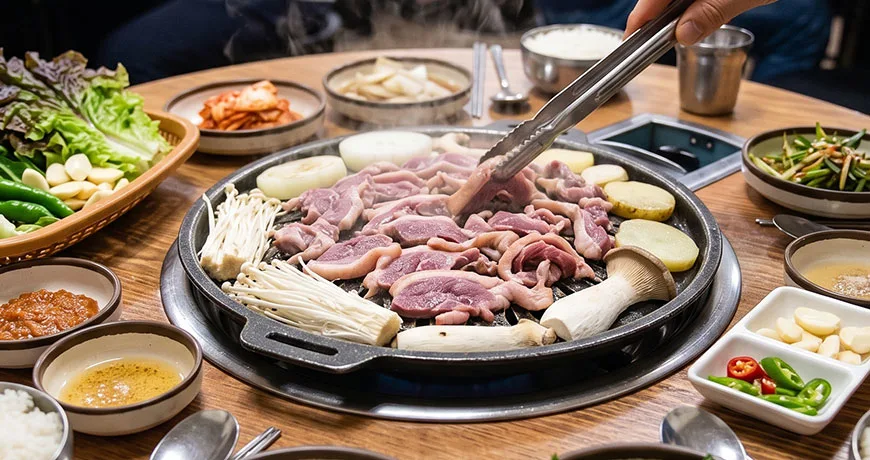
Ori-roseu involves grilling unmarinated, thinly sliced raw duck. This cooking method relies on the thermodynamic rendering of the duck’s dense unsaturated fats, allowing the lean meat to essentially shallow-fry in its own rendered lipids. Unlike thick duck breasts, the thin slices undergo thermal coagulation almost instantly. Therefore, the key is to rapidly evaporate the surface moisture to trigger aggressive Maillard browning before the meat dries out. Pairing the crispy, rich duck with an allyl isothiocyanate-rich mustard sauce or umami-dense fermented Doenjang chemically cleanses the lipid coating from your palate, achieving a perfect, refreshing balance with every bite.
⏱️ Total: 15 mins | Prep: 5 mins | Cook: 10 mins | 🍳 Difficulty: Low (Requires rapid moisture evaporation and rendering control) | 🌶️ Profile: Richly Fatty, Savory, and Crispy | 🍚 Focus: Lipid Rendering, Flash Searing, & Palate Cleansing
Ingredients (2 servings)
- Protein & Lipid Matrix: 500g raw Duck for roasting (thinly sliced, skin-on)
- Osmotic Seasoning: 0.5 tsp coarse sea salt, a pinch of ground black pepper
- Chemical Cleansers: Mustard Sauce (1 tbsp yellow/hot mustard, 1 tbsp vinegar, 1 tbsp sugar, 1 tbsp water), Ssamjang or Doenjang for dipping
- Fiber Matrix: Lettuce, perilla leaves, thinly sliced raw garlic, green chilies
Allergy Information Contains: Poultry (Duck), Soy (from Doenjang), Mustard
Equipment Grill Pan with fat drainage or Non-stick Skillet, Meat Tongs, Paper Towels
Cooking Instructions
- Mechanical Prep: Gently press the surface of the sliced duck with paper towels to remove excess moisture. If surface water is present, the thermal energy will be wasted on evaporation (latent heat of vaporization), causing the meat to steam rather than fry.
- Thermodynamic Lipid Rendering: Heat the grill pan to medium and lay out the duck slices. Because the slices are thin, thermal conduction is rapid, causing the subcutaneous fat to instantly bubble and liquefy (render).
- Maillard Searing: Allow the exterior of the meat to shallow-fry in the rendered duck fat. Once the surface turns a golden-brown color and forms a crispy crust, season with salt and pepper to induce osmotic flavoring.
- Moisture Control: Do not overcook. Because the slices are thin, the proteins coagulate quickly. Once the edges are crispy and the center is cooked through, immediately move the meat to the edge of the pan to prevent the loss of internal kinetic moisture.
- Biochemical Plating: Dip the grilled duck into the mustard sauce or Doenjang, wrap it in fresh vegetables, and serve immediately.
💡 Professional Culinary Tips
- Thermodynamics of Thin-Slice Rendering: While thick duck breasts require a “Cold Pan Start” to render fat without toughening the meat, thinly sliced Ori-roseu is physically thin enough that heat penetrates instantly. Placing the slices on a preheated medium pan ensures the fat is extracted quickly while initiating rapid Maillard browning, preventing the thin muscles from drying out.
- Biochemical Advantage of Unsaturated Fats: Duck fat possesses an overwhelmingly high ratio of unsaturated fatty acids (like oleic acid) compared to beef or pork. This biochemical structure results in a much lower melting point. It remains liquid at room temperature and within the human body, giving the incredibly rich lipids a surprisingly light and delicate texture on the palate.
- Biochemical Palate Cleansing: Mustard’s pungent compound (allyl isothiocyanate) forcefully stimulates nasal receptors, instantly cutting through the heavy sensation of duck fat. Fermented Doenjang operates similarly; its complex amino acids chemically wash the lipid film off your tongue, essentially resetting your taste buds and amplifying the savory notes for the next bite.
Nutrition Facts (Estimated)
Total Content : Approx. 200g (1 serving, reflecting significant fat rendering)
Calories : 480 kcal
– Sodium : 420mg
– Total Carbohydrate : 1.0g
– Sugar : 0.0g
– Total Fat : 37.0g
– Saturated Fat : 9.5g
– Cholesterol : 115.0mg
– Protein : 34.0g
– Dietary Fiber : 0.0g
*Daily Values are based on a 2,000 calorie diet and standard Korean nutritional reference values.
**Nutritional values are calculated based on original ingredients; substitutions may alter specific macronutrients.
Origins and Food Culture of Grilled Duck (Ori-Roseu)
1. The ‘Roast’ Nomenclature in Korean Barbecue and the Fresh Duck Boom
- Adapted from the Western term “roast,” the Korean dining concept of roseu-gui refers to thinly sliced, prime unmarinated meats grilled directly at the table, a technique brilliantly applied to fresh duck.
- With the modernization of local duck farming and cold-chain distribution in the 1980s and 1990s, suburban “duck gardens” (ori-garden) popularized this unseasoned, health-forward style of barbecue into a beloved national dining standard.
2. The Culinary Science of Skin-On Slicing and Natural Fat Searing
- Slicing the meat evenly with the skin intact ensures the ideal balance of lean muscle and subcutaneous fat before it meets the high heat of the griddle.
- Searing rapidly renders out the clean unsaturated fats, turning the skin into a blistered, golden crackling while locking in tender interior juices; the rendered duck oil simultaneously pan-fries accompanying sliced potatoes, king oyster mushrooms, and sweet onions to savory perfection.
3. The Harmony of Garlic Chives, Ssam Wraps, and Restorative Broth
- Rooted in traditional food synergy, duck is paired with fresh garlic chives tossed in perilla powder (buchu-muchim) to balance the cooling properties of the meat with warming herbal vitality.
- The feast traditionally follows a complete culinary progression: dipping crispy morsels into piquant mustard or rich ssamjang, wrapping them in fresh perilla leaves, and finishing with a bubbling pot of spicy duck bone stew (ori-tang) or crisp griddled fried rice.
The Luminous Cascade of Rendered Lipids and the Resilient Snap of Dark Duck Breast: A Refined Portrait of Ori-Roast
Ori-Roast (Pan-Seared Fresh Duck Slices) stands as a pristine, healthfully balanced pinnacle of Korean poultry gastronomy, where whole fresh duck is thickly sliced with its rich subcutaneous fat and red muscle fibers intact, lightly dusted with coarse sea salt and cracked black pepper, and seared over a blistering tabletop griddle. Stripping away heavy marinades to celebrate the unadorned quality of prime poultry, this dish initiates a dynamic self-searing process as the meat meets the hot iron—rendering out clear, aromatic duck fat that shallow-fries accompanying slices of potato, onion, and garlic to golden perfection around the perimeter.
Lifting a golden-crusted slice from the pan and dipping it into sharp Korean mustard or fermented doenjang dip before enfolding it within crisp leafy lettuce and seasoned chives reveals a dazzling textural interplay. The initial bite delivers a delicate crackle from the rendered skin, which instantly gives way to the firm, springy chew of the juicy dark meat beneath. Because duck fat possesses an exceptionally low melting point, it coats the tongue in a light, liquid savoriness rather than heavy grease, while the zesty tang of mustard and the earthy depth of the soybean paste cut cleanly through the richness, leaving the palate energized and refreshed.
The true elegance of unmarinated duck roast lies in its culinary transparency—refusing to rely on thick sauces and instead elevating the natural balance of rich lipids and succulent muscle through radiant thermal conduction and mineral salt. Purging heavy saturated fats while providing bioavailable proteins and essential micronutrients, a sizzling platter of fresh duck roast remains a cherished restorative feast that revitalizes tired bodies and offers timeless hearthside comfort.
Editor’s Review
1. A Harmonious Interplay of Crisped Skin Crunch, Springy Dark Meat Elasticity, and Piquant Mustard-Doenjang Harmony
The visual and textural contrast of griddled skin-on duck slices sets a compelling sensory standard. As excess lipid renders out on the hot plate, the skin transforms into a delicate, golden-brown crust while the succulent red meat retains its tender, springy elasticity without dryness. Dipping the meat into vibrant yellow mustard or savory doenjang dip—paired with crisp lettuce wraps and chives—orchestrates a clean, multi-layered sensory cadence that refreshes the palate from first bite to last.
2. Low-Melting-Point Unsaturated Fatty Acid Fluidity, High-Myoglobin Muscle Hydration, and Piperine-Sinigrin Digestive Kinetics
Ori-Roast represents an exacting study in avian lipid chemistry and red-muscle thermodynamics. Duck fat contains roughly 70% unsaturated fatty acids (notably oleic and linoleic acids) with an exceptionally low melting threshold around 14°C, ensuring the rendered lipids remain fluid at body temperature for rapid cellular metabolism and gentle digestion. Furthermore, duck muscle’s high myoglobin concentration ensures high water-holding capacity (WHC) under direct heat, preserving intracellular tenderness, while piperine from black pepper and sinigrin from mustard stimulate gastric acid and bile secretion to accelerate lipid breakdown.
3. The Suburban Garden Hearthside Heritage and the Grounding Sanctuary of Wholesome Tabletop Feasts
Originating as a celebrated weekend retreat meal in spacious suburban garden restaurants where multi-generational families gather around expansive tabletop griddles with vegetables, fresh duck roast serves as a treasured emotional haven against modern fatigue. By relying solely on radiant heat, mineral salt, and fresh garden accompaniments to highlight the pristine purity of the meat, this honest culinary tradition continues to offer diners a deeply revitalizing sanctuary of wholesome nourishment and shared happiness.