
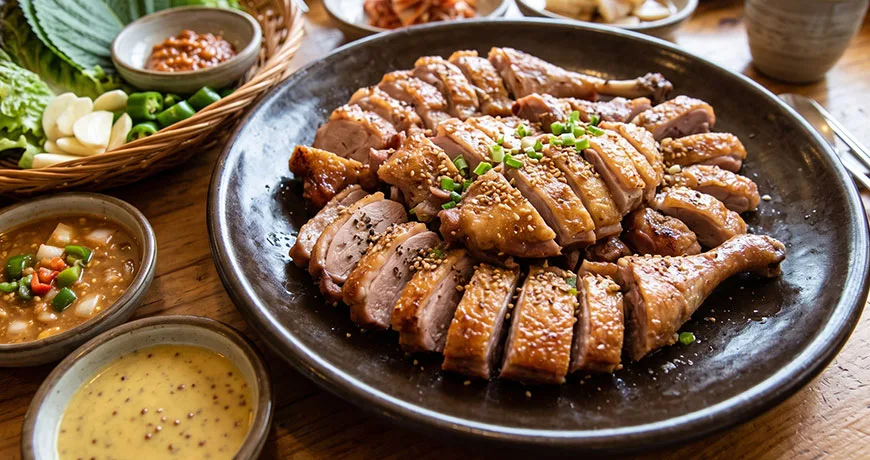
Ori-gui (Grilled Duck) is a dish fundamentally driven by the thermodynamic rendering of the duck’s exceptionally thick layer of subcutaneous fat. Because duck fat contains a high percentage of unsaturated fatty acids, it has a lower melting point. Therefore, cooking must begin with a “Cold Pan Start.” By placing the duck skin-side down on a cold surface and gradually raising the temperature, the dense lipids liquefy (render) slowly without the muscle fibers rapidly contracting and trapping the fat inside. The rendered fat then acts as a shallow-frying medium, inducing a severe Maillard reaction on the skin for ultimate crispiness. Paired with the biochemical palate-cleansing properties of mustard (allyl isothiocyanate) or fermented Doenjang, this dish offers a scientifically balanced, intensely savory experience.
⏱️ Total: 20 mins | Prep: 5 mins | Cook: 15 mins | 🍳 Difficulty: Moderate (Requires patience and control over the cold-pan lipid rendering) | 🌶️ Profile: Richly Fatty, Savory, and Crispy | 🍚 Focus: Cold Pan Start, Lipid Rendering, & Palate Cleansing
Ingredients (2 servings)
- Protein & Lipid Matrix: 500g sliced Duck or Duck Breasts (raw, skin-on)
- Osmotic Seasoning: 0.5 tsp coarse sea salt, a pinch of ground black pepper
- Chemical Cleansers: Mustard Sauce (1 tbsp yellow/hot mustard, 1 tbsp vinegar, 1 tbsp sugar, 1 tbsp water), Ssamjang or Doenjang for dipping
- Fiber Matrix: Lettuce, perilla leaves, pickled radish paper (ssam-mu), raw garlic, chilies
Allergy Information Contains: Poultry (Duck), Soy (from Doenjang), Mustard
Equipment Non-stick Frying Pan or Cast Iron Griddle, Meat Scissors, Tongs, Paper Towels
Cooking Instructions
- Mechanical Prep: Thoroughly pat the duck dry with paper towels. If using whole duck breasts, score the skin in a crosshatch pattern without piercing the flesh. This mechanical scoring prevents the connective tissues from shrinking violently under heat and creates escape channels for the rendering fat.
- Cold Pan Start: Place the duck skin-side down into an unheated, cold frying pan. Turn the stove on to medium-low heat.
- Thermodynamic Lipid Rendering: As the pan slowly heats up, the subcutaneous fat will begin to melt and pool in the pan. Do not wipe this fat away immediately. Let the duck cook undisturbed in its own rendered fat for 5–7 minutes, effectively frying the skin.
- Maillard Searing: Once the skin develops a deep, golden-brown crispy crust (Maillard reaction), season with salt and pepper, then flip. Sear the flesh side briefly. Duck meat dries out quickly if overcooked, so you only want to coagulate the surface proteins to lock in the kinetic moisture.
- Resting & Biochemical Plating: Remove the duck from the pan and let it rest for 2–3 minutes. This allows the internal kinetic energy to subside and redistributes the juices evenly throughout the muscle matrix. Serve wrapped in fresh vegetables with a dab of mustard or Doenjang to chemically cut through the rich lipids.
💡 Professional Culinary Tips
- Thermodynamics of the Cold Pan Start: If you drop a duck breast into a screaming-hot pan (as you would a steak), the intense heat will instantly coagulate the surface proteins. This creates an impenetrable seal that traps the thick layer of fat underneath, resulting in a rubbery, unpleasant skin. Starting cold allows the fat to liquefy and drain completely before the proteins seize up.
- Unsaturated Fatty Acids: Duck fat is incredibly rich in unsaturated fatty acids, such as oleic and linoleic acids. Because of this biochemical composition, it remains liquid at room temperature and has a much lower melting point than beef tallow or pork lard, making it feel significantly less heavy on the palate.
- Biochemical Palate Cleansing: Consuming high volumes of rich duck fat will quickly exhaust your taste receptors. The allyl isothiocyanate found in mustard forcefully stimulates the trigeminal nerve in your nasal cavity, physically cutting through the heavy lipid film on your tongue. Fermented Doenjang works similarly, using its complex amino acids to reset your palate for the next bite.
Nutrition Facts (Estimated)
Total Content : Approx. 200g (1 serving, reflecting significant fat rendering)
Calories : 490 kcal
– Sodium : 420mg
– Total Carbohydrate : 1.0g
– Sugar : 0.0g
– Total Fat : 38.0g (High in unsaturated fats)
– Saturated Fat : 10.0g
– Cholesterol : 115.0mg
– Protein : 35.0g
– Dietary Fiber : 0.0g
*Daily Values are based on a 2,000 calorie diet and standard Korean nutritional reference values.
**Nutritional values are calculated based on original ingredients; substitutions may alter specific macronutrients.
Origins and Food Culture of Grilled Duck (Ori Gui)
1. Evolution from Herbal Tonics to Contemporary Tabletop Barbecue
- Historically revered in Korean traditional medicine as a cooling, restorative tonic consumed in slow-simmered herbal broths (baeksuk), duck transitioned into a mainstream dining favorite with modern poultry processing in the 1980s and 1990s.
- Suburban dining destinations and specialized “duck gardens” (ori-garden) flourished across Korea, popularizing the minimalist method of grilling fresh, unmarinated duck with simple salt and pepper as a nutritious, health-forward culinary standard.
2. The Culinary Science of Skin-On Slicing and High-Heat Fat Rendering
- The key technique lies in slicing the meat evenly with the skin intact, balancing lean muscle and healthy subcutaneous fat before cooking over intense heat.
- Searing on heavy iron pans or charcoal griddles allows excess surface fats to melt away cleanly, transforming the outer skin into a golden, blistered crackling while locking in the natural juices for a tender, succulent chew.
3. Vibrant Sauce Harmonies and the Hearty Bone Broth Finale
- Diners customize each bite by dipping crispy duck slices into sharp mustard or rich ssamjang, wrapping them in fragrant perilla leaves alongside seasoned garlic chives and aged kimchi.
- The meal traditionally concludes with a comforting full-course finale: a bubbling pot of spicy duck bone stew (ori-tang) or rich perilla-infused duck porridge (ori-juk), ensuring that every bit of flavor and nourishing essence is thoroughly enjoyed.
The Pure Dialogue of Searing Skin and Liquefied Unsaturated Juices: A Refined Portrait of Fresh Ori-gui
Ori-gui (Pan-Grilled Duck Slices) stands as a pristine, healthfully balanced pinnacle of Korean poultry gastronomy, where whole fresh duck is thickly sliced with its rich skin intact, delicately seasoned with coarse sea salt and freshly cracked black pepper, and seared over a sizzling tabletop griddle. Unlike pale chicken breast, duck features deep-red, myoglobin-rich muscle fibers embraced by a luscious subcutaneous fat layer; as the cold slices meet blistering heat, clear duck fat renders out smoothly, initiating an aromatic self-searing process that perfumes the surrounding air with an unmistakably clean, savory poultry essence.
Lifting a golden-seared morsel from the heat and dipping it into piquant Korean mustard or fermented doenjang dip before wrapping it inside crisp lettuce and seasoned chives reveals a dazzling textural interplay. The initial bite delivers a satisfying, delicate crackle from the rendered skin, which instantly gives way to the firm, springy chew of the juicy dark meat beneath. Because duck fat possesses an exceptionally low melting point, it coats the tongue in a light, liquid savoriness rather than heavy grease, while the sharp acidity of the mustard and the earthy depth of the soybean paste cut through the richness, leaving the palate remarkably refreshed and energized.
The enduring elegance of simply grilled duck lies in its absolute culinary transparency—refusing to hide behind thick, heavy sauces and instead celebrating the unadorned quality of prime poultry through radiant heat and mineral salt. Purging heavy saturated fats while locking in bioavailable proteins and essential micronutrients, a sizzling platter of fresh grilled duck remains a cherished, restorative dining ritual that revitalizes exhausted bodies and offers timeless hearthside comfort.
Editor’s Review
1. A Harmonious Interplay of Crisped Skin Snap, Springy Dark Meat Elasticity, and Piquant Mustard-Doenjang Piquancy
The visual and textural contrast of grilled skin-on duck slices sets a compelling sensory standard. As excess fat renders out on the griddle, the skin transforms into a delicate, golden-brown crust while the succulent red meat retains its tender, springy elasticity without dryness. Dipping the meat into vibrant yellow mustard or savory doenjang dip—and pairing it with crisp leafy wraps and chives—orchestrates a clean, multi-layered sensory cadence that refreshes the palate from first bite to last.
2. Low-Melting-Point Unsaturated Fatty Acid Thermodynamics, High-Myoglobin Muscle Hydration, and Mustard AITC Digestive Kinetics
Ori-gui represents an exacting study in avian lipid chemistry and red-muscle thermodynamics. Duck fat contains roughly 70% unsaturated fatty acids (notably oleic and linoleic acids) with an exceptionally low melting threshold around 14°C, ensuring the rendered lipids remain fluid at body temperature for rapid cellular metabolism and gentle digestion. Furthermore, duck muscle’s high myoglobin concentration ensures high water-holding capacity (WHC) under direct heat, preserving intracellular tenderness, while allyl isothiocyanate (AITC) from the mustard condiment stimulates gastric acid and bile secretion to accelerate lipid breakdown.
3. The Suburban Garden Hearthside Heritage and the Grounding Sanctuary of Wholesome Tabletop Feasts
Originating as a celebrated weekend retreat meal in spacious suburban garden restaurants where multi-generational families gather around expansive tabletop griddles, simply grilled duck serves as a treasured emotional haven against modern fatigue. By relying solely on radiant heat, mineral salt, and fresh garden accompaniments to highlight the pristine purity of the meat, this honest culinary tradition continues to offer diners a deeply revitalizing sanctuary of wholesome nourishment and shared happiness.