
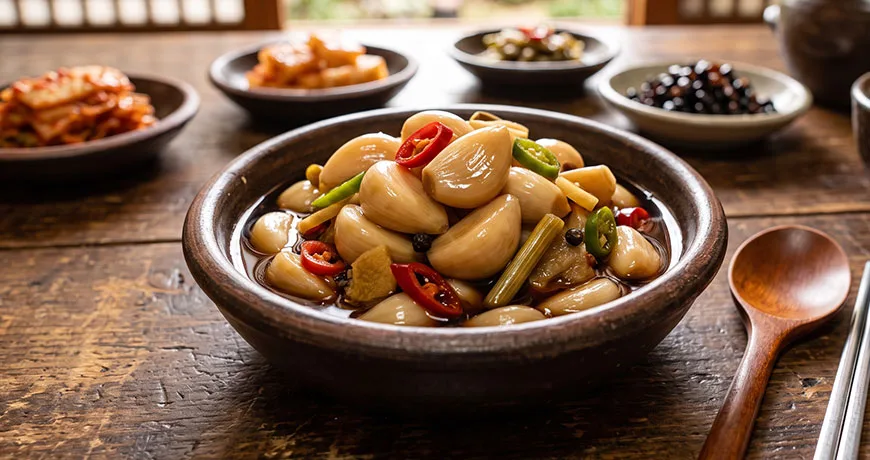
Maneuljangajji is a testament to the transformative power of time and patience. The fierce, fiery nature of raw garlic, born from the strong energy of the earth, is gently subdued by clear vinegar and deep brewed soy sauce. Over weeks of careful aging in the dark, the sharp bite of allicin gracefully yields to a round, elegant sweetness. Unlike preserves that rely on thermal shock, this garlic maintains its pristine ivory hue and resounding crunch through a fully cold infusion. Crafted without heat on the vegetable itself, this masterpiece serves as a sophisticated palate cleanser, effortlessly cutting through heavy fats and reviving the senses during the peak of summer.
- ⏱️ Total Time: 3–4 Weeks | Prep: 7 Days (Primary vinegar curing in the dark) | Cook & Ferment: Slow-simmering broth and 2–3 weeks of cold aging
- 🍳 Difficulty: Medium (Requires meticulous moisture control and light deprivation to prevent greening)
- 🌶️ Profile: A resoundingly crisp, sweet-and-sour depth with the garlic’s fiery bite completely mellowed out
- 🍚 Core Process: Light Deprivation, Primary Vinegar Curing, Slow-simmering Broth, Cold Infusion
- 🍶 Pairing: Charcoal-grilled Hanwoo beef, rich bone broth soups (Gomtang), grilled eel
Physicochemical & Sensory Matrix
- Baseline Salinity: 4.5% ~ 5.5% (A delicately tuned salinity that elevates the garlic’s natural sweetness without overpowering it)
- pH Equilibrium: 3.8 ~ 4.2 (A bright, acetic matrix vital for locking in the crisp pectin and preventing enzymatic discoloration)
- Textural Crunch Index: [■■■■□] (The robust, deeply satisfying snap characteristic of premium root vegetables)
- Umami Density: 7.2 / 10 (A subtle, lingering depth formed by soy amino acids and natural allium sugars)
- Shelf Stability: Peaks after 3 weeks; maintains its ivory purity and crispness for over 1 year refrigerated
- Aroma Profile: Gracefully Mellowed Allium | Aromatic Brewed Soy | Clean Acetic Brightness
Ingredients (Yields 1 Medium Airtight Glass Container)
- Primary Plant Matrix: 1kg Premium, unblemished peeled Garlic Cloves (Newly harvested garlic is highly recommended)
- Primary Curing Matrix: 2 Cups Purified Water, 2 Cups Naturally Fermented Vinegar (Apple or Brown Rice)
- Aromatic Broth Matrix: 2 Cups Brewed Soy Sauce, 1 Cup of the reserved Vinegar Curing Water, 1.5 Cups Unrefined Sugar, 0.5 Cup Plum Extract (Maesil-cheong)
- Aromatic Catalyst: 1 Sheet Dried Kelp (10x10cm)
Allergy Information
- Contains: Soy, Wheat (inherent in brewed soy sauce)
Equipment Stainless Steel Saucepan, Heat-resistant Glass Airtight Container, Black Plastic Bag or Blackout Cloth, Wire Mesh Strainer
Cooking Instructions
- Pristine Preparation: Wash the peeled garlic cloves with immense care to avoid any bruising, and cleanly trim the root ends. Any residual moisture can invite spoilage during the long aging process. Spread them out on a wire strainer and let them air-dry completely for at least half a day until the surface is absolutely bone-dry.
- Primary Curing in the Dark: Place the dry garlic into the glass container and pour in the water and vinegar. When exposed to sunlight in an acidic environment, garlic naturally turns blue or green. To protect its elegant ivory color, tightly wrap the container in a blackout cloth or black bag. Leave it in a cool, dark place for 7 days to quietly tame its fiery bite.
- Simmering the Broth: After 7 days, drain the vinegar water from the container, reserving exactly 1 cup of it (discard the rest). In a saucepan, combine this 1 cup of vinegar water with the soy sauce, sugar, and kelp. Bring to a gentle simmer over medium heat. Once fragrant, remove the kelp, turn off the heat, and stir in the plum extract.
- Cold Infusion: Do not pour the broth while it is hot. Allow the simmered soy broth to cool completely to room temperature. Pour this entirely cold broth over the garlic in the container.
- Time-honored Aging: Wrap the container again to block out light and leave it in a cool place for another 3 to 4 days, then transfer it to the refrigerator for 2 to 3 weeks of deep aging. In the cold darkness, the aggressive heat of the garlic vanishes, leaving behind an incredibly refined, sweet-and-savory bite.
💡 Professional Culinary Tips
- 1. The Silence of Light Deprivation: Garlic contains sulfur compounds and amino acids that react under acidic conditions when exposed to light, resulting in a harmless but visually unappealing blue or green tint. Wrapping the jar tightly in a dark cloth from the very first day of the vinegar soak is a chef’s necessary intervention to protect and preserve the garlic’s pure, ivory radiance.
- 2. The Elegant Mellowing of Allicin: The initial 7-day soak in the vinegar solution is not merely for acidity; it is a crucial technique to gently neutralize allicin, the compound responsible for raw garlic’s aggressive burn. Skipping this step and pouring soy broth directly would result in a harshly pungent preserve that fatigues the palate and compromises the structural integrity of the clove over time.
- 3. Cold Broth for an Unyielding Crunch: Unlike high-water-content vegetables (like cucumbers or onions) that rely on boiling broth to sear their pectins, the dense structure of garlic reacts poorly to heat. Hot broth would partially cook the clove, leaving it with a mushy, unpleasant texture. The cold infusion technique guarantees that the garlic retains its raw, vibrant snap even after a year of aging.
🍶 Gastronomic Pairing
- A Crisp Resonance to Cleanse the Palate: Serve this cold-aged garlic alongside heavily marbled, charcoal-grilled beef or rich, fatty grilled eel. As the heavy lipids coat your tongue, a single bite of the Maneuljangajji delivers a resounding crunch and a burst of transparent acidity, flawlessly resetting your palate. It is also an undeniable Korean classic when paired with a steaming bowl of milky bone broth (Gomtang), bringing a sharp, elegant contrast to the deep, comforting soup.
Nutrition Facts (Estimated)
Total Content : Approx. 20g (5-6 cloves)
Calories : 25 kcal (Garlic’s complex carbohydrates and infused broth sugars)
– Sodium : 340mg (A deeply penetrating, mild salinity achieved through slow aging)
– Total Carbohydrate : 5.5g
– Sugar : 3.5g
– Total Fat : 0.0g
– Saturated Fat : 0.0g
– Cholesterol : 0.0mg
– Protein : 0.8g
– Dietary Fiber : 0.4g
*Daily Values are based on a 2,000 calorie diet and standard Korean nutritional reference values.
**Nutritional values are calculated based on original ingredients; substitutions may alter specific macronutrients.
Origins and Food Culture of Pickled Garlic (Maneuljangajji)
1. Foundations in the Dangun Myth and Joseon Pharmacopeia: From “Daesan” to Aristocratic Preserves
- Garlic (Allium sativum) holds a foundational place in Korean identity, immortalized in the peninsula’s foundational Dangun myth, where a bear endured 100 days in a cave subsisting on wild mugwort and alliums (san 蒜) to transform into the first human woman, Ungnyeo. While ancient san encompassed indigenous wild rocambole and alpine leeks, the introduction and cultivation of cultivated garlic inherited this spiritual reverence as a symbol of physical fortitude and endurance.
- In Heo Jun’s 1613 medical encyclopedia Dongui Bogam, garlic was cataloged under the classical Hanja name Daesan (大蒜): “Extremely warm in nature, pungent in taste, and possessed of mild toxicity; it resolves boils and carbuncles, dispels cold wind and dampness, warms the spleen and stomach, and aids in digesting heavy meats.” Later Joseon culinary manuscripts—including Hong Man-seon’s Sallim Gyeongje, Lady Yi’s Gyuhap Chongseo (1809), and the late 19th-century Siuijeonso—codified exact recipes for Daesanji (大蒜漬 / Maneuljangajji), demonstrating how households pre-soaked garlic in vinegar to neutralize its stinging toxins before long-term soy immersion.
2. The Food Chemistry of Two-Step Curing and Prevention of Greening (녹변 현상)
- The culinary science of Maneuljangajji centers on an indispensable two-stage curing process designed to eliminate harsh acridity and arrest enzymatically driven green discoloration.
- If raw garlic is steeped directly in soy sauce, active alliinase enzymes react with endogenous isoalliin and cellular amino acids under acidic conditions, forming complex polypyrrole pigments that turn the cloves an unappetizing blue-green (nokbyeon). To circumvent this, traditional recipes mandate an initial 10-to-14-day pre-soak in mild vinegar and saline brine in complete darkness. This preliminary acidification denatures the alliinase enzyme, expels volatile sulfurous irritants, and stabilizes cellular membranes. Once drained, introducing the boiled and cooled dark soy marinade allows the cloves to mature into a pristine, translucent amber tone within cool, breathable earthenware vessels.
3. Regional Allium Heritage and the Sovereign Companion of Korean Meat Gastronomy
- Across the premier garlic-producing terroirs of South Korea—including the cold-climate mountainous soils of Uiseong and the warm-climate coastal maritime plains of Namhae, Seosan, and Goheung—the early summer harvest of fresh garlic (haet-maneul) prompted annual community pickling rituals. Gastronomic variations distinguish between Putmaneuljangajji (made from tender young stalks in mid-spring) and Tongmaneuljangajji (cured as whole intact bulb heads).
- In a culinary culture that consumes more garlic per capita than almost any other in the world, Maneuljangajji functions as an essential digestive counterbalance to heavy animal proteins and savory stews. Softening the ferocious medicinal potency of raw alliums through patience, salt, and vinegar, Pickled Garlic stands as an enduring monument to Korean slow-food ingenuity, seasonal foresight, and holistic dining harmony.
Taming the Searing Sulfurous Flame of Summer Alliums with the Measured Submersion of Vinegar and Brewed Soy, Transmuting Fiery Pungency into a Translucent Amber Jewel with an Auditory Crunch: A Refined Portrait of Traditional Maneuljangajji
Maneuljangajji (Pickled Whole Garlic Cloves in Seasoned Soy Sauce) represents an austere, intellectually sophisticated landmark in Korea’s heritage of allium preservation. Focused on plump, young garlic bulbs (haet-maneul) gathered in early summer while their papery skins are still tender and rich in moisture, this venerable preserve is crafted through a two-stage thermodynamic and osmotic discipline. Whole heads or separated cloves undergo an initial curing in mild vinegar brine (sak-him) to leach away harsh, mucous-scorching pungency, followed by prolonged submersion in a boiled and chilled marinade of brewed soy sauce, vinegar, and sugar stored within cool earthenware crocks. Present since the foundational myth of Dangun as the sacred herb that transformed a bear into the first woman, garlic has always been the fiery spiritual backbone of the Korean peninsula. Yet raw, its aggressive allyl sulfur volatiles can overwhelm the stomach. Ancestral cooks resolved this raw hostility without applying heat—which would reduce the cloves to paste—by using the dual osmotic barriers of acetic acid and soy salinity. The preliminary acid cure gently draws out tear-inducing volatiles, while the slow diffusion of rich soy amino acids densifies the cellular matrix, converting an aggressive bulb into a polished, crisp treasure.
Lifting an amber-stained clove of pickled garlic with chopsticks reveals a jewel-like translucence, its smooth contours glistening under a thin film of savory glaze. Approaching the nose, the piercing sulfur stench of fresh garlic is entirely absent; in its place rises a refined bouquet of volatile acetic acid and malty soy peptides, anchored by a deep, warm vegetal earthiness. Clamping down with the molars yields a startling tactile sensation: completely removed from the soft collapse of roasted garlic or the soggy yield of commercial pickles, an authoritative, crystalline snap rings through the jaw. The intact cell walls rupture abruptly under tooth pressure, releasing chilled, savory brine infused with soy umami, bright vinegar tang, and rounded sweetness. Chewing releases a gentle, radiant warmth across the palate that stimulates the senses without the lingering, acrid burn of raw alliums. Paired with thick slices of grilled pork belly (samgyeopsal) or rich beef short ribs, a single clove slices through heavy animal fats like a razor, leaving the palate clean, awakened, and invigorated.
The cultural identity of Maneuljangajji lies in the domestic patience that refused to extinguish the vital sulfurous soul of the plant, choosing instead to temper its elemental fire through the slow equilibrium of salt, acid, and time. Preserving the structural snap of raw tissue while replacing harsh pain with deep, multi-layered savor, this modest bowl of pickled garlic stands as an unvarnished monument to cellular preservation, pharmacological intuition, and the quiet dignity of the Korean hearth.
Editor’s Review
1. Non-Thermal Osmotic Densification and Brittle Parenchymal Fracture
Maneuljangajji occupies a singular textural space that completely bypasses the mushy collapse of cooked garlic:
- Non-Thermal Cell Wall Preservation: Garlic cloves are composed of tightly packed, polyhedral parenchymal cells. Thermal processing hydrolyzes the middle lamella pectins, causing the cells to slide apart into a soft purée. Maneuljangajji utilizes a cold liquid cure that preserves native cellulose microfibrils and structural pectins intact.
- Osmotic Plasmolysis and Acoustic Snap: The hypertonic solute environment established by dissolved salts, sucrose, and acetic acid draws out vacuolar free water through steady osmotic gradients. The cell walls contract and stiffen without rupturing prematurely. When bitten, the dense, dehydrated tissue fractures cleanly along its lamellar boundaries, generating a crisp, audible acoustic snap (ajak).
2. Enzymatic Greening Prevention and Allicin Attenuation Kinetics
The clear amber color and mellowed heat of Maneuljangajji are the products of precise biochemical regulation:
- Arresting Pyrrole Greening: Under certain cold-storage conditions and acidic exposures, garlic can undergo enzymatic greening, where isoalliin reacts with alliinase and amino acids to form blue-green pyrrole pigment complexes. Utilizing freshly harvested summer garlic cured at room temperature, followed by exposure to boiled-and-cooled soy marinades, disrupts the enzymatic cascade and steers pigment development toward a clean, stable translucent amber.
- Thiosulfinate Transformation: When garlic tissue is breached, alliin is cleaved by alliinase into allicin, an unstable thiosulfinate responsible for the burning sting detected by lingual TRPV1 receptors. Over extended liquid aging, allicin slowly rearranges into more stable, non-stinging organosulfur compounds, including diallyl disulfide (DADS) and diallyl trisulfide (DATS). Concurrently, high concentrations of soy glutamates and dissolved sugars exert cross-modal sensory suppression, muting harsh pungency into a warming, savory baseline.
- Water Activity (Aw) Depression: Acetic acid (depressing pH to 3.5–4.0) and dissolved solutes lower system water activity (Aw) toward 0.82, establishing a robust microbial barrier that ensures long-term preservation without artificial additives.
3. Interfacial Lipid Cleansing and Systemic Circulatory Functionality
Maneuljangajji operates as a high-precision physiological counterweight against dense, fat-laden dishes:
- Emulsification of Hydrophobic Fats: Saturated animal fats (pork lard, beef tallow) coat oral tissues with an unctuous lipid film that desensitizes taste receptors. The low-pH acetic acid solution lowers the surface tension of this grease, emulsifying and flushing it from the lingual mucosa.
- Allithiamine Bioavailability and Platelet Homeostasis: The stable sulfur compounds in the cured garlic complex readily with dietary thiamine (vitamin B1) from rice and pork to form allithiamine, a lipid-soluble molecule with vastly superior absorption rates that stimulates carbohydrate metabolism, while active polysulfides support healthy blood flow following rich feasts.