
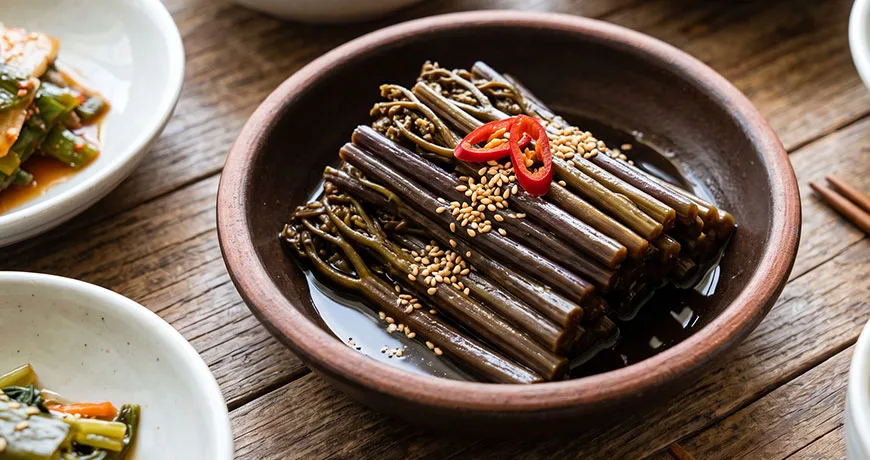
Dureupjangajji is a sublime seasonal chronicle, capturing the fierce vitality of spring’s first shoots and preserving them on the dining table. The Fatsia shoot (Dureup), prized for its distinctively bitter saponin aroma and tender green leaves, yields its wild edge when embraced by a gently warm, sweet-and-sour soy broth. Preparing it requires the precision of asymmetrical blanching—a technique that respects the difference between its woody base and fragile tips. By avoiding artificial sweetness and instead utilizing the subtle fruitiness of plum extract, the delicate breath of spring is elegantly protected. In a season when the palate can easily fatigue, this deep, forest-scented delicacy offers the most perfect culinary comfort.
- ⏱️ Total Time: 2–3 Days | Prep: 30 Mins (Trimming and asymmetrical blanching) | Cook & Ferment: 48 Hours cold aging
- 🍳 Difficulty: Medium (Requires precise timing to blanch uneven textures and preserve chlorophyll)
- 🌶️ Profile: A beautifully balanced, herbal bitterness woven into a clear, softly acidic soy umami
- 🍚 Core Process: Delicate Trimming, Asymmetrical Blanching, Lukewarm Infusion
- 🍶 Pairing: Steaming hot stone-pot rice (Sotbap), charcoal-grilled Hanwoo beef, pan-fried tofu in perilla oil
Physicochemical & Sensory Matrix
- Baseline Salinity: 4.5% ~ 5.5% (A gentle saltiness that refrains from overpowering the fragile spring aromas)
- pH Equilibrium: 4.2 ~ 4.6 (A transparent, light acidity crafted from apple vinegar and plum extract)
- Textural Crunch Index: [■■■□□] (A complex mouthfeel offering a crisp snap at the base and a tender, juicy leaf)
- Umami Density: 7.5 / 10 (A comforting oceanic base from kelp that elegantly supports the shoot’s herbal bitterness)
- Shelf Stability: Peaks after 2 days; maintains its vibrant green hue and flavor for 3 weeks refrigerated
- Aroma Profile: Deep Earthy Saponin (Woodland notes) | Aromatic Brewed Soy | Subtle Fruity Plum
Ingredients (Yields 1 Medium Airtight Glass Container)
- Primary Plant Matrix: 500g Premium, plump Fatsia Shoots (Cham-dureup) with unopened leaf tips
- Pretreatment Matrix: 2L Boiling Water, 1 tbsp Coarse Sea Salt
- Aromatic Broth Matrix: 1.5 Cups Brewed Soy Sauce, 1.5 Cups Purified Water, 0.5 Cup Unrefined Sugar, 0.5 Cup Plum Extract (Maesil-cheong), 1 Cup Apple Vinegar
- Aromatic Catalyst: 1 Sheet Dried Kelp (10x10cm), 1 Dried Shiitake Mushroom, 1 Slice of Fresh Lemon
Allergy Information
- Contains: Soy, Wheat (inherent in brewed soy sauce)
Equipment Stainless Steel Saucepan, Large Ice Water Bowl, Wire Mesh Strainer, Heat-resistant Glass Airtight Container
Cooking Instructions
- Delicate Trimming: Using a paring knife, gently shave off the rough, woody skin at the very base of the shoot and remove the small, leaf-like sheaths wrapping the bottom. For thicker shoots, carve a deep cross (+) into the woody base to ensure the heat penetrates evenly during blanching.
- Asymmetrical Blanching & Quenching: Add coarse sea salt to boiling water. Holding the leaves, submerge only the thick woody bases of the shoots into the boiling water for 30 seconds. Afterward, push the entire shoot, leaves and all, into the water for a brief 15 seconds. Instantly remove them and plunge them into an ice bath to completely halt the cooking process.
- Moisture Extraction: Once thoroughly chilled, take a few shoots at a time and gently squeeze them with both hands, pushing the water from the base down through the leaves. Do not crush them; apply just enough pressure to expel the free water while maintaining their elegant form. Spread them on a strainer to dry.
- Slow-simmering the Broth: In a saucepan, combine the water, soy sauce, sugar, kelp, and shiitake. Bring to a boil over medium heat. Once the aroma blooms, remove the kelp and turn off the heat. When the intense heat has dissipated, stir in the plum extract and apple vinegar to lock in their bright, volatile acidity.
- Lukewarm Infusion & Aging: Do not wait for the broth to chill completely. While it still retains a gentle, comforting warmth (around 40–50°C), pour it over the neatly packed Dureup. Tuck a slice of lemon on top. Allow it to reach room temperature, cover, and age quietly in the refrigerator for 48 hours.
💡 Professional Culinary Tips
- 1. The Art of Asymmetrical Blanching: A Fatsia shoot is a study in contrasts, featuring a dense, woody base and incredibly fragile leaves. Tossing the entire shoot into boiling water at once will reduce the leaves to mush before the base is cooked. Plunging the base first for 30 seconds is a chef’s precise thermal control, preserving the structural integrity of the plant while neutralizing any trace of its natural mild toxins (alkaloids).
- 2. Lukewarm Broth Infusion: Pouring boiling broth will destroy the chlorophyll, turning the vibrant green shoots into a dull, unappetizing yellow, and making the texture tough. Conversely, ice-cold broth fails to penetrate the fibrous stems. A lukewarm broth is the master’s compromise—warm enough to gently open the cell walls for deep flavor absorption, yet cool enough to protect the plant’s pristine green vitality.
- 3. Taming Bitterness with Fruit Acidity: The herbal bitterness of Dureup is its greatest charm, but if it clashes harshly with the salt of the soy sauce, it can fatigue the palate. Introducing the clear tang of apple vinegar and the elegant aromas of plum and lemon off the heat creates an acidic veil. This fruit-driven acidity beautifully rounds out the rough, bitter edges, resulting in a supremely sophisticated flavor profile.
🍶 Gastronomic Pairing
- A Perfect Harmony of Aroma and Temperature: Place a single, cold-aged Dureup shoot over a bowl of steaming, freshly cooked rice. As the heat of the rice warms the shoot, the deep, woodland aromas explosively awaken on the tongue. Serve this elegant preserve alongside high-quality charcoal-grilled beef or tofu pan-fried in perilla oil; its bright, herbaceous acidity will cleanly cut through the heavy fats, leaving the palate blissfully refreshed.
Nutrition Facts (Estimated)
Total Content : Approx. 30g (2-3 shoots)
Calories : 20 kcal (Plant dietary fiber and trace polysaccharides)
– Sodium : 380mg (A gentle salinity crafted to highlight the spring aromas)
– Total Carbohydrate : 4.2g
– Sugar : 3.0g
– Total Fat : 0.0g
– Saturated Fat : 0.0g
– Cholesterol : 0.0mg
– Protein : 1.5g (Plant-based proteins inherent in the shoots)
– Dietary Fiber : 1.8g
*Daily Values are based on a 2,000 calorie diet and standard Korean nutritional reference values.
**Nutritional values are calculated based on original ingredients; substitutions may alter specific macronutrients.
Origins and Food Culture of Pickled Fatsia Shoot (Dureupjangajji)
1. Historical Lineage: “Mokduchae” (木頭菜) in the Dongui Bogam and Joseon Agrarian Treatises
- The tradition of foraging young Aralia elata shoots dates back centuries across the Korean peninsula, serving as a seasonal delicacy and a medicinal wild green. Classical Hanja texts cataloged the plant as Mokduchae (木頭菜)—literally “vegetable from tree heads”—or Chongmokdu (楤木頭), referring to the edible terminal buds emerging from woody stems.
- In Heo Jun’s 1613 royal medical compendium Dongui Bogam, Mokduchae was documented as “neutral in nature, pungent, and non-toxic; it invigorates vital qi (補氣), fortifies the stomach, strengthens kidney vitality, and pacifies bodily aches.” Classical agrarian treatises, including Hong Man-seon’s Sallim Gyeongje (early 18th century), Seo Yu-gu’s Imwon Gyeongjeji, and Lady Yi’s Gyuhap Chongseo (1809), recorded methods for blanching the harvested buds to dress with seasoned vinegared paste or steeping them in soy sauce and vinegar brines. These records demonstrate that ancestral households refined pickling techniques to preserve this fleeting mountain treasure for year-round dining.
2. The Food Processing Chemistry of Differential Blanching and Cold Brine Steeping
- The craftsmanship of authentic Dureupjangajji relies upon managing the physical disparity between the dense, woody stalk and the delicate, paper-thin leaflets.
- The raw shoot harbors bitter tannins and mild alkaloids that can provoke digestive distress if consumed raw. Ancestors devised a “differential parboiling” technique, submerging the thick fibrous base in boiling water several seconds before immersing the tender upper foliage, then immediately arresting the heat in cold mountain spring water. This empirical step preserved cell-wall pectin integrity, neutralized volatile irritants, and locked in the vivid green color. Once drained, steeping the shoots in boiled and chilled soy-vinegar syrup under cool cellar temperatures prevented microbial spoilage while allowing complex fermented amino acids to saturate the interior fibers.
3. Highland Foraging Heritage in Gangwon and Mount Jiri and Scholarly Gastronomy
- The premier foraging grounds for wild fatsia shoots span the rugged granite valleys of Gangwon Province and the foothills of Mount Jiri in Jeollanam-do and Jeollabuk-do. Shoots emerging through rocky soils in these cold highland microclimates developed intense resinous aromatics and concentrated medicinal properties, earning them a place as prized royal tribute items.
- Joseon Confucian scholars revered the fatsia shoot’s ability to pierce through thorny bark in early spring as an emblem of moral resilience, enjoying Dureupjangajji alongside unrefined wine (takju) during spring poetry gatherings. Preserving the peak of wild mountain vitality within earthenware jars, Pickled Fatsia Shoot stands as an enduring monument to Korean foraging heritage, seasonal wisdom, and slow-food pickling mastery.
The Prickly Armor of Mountain Briers Yielding Emerald Shoots in Spring Rains, Taming Piercing Saponin Bitterness with a Scalding Blanch and Chilled Soy-Vinegar Brine: A Refined Portrait of Traditional Dureupjangajji
Dureupjangajji (Pickled Korean Angelica Tree Shoots in Seasoned Soy Sauce) represents an aristocratic herald of the wild foraging tradition in Korean gastronomy. Centered upon the nascent spring shoots of Aralia elata—gathered in early April from thorny thickets before the leaves can unfurl into mature foliage—this celebrated preserve demands thoughtful thermodynamic and osmotic calibration. Revered as the sovereign of wild spring mountain greens, fresh dureup bursts with deep pine-forest aromatics and bracing saponin bitterness. However, raw shoots are exceptionally fragile: their cut bases oxidize rapidly to a murky brown, and the leafy crowns spoil within days. Ancestral cooks resolved this vulnerability through the decisive art of the scalding blanch: plunging the trimmed shoots into boiling, salted water for mere seconds. This rapid thermal shock permanently arrests discoloration enzymes, purges harsh astringency, and locks in a jewel-like emerald hue. Cooled and bathed in a chilled, boiled marinade of soy sauce, vinegar, and cane sugar, the delicate crowns hydrate into velvety ribbons while the fibrous base firms into an enduring, crisp seasonal treasure.
Lifting an amber-sheened shoot of Dureupjangajji with chopsticks reveals a striking anatomical contrast: a translucent, golden-hued woody stem giving way to deep olive-green feathery leaf crowns. Approaching the nose, the deep, savory amino acids of brewed soy sauce are brightened by a volatile flight of fermented acetic acid, swiftly underpinned by a resinous breeze of mountain pine needles, damp loam, and fresh timber. Clamping down with the molars on the thick base delivers a brisk, authoritative acoustic snap. The pressurized, cellular vascular bundles rupture cleanly, discharging trapped, icy brine across the tongue. A multi-layered mouthfeel unfolds as the tender leaf tips melt smoothly like silk, while the crisp stem provides engaging dental resistance. The savory salinity of the soy sauce and the sharp lift of vinegar awaken the salivary glands, leaving behind a refined, noble bitterness that cleanses the palate. Stationed beside crisp grilled pork belly or rich beef brisket, a single shoot of Dureupjangajji cuts through heavy animal fats like a razor, carrying the palate straight into a sunlit pine forest.
The cultural identity of Dureupjangajji lies in the intuitive craftsmanship that captured the fleeting, untamed spirit of spring mountains and preserved it for all seasons. By softening raw woodland bitterness into a harmonious balance of acid, salt, and crunch, this glistening pickle remains an unblemished monument to forest foraging, cellular preservation, and the quiet elegance of the Korean table.
Editor’s Review
1. Dual Textural Mechanics: Basal Vascular Shear vs. Apical Lamellar Capillarity
Dureupjangajji showcases a rare, bimodal mouthfeel engineered from the distinct anatomy of a single botanical shoot:
- Basal Vascular Fracture: The lower stalk is densely reinforced with longitudinal vascular bundles rich in cellulose and hemicellulose. The brief hot-water blanch followed by cold hypertonic brining preserves this rigid framework without cell collapse, generating an audible, crisp snapping fracture (ajak) that releases pressurized marinade upon dental shear.
- Apical Leaf Capillary Adhesion: The delicate young leaflets undergo turgor relaxation during blanching, allowing them to cling together through surface tension. They trap the viscous soy-vinegar liquor in microscopic capillary sheets, yielding a soft, melting mouthfeel that cushions the crisp resistance of the stem.
2. Thermal Blanching Kinetics: Polyphenol Oxidase (PPO) Inactivation, Saponin Leaching, and Terpene Retention
The luminous color and balanced flavor of Dureupjangajji are governed by targeted enzymatic arrest and phase separation:
- PPO Denaturation: Freshly cut dureup contains abundant polyphenols and active polyphenol oxidase (PPO). Exposure to boiling water for 30 to 60 seconds thermally denatures PPO, preventing oxidative melanin synthesis and halting the substitution of magnesium in chlorophyll, thus preserving its vivid emerald color.
- Controlled Saponin Extraction: The raw shoot’s harsh, throat-scratching astringency stems from triterpenoid saponins (araliosides). The scalding blanch leaches excess water-soluble saponins and green aldehydes into the wastewater, refining the bitterness into a pleasant, appetite-stimulating tonic note.
- Hydrophobic Terpene Entrapment: Non-polar monoterpenes responsible for the shoot’s coniferous fragrance—primarily alpha-pinene, myrcene, and limonene—are water-insoluble. They remain trapped within intracellular lipid compartments through the blanch, infusing the cold soy marinade with persistent evergreen top notes.
3. Acetic Acid Buffering and Lipid Degreasing Physiology
Dureupjangajji serves as an agile physiological counterbalance against heavy, fat-laden dishes:
- Interfacial Lipid Cleansing: Saturated animal fats coat the lingual papillae with a hydrophobic film, blunting sensory reception. The organic acetic acid in the pickle (pH 3.8–4.2) drastically lowers interfacial surface tension, dispersing and stripping away grease with precision.
- Digestive Reflex Stimulation: The combination of residual saponins and soy glutamates stimulates cranial nerve pathways, promoting copious salivary and gastric juice secretion and expediting the digestive processing of protein-rich banquets.