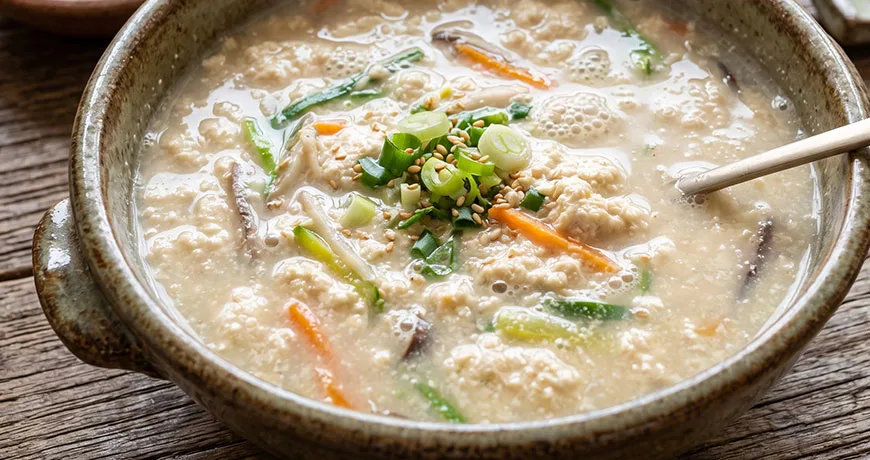
Unlike Kongbijitang, which utilizes the leftover fibrous pulp of soybeans, Kongtang is a high-density, plant-based colloidal suspension made by mechanically grinding fully hydrated whole soybeans. This process yields an incredibly rich emulsion packed with intact glycinin proteins, natural soy lecithin, and micro-cellulose. The artisan begins by extracting animal lipids from sautéed pork via the Maillard reaction, then coating the turgid cellular structure of blanched Napa cabbage with this fat. The ultra-fine raw soybean suspension is then poured over this matrix and heated thermodynamically with immense caution. If allowed to boil violently, the soy proteins irreversibly denature and curdle, separating from the water and ruining the velvety texture. The critical technique involves constant, gentle mechanical agitation just below the boiling point to maintain a perfectly smooth, creamy emulsion. Furthermore, no salt is added to the pot during cooking to prevent premature chemical coagulation. Instead, a hypertonic soy sauce binder is dynamically applied by the diner at the table, allowing the profound, unadulterated viscoelasticity and nutty richness of the soy to completely coat the palate.
⏱️ Total: 40 mins (excluding 8 hrs hydration) | Prep: 15 mins | Cook: 25 mins | 🍳 Difficulty: High (Requires ultra-fine grinding and strict thermal denaturation control) | 🌶️ Profile: Profoundly Nutty, Velvety, and deeply Savory | 🍚 Focus: Colloidal Suspension, Thermal Denaturation, & Premature Coagulation Control | 🍶 Pairing: Ice-cold, lactic acid-fermented Dongchimi (Radish water kimchi) brine
Ingredients (2–3 servings)
- Protein-Lipid Suspension Matrix: 300g Whole Dried Soybeans (Baektae – fully hydrated in cold water for 8–10 hours, then mechanically ground in a high-speed blender with 400ml of water until ultra-smooth)
- Animal Lipid Binder: 100g Pork (shoulder or stewing cut, finely chopped)
- Cellulose & Turgor Matrix: 150g Napa Cabbage leaves (blanched, excess water squeezed out, and finely chopped)
- Aqueous Umami Solvent: 400ml Anchovy-Kelp Broth or Purified Water
- Hypertonic Aromatic Emulsion (Yangnyeomjang): 2 tbsp Brewed Soy Sauce, 1 tbsp Soup Soy Sauce, 2 tbsp finely chopped green onions, 0.5 tbsp minced garlic, 1 tbsp Toasted Sesame Oil, 1 tsp Gochugaru (chili flakes), 1 tbsp Toasted Sesame Seeds
Allergy Information Contains: Soy, Wheat (from soy sauces), Pork
Equipment High Thermal Mass Pot (well-coated or cast-iron), High-speed Blender, Spatula
Cooking Instructions
- Lipid Extraction & Coating: Heat the pot over medium heat and sauté the pork. Once the Maillard reaction occurs and the animal lipids are sufficiently rendered, add the blanched cabbage. Sauté together to seamlessly coat the cellular cellulose of the cabbage with the savory pork fat.
- Solvent & Suspension Addition: Pour the 400ml of anchovy broth over the pork and cabbage. Immediately follow by pouring in the entire ultra-fine raw soybean suspension.
- Critical Thermodynamic Heating: Maintain the heat at medium-low. To prevent the dense soybean suspension from scorching at the bottom, use a spatula to continuously and gently agitate the mixture, scraping the bottom in a single direction.
- Denaturation Control: Do not allow the soup to reach a rolling boil. The moment microscopic bubbles begin to rise around the edges, the raw, grassy scent of the soybeans transforms into a deeply nutty aroma, and the entire liquid thickens into a velvety gel (roughly 10–15 minutes). Turn off the heat immediately. (Absolutely no salt is added during this step.)
- Structural Finish & Dynamic Osmotic Seasoning: Ladle the pristine, creamy Kongtang into individual serving bowls. Serve the hypertonic aromatic soy sauce emulsion on the side, instructing the diner to spoon it directly over their soup to control the osmotic pressure and flavor exactly at the moment of consumption.
💡 Professional Culinary Tips
- Kinetics of Hydration & Mechanical Grinding: Attempting to grind soybeans that have not been hydrated for at least 8 hours will result in coarse, sandy cellulose particles rather than an ultra-fine suspension. Only when the beans have absorbed maximum water can a high-speed motor physically shatter them into a microscopic matrix, allowing the proteins and natural lecithin to emulsify perfectly with the water into a flawless cream.
- Thermal Denaturation Threshold of Soy Proteins: The most common catastrophic error in making Kongtang is treating it like a normal boiling stew. If the glycinin proteins are subjected to aggressive kinetic convection and temperatures exceeding 95°C, the protein chains rapidly denature, tangle, and separate from the water, forming a grainy, unpalatable curd. Gently elevating the temperature just below the boiling point while stirring is the paramount secret to preserving its signature velvety viscosity.
- Prevention of Premature Osmotic Coagulation: If sodium chloride (salt or soy sauce) is introduced into the boiling pot, the sodium ions biochemically bind with the hot soy proteins, triggering instantaneous salt coagulation (curdling the soup into firm tofu curds). Leaving the pot entirely unseasoned and allowing the diner to apply the hypertonic soy sauce dynamically at the table is a necessary gastronomic control to preserve the liquid, creamy colloidal state until it reaches the mouth.
🍶 Gastronomic Pairing
- Biochemical Palate Cleansing: When the ultra-dense plant proteins and the heavy, rendered pork lipids coat your mucosal membranes in a thick, velvety film, pair this dish with a bowl of ice-cold Dongchimi (Radish Water Kimchi) brine. The extreme endothermic cooling effect and the sharp, piercing lactic acid of the fermented brine act like a surgical scalpel, cleanly stripping the slick lipids and starches from your tongue. This flawlessly resets your palate and exponentially amplifies the subtle, nutty sweetness of the soybeans for the next spoonful.
Nutrition Facts (Estimated)
Total Content : Approx. 450g (1 serving)
Calories : 380 kcal
– Sodium : 750mg (Variable depending on the dynamic application of the soy sauce binder)
– Total Carbohydrate : 22.0g (Complex plant carbohydrates and cellulose)
– Sugar : 4.0g
– Total Fat : 18.0g (Natural unsaturated soy lipids and rendered pork fat)
– Saturated Fat : 4.0g
– Cholesterol : 30.0mg (From pork)
– Protein : 32.0g (Ultra-high density intact soy protein matrix)
– Dietary Fiber : 14.0g
*Daily Values are based on a 2,000 calorie diet and standard Korean nutritional reference values.
**Nutritional values are calculated based on original ingredients; substitutions may alter specific macronutrients.
Origins and Food Culture of Soybean Soup (Kongtang)
1. Northern “Doebiji” Lineage and Highland Famine Relief Traditions
- Rooted in the historical culinary traditions of the northern provinces (Hwanghae-do and Pyeongan-do) as well as the rugged mountainous interior of Gangwon and Chungcheong, where agrarian communities prioritized extracting maximum nutrition from their crops.
- While urban and southern centers strained soybeans to craft refined tofu and cooked the leftover pulp into bijitang, northern households ground whole soaked beans into an unfiltered slurry to ensure no caloric energy or protein was wasted, creating a high-density, sustaining dish that sustained families through long, sub-zero winters.
2. The Culinary Science of Unfiltered Wet-Milling and Controlled Thermal Gelation
- The hallmark of authentic preparation lies in the technique of unfiltered wet-milling: soaking dried soybeans in cold water until fully rehydrated and grinding them with minimal water using stone mills (maetdol) into an ultra-smooth, creamy purée rather than separating the milk from the solids.
- Because whole soy proteins and starches scorch rapidly over high heat, the cooking requires delicate thermal management: introducing the pureed beans into simmering broth over a low, steady flame while stirring patiently with a wooden paddle. This controlled hydrothermal process fully denatures bitter lipoxygenase enzymes (dispelling raw beany odors) while inducing gentle thermal protein gelation, achieving the dish’s signature velvety, porridge-like consistency.
3. The Pure Ode to “Field Beef” and Monastic Non-Irritant Comfort Dining
- Long revered in Buddhist temple cuisine (Sachal Eumsik) and aristocratic scholar households (Banga) as a tranquil restorative food, serving as a vital source of stamina for meditating monks and convalescing elders who required nutrient-dense nourishment free from animal fats or pungent alliums (Osinchae).
- Proving that profound gastronomic luxury can emerge purely from the unadorned sweetness of whole earth-grown legumes, Kongtang stands as an enduring monument to Korean slow food and plant-based heritage dining, offering modern diners a serene, restorative sanctuary for digestion and cellular vitality.
The Silken Suspension of Whole Stone-Milled Soybeans and the Gentle Warmth of Simmered Field Greens: A Refined Portrait of Kongtang
Kongtang (Pureed Whole Soybean Soup with Winter Greens) stands as the pristine, tranquil, and deeply comforting summit of Korea’s unrefined legume (tangban) gastronomy. Prime dried yellow soybeans (baektae), plumped through hours of soaking in cold spring water and lightly dehulled, are finely pulverized on a traditional stone mill into a pure, snow-white slurry. Crucially bypassing the industrial separation of curds and fibrous pulp (kongbiji) typical of tofu making, this dish utilizes the intact soybean puree in its entirety, preserving every fraction of plant protein, dietary fiber, and natural lipids. Poured gently into an earthenware pot over a light anchovy-kelp stock or delicate pork bone broth containing tender braised winter cabbage greens (ugeoji) or radish tops, the soup is coaxed into a slow, watchful simmer over low convective heat. Strictly eschewing the sharp, fermented red kimchi and assertive chili oils of classic kongbijitang, Kongtang champions the unmasked, pristine sweetness and nutty velvet of whole legumes, wrapping the body in deep, restorative serenity.
Presented in an earthenware bowl with soft, ivory micro-bubbles cresting its surface, lifting a deep spoonful releases an immediate, grounding sensory charge: the clean, toasted aroma of freshly cooked soybeans mingles seamlessly with the delicate sweetness of simmered brassica greens and the faint marine savor of dried kelp. Gliding across the tongue, the soup’s velvety, micro-particle suspension coats oral tissues with zero graininess, delivering deep warmth down the throat to calm a tired digestive system. The inherent sugars and free amino acids of the whole bean bloom across the palate in a wave of gentle, nutty sweetness. The tender leaves of braised cabbage yield with a soft, succulent give, releasing trapped vegetal juices that balance the soup’s natural density. Seasoned lightly at the table with a touch of aged soy sauce or salted fermented shrimp, this unembellished dish provides an unforgettable ritual of clean nutrition and quiet gastronomic solace.
The enduring brilliance of Kongtang lies in its northern agrarian heritage—nurtured across the chilly winters of Hwanghae, Pyongan, and the rugged mountain highlands of Gangwon, where families gathered around stone mills to transform dried harvest legumes into life-sustaining tonics. Celebrating the complete nutritional wholeness of the humble soybean without chemical or mechanical fractionation, a steaming bowl of Kongtang remains an irreplaceable monument of agrarian resourcefulness, maternal tenderness, and the timeless beauty of Korean whole-food gastronomy.
Editor’s Review
1. A Dynamic Harmony of Silken Soybean Suspension, Melting Winter Cabbage Tenderness, and Low-Shear Broth Fluidity
The textural landscape inside the bowl delivers extraordinary structural lightness, physical comfort, and effortless digestion. The finely stone-ground soybean particles form a continuous colloidal suspension that yields a cloud-like, frictionless mouthfeel without chalky grit. The braised winter cabbage leaves, relaxed by prolonged simmering, collapse tenderly under tooth pressure to release refreshing vegetable moisture. This prevents the rich bean puree from cloying, while the light broth matrix provides smooth lubrication, ensuring an impeccably balanced, non-fatiguing mouthfeel from the first steaming spoonful to the last.
2. Glycinin and Beta-Conglycinin Sol-Gel Transition, Saponin Foam Thermokinetics, Trypsin Inhibitor Thermal Inactivation, and Oligosaccharide Savor
Kongtang represents an exacting study in legume protein rheology, interfacial foam dynamics, and antinutrient heat inactivation. Pulverizing soaked soybeans releases major storage globulins—predominantly 11S glycinin and 7S beta-conglycinin—into an aqueous emulsion. Gentle heating between 80°C and 90°C initiates partial protein unfolding, exposing hydrophobic amino acid residues that cross-link to form a delicate, thermoreversible hydrogel network responsible for the soup’s rich, creamy body. Surface-active soy saponins act as potent natural surfactants that generate rapid, voluminous foaming (boil-over risk) under aggressive heat, making precise low-temperature convective simmer control essential. Crucially, sustained thermal exposure denatures and completely inactivates antinutritional factors—principally heat-labile Kunitz Trypsin Inhibitors (KTI) and phytohemagglutinins (lectins)—elevating protein bioavailability and intestinal absorption beyond 90%. Natural bean oligosaccharides (stachyose and raffinose) combine with native glutamates and stock inosinate (IMP) to stimulate human T1R1/T1R3 umami heterodimers, yielding a delicate, multi-tiered natural sweetness without added sugars.
3. Whole-Bean Archeology and the Living Lineage of Northern Korean Grain Gastronomy
By preserving the intact matrix of the soybean prior to the historical divergence of tofu curds and separated pulp, Kongtang serves as a living culinary artifact of ancient whole-legume cookery. Delivering balanced bioavailable nutrition, isoflavones, and dietary fiber through unadorned agrarian staples, this pristine ivory bowl stands as an enduring sanctuary of domestic comfort, nutritional purity, and brilliant culinary restraint.