
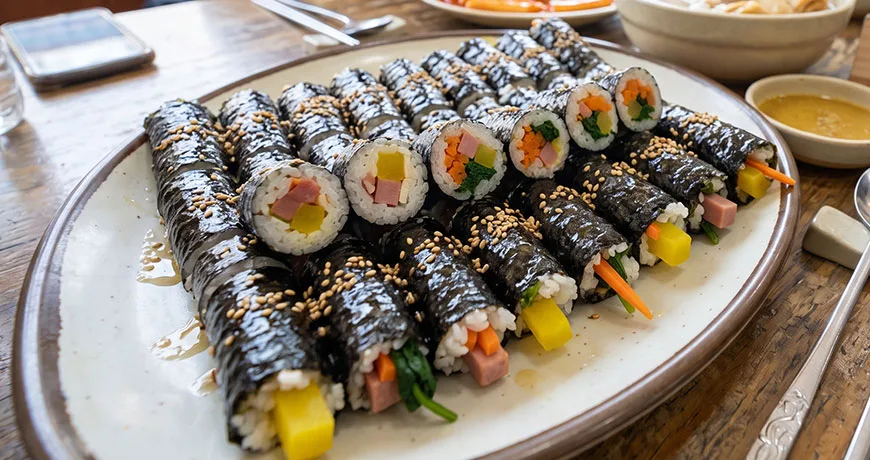
Kkomagimbap is a micro-cylindrical molecular gastronomy construct where the surface-area-to-volume ratio is massively increased compared to standard Gimbap. This geometric shift means the flavor profile is heavily dominated by the umami of the roasted marine algae wrapper (Gim) and the intense mechanical turgor pressure of the fillings. To prevent the kinetic moisture of the warm rice from penetrating and ruining the delicate, hydroscopic algae matrix, the amylopectin starches must be cooled to body temperature and perfectly coated with a hydrophobic lipid layer (sesame oil). Compressed tightly within this dry membrane are hypertonic pickled radishes, Maillard-seared ham, and beta-carotene-rich carrots. When paired with a sharp mustard-soy emulsion, the volatile allyl isothiocyanate compounds biochemically slice through the heavy sesame lipids, resetting the palate with every single bite.
⏱️ Total: 25 mins | Prep: 20 mins | Cook: 5 mins | 🍳 Difficulty: Low (Requires strict moisture control and tight mechanical rolling) | 🌶️ Profile: Nutty, Crisp, Savory, and Sharp | 🍚 Focus: Moisture Migration Thermodynamics, Lipid Coating, & Chemical Palate Cleansing
Ingredients (2 servings / 12–16 mini rolls)
- Hydroscopic Algae Matrix: 3–4 sheets roasted seaweed for Gimbap (cut into quarters with scissors)
- Lipid-Coated Starch Matrix: 1.5 bowls cooked white rice, 1.5 tbsp toasted sesame oil, 3 pinches fine salt, 1 tbsp toasted sesame seeds
- Turgor & Color Matrix: 12–16 strips pickled radish for mini gimbap (moisture aggressively squeezed out), 1/2 carrot (julienned), 1 handful spinach (blanched, squeezed, and seasoned with a drop of sesame oil and salt)
- Protein Matrix: 12–16 strips Gimbap ham
- Chemical Cleansing Emulsion (Mustard Sauce): 0.5 tbsp Korean yellow mustard paste (Yeon-gyeoja), 1 tbsp soy sauce, 1 tbsp vinegar, 1 tbsp sugar, 1 tbsp water
Allergy Information Contains: Soy, Wheat (from soy sauce), Pork (Ham)
Equipment Frying Pan, Mixing Bowls, Knife, Cutting Board, Scissors
Cooking Instructions
- Starch Thermodynamics (Cooling & Coating): Spread the warm rice in a wide bowl. Add the salt, sesame oil, and sesame seeds. Use a spatula in a slicing motion (mechanical agitation) to evenly coat every grain of starch with the lipids. Allow the rice to cool to body temperature (approx. 37°C/98°F). This stops the emission of kinetic steam, which would otherwise wilt the seaweed.
- Matrix Prep (Searing & Turgor Control): Lightly oil a pan and sauté the julienned carrots to break down their cellulose walls and extract the fat-soluble beta-carotene. Briefly sear the ham to induce Maillard browning for structural integrity. Pat the pickled radish completely dry with paper towels to prevent internal moisture leakage.
- Mustard Emulsification: Whisk the mustard paste, soy sauce, vinegar, sugar, and water until smooth. This acidic, hypertonic emulsion acts as the primary chemical catalyst to cut through the fats during consumption.
- Micro-cylindrical Assembly: Place a quartered sheet of seaweed rough-side up. Spread a very thin, even layer of the cooled rice, leaving a 1cm bare margin at the top edge. Line up the radish, carrot, ham, and spinach in the center. Using your fingertips, compress the ingredients tightly and roll it into a firm micro-cylinder.
- Rheological Finish: Lightly brush the exterior of the finished mini rolls with a touch of sesame oil and sprinkle with sesame seeds to prevent oxidation. Serve immediately alongside the mustard dipping sauce.
💡 Professional Culinary Tips
- Thermodynamics of Moisture Migration: The most common failure in Gimbap making is using hot rice. Roasted seaweed (Gim) is incredibly hydroscopic; it eagerly absorbs moisture. Steam from hot rice instantly penetrates the algae, turning a crisp, brittle wrapper into a chewy, rubbery disaster. Cooling the rice and creating a hydrophobic barrier with sesame oil physically isolates the wet starch from the dry seaweed.
- Surface-Area-to-Volume Rheology: Even with identical ingredients, Kkomagimbap tastes structurally different from large Gimbap. Because the diameter is so small, the ratio of seaweed wrapper to internal rice is exceptionally high. During mastication, your jaws encounter significantly less soft starch and a much higher concentration of snappy vegetable turgor and chewy algae tensile strength, creating a highly dynamic mechanical crunch.
- Biochemical Mechanism of Allyl Isothiocyanate: Dipping Kkomagimbap in mustard sauce is a functional palate cleanser. The volatile sulfur compounds in the mustard violently stimulate the TRPA1 receptors in the nasal and oral cavities. This intense chemical shock instantly neutralizes the heavy coating of sesame oil and pork fat on your tongue, completely resetting your sensory baseline so that every subsequent roll tastes incredibly fresh.
Nutrition Facts (Estimated)
Total Content : Approx. 250g (1 serving, approx. 6–8 mini rolls)
Calories : 380 kcal
– Sodium : 720mg
– Total Carbohydrate : 54.0g
– Sugar : 4.0g
– Total Fat : 12.0g (Primarily unsaturated from sesame oil)
– Saturated Fat : 2.5g
– Cholesterol : 10.0mg
– Protein : 11.0g
– Dietary Fiber : 3.5g
*Daily Values are based on a 2,000 calorie diet and standard Korean nutritional reference values.
**Nutritional values are calculated based on original ingredients; substitutions may alter specific macronutrients.
Origins and Food Culture of Mini Gimbap (Kkomagimbap)
1. Historical Lineage: Marketplace Efficiency and Gwangjang Market’s “Mayak Gimbap”
- Originating in the bustling traditional wholesale marketplaces of Seoul during the 1970s and 1980s (most notably Gwangjang and Dongdaemun markets), where busy fabric merchants and itinerant traders required swift, mess-free, one-handed sustenance without stepping away from their stalls.
- In Gwangjang Market, the minimalist combination of slender rice rolls filled simply with pickled radish, carrots, and spinach served alongside a sharp, nasal-clearing mustard-soy dipping sauce became so irresistibly popular that it earned the nationwide moniker Mayak Gimbap (“addictive gimbap”).
2. The Culinary Science of Quartered Sheets and Whole-Roll Sealing
- The hallmark of authentic preparation lies in quartering standard roasted laver sheets (gim), spreading an ultra-thin layer of rice, and tightly rolling a select few ingredients to maximize the crisp filling-to-rice textural ratio.
- Unlike standard gimbap, mini rolls are deliberately left uncut; brushing the exterior generously with toasted sesame oil creates a hydrophobic barrier that shields the seaweed from indoor moisture, locking in internal juices and preserving a crisp, tender snap.
3. Nostalgic Picnic Traditions, Finger-Food Practicality, and Street Food Pairing
- Celebrated across generations as an essential finger-food classic, its bite-sized shape makes it the definitive choice for kindergarten excursions, casual road trips, and quick on-the-go breakfasts.
- An indispensable cornerstone of Korean street food (bunsik) dining, frequently paired with bubbling tteokbokki or skewered fish cakes, Mini Gimbap represents the heartwarming simplicity, energetic resilience, and accessible joy of Korean everyday comfort gastronomy.
The Crisp Snap of Toasted Porphyra Glazed in Sesame Oil and the Joyful Harmony of Compressed Colors: A Refined Portrait of Kkomagimbap
Kkomagimbap (Mini Seaweed Rice Rolls) stands as the dynamic, accessible, and delightfully uninhibited pinnacle of Korean street-food and market (bunsik) gastronomy. Tender roasted sheets of dried sea laver (gim—Porphyra) are halved or quartered into compact squares, thinly layered with short-grain white rice delicately seasoned with fine sea salt and cold-pressed toasted sesame oil, and neatly wrapped around slender ribbons of yellow pickled daikon radish (danmuji), savory ham, parboiled spinach, and lightly sautéed julienned carrots. Diverging decisively from the grand, sliced architecture of standard full-sized Gimbap, this dish presents slender, finger-width cylinders served whole and uncut. Finished with a generous brush of fragrant sesame oil and a dusting of toasted sesame seeds, it offers an ergonomic masterpiece designed to be eaten by hand in two or three satisfying bites.
Grasping a glistening, sesame-scented roll and taking the first clean bite unleashes an immediate sensory spark. The intoxicating aroma of toasted sea laver mingles effortlessly with the warm, nutty perfume of roasted sesame oil. Sinking your teeth into the cylinder triggers an auditory, crackling snap as the brittle seaweed casing gives way, immediately met by the comforting, chewy elasticity of the warm rice grains within. Sinking deeper reveals the vibrant, juicy crunch of the slender pickled daikon radish bursting with sweet, lactic-fermented acidity, seamlessly balanced by the rich, savory depth of seared ham and the earthy, chlorophyll-rich tenderness of garden spinach. When paired with a dip of pungent yellow mustard-soy sauce (gyeoja-jang), a sharp, nasal burst of refreshing heat slices cleanly through the lingering lipids, delivering an endlessly addictive culinary cadence that compels you toward the next roll. The enduring brilliance of Kkomagimbap lies in its functional minimalism—curating only the most essential, time-tested components of traditional gimbap and concentrating them into a pocket-sized roll that requires no utensils or slicing. Born from the bustling energy of historic five-day markets and the legendary alleyways of Seoul’s Gwangjang Market—where it earned the affectionate moniker Mayak Gimbap (“narcotic gimbap”) for its irresistible snack appeal—this compact cylinder remains a timeless cultural monument of unpretentious nourishment, nostalgic childhood
Editor’s Review
1. A Dynamic Harmony of Brittle Laver Tensile Snap, Crisp Radish Turgor, and Sesame-Lubricated Starch Elasticity
The structural mechanics within this slender roll deliver an extraordinarily vivid textural rhythm. Biting into an uncut mini roll preserves the crisp, brittle fracture of freshly roasted seaweed, offering an immediate auditory crunch that yields smoothly to the firm, distinct chew of well-seasoned rice. The slender cut of pickled radish imparts a lively, watery snap without overwhelming the delicate layers, while the supple chew of ham and blanched greens provides a soft, savory interior. The exterior sesame oil sheen ensures a luxurious, frictionless mouthfeel that finishes clean without clumping.
2. Porphyra Hydrocolloid Tensile Mechanics, Hydrophobic Lipid Moisture Barrier Dynamics, and Allyl Isothiocyanate Flavor Kinematics
Kkomagimbap represents an exacting study in seaweed polymer biophysics, interfacial lipid chemistry, and volatile trigeminal stimulation. High-grade roasted laver maintains a brittle, crisp cell structure when its moisture content is kept below 3%. Coating the roll’s surface and the seasoned rice with unsaturated fatty acids from toasted sesame oil establishes a hydrophobic barrier that physically impedes the capillary migration of free water from the warm rice to the hygroscopic seaweed matrix, delaying sogginess. Furthermore, nucleotide inosinates (IMP) from the cured ham bond with natural free glutamates concentrated within the toasted laver and soy seasoning, multiplying umami perception. Concurrently, volatile allyl isothiocyanates (AITC) from the accompanying mustard dip trigger transient trigeminal nerve stimulation in the nasal cavity, accelerating salivation, balancing oral lipids, and elevating overall aromatic clarity.
3. The Marketplace Vitality of ‘Mayak Gimbap’ and the Modern Triumph of Korean Finger-Food Gastronomy
Pioneered within the vibrant labyrinth of Seoul’s traditional marketplaces and rapidly popularized as an iconic Korean finger food, Kkomagimbap captures the agile, pragmatic genius of contemporary dining. By delivering the holistic nutritional balance of grains, cured protein, and fermented botanicals in an ergonomic, hand-held parcel, this humble classic serves as an enduring sanctuary of casual conviviality, nostalgic comfort, and effortless culinary craftsmanship.