
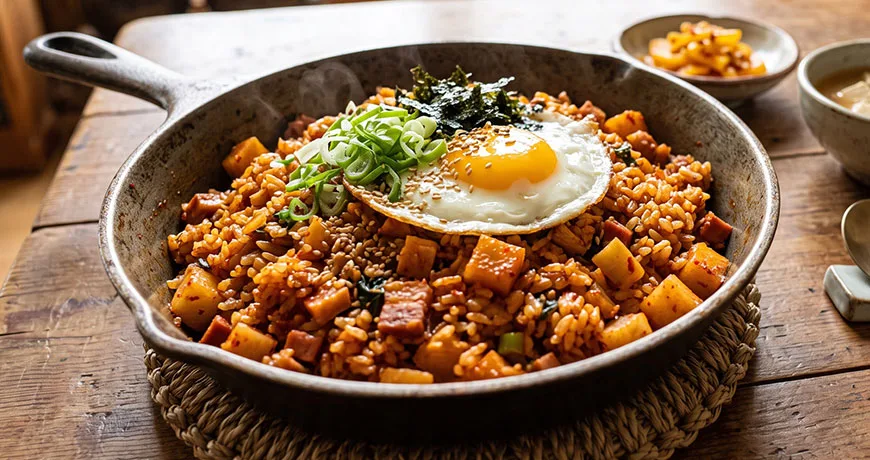
Kkakdugibokkeumbap is a high-impact thermodynamic fried rice engineered to control the rigid pectin and cellular turgor pressure of lactic-acid-fermented radish (Kkakdugi), rapidly coating retrograded cold rice with rendered animal lipids. The artisan starts by rendering the high-melting-point fats from thinly sliced beef brisket or pork belly in a screaming hot cast-iron pan. Once the diced radish and highly concentrated kimchi brine are added, the intense heat triggers explosive moisture evaporation, condensing the tartness into a savory paste. When the cold, dry rice is introduced, the artisan employs a precise mechanical agitation (Wok-hei)—slicing through the grains with a spatula without crushing them—so that the hypertonic seasoning and rendered fat perfectly emulsify and form a lipid shield around each individual grain. The resulting Maillard reaction on the surface of the rice, contrasted with the explosive mechanical crunch of the radish and its refreshing lactic acid, delivers an unparalleled textural and flavor experience.
⏱️ Total: 20 mins | Prep: 10 mins | Cook: 10 mins | 🍳 Difficulty: Moderate (Requires moisture evaporation and Maillard reaction control) | 🌶️ Profile: Deeply Savory, Tart, Spicy, and Rich | 🍚 Focus: Starch Retrogradation, Lipid Coating, & Turgor Preservation | 🍶 Pairing: Ice-cold, highly carbonated crisp Lager beer
Ingredients (2 servings)
- Amylopectin Matrix: 2 bowls cold, cooked White Rice (day-old to ensure starch retrogradation and low moisture activity)
- Turgor & Lactic Matrix: 1 cup well-fermented Kkakdugi (Diced Radish Kimchi, finely chopped into 1cm cubes), 3–4 tbsp Kkakdugi brine
- Animal Lipid & Amino Acid Binder: 100g thinly sliced Beef Brisket (Chadolbagi) or Pork Belly, 1/2 stalk Green Onion (chopped, to extract aromatic oils)
- Chemical Seasoning Binder: 0.5 tbsp Brewed Soy Sauce, 0.5 tsp Sugar (to buffer the lactic acid), 0.5 tbsp Gochugaru (chili flakes)
- Lipid Coating & Garnish: 1 tbsp Toasted Sesame Oil, 2 fresh Eggs (fried sunny-side up), 1 tbsp Toasted Sesame Seeds, 1 handful Roasted Seaweed flakes (Gim)
Allergy Information Contains: Beef (or Pork), Soy, Wheat (from soy sauce), Egg
Equipment Cast-Iron Pan or High Thermal Mass Wok, Spatula, Cutting Board, Knife
Cooking Instructions
- Lipid Extraction: Heat the pan aggressively. Add the beef brisket and chopped green onions. Sauté until the high-protein muscle fibers trigger the Maillard reaction, extracting a highly concentrated animal lipid infused with the volatile sulfur compounds of the onions.
- Lactic Acid Condensation: Once the meat is browned, add the chopped Kkakdugi and sauté over high heat. As the surface of the radish begins to turn translucent, pour the sugar and soy sauce onto the bare, hot edges of the pan to instantly caramelize them, exploding their umami. Immediately add the Kkakdugi brine and Gochugaru, aggressively boiling off the excess water to evaporate the sharp acidity.
- Amylopectin Lipid Coating: Once the liquid condenses into a sticky gel paste, reduce the heat to medium-low and add the cold rice. Use the edge of the spatula to slice through the rice matrix—a precise mechanical agitation that avoids crushing the grains—allowing the hypertonic paste and animal lipids to form a seamless emulsion coating around each retrograded starch grain.
- Maillard Crust Formation: Spread the thoroughly mixed rice into a thin, even layer across the bottom of the pan. Increase the heat slightly and leave it completely undisturbed for 1–2 minutes. This thermodynamic application evaporates the remaining moisture at the bottom, forging a crispy, caramelized crust (Nurungji) via the Maillard reaction.
- Structural Finish: Turn off the heat and drizzle with sesame oil for a volatile nutty finish. Plate the rice, crown with a sunny-side-up egg, seaweed flakes, and sesame seeds, utilizing the yolk’s lecithin to add a final creamy dimension.
💡 Professional Culinary Tips
- Thermodynamics of Starch Retrogradation: Using freshly cooked, high-water-activity rice results in a gummy, mashed texture as the amylopectin starches stick together. Using cold, day-old rice that has undergone starch retrogradation—where the moisture has evaporated and the starch chains have crystallized—allows the high-heat animal lipids to coat the exterior of each distinct grain, achieving the perfect fluid-dynamic fried rice.
- Moisture Evaporation & Acid Buffering: Kkakdugi brine is the core umami matrix, but excess moisture turns fried rice into a soggy porridge. Vigorously boiling off the water content of the brine over high heat until it condenses into a sticky paste evaporates the sharp acidity while exponentially concentrating the savory depth. A touch of sugar acts as a biochemical buffer, rounding off the harsh edges of the remaining lactic acid.
- Cellular Turgor & Thermodynamic Timing: Radishes possess significantly higher cellular turgor pressure and denser cellulose/pectin networks than Napa cabbage. Overcooking them via prolonged thermal hydrolysis completely obliterates this mechanical crunch. Introducing the cold rice at the exact thermodynamic threshold—just as the exterior of the radish turns translucent—rapidly drops the pan’s temperature, preserving an explosive textural crunch that perfectly contrasts the chewy rice grains.
🍶 Gastronomic Pairing
- Biochemical Palate Cleansing: When the heavy animal lipids of the beef, the spicy lactic kick of the radish, and the creamy egg yolk thoroughly coat your palate, pair this intense dish with a profoundly cold, highly carbonated crisp Lager beer. The freezing micro-bubbles of carbonation and refined ethanol molecules slice cleanly through the sticky lipid barrier, impeccably resetting your taste receptors and fiercely amplifying the condensed carbohydrates of the fried rice.
Nutrition Facts (Estimated)
Total Content : Approx. 450g (1 serving)
Calories : 520 kcal
– Sodium : 1,050mg (Variable depending on Kkakdugi and soy sauce)
– Total Carbohydrate : 75.0g (Primarily retrograded amylopectin)
– Sugar : 4.0g
– Total Fat : 18.0g (Rendered animal lipids and sesame oil)
– Saturated Fat : 6.0g
– Cholesterol : 210.0mg (From egg and beef)
– Protein : 14.0g
– Dietary Fiber : 5.0g
*Daily Values are based on a 2,000 calorie diet and standard Korean nutritional reference values.
**Nutritional values are calculated based on original ingredients; substitutions may alter specific macronutrients.
Origins and Food Culture of Diced Radish Kimchi Fried Rice (Kkakdugibokkeumbap)
1. The Pinnacle of K-BBQ: Evolution of the Cast-Iron “Finishing Rice”
- Emerging from the historic beef culture surrounding the Wangsimni slaughterhouses in Seoul during the 1960s and 1970s, popularized by legendary Hanwoo beef houses such as Daedo Sikdang before spreading nationwide as an iconic restaurant ritual.
- Rooted in the frugal custom of utilizing the rich rendered tallow (uji) left behind in heavy cast-iron skillets after grilling prized cuts of beef; diners poured in aged radish kimchi and its vibrant brine to scour the pan and create a savory concluding dish that neutralized palate grease and satisfied lingering hunger.
2. The Culinary Science of Brine Reduction, Maillard Reactions, and Scorched Rice (Nurungji)
- The hallmark of authentic preparation lies in simmering the finely diced radish and its crimson brine alone in the hot skillet over high heat before adding the cooked rice. This reduction step evaporates raw botanical moisture, concentrates organic acids and sugars, and prevents the final dish from turning mushy.
- Leveraging the high thermal retention of thick cast iron, the seasoned rice is pressed into a thin layer and covered to trap steam before frying unmolested; this facilitates non-enzymatic browning (the Maillard reaction) and starch retrogradation, creating the coveted golden-brown, crispy bottom layer (nurungji) that provides an addictive acoustic and textural chew.
3. The “Korean Carbohydrate Dessert” and the Communal Iron Pan Ritual
- Perfectly embodying the distinctive Korean dining sentiment where no feast is complete without a warm grain course, earning fried rice the humorous cultural title of the ultimate “K-Dessert.”
- Served sizzling in the center of the table, where friends and family gather to scrape the crispy crust from the pan with metal spoons, Kkakdugibokkeumbap represents an enduring emblem of communal warmth, culinary resourcefulness, and the celebratory finale of Korean barbecue culture.
The Incandescent Sizzle of Cast-Iron Rendered Beef Tallow and the Fermented Crispness of Aged Radish Cubes: A Refined Portrait of Kkakdugibokkeumbap
Kkakdugibokkeumbap (Diced Radish Kimchi Fried Rice in Beef Tallow) stands as the dynamic, intensely craveable, and exhilarating summit of Korea’s skillet-seared (bokkeumbap) and post-barbecue finale gastronomy. Utilizing the pure, golden bovine tallow rendered naturally on heavy cast-iron skillets during the grilling of prime native Hanwoo beef, finely diced, fully matured radish kimchi (kkakdugi) and its concentrated lactic fermentation juices are simmered until reduced to an assertive glaze. Tossed with firm, dry-steamed white rice over fierce heat and pressed thin across the screaming iron surface to yield a caramelized, crackling scorched crust (nurungji), this dish deliberately moves away from the moisture-heavy, yielding softness of common Napa cabbage kimchi fried rice. Instead, it pairs the rigid, auditory fracture of fermented winter radish with the colossal thermal mass of heavy cast iron, creating an electrifying culinary punctuation mark that cleanly resolves the rich satiety of a grand beef banquet.
Confronting the wide cast-iron pan as the ruby-red kimchi broth bubbles furiously and the steeped grains begin their rhythmic, crackling dance, lifting a laden metal spoon releases an intoxicating sensory charge: the deep, roasted perfume of high-heat beef tallow mingles with the smoky caramel of charred chili flakes, aged alliums, and the crisp, cold breath of fermented root cellar radishes. Sinking your teeth into a spoonful delivers an exhilarating succession of textures: the golden, scorched rice crust on the pan’s surface shatters with an audible crunch, releasing streams of nutty, roasted starch sweetness. Immediately following, the tiny cubes of braised radish kimchi rupture with an icy, refreshing snap, flooding the oral cavity with bright lactic acids and natural vegetable sugars. The dense, luxurious lipid veil of rendered tallow is cleanly cut and illuminated by the fermented radish juice, while flecks of toasted seaweed and sliced scallions impart a vibrant herbal lift, transforming the scraping of the cast iron into an addictive, communal ritual of pure gastronomic triumph.
The enduring brilliance of Kkakdugibokkeumbap lies in its working-class Seoul heritage—born around the historic abattoirs and rough-hewn beef houses of Wangsimni, where thrifty taverns never wiped away the rich beef fats clinging to heavy cast-iron pans, but instead poured in leftover scallions, rice, and pungent radish kimchi brine to feed hungry patrons. Standing as the undisputed sovereign of Korea’s revered “post-meat carbohydrate ritual” (affectionately termed the definitive K-Dessert), a scorching pan of diced radish kimchi fried rice remains a magnificent cultural monument of zero-waste culinary ingenuity, primal fire, and deeply satisfying everyday comfort.
Editor’s Review
1. A Dynamic Harmony of Scorched Nurungji Brittleness, Diced Radish Auditory Snap, and Plump Grain Turgor
The textural landscape across the palate delivers an extraordinary, high-friction choreography between thermal solid-phase starches and cellular plant structures. The bottom layer of rice, pressed against the dense cast-iron skillet, dehydrates and fuses into a deeply caramelized crust (nurungji) that shatters like brittle glass under tooth pressure. In contrast, the upper grains remain plump and individually distinct, protected from moisture sogginess by a microscopic film of rendered beef fat. The tiny cubes of fermented radish kimchi retain their dense, rigid cell walls despite intense heat, bursting with an audible, refreshing snap that cuts through the grain matrix and ensures an invigorating, non-fatiguing mouthfeel from the first bite to the last scraped grain.
2. Bovine Tallow Thermal Conductance and Starch Encapsulation, Leuconostoc-Derived Mannitol and Lactic Acid Lipid Cleansing, Calcium-Pectate Thermal Integrity, and Pyrodextrin Maillard Mechanics
Kkakdugibokkeumbap represents an exacting study in high-temperature lipid thermodynamics, plant histology, and polysaccharide dry-heat kinetics. Rendered beef tallow, composed predominantly of high-melting-point saturated and monounsaturated fatty acids (palmitic, stearic, and oleic acids), boasts a high smoke point near 200°C. This allows ultra-high-heat pan frying without oxidative rancidity, encapsulating individual starch granules in a protective hydrophobic film that halts retrograded starch dissolution into a mushy paste. The primary heterofermentative bacterium in mature kkakdugi, Leuconostoc mesenteroides, synthesizes abundant natural mannitol and lactic acid; these compounds act as biological emulsifiers that disperse and counterbalance the heavy lipid molecules across oral tissues, cleansing the palate and imparting a crisp, lingering sweetness. Furthermore, unlike the leafy mesophyll of Napa cabbage, the parenchyma tissues of the radish maintain resilient calcium-pectate cross-links in the middle lamella, preventing thermal softening at boiling temperatures. Against the cast-iron floor, the starches undergo partial thermal degradation into soluble pyrodextrins, while free amino acids from aged chili-garlic seasonings participate in intense Maillard reactions, producing volatile alkylpyrazines and alkylpyridines that define its irreplaceable roasted depth.
3. The Climax of Korean Barbecue Tableware and the Living Summit of Skillet-Pressed Finale Gastronomy
Reflecting the communal circularity of the Korean table—where the cooking vessel transitions effortlessly from meat grill to soup cauldron and finally to carbohydrate hearth—Kkakdugibokkeumbap represents the ultimate evolution of the post-barbecue course. By capturing the soul of discarded culinary fats and redeeming them through the bright acidity of artisanal fermented roots, this iconic pan serves as an enduring sanctuary of domestic comfort, industrial dining resilience, and brilliant culinary craftsmanship.