
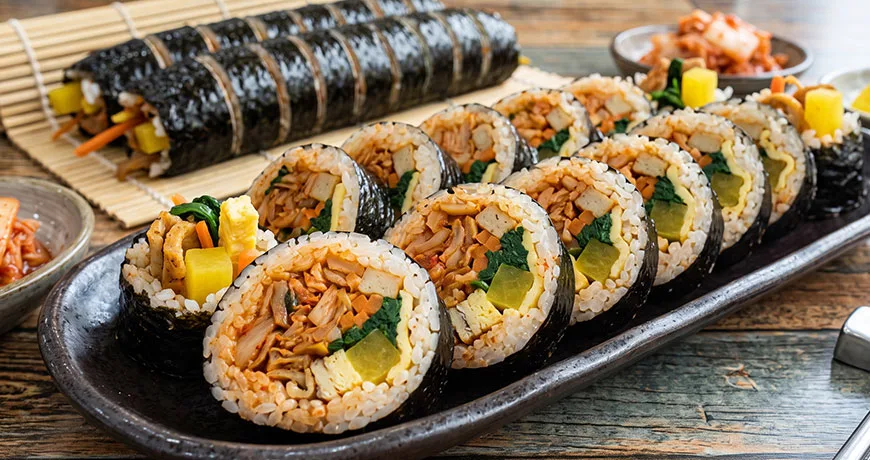
Kimchigimbap tackles the paradoxical physicochemical challenge of encapsulating a wet, highly acidic fermented matrix (Kimchi) inside a delicate, hydroscopic algae membrane (roasted seaweed). To prevent the Roll’s structural integrity from failing, the heavily fermented, lactic-acid-rich Kimchi must undergo aggressive mechanical dehydration, followed by flash evaporation in a hot pan. Frying the Kimchi with oil and a touch of sucrose not only vaporizes the destructive residual moisture but biochemically masks the sharp, stinging acidity through caramelization. The rice is cooled to body temperature and thoroughly coated with hydrophobic sesame lipids to block kinetic steam from wilting the seaweed. Packed with this dense, deeply savory Maillard-browned Kimchi, along with turgid radishes and thermo-coagulated egg proteins, the roll is subjected to high radial compression. The resulting bite offers a magnificent rheological contrast between the fiery, concentrated acidity of the Kimchi and the rich, unctuous lipid coating of the rice.
⏱️ Total: 35 mins | Prep: 20 mins | Cook: 15 mins | 🍳 Difficulty: Moderate (Requires strict moisture flash-evaporation and acidity masking) | 🌶️ Profile: Tangy, Spicy, Savory, and Deeply Toasted | 🍚 Focus: Lactic Acid Masking, Flash Evaporation, & Hydrophobic Lipid Coating
Ingredients (2–3 servings / 3 rolls)
- Hydroscopic Algae Matrix: 3 sheets of roasted seaweed for Gimbap (Gim)
- Lipid-Coated Starch Matrix: 2.5 bowls of cooked short-grain white rice, 1.5 tbsp toasted sesame oil, 0.5 tsp fine salt, 1 tbsp toasted sesame seeds
- Lactic Acid & Acidity Matrix: 250g well-fermented Kimchi (marinade lightly brushed off, mechanically squeezed bone-dry, and chopped or torn into strips), 1 tbsp cooking oil, 0.5 tbsp sugar, 1 tsp sesame oil
- Turgor & Protein Matrix: 3 strips of pickled radish (Danmuji), 3 fresh eggs (beaten, seasoned, and fried into a thick crepe), 3 strips of Gimbap ham (lightly sautéed to induce a Maillard crust)
Allergy Information Contains: Egg, Soy, Wheat (from Kimchi seasoning/ham), Pork (Ham)
Equipment Bamboo Rolling Mat (Gimbal), Frying Pan, Mixing Bowls, Paper Towels, Cutting Board, Knife
Cooking Instructions
- Kimchi Dehydration & Masking: Use your hands or paper towels to aggressively squeeze the cellular juice out of the Kimchi. Heat cooking oil in a pan over medium-high heat and add the dehydrated Kimchi and sugar. Stir-fry aggressively until all remaining kinetic moisture is completely flash-evaporated and the edges begin to caramelize. Turn off the heat and stir in 1 tsp of sesame oil for aromatic depth.
- Starch Thermodynamics (Cooling & Coating): Spread the warm rice in a wide bowl, adding the salt, sesame oil, and sesame seeds. Use a spatula to slice through the rice, coating every amylopectin grain with a thin hydrophobic lipid layer. Allow the rice to cool to body temperature (approx. 37°C/98°F) to prevent escaping steam from destroying the algae wrapper.
- Protein Coagulation: Cook the beaten eggs slowly into a thick, porous gel crepe, then slice into strips. Lightly sear the ham to melt its superficial fats and firm up its mechanical texture.
- Radial Compression Assembly: Place a sheet of seaweed rough-side up on the bamboo mat. Spread the cooled rice exceptionally thinly across 3/4 of the sheet. Lay down the pickled radish, egg, and ham to create structural pillars, then generously pack the completely dry, fried Kimchi in between them. Lift the bamboo mat, rolling the matrix onto itself while applying intense radial stress to squeeze out air pockets and form a highly dense cylinder.
- Mechanical Slicing & Rheological Finish: Lightly brush the exterior with sesame oil to prevent oxidation. Using a very sharp knife lightly lubricated with oil or water, slice the roll into uniform pieces using a swift sawing motion to prevent the sticky starch from tearing the seaweed.
💡 Professional Culinary Tips
- Thermodynamics of Kimchi Moisture Control: Placing raw, wet Kimchi directly into Gimbap is a recipe for structural failure. Osmotic pressure will force the Kimchi brine into the rice, which then breaches the seaweed, turning the entire roll into a soggy, un-sliceable mess. Mechanical squeezing combined with thermal flash-evaporation in a pan is the only physicochemical method to guarantee the moisture is eradicated while concentrating the umami compounds.
- Biochemical Antagonism of Lactic Acid and Sucrose: Highly fermented Kimchi possesses a low pH that sharply attacks taste receptors. Adding a small amount of sucrose (sugar) during the frying process biochemically masks this intense acidity. As the plant lipids and sesame oil coat the tongue, the sugar rounds out the sharp edges of the lactic acid, generating a massive umami synergy that tastes rich rather than purely sour.
- The Buffer Function of the Porous Egg Crepe: Even heavily fried Kimchi may release microscopic amounts of moisture under compression. The thickly fried egg crepe, which is riddled with micro-air pockets from thermal coagulation, acts as an internal fluid-dynamic sponge. It absorbs any stray moisture before it can reach the seaweed wrapper, acting as a critical structural buffer.
Nutrition Facts (Estimated)
Total Content : Approx. 500g (1 serving, approx. 1.5 rolls)
Calories : 540 kcal
– Sodium : 1,050mg (Variable depending on Kimchi salinity)
– Total Carbohydrate : 78.0g
– Sugar : 6.0g
– Total Fat : 16.0g
– Saturated Fat : 3.5g
– Cholesterol : 185.0mg
– Protein : 16.0g
– Dietary Fiber : 7.0g
*Daily Values are based on a 2,000 calorie diet and standard Korean nutritional reference values.
**Nutritional values are calculated based on original ingredients; substitutions may alter specific macronutrients.
Origins and Food Culture of Kimchi Gimbap (Kimchigimbap)
1. The 1990s Gimbap Franchise Era and the Evolution of Korean Identity
- Emerging during the mid-to-late 1990s alongside the explosive nationwide rise of 24-hour casual dining franchises (such as Gimbap Cheonguk and Jongno Gimbap), it stands as the first generation of indigenous fusion gimbap that moved beyond basic standard fillings.
- By incorporating kimchi—the indispensable soul of the Korean dining table—directly inside the roll rather than serving it as a separate side dish (banchan), it established an efficient, all-in-one comfort meal suited for modern urban life.
2. The Culinary Science of Moisture Reduction and Sautéed Umami
- The hallmark of authentic preparation lies in thoroughly squeezing out excess brine from the aged cabbage and quickly pan-frying it in sesame or perilla oil to evaporate surface water, preventing the delicate seaweed sheet from turning soggy.
- Sautéing the kimchi mellows harsh sharp acids and triggers gentle caramelization, concentrating rich umami juices that seamlessly season the rice grains while serving as an ideal flavor anchor when paired with modern variations like tuna (chamchi) or cheese.
3. The Ultimate Partner to Ramyeon and an Everyday Korean Soul Classic
- Revered nationwide as the undisputed “soulmate” to a piping-hot bowl of instant ramyeon, where the tangy, effervescent acidity of the kimchi roll cuts effortlessly through the rich, spicy noodle broth.
- Offering unmatched culinary practicality and refreshing balance without heavy gastrointestinal fatigue, Kimchigimbap represents an enduring icon of everyday Korean comfort food that connects diners directly to the pure, invigorating heritage of Korean fermentation.
The Lactic Radiance of Fermented Napa Cabbage and the Toasted Perfume of Sesame-Kissed Grains: A Refined Portrait of Kimchigimbap
Kimchigimbap (Fermented Kimchi Seaweed Rice Roll) stands as the dynamic, palate-cleansing, and impeccably balanced zenith of Korea’s portable (doshirak) and casual snack (bunsik) gastronomy. Matured, lactic-fermented Napa cabbage Kimchi—at the absolute peak of its deep umami complexity and sparkling organic acidity—is gently pressed to eliminate excess brine (or lightly braised in cold-pressed perilla oil), then layered alongside savory egg ribbons (jidan), cured ham, fish cake, sweet pickled daikon radish (danmuji), and aromatic perilla leaves across a foundation of warm, sesame-seasoned short-grain rice and crisp roasted sea laver (gim). Transcending the rich, sometimes palate-saturating density of standard rolls, this creation harnesses the sharp, lactic brilliance and subtle capsaicin warmth of Korea’s national staple to slice through savory lipids, achieving an effortlessly vibrant and multifaceted harmony inside every circular bite.
Placing a sesame-glazed round onto the tongue awakens the palate with an immediate, intoxicating aroma of toasted porphyra laver intertwined with the nutty warmth of cold-pressed sesame oil. Sinking your teeth into the slice triggers an auditory snap as the brittle seaweed gives way, yielding smoothly to the pillowy, chewy elasticity of the seasoned rice grains. As your teeth pierce the core, an exhilarating burst of texture unfolds: the braised Kimchi yields with a lively, juicy crunch (ajak), releasing a flood of tangy lactic acidity, savory fermented brine, and sweet vegetal juices. This effervescent acidity instantly cuts through the richness of the egg and ham, while the minty, peppery perfume of fresh perilla leaf forms a fragrant aromatic envelope, delivering an endlessly addictive, palate-refreshing rhythm that compels you toward the next piece.
The enduring brilliance of Kimchigimbap lies in its functional completeness—infusing the structural architecture of portable gimbap with the gut-nourishing probiotic heritage of aged kimchi, achieving an autonomous digestive harmony that requires no auxiliary side dishes. From nostalgic early-morning train platforms and school excursions to the late-night comfort of neighborhood diners where it sits alongside bubbling bowls of ramyeon, a rolled cylinder of Kimchi gimbap remains a timeless cultural monument of unpretentious nourishment, domestic ingenuity, and heartwarming culinary vitality.
Editor’s Review
1. A Dynamic Harmony of Brittle Laver Tensile Fracture, Resilient Kimchi Turgor, Pillowy Egg Cushioning, and Chewy Starch Equilibrium
The concentric architecture of the sliced roll delivers an extraordinary equilibrium of contrasting physical textures. The crisp, papery fracture of toasted seaweed yields smoothly upon contact with oral moisture, creating a seamless entry to the bouncy, distinct grains of sesame-seasoned rice. At the core, the dense, hydrated cellular matrix of the Kimchi provides a robust, auditory crunch that contrasts delightfully against the melting softness of the layered egg omelet and savory ham. The wrapper of fresh perilla leaf acts as an essential textural and aromatic buffer, ensuring a crisp, non-soggy mouthfeel that remains vibrant and light from the first piece to the last.
2. Organic Lactic-Acetic Acid Kinetics, Pectin Cross-Linking Retention, Moisture Migration Barrier Dynamics, and Nucleotide Synergism
Kimchigimbap represents an exacting study in plant tissue biophysics, interfacial moisture kinetics, and sensory organic acid chemistry. The abundant lactic and acetic acids synthesized by Leuconostoc and Lactobacillus species during fermentation lower the oral pH, stimulating immediate salivary flow and accelerating the clean enzymatic clearance of dietary lipids. The calcium cross-linked protopectin and cellulose within the fermented cabbage cell walls retain high structural resilience even after gentle pressing or brief stir-frying. De-watering the kimchi and cocooning it within hydrophobic perilla leaves effectively impedes capillary moisture migration toward the dry laver, preventing the rapid hydration and textural collapse of the seaweed’s structural porphyran polymers. Concurrently, natural free glutamates from fermented fish sauce (aekjeot) in the kimchi merge with nucleotide inosinates (IMP) from the ham and egg, generating an exponential umami synergy that amplifies savory perception without artificial enhancers.
3. The Inevitable Union of National Fermentation Heritage and Portable Roll Gastronomy: The Heart of Bunsik Culture
Representing the natural synthesis of Korea’s foundational staple—well-fermented Kimchi—with the convenience of 20th-century roll culture, Kimchigimbap exemplifies the practical, comfort-driven genius of Korean everyday dining. Serving as the quintessential companion to fiery tteokbokki and brothy noodle bowls across countless street diners and schoolyards, this unassuming masterpiece stands as an enduring sanctuary of restorative vitality, nostalgic domestic care, and brilliant culinary craftsmanship.