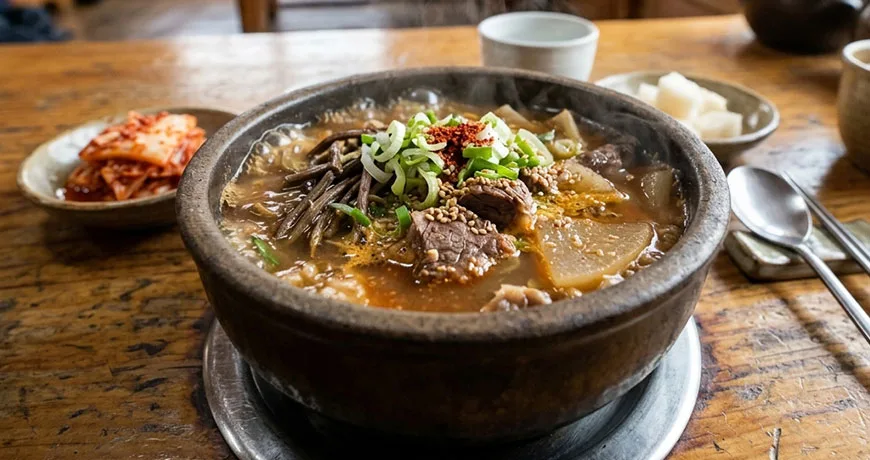
Janggukbap is a highly thermodynamic soup that relies on the slow, kinetic tenderization of tough beef connective tissues. Prolonged simmering breaks down the dense collagen matrix into water-soluble gelatin, extracting a massive payload of inosinate and free amino acids into the broth. Sliced radish and bracken are added to lend osmotic sweetness and earthy notes, while traditional Korean soup soy sauce (Guk-ganjang) dials in the hypertonic umami baseline. The defining technical execution of this dish is Toryeom (Thermodynamic Basting). By repeatedly pouring boiling broth over retrograded (cold, crystallized) rice in an earthenware pot and draining it back, you gently re-gelatinize only the exterior of the grains. This prevents the starch from dissolving and clouding the soup, ensuring the rice absorbs the savory broth like a sponge while retaining its distinct, chewy structural integrity.
⏱️ Total: 1 hr 40 mins | Prep: 10 mins | Cook: 1 hr 30 mins | 🍳 Difficulty: Moderate (Requires strict meat tenderization kinetics and precise Toryeom execution) | 🌶️ Profile: Deeply Savory, Clean, and Earthy | 🍚 Focus: Collagen Hydrolysis, Starch Retrogradation, & Thermodynamic Basting
Ingredients (2 servings)
- Protein & Gelatin Matrix: 300g Beef for soup (Brisket or Shank – cuts rich in connective tissue)
- Starch Matrix: 2 bowls of cold, cooked white rice (Starch must be retrograded/firm)
- Fiber Matrix: 150g Korean Radish (Mu, cut into squares), 100g rehydrated Bracken (Gosari), 1 stalk Green Onion (chopped)
- Hypertonic Seasoning: 3 tbsp Soup Soy Sauce (Guk-ganjang), 1 tbsp minced garlic, a pinch of black pepper, salt to taste
- Solvent: 1.5L Water
Allergy Information Contains: Beef, Soy (from soy sauce)
Equipment Heavy-bottomed Pot, Ttukbaegi (Korean Earthenware Pot) for serving, Ladle, Cutting Board, Knife
Cooking Instructions
- Aqueous Extraction & Meat Tenderization: In a large pot, combine the beef (soaked briefly to remove excess blood) and 1.5L of water. Bring to a rolling boil and skim off any coagulated blood proteins that float to the top. Reduce the heat to a low simmer and cover. Cook for at least 1 hour. This extended kinetic heating allows the dense collagen in the meat to hydrolyze into unctuous gelatin, giving the broth a profound body.
- Fiber Integration: Once the beef is completely tender, remove it from the broth, let it cool slightly, and shred it along the muscle fibers. Add the sliced radish and bracken to the boiling broth. Cook for another 15–20 minutes until the pectin in the radish breaks down and becomes translucent, releasing its natural sugars.
- Osmotic Balancing: Season the broth with the soup soy sauce and minced garlic. The fermented glutamates in the soy sauce will chemically bond with the inosinate from the beef, creating an explosive umami synergy. Adjust the final salinity with salt.
- Thermodynamic Basting (Toryeom): Place a portion of the cold, retrograded rice into an unheated Ttukbaegi. Ladle the boiling broth generously over the cold rice, then immediately pour the liquid back into the cooking pot. Repeat this thermodynamic pumping process 3 to 4 times to slowly raise the core temperature of the rice without destroying its structural integrity.
- Plating: Top the warmed rice with the shredded beef and chopped green onions. Ladle a final, generous pour of the boiling broth over everything and serve immediately.
💡 Professional Culinary Tips
- Thermodynamics of Toryeom & Starch Retrogradation: Dropping freshly cooked, hot rice directly into boiling soup causes the loose amylopectin bonds to disintegrate, resulting in a cloudy, porridge-like texture. By using cold rice where the starches have re-crystallized (retrogradation) and employing the Toryeom technique, you only superficially re-gelatinize the grains. They maintain a firm bite while drinking in the flavorful broth.
- Meat Tenderization Kinetics: Locomotor muscles like brisket are packed with cross-linked collagen. Boiling them aggressively at 100°C+ forces the muscle fibers to violently contract, squeezing out moisture and turning the meat to rubber. Maintaining a gentle simmer (85–90°C) is thermodynamically necessary to slowly melt the collagen into gelatin without evaporating the internal kinetic moisture.
- The Chemistry of Guk-ganjang: You must use traditional soup soy sauce (Guk-ganjang), not regular soy sauce. Guk-ganjang is fermented entirely from soybeans without wheat. It possesses a much higher salinity and amino acid density but is lighter in color. It injects a sharp, penetrating umami into the broth without turning the clear liquid muddy or overly sweet.
Nutrition Facts (Estimated)
Total Content : Approx. 600g (1 serving, including rice)
Calories : 480 kcal
– Sodium : 950mg
– Total Carbohydrate : 68.0g
– Sugar : 3.0g
– Total Fat : 8.0g
– Saturated Fat : 3.0g
– Cholesterol : 55.0mg
– Protein : 34.0g
– Dietary Fiber : 5.5g
*Daily Values are based on a 2,000 calorie diet and standard Korean nutritional reference values.
**Nutritional values are calculated based on original ingredients; substitutions may alter specific macronutrients.
Origins and Food Culture of Beef and Rice Soup (Janggukbap)
1. Roadside Taverns (Jumak) and the Historic Birth of Korean Commercial Dining
- Tracing its roots back to the late Joseon Dynasty roadside taverns (jumak) along major national trading roads and the bustling Unjongga marketplace (modern Jongno, Seoul), where it served travelers, merchants, and scholars with rapid, high-protein nourishment.
- Documented extensively in historical Joseon culinary texts such as Siuijeonseo and Gyugonyoram under the names Janggukbap or Onbap, it flourished as an essential comfort staple beloved across royal courts, nobility, and common households alike.
2. The Culinary Science of Cauldron Simmering and “Toryeom” Broth Infusion
- The hallmark of authentic preparation lies in gently slow-simmering beef cuts, seasonal radish, and wild fernbrake in massive iron cauldrons, allowing bovine collagen and botanical essences to meld seamlessly into the soy sauce broth.
- Employing the traditional toryeom technique—repeatedly pouring and draining hot broth over cooled rice inside an earthenware bowl—allows the rich broth to penetrate each individual rice grain, ensuring a tender, non-soggy texture served at the perfect temperature.
3. The Ultimate One-Bowl Comfort Food and Generous Tabletop Hospitality
- Served simply alongside a bowl of crisp, tangy cubed radish kimchi (kkakdugi) or ripe baechu kimchi, it delivers a nutritionally complete and deeply satisfying meal in a single bowl without needing elaborate side dishes.
- Providing immediate warmth and sustenance to weary travelers and hardworking laborers, Janggukbap represents the purest, most generous spirit of traditional Korean culinary hospitality.
The Deep Resonance of Slow-Simmered Beef Broth and the Earthy Grace of Wild Mountain Bracken: A Refined Portrait of Janggukbap
Janggukbap (Traditional Beef and Rice Soup in Earthenware) stands as the historic, foundational archetype of Korean tangban (soup-and-rice) gastronomy. Tender cuts of native beef rich in intramuscular connective tissue—such as brisket and shank—are gently simmered in fresh water for hours until an exquisitely clear, savory broth is extracted. Sliced beef ribbons, sweet Korean radish, earthy wild bracken (gosari), and green scallions are then added to the pot and carefully balanced with aged traditional soup soy sauce (joseon-ganjang). Rather than cooking the rice directly in the broth, the soup is poured over cooked rice in an earthenware vessel (ttukbaegi) through the artisanal toryeom technique (repeatedly ladling hot broth over the grains), representing a restrained, aristocratic elegance rooted in the historic tavern culture of Old Seoul (Hanyang).
Receiving a steaming earthenware bowl and scooping a hearty mouthful of the broth-soaked rice awakens the senses immediately. The delicate, toasted aroma of aged soy fermentation intermingles with the deep essence of slow-cooked beef and wild herbs. The first bite reveals rice grains swollen with clear, savory beef nectar that glide across the tongue, while the tender beef slices, softened through long simmering, release a flood of clean, natural juices. The melting sweetness of translucent radish slices and the chewy, forest-like bite of wild bracken provide an engaging textural counterpoint, delivering a soothing wave of radiant warmth that nourishes the entire body.
The enduring brilliance of Janggukbap lies in its self-contained nutritional and culinary completeness—delivering a balanced harmony of complex carbohydrates, clean protein, and mineral-rich botanicals in a single vessel without requiring elaborate side dishes. Originating in the bustling tavern alleys of historic Hanyang (such as Supyogyo and Pimatgol), where scholars traveling for national civil examinations and busy marketplace traders sought fast, restorative nourishment, a steaming bowl of Janggukbap remains an enduring monument of generous hospitality, culinary ingenuity, and comforting everyday sustenance.
Editor’s Review
1. A Balanced Interplay of Flaking Beef Tenderness, Earthy Bracken Elasticity, and Broth-Steeped Rice Grains
The textural cohesion within the earthenware vessel is remarkably refined. The tender, hand-sliced beef brisket yields effortlessly upon mastication, harmonizing with the chewy, fibrous snap of wild bracken and the velvety melt of simmered radish. Because the rice is warmed via toryeom rather than boiled to starch mush, each individual grain retains its distinct shape while soaking in the savory broth, ensuring a clean, velvety mouthfeel from the first spoonful to the last.
2. Beef Inosinate-Glutamate Umami Synergism, Collagen Gelatinization, and Toryeom Starch Thermal Stabilization Kinetics
Janggukbap represents an exacting study in nucleotide-amino acid synergy and starch surface thermodynamics. Nucleotide inosinates (IMP) extracted from the slow-simmered beef muscle bind with free glutamic acid present in naturally fermented soup soy sauce, generating an exponential umami synergy. Concurrently, the toryeom process washes away loose amylose fragments from the grain exterior to prevent broth cloudiness, while transferring heat through convection to bring the rice core directly to 65–70°C—the optimal physiological window for oral flavor receptors to perceive peak umami.
3. The Historic Hanyang Tavern Heritage of Pimatgol and the Enduring Comfort of Korean Tabletop Tangban Gastronomy
Serving as the premier fast-casual sustenance of the Joseon Dynasty, where merchants, travelers, and commoners gathered at city taverns to refuel over steaming bowls accompanied only by crisp radish kimchi, Janggukbap marks the historical origin of Korea’s commercial dining culture. Providing deeply restorative nourishment through the unpretentious pairing of clear meat broth and humble rice, this iconic soup remains a timeless haven of warmth, communal equality, and restorative culinary comfort.