
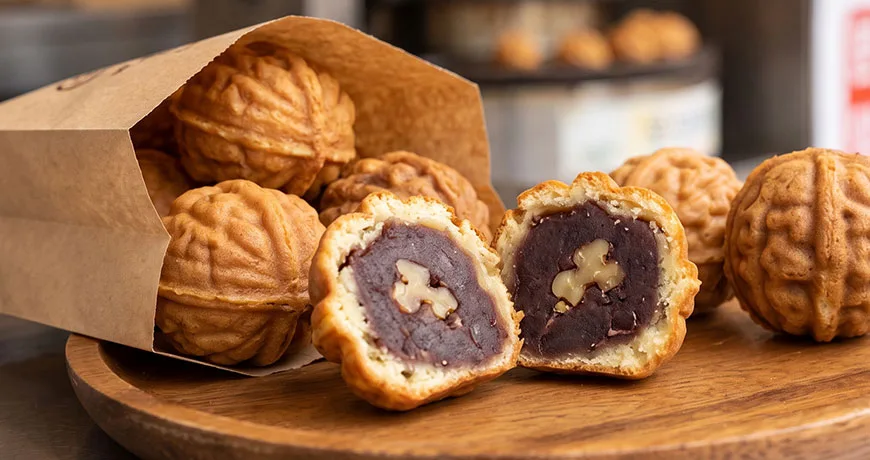
Hodugwaja is a masterclass in confectionery engineering. It utilizes the thermal expansion of trapped gases and leavening agents within a low-gluten batter, coupled with high-heat Maillard reactions against a heavy cast-iron mold, to forge a golden-brown, crispy exterior shell. While minimizing gluten development keeps the pastry tender and cake-like, a dense core of adzuki bean paste (Anko)—anchored by an amylose-sucrose matrix—retains internal moisture to prevent desiccation. The crown jewel of this recipe is the pre-treatment of the walnuts (Juglans regia). By lightly roasting the walnut kernels beforehand, we activate nutty pyrazine aromatics generated via the pyrolysis of linoleic lipids and amino acids, embedding them alongside the red bean paste for an addictive textural and sensory contrast.
- ⏱️ Total: 40 mins | Prep: 15 mins (Batter resting & walnut pre-toasting) | Cook: 25 mins
- 🍳 Difficulty: Medium (Cast-iron mold temperature management and precise piping timing)
- 🌶️ Profile: Rich Butter-and-Egg Maillard Aromas, Deep Sweet Bean Paste, and Nutty Pyrazine Crunch
- 🍚 Focus: Low-Gluten Batter Hydration, Walnut Pyrazine Activation, & Cast-Iron Maillard Shell Sealing
Ingredients (Yields approx. 20–24 pieces)
- Starch & Flour Matrix: 150g Pastry Flour, 4g Baking Powder (for thermal expansion), 1g Salt
- Emulsion & Maillard Precursors: 2 Eggs, 40g White Sugar (Sucrose), 40g Melted Unsalted Butter, 100ml Milk
- Adzuki & Sugar Matrix: 250g Smooth Red Bean Paste (Anko)
- Juglans Regia Lipid Matrix: 70g Walnut Halves (Pre-toasted)
- Mold Sealing Lipid: Cooking oil or melted butter as needed (for coating the cast-iron mold)
Allergy Information Contains: Wheat, Milk, Eggs, Tree Nuts (Walnuts), Soy (may be present in commercial red bean paste)
Equipment Dedicated Cast-Iron Walnut Pastry Mold (Stove-top or Electric), Mixing Bowl, Whisk, Piping Bag
Cooking Instructions
- Pyrazine Aroma Activation: Roast the walnut halves in a 160°C oven or pan for 5–7 minutes. This thermal process subdues bitter tannins and pyrolyzes unsaturated fatty acids into robust, nutty pyrazine aromatics. Allow them to cool completely.
- Batter Hydration & Gluten Control: In a mixing bowl, whisk together the eggs and sugar to form a light emulsion. Stir in the milk and melted butter. Sift in the pastry flour, baking powder, and salt, folding gently with a spatula just until no dry flour remains. (Over-mixing develops unwanted gluten, so a gentle fold is mandatory to preserve a fluffy cake texture.) Rest the batter for 15 minutes to fully hydrate the starches, then transfer it to a piping bag.
- Mold Thermal Conditioning: Heat the cast-iron walnut mold over medium heat until thoroughly conditioned. Using a pastry brush, apply a thin, meticulous layer of oil or melted butter to every cavity. This lipid barrier prevents sticking and promotes a crisp Maillard crust.
- Layered Piping & Assembly: Pipe batter into each cavity of the preheated mold until half full. Deposit a neat ball of red bean paste into the center, press one pre-toasted walnut half firmly into the paste, and pipe additional batter over the top to completely seal the filling inside.
- Rotational Thermal Baking: Close the mold lid and bake for 2–3 minutes, then flip the mold to bake the opposing side for another 2 minutes. The baking powder reacts to generate carbon dioxide and water vapor, expanding the batter to fill the mold’s walnut shape while direct contact with the hot iron triggers a golden Maillard crust. Extract the pastries with a skewer and cool on a wire rack. (Cooling allows internal steam to escape, locking in maximum outer crispness.)
💡 Professional Culinary Tips
- The Physics of Gluten Minimization: Using high-protein bread flour or aggressively beating the batter will result in a tough, rubbery pastry rather than a tender cake. Utilizing pastry flour, gently folding, and resting the batter are vital steps to engineer an airy, delicate cell structure.
- Thermal Mass Control of Cast-Iron: The hallmark of elite Hodugwaja is a crispy exterior. Pyping batter into an insufficiently heated mold causes the pastry to absorb grease and turn soggy. The iron must be blazing hot and properly lubricated to instantly flash-cook the batter into a flawless Maillard shell.
- Chemistry of Walnut Pre-Toasting: Dropping raw walnuts directly into the pastry introduces bitter tannins that clash with the sweet red bean paste while suppressing nutty lipid volatiles. Thermal toasting wakes up the pyrazine compounds, creating a sophisticated sensory contrast against the sweet bean paste.
🍶 Gastronomic Pairing
- Biochemical Palate Cleansing: When the rich butter lipids, tender egg-starch cake, and high-density sucrose of the red bean paste coat your oral mucosa, pair this confection with a bitterly sharp, high-acidity Espresso or a glass of Warm Milk. The coffee alkaloids surgically cut through the sucrose sweetness, while the milk lipids smoothly harmonize with the nutty pyrazine aromatics.
Nutrition Facts (Estimated)
Total Content : Approx. 40g (1 piece)
Calories : 125 kcal (Carbohydrate-sugar & lipid energy matrix)
– Sodium : 45mg
– Total Carbohydrate : 19.0g (Wheat starches and red bean sucrose)
– Sugar : 9.0g (Added sugars in paste and batter)
– Total Fat : 4.5g (Butter milk-fat and walnut linoleic unsaturated lipids)
– Saturated Fat : 1.8g
– Cholesterol : 15.0mg (Derived from eggs and butter)
– Protein : 2.5g (Wheat gluten and egg/walnut proteins)
– Dietary Fiber : 1.0g (Adzuki bean and walnut cellulose)
*Daily Values are based on a 2,000 calorie diet and standard Korean nutritional reference values.
**Nutritional values are calculated based on original ingredients; substitutions may alter specific macronutrients.
Origins and Food Culture of Walnut Cake (Hodugwaja)
1. Historical Lineage: Goryeo Walnut Acclimatization and the 1934 Genesis of Hakhwa Hodugwaja
- The historical home of Hodugwaja is Cheonan, Chungcheongnam-do. In 1290 (the 16th year of King Chungnyeol of Goryeo), royal envoy Yu Cheong-sin brought walnut saplings and seeds from Yuan Dynasty China and planted them within the grounds of Gwangdeoksa Temple in Cheonan, establishing the region as the historic epicenter of Korean walnut cultivation (where the ancient mother tree still stands as a National Natural Monument).
- In 1934, during the modern transition of peninsular baking, Cheonan master confectioner Jo Gwi-geum and his wife Shim Bok-sun innovated the confection by fusing traditional Korean rice-cake aesthetics with Western sponge cake techniques. Creating custom molds shaped like real walnuts and stuffing them with Cheonan walnuts and silky adzuki bean paste, they established the historic Hakhwa Hodugwaja (鶴華胡桃菓子), giving birth to Cheonan’s most celebrated regional delicacy.
2. The Culinary Science of Cast-Iron Mold Thermodynamics and Water Activity Control
- The technical mastery of authentic Hodugwaja relies on the radiant heat retention of custom cast-iron molds and precise moisture control within the bean paste.
- Heavy cast iron provides high thermal inertia, searing the outer batter instantly to prevent steam leakage, which forces the internal moisture to leaven the crumb into a castella-like airy texture. The red bean filling uses finely hulled beans (geopi-anggeum), removing the bitter outer seed coats to achieve a velvety starch gel. This high-density paste achieves an optimal osmotic balance that retains internal moisture without turning the outer cake soggy, ensuring the pastry retains its signature chewiness and fresh flavor for days at room temperature.
3. Railway Travel Nostalgia, Cheonan Station, and the Sovereign Icon of Highway Rest Stops
- Hodugwaja achieved legendary nationwide fame through the Gyeongbu Railway Line and historic Cheonan Station. Throughout the 1960s to 1980s, whenever long-distance steam and diesel passenger trains made brief stops at Cheonan Station, passengers eagerly pushed open train windows to purchase boxes of freshly baked walnut cakes from platform cart vendors, etching the pastry into the nation’s collective travel nostalgia.
- Following the opening of the Gyeongbu Expressway, the confection seamlessly conquered highway rest stops (hyugeso) nationwide—most famously the Cheonan Samgeori Rest Area. Today, sharing a warm paper bag of freshly baked walnut cakes on family road trips stands as an enduring emblem of filial warmth, transit camaraderie, and a living cultural monument to Korean highway and railway gastronomy.
The Crisp Golden Sponge Shell Baked in Heavy Iron Molds, the Velvety Sweet Adzuki Bean Paste, and the Crunchy Earthy Walnut Kernel: A Refined Portrait of Hodugwaja
Hodugwaja (Walnut Cake) stands as the comforting, nostalgic, and biologically delightful summit of Korea’s modern confectionery and highway rest-stop gastronomy. Centered upon a delicately aerated batter of fresh wheat flour, eggs, sugar, and milk—cradling a core of smooth, sweetened adzuki bean paste (anko) and crunchy walnut pieces harvested from California or the fertile slopes of Mount Gwangdeok in Cheonan—the preparation begins with precise casting discipline. Heavy, double-sided cast-iron molds carved with intricate walnut-shell patterns are heated over intense gas flames or electric coils, lightly greased with clean vegetable oil or butter, and filled halfway with the bubbly batter. A dollop of velvety red bean paste and a fragment of nutrient-rich walnut are dropped into the center before sealing the mold with another layer of batter, baking both sides rapidly under high conductive heat. The powerful thermal conduction of the cast-iron mold caramelizes the exterior sugars and proteins instantaneously, establishing a dual texture of a delicate, crisp outer crust framing a pillowy, soft sponge interior. Served piping hot from wax paper bags during winter commutes or festive family road trips, this iconic morsel transcends simple baking to become an enduring symbol of Korean highway travel, domestic affection, and confectionery craftsmanship.
Approaching the warm wax paper bag as a gentle, sweet aroma curls upward to reveal golden-brown morsels shaped like textured walnut shells, lifting a single piece and bringing it to the lips releases an immediate, comforting olfactory charge: the toasted Maillard perfume of baked egg and flour mingles seamlessly with the nutty, roasted aroma of warm walnuts and sweet vanilla-sugar notes. Biting into the cake delivers an extraordinary textural revelation: the thin, golden outer crust shatters with a delicate, crisp crunch (sak-sak), giving way instantly to the pillowy, cloud-like sponge cake that melts across the palate alongside the smooth, velvety sweetness of the red bean paste. Hidden within the bean paste, the crunchy walnut fragments burst with rich, earthy oils that anchor the sweetness with sophisticated structural depth. Pairing each warm bite with a cup of bitter black coffee or a glass of cold milk elevates the experience into a moment of pure bliss. Fusing regional agrarian pride with accessible street-side comfort, this golden little cake transforms humble pantry staples into an unforgettable masterpiece of sensory delight and profound gastronomic catharsis.
The enduring majesty of Hodugwaja lies in its precise historical pedigree—invented in 1934 in Cheonan, South Chungcheong Province, by confectionery artisans Shim Bok-sun and Han Gwi-hyun, who sought to utilize Cheonan’s celebrated local walnut harvest to create a distinctive regional pastry. Catalyzed by the opening of the Gyeongbu Expressway in the 1970s, Hodugwaja became the quintessential companion of long-distance travelers, transforming from a local specialty into an indispensable national institution across every highway rest-stop in the country. Fusing traditional baking techniques with heartfelt hospitality, a bag of warm walnut cakes remains an irreplaceable monument of comforting sweetness, cultural memory, and brilliant Korean culinary craftsmanship.
Editor’s Review
1. A Dynamic Harmony of Golden Crust Crunch, Pillowy Sponge Yield, Silken Bean Paste Melt, and Crunchy Walnut Contrast
The structural architecture inside the morsel delivers an extraordinary, four-tiered choreography between a heat-cast iron-baked outer cuticle, an aerated sponge cake matrix, a moisture-bound sugar-bean paste hydrogel, and brittle whole-nut fragments. The exterior shell of Hodugwaja consists of a thin, crisp crust achieved through high-temperature cast-iron conduction; under initial tooth pressure, it yields with a delicate, satisfying crunch (sak-sak). As the crust fractures, the interior batter—fortified by whipped eggs and leavening gases—reveals a pillowy, soft tenderness that melts across the tongue. Embedded at the core, the smooth adzuki bean paste provides a velvety, lubricating melt, while crunchy walnut fragments introduce vital masticatory friction, ensuring an impeccably balanced, non-fatiguing mouthfeel from the first warm bite to the last.
2. Cast-Iron Conduction Maillard-Caramelization Kinetics, Egg-Leavening Aeration Thermodynamics, Bean Paste Moisture Activity ( ) Stability, and Walnut Polyunsaturated Lipid Preservation
Hodugwaja represents an exacting study in confectionery baking physics, batter rheology, and nut lipid preservation. The batter relies on whipped whole eggs and flour to entrap micro-air cells, which expand rapidly when subjected to the thermal shock of pre-heated cast-iron molds (160–180°C). This rapid heat transfer triggers intense Maillard reactions between amino acids and reducing sugars across the iron interface, generating complex pyrazines and caramel notes that define the crust’s golden hue and roasted bouquet. The interior adzuki bean paste is formulated with optimized sugar content and low moisture activity ( ), preventing boiling or structural blowout during high-heat baking while retaining its smooth, spreadable melt. Concurrently, polyunsaturated fatty acids (omega-3 alpha-linolenic acid) and natural tocopherols residing within the walnut kernels undergo mild thermal roasting, diffusing rich, nutty volatiles that anchor the overall flavor profile without oxidative rancidity.
3. The 1934 Cheonan Origin Heritage and the Sovereign Apex of Highway Confectionery Gastronomy
Forged out of the confectionery innovation of 1934 Cheonan and polished within the demanding canons of modern highway travel, Hodugwaja stands as the ultimate archetype of accessible, comforting pastry cookery in Korean food history. Proving that profound confectionery joy requires neither elaborate plating nor rare ingredients, this warm, walnut-shaped classic captures the very soul of Korean hospitality, standing as an enduring sanctuary of domestic comfort, cultural memory, and brilliant culinary artistry.