
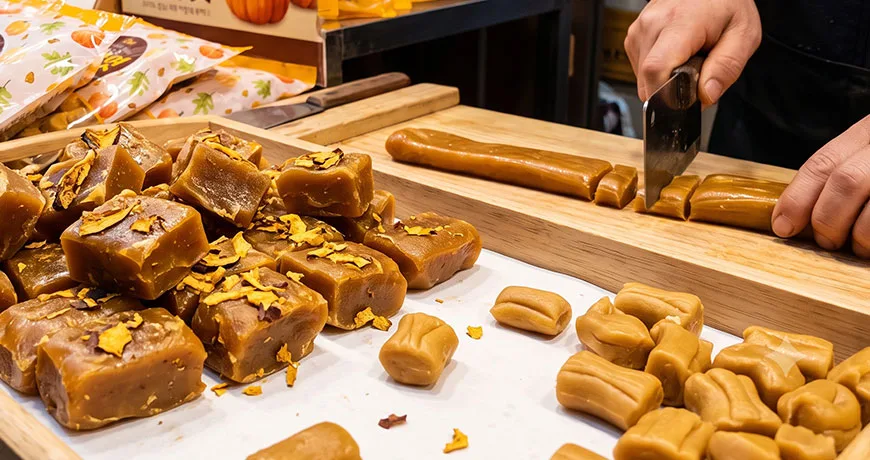
Hobagyeot is a masterpiece of enzymatic saccharification and rheological engineering. It utilizes the naturally occurring amylase enzymes found in malt barley to molecularly cleave the dense amylopectin starches of glutinous rice and the complex polysaccharides of aged pumpkin, transforming them into pure, sweet maltose. This extracted liquid is then subjected to severe thermal reduction at 115–120°C, evaporating the water and concentrating the sugars into a hyper-viscous amber syrup. The true magic of this confectionery, however, is a physical one: mechanical aeration (pulling). By repeatedly folding and stretching the cooling viscoelastic sugar matrix, countless microscopic air bubbles are trapped inside. This physical disruption of the sugar glass scatters light—turning the dark syrup opaque and golden—and interrupts the rigid structural lattice, creating the iconic chewy, soft, and yielding texture of traditional Korean Yeot.
- ⏱️ Total: 10+ hrs | Prep: 8 hrs (Enzymatic saccharification & extraction) | Cook: 2 hrs (Thermal reduction & mechanical pulling)
- 🍳 Difficulty: Extreme (Requires precision temperature control for amylase activity [60-65°C] and final sugar concentration [115°C])
- 🌶️ Profile: Profound, Earthy Pumpkin Sweetness with an Addictive Viscoelastic Chew
- 🍚 Focus: Enzymatic Saccharification, Thermal Evaporation, & Mechanical Aeration (Pulling)
Ingredients (Yields approx. 1kg of Yeot)
- Polysaccharide & Beta-carotene Matrix: 1kg Aged Pumpkin (Peeled, deseeded, steamed, and mashed into a puree)
- High-Density Amylopectin Matrix: 1kg Glutinous Rice (Soaked, steamed into a firm, dry state to initiate starch gelatinization)
- Amylase Enzyme Catalyst: 300g Traditional Malt Barley (Yeotgireum – Kneaded in warm water to extract the enzymes; only the clear supernatant liquid is used)
- Solvent Matrix: 4L Purified Water (For malt enzyme extraction and saccharification base)
- Anti-Caking Agent: 1/2 cup Roasted Soybean Powder or Corn Starch (For surface dusting)
Allergy Information Contains: Soy (if soybean powder is used for dusting)
Equipment Rice Cooker with Keep-Warm Function (or precise water bath), Fine Cheesecloth, Heavy-Duty Cast-Iron Cauldron or thick-bottomed pot, Wooden Spatula, Silicone Mat
Cooking Instructions
- Gelatinization & Enzyme Extraction: Steam the glutinous rice until fully cooked (gelatinization). In a bowl, aggressively knead the malt barley in warm water to extract its milky enzymes. Let the sediment fall to the bottom and carefully decant only the clear, enzyme-rich liquid on top.
- Enzymatic Saccharification: In the rice cooker, combine the steamed glutinous rice, pumpkin puree, and the clear malt enzyme liquid. Mix thoroughly. Set the temperature to strictly 60–65°C and hold it there for 6–8 hours. The amylase enzymes will methodically dismantle the complex starch chains into sweet maltose and glucose. (The process is complete when the broken-down rice grains become hollow and float to the surface.)
- Liquid-Solid Separation: Pour the saccharified mash into a fine cheesecloth and violently squeeze to extract every drop of the sweet liquid, leaving the fibrous husks and cellulose behind. This clear, incredibly sweet liquid is called Sikhye.
- Thermal Reduction & Concentration: Transfer the extracted liquid into a heavy cauldron and bring to a rapid boil over high heat. As the water evaporates and viscosity spikes, reduce the heat to medium-low and stir relentlessly to prevent scorching. Continue boiling until the liquid reaches 115–120°C (soft-crack/hard-ball stage). (At this stage, a drop of the syrup into ice water will instantly form a hard, malleable ball.)
- Mechanical Aeration & Glass Transition: Pour the ultra-concentrated syrup onto a silicone mat and let it cool just until it is a manageable viscoelastic solid. Using your hands, pull the taffy into a long rope, fold it in half, twist, and pull again. Repeat this mechanical aeration process dozens of times. Trapped micro-air bubbles will transform the dark, rigid sugar into an opaque, golden, and beautifully chewy taffy.
- Anti-Caking Finish: Roll the pulled taffy into long cylindrical ropes and dust thoroughly with roasted soybean powder or starch to block hygroscopy (absorbing moisture from the air). Snip into bite-sized pieces with scissors before it cools into a completely rigid state.
💡 Professional Culinary Tips
- The Thermodynamic Window of Amylase: If the saccharification temperature exceeds 70°C, the amylase enzymes suffer irreversible thermal denaturation and the process halts immediately. If it drops below 50°C, ambient lactic acid bacteria will proliferate, turning the batch sour and rancid. 60–65°C is the absolute biochemical sweet spot for explosive enzymatic activity.
- Boiling Point vs. Sugar Concentration: The boiling point of a sugar solution rises as water evaporates. Stopping the boil at 100–105°C yields a liquid syrup (Jocheong). You must push the thermodynamic reduction past 115°C to achieve a matrix that will solidify at room temperature (Yeot).
- The Physics of Taffy Pulling: Simply cooling the concentrated syrup yields a dark, rock-hard sugar glass capable of breaking teeth. The manual pulling process forces countless microscopic air bubbles into the matrix. This aeration scatters light (changing the color from dark amber to creamy yellow) and acts as a structural cushion, transforming a brittle solid into a yielding, chewy delicacy.
🍶 Gastronomic Pairing
- Biochemical Palate Cleansing: When the hyper-dense maltose and sticky viscoelastic matrix of the taffy heavily coat your teeth and oral mucosa, pair this confectionery with a scalding cup of highly astringent Traditional Hadong Green Tea. The intense catechins and tannins in the tea act as a chemical astringent, surgically stripping the dense sugars from your palate and elegantly resetting your taste receptors.
Nutrition Facts (Estimated)
Total Content : Approx. 30g (3-4 pieces)
Calories : 115 kcal (Hyper-dense reducing sugar energy matrix)
– Sodium : 5mg (Trace amounts)
– Total Carbohydrate : 28.0g (Glutinous rice amylopectin and malt cleavage products)
– Sugar : 22.0g (Natural maltose and glucose from enzymatic breakdown)
– Total Fat : 0.0g (100% Fat-free)
– Saturated Fat : 0.0g
– Cholesterol : 0.0mg (100% Plant-based matrix)
– Protein : 0.5g (Trace residual plant proteins)
– Dietary Fiber : 0.5g (Residual pumpkin pectin)
*Daily Values are based on a 2,000 calorie diet and standard Korean nutritional reference values.
**Nutritional values are calculated based on original ingredients; substitutions may alter specific macronutrients.
Origins and Food Culture of Pumpkin Taffy (Hobagyeot)
1. Classical Lineage: The Ancient Sweet “Yi” (飴) and the Linguistic Genesis of Ulleungdo Taffy
- Taffy (yeot) is Korea’s oldest recorded traditional sweetener and confection, documented as early as the 12th century in the Goryeo Dynasty text Gyerim Yusa under the native term pori.
- In Heo Jun’s 1613 Joseon medical compendium Dongui Bogam, grain taffy was documented under the classical Hanja character Yi (飴), praised because “its nature is warm, its flavor sweet, and it is non-toxic; it tonifies bodily deficiency (補虛), quenches parching thirst, cools the blood, treats chronic coughs, and strengthens the five visceral organs.” For centuries, it served as an elite medicinal tonic and culinary delicacy in royal and aristocratic households.
- The iconic homeland of Pumpkin Taffy is Ulleungdo, an isolated volcanic island in the East Sea. During the late 19th-century resettlement of the island, early pioneers harvested the bark of native Machilus thunbergii (Hubak-namu), a medicinal laurel renowned in folk pharmacopeia for treating gastrointestinal distress and asthma, boiling it down with wild grains to create a therapeutic medicinal taffy known as Hubakyeot (후박엿). When merchants and travelers from the mainland visited, they misheard the regional pronunciation “Hubak” as “Hobak” (meaning pumpkin). As stripping the bark of native trees became environmentally unsustainable, islanders began incorporating the abundantly cultivated, sweet local pumpkins (neulgeun-hobak) into the cauldrons, successfully establishing the legendary sweet delicacy celebrated nationwide today as Ulleungdo Hobagyeot.
2. The Culinary Science of Maltose Saccharification and Aeration-Pulling Thermodynamics
- The artisanal mastery of Hobagyeot hinges on strict enzymatic regulation during malting and precise thermodynamic management during the pulling phase.
- Cooked rice starches are held precisely between 55°C and 60°C to activate barley amylase enzymes, fully converting insoluble starches into sweet, soluble maltose syrup. After filtering, the liquid is simmered alongside strained pumpkin puree in massive cast-iron vats until water content drops below 10%, forming a dark, molten syrup. Before it solidifies, artisans mount the warm taffy mass onto wooden posts, pulling and folding it hundreds of times. This aeration process infuses countless micro-air pockets into the matrix, transforming the dense, sticky, dark amorphous sugar into a light, creamy-golden confection with a porous microstructure that fractures crisply upon biting.
3. The Itinerant Yeot-Jangsu’s Clacking Shears and Academic Good-Luck Folklore
- Hobagyeot occupies an affectionate place in Korean folk culture through the iconic figure of the itinerant taffy peddler (yeot-jangsu). Carrying a wooden chest suspended from his shoulders, the peddler rhythmically clacked oversized iron shears (yeot-gawi) through village lanes, trading sweet shards of freshly chiseled taffy for worn rubber shoes, scrap metal, or discarded paper, providing rural communities with entertainment, community gossip, and cherished sweetness.
- Furthermore, due to the tenacious adhesion of un-aerated taffy, ancient folklore held that eating yeot would cause good fortune and success to “stick” firmly to an individual. Joseon scholars carrying traveling packs to sit for imperial civil service examinations (gwageo) carried taffy as an auspicious talisman. This living tradition persists today: families and friends gift boxes of Hobagyeot to students preparing for the grueling College Scholastic Ability Test (Suneung), wishing them good luck and sticking taffy onto school gates as an immortal symbol of communal encouragement, filial love, and Korean confectionery heritage.
The Enzymatic Saccharification of Starch via Malted Barley, the Earthy Sweetness of Sun-Ripened Pumpkin, and the Phenomenal Linguistic Evolution of Ulleungdo: A Refined Portrait of Hobagyeot
Hobagyeot (Pumpkin Taffy) stands as the unctuous, deeply comforting, and culturally fascinating summit of Korea’s traditional confectionery (yeot) gastronomy. Centered upon the ancient biochemical mastery of saccharifying grain starches using barley malt (yeotgireum), intertwined with the thick, botanical sweetness of mature, steamed pumpkins, the preparation begins with precise enzymatic discipline. Premium glutinous or short-grain rice is steamed into a firm state and submerged in malted barley water, holding at a warm temperature overnight to allow the malt’s diastase enzymes to systematically cleave complex starches into sweet, bioavailable maltose. The resulting clear malt liquor is filtered, generously enriched with the mashed purée of mature winter pumpkins, and reduced slowly inside a massive cast-iron cauldron. As evaporation drives off moisture, the liquid thickens through the syrup stage (jocheong) until it reaches a dense, hard-crack state. Once cooled slightly, the dark amber mass is subjected to the physically demanding art of taffy pulling (tarae-chigi)—stretched, folded, and aerated repeatedly by hand. This rigorous mechanical agitation traps millions of microscopic air bubbles within the sugar matrix, transforming the dense, dark amber lump into an opaque, pale-golden confection with a tenderized, porous structure. Completely devoid of artificial sweeteners or commercial gelling agents, this golden matrix binds the natural enzymes of sprouted grains with the fibrous pectin of pumpkins, delivering an austere masterclass in traditional candy physics that yields gently on the palate without ruthlessly adhering to the teeth.
Approaching the serving tray to lift a piece of pale-golden pumpkin taffy releases an immediate, deeply resonating olfactory charge: the toasted, caramelized perfume of concentrated maltose mingles seamlessly with the dense, earthy (뭉근한) sweetness of mature winter pumpkin. Biting into the confection delivers an extraordinary textural revelation: maintaining a firm, glassy state at room temperature, the taffy rapidly breaches its glass transition temperature upon contacting the warmth of the mouth (36.5°C), immediately yielding into an energetic, viscoelastic chew. Because the pumpkin’s natural pectin and dietary fibers disrupt the pure maltose matrix, the candy refrains from aggressively sticking to the dental enamel. Instead, it melts across the tongue like an opulent botanical caramel, flooding the oral cavity with a sophisticated, layered sweetness that balances the roasted grain depth with bright vegetable sugars. Pairing each dense, chewy bite with a cup of bitter green tea or icy sujeonggwa (cinnamon punch) cleanses the palate, transforming this humble confection into an unforgettable ritual of sensory relief, nostalgic comfort, and profound gastronomic catharsis.
The enduring majesty of Hobagyeot lies in its brilliant, almost accidental etymological evolution native to the volcanic island of Ulleungdo. Originally, the island’s legendary taffy was crafted using the medicinal bark extract of the Hubak tree (Machilus thunbergii), prized for soothing stomach ailments. However, as the Hubak trees faced depletion, the ingenious islanders turned to a linguistically similar and readily available crop: the pumpkin (Hobak). Through a sheer phonetic coincidence, Hubak-yeot organically morphed into Hobak-yeot, replacing a medicinal bitter bark with the golden, sweet flesh of winter squashes. This remarkable transition from a medicinal curative to a nationally beloved dessert stands as an irreplaceable monument of linguistic serendipity, island resilience, and brilliant Korean culinary craftsmanship.
Editor’s Review
1. A Dynamic Harmony of Initial Solid Resistance, Thermo-Responsive Viscoelastic Yield, and Pectin-Smoothed Dissolution
The structural architecture of the confection delivers an extraordinary, three-tiered choreography between a tempered maltose glass, a heat-activated flexible polymer, and a botanical polysaccharide matrix. At room temperature, Hobagyeot presents a firm, resilient exterior that snaps cleanly. However, upon exposure to oral body heat, it rapidly shifts into a viscoelastic, chewy state. Crucially, the abundant pectin and cellulose fibers contributed by the pumpkin purée slightly loosen the internal hydrogen bonds of the maltose matrix. This prevents the taffy from exhibiting the aggressive tooth-adhesion typical of pure grain yeot, allowing it instead to dissolve smoothly and cleanly across the palate like a premium cream caramel, ensuring an impeccably balanced mouthfeel from the first bite to the last.
2. Malt Amylase Enzymatic Saccharification, Cast-Iron Maltose Caramelization, Aerating Pull Mechanics, and Pectin Plasticizer Kinetics
Hobagyeot represents an exacting study in cereal biochemistry, high-solids thermodynamics, and polymer rheology. The process relies entirely on diastase (amylase) enzymes endemic to malted barley to hydrolyze rice amylopectin into maltose, generating a clean, profound sweetness. Boiling this malt liquor with pumpkin purée over cast-iron heat induces water evaporation, driving up the boiling point and accelerating Maillard browning between trace amino acids and reducing sugars. The post-boil taffy pulling (tarae-chigi) introduces micro-air cells that scatter light (turning the taffy opaque) and physically disrupt the crystalline lattice, softening the chew. Furthermore, the pumpkin’s natural polysaccharides function as a rheological plasticizer, altering the glass transition temperature ( ) and physically blocking the concentrated sugar polymers from adhering stubbornly to dental enamel.
3. The Linguistic Evolution from Ulleungdo Hubak (Tree Bark) to Hobak (Pumpkin) and the Apex of Korean Traditional Confectionery
Tracing a fascinating trajectory from a medicinal bark reduction to a golden, pumpkin-enriched dessert fueled by phonetic similarity and resource adaptation, Hobagyeot stands as the ultimate archetype of evolutionary culinary engineering in Korean history. Proving that linguistic serendipity and terroir-driven ingenuity can forge a masterpiece of confectionery science, this pale-golden, chewy classic captures the resilient, adaptive soul of traditional Korean gastronomy, standing as an enduring sanctuary of botanical sweetness, cultural memory, and brilliant culinary artistry.