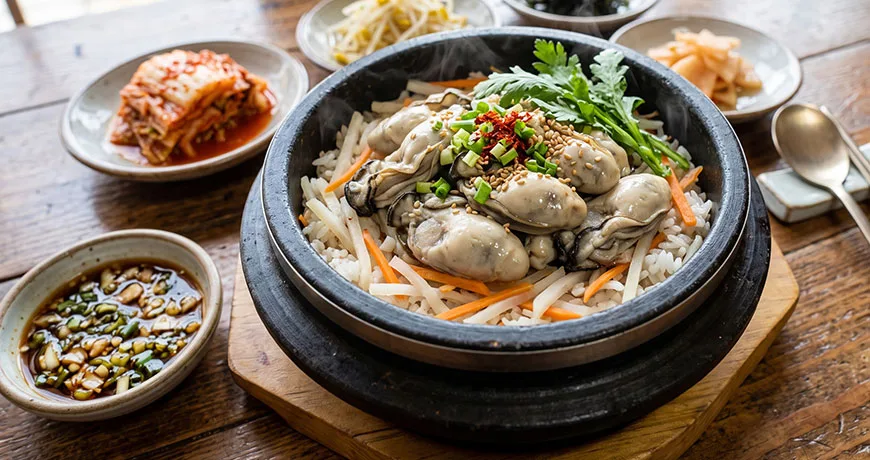
Gulbap is a precision-engineered dish that overcomes the structural vulnerability of marine mollusks to thermal contraction by strictly utilizing residual heat (steaming). If fresh oysters are boiled alongside the rice from the beginning, the kinetic energy of temperatures exceeding 100°C violently coagulates their proteins, aggressively expelling their intracellular moisture and shrinking them into chewy, rubbery erasers. To circumvent this, the oysters are introduced only during the Tteum (resting/steaming) phase, immediately after the rice starches have achieved primary gelatinization. The trapped 80–90°C steam gently denatures the oyster proteins without inducing violent contraction, preserving their plump, viscoelastic, hydrocolloid-like geometry. Served with a hypertonic seasoned soy sauce, the rich marine glycogen from the oysters seamlessly fuses with the rice’s amylopectin, delivering a powerful umami synergy.
⏱️ Total: 40 mins (excluding rice soaking) | Prep: 15 mins | Cook: 25 mins | 🍳 Difficulty: Moderate (Requires exact thermal coagulation limits and moisture control) | 🌶️ Profile: Deeply Briny, Savory, and Subtly Sweet | 🍚 Focus: Residual Heat Coagulation, Osmotic Washing, & Starch Gelatinization
Ingredients (2 servings)
- Marine Protein Matrix: 250g Fresh Oysters (washed in a 3% isotonic salt solution to prevent osmotic cellular rupture)
- Moisture & Enzyme Catalyst: 150g Daikon Radish (julienned into uniform strips)
- Starch Matrix: 2 bowls worth of soaked short-grain white rice, water (reduce the standard water volume by 10% to account for moisture released by the radish)
- Hypertonic Umami Binder (Sauce): 3 tbsp soy sauce, 1 tbsp soup soy sauce (Guk-ganjang), 1 tbsp Gochugaru (chili flakes), 2 tbsp minced wild chives (Dallae) or scallions, 0.5 tsp minced garlic, 1 tbsp sesame oil, 1 tbsp toasted sesame seeds
- Aromatic Lipid: 1 tsp toasted sesame oil (added to the cooking rice)
Allergy Information Contains: Shellfish (Oyster), Soy, Wheat (from soy sauce)
Equipment High Thermal Mass Cast-Iron Pot (Gamasot) or Earthenware Pot (Ttukbaegi), Mixing Bowls, Strainer
Cooking Instructions
- Isotonic Osmotic Washing: Washing delicate oysters in pure tap water causes a violent osmotic imbalance, rupturing their cell walls and bleeding out their flavor. Dissolve sea salt in cold water to create a 3% isotonic solution (similar to seawater). Gently swish the oysters to remove shell fragments and mucin, then drain completely.
- Starch Gelatinization (Cooking): Layer the soaked rice and julienned radish in the heavy pot. Add the measured water (10% less than usual) and 1 tsp of sesame oil to create a lipid barrier. Bring to a boil over medium heat.
- Thermal Coagulation Control (Adding Oysters): Once the water level drops below the surface of the rice and you hear a distinct sizzling (signaling water absorption), reduce the heat to the absolute minimum. Quickly open the lid, spread the washed oysters evenly over the rice, and immediately close the lid tightly.
- Residual Heat Steaming (Tteum): Keep on the lowest heat for 3 more minutes, then turn the heat completely off. Do not open the lid for 10 minutes. The immense thermal mass of the pot will trap 80–90°C residual steam, gently thermo-coagulating the oysters to plump perfection without seizing their collagen fibers.
- Rheological Integration: Once resting is complete, use a rice paddle with a slicing motion to gently fold the rice and radish without crushing the tender oysters. Serve in individual bowls alongside the wild chive soy sauce emulsion.
💡 Professional Culinary Tips
- The Thermodynamic Dilemma of Oysters: Oysters are over 85% water and have an extremely low protein coagulation point. Boiling them vigorously forces the muscle fibers to seize, squeezing out all kinetic moisture and reducing their volume by half. Utilizing the Tteum (resting) phase to steam them purely with trapped residual heat is the only thermodynamic solution to perfectly preserving their size, texture, and delicate marine juices.
- Biochemical Role of the Radish (Daikon): When julienned radish is cooked with rice, its pectin network collapses, releasing cellular sap into the pot. This moisture aids in the even gelatinization of the rice. More importantly, radish is rich in diastase, a digestive enzyme that chemically breaks down complex starches, significantly easing the digestive load commonly associated with heavy starch and protein meals.
- Palate Cleansing via Wild Chives: The glycogen in oysters provides a dense, sweet, and heavy oceanic flavor that can rapidly fatigue the palate. The sharp, volatile sulfur compounds (allicin) found in the seasoned soy sauce—especially from wild chives (Dallae) or scallions—act as a chemical astringent. They slice through the heavy marine lipids, neutralize trimethylamine (TMA/fishiness), and reset your taste receptors for the next bite.
Nutrition Facts (Estimated)
Total Content : Approx. 450g (1 serving, including sauce)
Calories : 410 kcal
– Sodium : 850mg (Variable based on sauce usage)
– Total Carbohydrate : 68.0g
– Sugar : 3.0g
– Total Fat : 7.0g
– Saturated Fat : 1.0g
– Cholesterol : 65.0mg
– Protein : 18.0g
– Dietary Fiber : 5.0g
*Daily Values are based on a 2,000 calorie diet and standard Korean nutritional reference values.
**Nutritional values are calculated based on original ingredients; substitutions may alter specific macronutrients.
Origins and Food Culture of Oyster Rice (Gulbap)
1. Historical Lineage: From Dongui Bogam Chronicles to Coastal Mudflat Foraging
- Tracing its roots back to historic medical treatises such as Heo Jun’s Dongui Bogam (1613), which praised oysters (moryeo) as the most precious marine food for purifying the blood, nourishing weak constitutions, and bestowing glowing skin.
- Originating in traditional fishing villages along Korea’s western mudflats (such as Ganweoldo Island in Seosan, Boryeong, and Dangjin) and southern deep-water bays (Tongyeong, Geoje, and Wando), where coastal families harvested oysters at their peak in winter to steam directly over communal pots of rice.
2. The Culinary Science of the “Tteum” Steaming Phase and Radish Cushioning
- The hallmark of authentic preparation lies in withholding the raw oysters until the rice cooking water has fully evaporated, allowing residual steam (tteum) to gently poach the shellfish so they stay plump and juicy rather than shrinking into rubbery morsels.
- Spreading a bed of finely shredded Korean radish beneath the rice grains provides a steady moisture reservoir that prevents scorching while allowing sweet vegetable sugars and milky oyster juices to coat every individual rice pearl.
3. Piquant Wild Chive Dressing and Winter Comfort Dining
- Universally savored with artisanal seasoned soy sauce enriched with pungent seasonal wild chives (dallae) or green onions, toasted sesame seeds, and crushed chili flakes, capturing the aromatic transition from winter to early spring.
- Served piping hot in heavy earthenware bowls (ttukbaegi) or natural stone pots (dolsot) alongside refreshing winter radish water kimchi (dongchimi) or clear kelp soup, Gulbap represents an enduring emblem of seasonal Korean hospitality and nourishing coastal slow food.
The Silken Opulence of Winter Tides and the Gentle Alchemy of Low-Heat Steaming: A Refined Portrait of Gulbap
Gulbap (Steamed Rice with Fresh Winter Oysters) stands as the pristine, nutrient-dense, and biologically harmonious zenith of Korea’s seasonal coastal hot-pot gastronomy. Fresh shucked oysters (gul)—reaching their peak plumpness, natural glycogen levels, and mineral density during the freezing winter months—are rinsed in cold salt water and kept ready. Plump short-grain white rice, paired with sweet matchsticks of Korean radish (mu), is brought to an initial boil; only when the liquid is fully absorbed and the pot transitions into the delicate, low-heat resting and steaming stage (tteum-deurigi) are the raw oysters placed on top. Cooked purely by the gentle, circulating interior vapor without direct contact with boiling water, this method prevents shrinkage and cellular rupture, yielding an aristocratic one-pot masterpiece where every grain of rice is lacquered in delicate ocean essence.
Lifting the heavy lid of the pot unleashes a fragrant billow of steam carrying the crisp, mineral purity of winter tidal flats, the comforting nuttiness of toasted sesame oil, and the slow-cooked sweetness of caramelized radish. Folding the plump, milky-white oysters and glistening grains together with a spoonful of seasoned soy-scallion dressing (yangnyeom-ganjang) delivers an immediate textural revelation. The rice grains, swollen with savory oyster jus, glide across the palate in a supple, velvety embrace. Sinking your teeth into a warm oyster triggers a delicate pop (tok) as the taut mantle gives way, releasing a torrent of sweet, creamy oyster liquor packed with oceanic amino acids. The tender, slow-steamed radish matchsticks melt effortlessly across the tongue, providing a cooling botanical counterbalance, while the fragrant burst of minced scallions, sesame seeds, and piquant chilies cuts cleanly through the richness, leaving an enduring, heartwarming finish.
The enduring majesty of Gulbap lies in its seasonal functionalism—marrying the rich stores of bioavailable zinc, taurine, glycogen, and vitamin A found in winter oysters (celebrated as the “Milk of the Sea”) with the sustained carbohydrate warmth of freshly steamed rice. Rooted in the resilient seafaring culture of Korea’s coastal regions—from the serene southern archipelago of Tongyeong to the historic tidal villages of Seosan and Boryeong—a steaming bowl of oyster rice remains a timeless monument of attentive culinary thermodynamics, seasonal reverence, and deeply comforting hospitality.
Editor’s Review
1. A Dynamic Harmony of Custard-Soft Oyster Plumpness, Broth-Lacquered Grain Elasticity, and Tender Radish Yield
The sensory progression within the hot pot delivers an exquisite equilibrium of contrasting textures. Cooking the oysters exclusively on ambient steam preserves their voluminous, silken creaminess without the rubbery toughness caused by overboiling. The rice grains absorb the expelled marine liquids without collapsing into mush, maintaining a buoyant, toothsome chew. Sliced winter radish dissolves softly into the grains to add gentle humidity and vegetal sweetness, while the crisp crunch of raw scallions in the dressing ensures an endlessly appetizing, fatigue-free finish from the first bite to the last.
2. Low-Temperature Resting Phase Actomyosin Denaturation Control, Glycogen Breakdown, and Succinate-Glutamate Umami Synergism
Gulbap represents an exacting study in marine invertebrate muscle biophysics, enzyme mechanics, and flavor synergy. Oyster mantle and adductor muscles contain delicate actomyosin filaments that undergo aggressive thermal denaturation above 65°C; boiling beyond 80°C induces irreversible contractile syneresis, squeezing out intracellular moisture and leaving the flesh tough and wrinkled. Introducing oysters strictly during the resting phase (ambient steam maintained at 80–85°C) prevents violent thermal shock, preserving cellular water and delicate lipids. Furthermore, winter-harvested oysters accumulate high concentrations of complex glycogen, which thermally cleaves into simple sweet sugars during gentle steaming. The oyster’s natural succinic acid works in synergy with the free glutamates in the naturally brewed soy sauce seasoning, multiplying umami reception across the palate, while endogenous diastase enzymes in the radish promote rapid starch breakdown and effortless digestion.
3. The Winter Tidal Flat Aquaculture Heritage and the Grounding Sanctuary of Korean Coastal Gastronomy
Originating as a seasonal staple among coastal communities harvesting wild rock oysters along the western tidal flats and the southern sea racks, Gulbap embodies the soul of mindful Korean foodways. Translating the cold vitality of the winter sea into a warming, restorative tonic through patient thermal restraint honors an authentic heritage of environmental harmony, nutritional resilience, and heartfelt culinary craftsmanship.
큰마을영양굴밥
#백년가게