
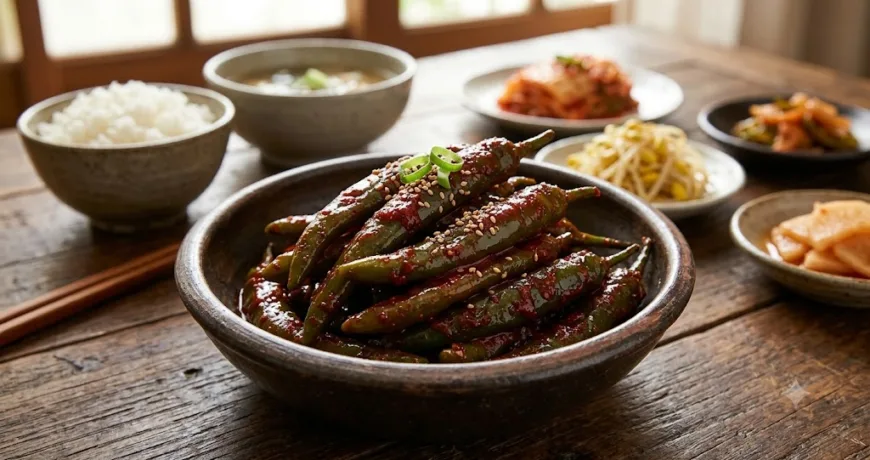
Gochujangajji is a sublime expression of culinary patience, where vibrant, sun-ripened green chili peppers are slowly transformed into an elegant preserve. Through a hot infusion of a carefully simmered soy broth, the natural, lively crunch of the peppers is perfectly captured. The delicate process of piercing each pepper allows the rich, savory broth to seep deep into the core, reflecting the chef’s meticulous care. It stands as a refined palate cleanser, cutting through rich, fatty dishes and bringing a sophisticated balance to the dining table.
- ⏱️ Total Time: 5–7 Days | Prep: 20 Mins | Cook & Ferment: Initial hot infusion, followed by a secondary boil and cold aging on day 3
- 🍳 Difficulty: Low-Medium (Requires delicate preparation and precise thermal control of the broth)
- 🌶️ Profile: A graceful balance of a vibrant, spicy kick woven into a deep, savory, and brightly acidic soy matrix
- 🍚 Core Process: Delicate Piercing, Slow-simmering Broth, Hot Infusion Technique, Secondary Cold Infusion
- 🍶 Pairing: Charcoal-grilled pork belly (Samgyeopsal), warm steamed pork slices (Suyuk), clear meat noodle soups
Physicochemical & Sensory Matrix
- Baseline Salinity: 4.5% ~ 5.5% (A steadfast salinity that cures the pepper without overpowering its natural flavor)
- pH Equilibrium: 3.8 ~ 4.2 (A bright, refreshing acidic buffer forged by natural vinegar)
- Textural Crunch Index: [■■■■□] (A resilient outer skin yielding to a juicy, crisp interior)
- Umami Density: 7.8 / 10 (A deeply comforting depth led by brewed soy, kelp, and shiitake)
- Shelf Stability: Peaks at 7 days; maintains its lively crunch for over 3 months refrigerated
- Aroma Profile: Vibrant Capsaicin Notes | Aromatic Brewed Soy | Clean Acetic Brightness
Ingredients (Yields 1 Medium Airtight Container)
- Primary Vegetable Matrix: 500g Fresh, firm Green Chili Peppers (Putgochu), 100g Cheongyang Green Chilies for an extra kick
- Aromatic Broth Matrix: 2 Cups Brewed Soy Sauce, 2 Cups Purified Water, 1.5 Cups Unrefined Sugar, 1.5 Cups Naturally Fermented Vinegar (Apple/Brown Rice)
- Aromatic Catalyst: 1 Sheet Dried Kelp (10x10cm), 2 Dried Shiitake Mushrooms, 5 Cloves Garlic
Allergy Information
- Contains: Soy, Wheat (inherent in brewed soy sauce)
Equipment Stainless Steel Saucepan, Heat-resistant Glass Airtight Container, Needle or Toothpick, Pressing Stone
Cooking Instructions
- Preparation of Vegetables: Wash the chilies thoroughly and dry them completely. Trim the stems neatly, leaving about 1cm. Using a needle or toothpick, gently pierce a few small holes in each pepper. This opens a delicate pathway for the savory broth to penetrate.
- Slow-simmering the Broth: In a saucepan, combine the water, soy sauce, sugar, kelp, shiitake, and garlic. Bring to a gentle simmer over medium heat to draw out their deep, earthy essence. Remove the kelp once the broth becomes fragrant.
- Preservation of Acidity: Immediately after turning off the heat, stir in the vinegar. This ensures the delicate, volatile organic acids are protected from the heat, locking a pristine, bright tang into the broth.
- Hot Infusion: Pour the boiling hot broth directly over the prepared peppers. This sudden embrace of heat gently sears the peppers’ exterior, preserving their crisp vitality. Place a pressing stone gently on top to keep them fully submerged.
- Time-honored Aging: Allow the container to cool completely at room temperature, then refrigerate. On the third day, drain the broth into a pot, bring it to a boil, and let it cool completely before pouring it back over the peppers. This secondary infusion secures an enduring texture and profound flavor over the ensuing days.
💡 Professional Culinary Tips
- 1. The Art of Delicate Piercing: Puncturing the peppers with a needle goes beyond merely allowing the soy sauce to seep in. It is a thoughtful technique that prevents the heated air inside the pepper from expanding and bursting the skin upon contact with the boiling broth, thereby preserving both the beautiful structure and the depth of flavor.
- 2. Temperature Precision for Retaining Crispness: Pouring near-boiling broth on the first day is a precise technique that causes the cell walls to contract, securing the natural pectins. This ensures the peppers do not become tough or mushy over time, but rather retain a deeply satisfying, lively crunch.
- 3. Deepening Flavors through Secondary Simmering: Re-boiling the drained broth on the third day and pouring it back only after it has completely cooled is a vital step of patience. It recalibrates the balance altered by the peppers’ natural moisture, granting the preserve microbiological stability and a steadfast, elegant taste for months.
🍶 Gastronomic Pairing
- A Perfect Contrast of Temperature and Texture: Serve this chilled preserve alongside thick, rich cuts of charcoal-grilled pork belly or tender, steaming slices of boiled pork (Suyuk). As the heavy, fatty richness coats the palate, a single bite of the cold, crisp pickled pepper delivers a vibrant burst of spicy and savory acidity, elegantly cleansing the senses and preparing the diner for the next exquisite bite.
Nutrition Facts (Estimated)
Total Content : Approx. 20g (2-3 peppers)
Calories : 20 kcal (Vegetable fiber and infused broth sugars)
– Sodium : 410mg (Mild, approachable salinity)
– Total Carbohydrate : 4.5g
– Sugar : 3.0g
– Total Fat : 0.1g
– Saturated Fat : 0.0g
– Cholesterol : 0.0mg
– Protein : 0.8g
– Dietary Fiber : 1.2g
*Daily Values are based on a 2,000 calorie diet and standard Korean nutritional reference values.
**Nutritional values are calculated based on original ingredients; substitutions may alter specific macronutrients.
Origins and Food Culture of Pickled Chili Peppers (Gochujangajji)
1. Historical Introduction of Capsicum and Joseon Treatises on “Choji” (椒漬)
- Chili peppers were introduced to the Korean peninsula in the late 16th to early 17th century around the Imjin War, with the earliest written record appearing in Yi Su-gwang’s 1614 encyclopedia Jibong Yuseol under the name nammancho (“southern barbarian pepper”). Initially approached with culinary caution, the crop adapted rapidly to peninsular soil and climate, becoming a universal agricultural staple by the 18th century.
- Classical agrarian treatises, including Hong Man-seon’s Sallim Gyeongje, Yu Jung-im’s Jeungbo Sallim Gyeongje (1766), Lady Yi’s Gyuhap Chongseo (1809), and the late 19th-century Siuijeonso, documented standardized recipes for Chojang-gochu (chili peppers cured in soy sauce) and Choji (椒漬). Harvesting plump green chilies before the first autumn frost and curing them in saline jars was an ingenious preservation strategy to secure vital vitamins throughout the frozen winter months.
2. The Culinary Science of Needle Puncture and Diverse Fermentation Variations
- The craftsmanship of authentic Gochujangajji rests upon managing the internal gas cavity and establishing anaerobic brine immersion.
- Because whole chilies have a hollow seed chamber, submerging them unpierced causes them to float and spoil from surface mold. Ancestors resolved this by meticulously pricking the skins with bamboo needles or bone pins, ensuring complete brine inundation under stone weights. Beyond soy-marinated peppers, households developed Sakhin-gochu (chilies cured in salt brine until golden-yellow, used to flavor cold radish water kimchi, dongchimi) and Doenjang-gochu (peppers aged directly inside thick earthenware soybean paste crocks), diversifying regional pantry assets for every culinary application.
3. The Invaluable Counterpoint to Rich Gastronomy and Zero-Waste Seasoning Art
- In contemporary Korean food culture, Gochujangajji has transcended its status as a humble side dish to become an indispensable table companion across barbecue houses, soup eateries (gukbap-jip), and handmade noodle stalls.
- The leftover spiced, pepper-infused soy brine is treasured as a versatile dipping glaze for savory pancakes (jeon) and dumplings, reflecting the zero-waste ethos of traditional Korean domestic kitchens. Integrating an introduced New World crop through the ancient science of fermented soy and vinegar pickling, Pickled Chili Peppers stand as an enduring monument to Korean domestic resourcefulness, balanced seasoning arts, and slow-food brilliance.
The Punctured Skin of Late-Autumn Chilies Drawing in Boiling Soy-Vinegar Brine, Taming Piercing Capsaicin into an Acidic-Umami Equilibrium: A Refined Portrait of Traditional Gochujangajji
Gochujangajji (Pickled Green Chili Peppers in Seasoned Soy Sauce) stands as an agile, structurally ingenious flavor sentinel on the Korean table. Centered upon firm, mature green chilies—predominantly the fiery Cheongyang varietal or end-of-season late-autumn peppers (kkeutmul-gochu) harvested just before the frost—this classic pickle transforms fierce capsaicin heat into an exquisite savory weapon. The technique begins with an indispensable microscopic intervention: piercing the tip of each pepper with a slender needle. The pepper’s skin is shielded by a dense, hydrophobic cuticular wax that naturally repels water; without perforation, curing brines cannot cross into the interior. These needle punctures create capillary highways that welcome the boiled, bubbling bath of soy sauce, vinegar, sugar, and water deep into the fruit, while concurrently preventing the hollow seed cavity from turning into a pressurized trap that splatters marinade across the room when bitten. As the boiling brine hits the cuticles, the vibrant emerald shifts to a dignified olive drab, locking the hollow pods into an enduring, crisp state of cold maturation.
Lifting an amber-sheened chili with chopsticks and biting down gently with the molars triggers an immediate sensory event: the taut skin fractures with an audible, brisk pop, instantly followed by a hydraulic geyser of chilled, savory-sour brine erupting from the hollow interior. In that very instant, the latent capsaicin strikes the palate, but its fiery edge is immediately caught and buffered by the savory depth of brewed soy amino acids, the bright lift of acetic acid, and the mellow sweetness of dissolved sugars. Chewing through the crisp flesh reveals the nuanced, botanical bitterness of the placenta tissue surrounding the seeds, while a lingering, pleasant warmth travels down the throat. Stationed beside crisp pork belly, rich beef short ribs, pan-fried savory pancakes, or a steaming crock of bone broth, a single bite of Gochujangajji cleaves through cloying animal fats like a razor, resetting the palate to immaculate clarity.
The cultural identity of Gochujangajji lies in the agrarian thrift of rural Korea, where the concentrated pungency of late-autumn chilies—too tough and searing to consume raw—was harnessed and stored for winter sustenance. By guiding unruly capsaicin through hypertonic brines and organic acids, the Korean table transformed raw botanical hostility into an indispensable culinary asset that commands every heavy feast.
Editor’s Review
1. Hydrophobic Cuticle Perforation and Hydraulic Reservoir Dynamics
Gochujangajji showcases an architectural, hollow-cavity mouthfeel distinct from dense root pickles:
- Cuticular Ingress Kinetics: The outer epidermis is sheathed in a water-repellent layer of cutin and wax polymers. Micro-puncturing the apical end bypasses this hydrophobic barrier, facilitating rapid capillary infiltration of the hypertonic marinade while displacing internal air pockets to secure complete anaerobic submersion.
- The Hydraulic Snap: Mastication forces the taut, pressurized outer wall beyond its tensile limit, releasing a distinct acoustic snap. Immediately upon fracture, the incompressible liquid trapped inside the hollow placenta chamber discharges directly into the mouth, delivering a dynamic, hydraulic sensory rush.
2. Osmotic Capsaicin Leaching, Multi-Modal TRPV1 Buffering, and Acidic Pectin Preservation
The sustained crispness and balanced heat of Gochujangajji are governed by applied organic chemistry and sensory neurobiology:
- Capsaicin Modulation: Being hydrophobic, capsaicin is partially drawn out by the heat of the boiling brine and stabilized within the liquid phase. Concurrently, high concentrations of dissolved sucrose and acetic acid exert cross-modal sensory suppression on oral TRPV1 vanilloid receptors, mitigating raw pain signals and reshaping sharp sting into rounded, warming piquancy.
- Low-pH Pectin Integrity: The vinegar-rich brine maintains an acidic medium (pH 3.6–4.0). This halts the beta-elimination degradation of cell-wall pectins that typically occurs under thermal stress, while divalent calcium ions (Ca2+) from sea salt cross-link de-esterified carboxyl groups into firm calcium pectate lattices, locking in structural crunch across months of storage.
3. Lipid Cleaving and Physiological Degreasing
Gochujangajji functions as an essential, high-precision culinary counterweight against heavy dietary fats:
- Disruption of Hydrophobic Grease: Saturated animal fats (pork lard, beef tallow) coat oral tissues in an unctuous film that deadens taste perception. The low-pH acetic acid solution lowers interfacial surface tension, actively dispersing and washing away this lipid layer.
- Stimulated Salivation and Motility: Capsaicin triggers salivary flow and digestive tract motility, sweeping away heaviness and expediting the processing of calorie-dense meals.