
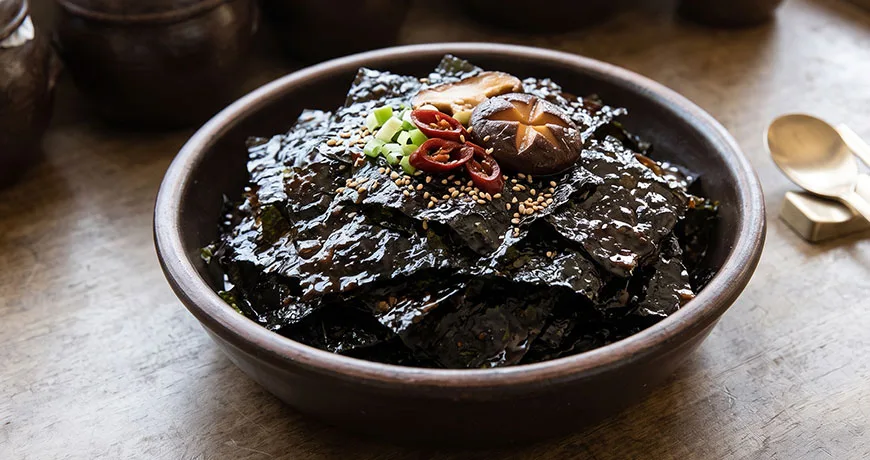
Gimjangajji is a study in density and delicacy, where paper-thin layers of wild-harvested sea laver quietly absorb a slow-simmered, aged soy broth. Because dried seaweed is incredibly fragile when exposed to heat and moisture, this recipe requires the broth to be completely cooled and carefully thickened before it is gently brushed onto each delicate layer. The moment it meets the palate, the intense, oceanic umami melts beautifully on the tongue, transforming a humble sheet of dried seaweed into an elegant masterpiece of high-end dining.
- ⏱️ Total Time: 1–2 Days | Prep: 20 Mins | Cook & Ferment: Slow-simmering broth and 24 hours of cold aging
- 🍳 Difficulty: Medium (Requires careful control of broth viscosity and gentle handling to preserve the seaweed’s form)
- 🌶️ Profile: A deeply comforting, melt-in-your-mouth oceanic umami balanced by the elegant, mellow sweetness of rice syrup
- 🍚 Core Process: Gentle Roasting, Simmering for Viscosity, Cold Layered Infusion
- 🍶 Pairing: Steaming hot white rice, warm green tea rice bowls (Ochazuke), abalone porridge with a drop of sesame oil
Physicochemical & Sensory Matrix
- Baseline Salinity: 5.0% ~ 6.0% (A deep, profound saltiness calibrated to perfectly complement plain rice)
- pH Equilibrium: 5.5 ~ 6.0 (A harmonious balance focused on rich savory notes rather than sharp acidity)
- Textural Crunch Index: [■□□□□] (Begins with a slight resilience that quickly gives way to a lush, melting texture on the tongue)
- Umami Density: 9.5 / 10 (An overwhelming oceanic synergy derived from the seaweed’s natural glutamates and the shrimp/shiitake broth)
- Shelf Stability: Peaks after 24 hours; retains its elegant flavor for up to 1 month refrigerated
- Aroma Profile: Deep Marine Iodine | Roasted Soy Melanoidins | Subtle Toasted Sesame
Ingredients (Yields 1 Wide, Shallow Airtight Container)
- Primary Marine Matrix: 20 Sheets Premium, thick, and coarsely textured Dried Laver (Gopchang-gim or Dol-gim)
- Aromatic Broth Matrix: 1 Cup Brewed Soy Sauce, 1 Cup Purified Water, 0.5 Cup Rice Syrup (Jocheong), 2 tbsp Plum Extract (Maesil-cheong), 3 tbsp Cooking Wine
- Aromatic Catalyst: 1 Dried Shiitake Mushroom, 1 Scallion, 1 Sheet Dried Kelp (10x10cm), 3 Cloves Garlic, 10g Dried Shrimp
- Garnish: 1 tbsp Toasted Sesame Seeds
Allergy Information
- Contains: Soy, Wheat (inherent in brewed soy sauce), Seafood (Shrimp, Seaweed)
Equipment Frying Pan, Stainless Steel Saucepan, Wide/Shallow Glass Airtight Container, Culinary Brush
Cooking Instructions
- Awakening the Marine Aroma: Heat a dry frying pan. Take two sheets of seaweed at a time and gently swipe them across the hot pan to toast them lightly. This vital step drives off any raw, fishy odors, maximizes the nutty aroma, and reinforces the fragile structure of the seaweed. Cut the toasted sheets into neat, bite-sized rectangles (usually sixths).
- Simmering for Depth: In a saucepan, combine the water, soy sauce, cooking wine, shiitake, scallion, kelp, garlic, and dried shrimp. Bring to a boil, remove the kelp, and then lower the heat. Simmer gently to extract the deep, earthy essences, then strain the broth to remove all solid aromatics.
- Finalizing Viscosity: Return the clear broth to the pan. Add the rice syrup and plum extract, simmering gently over low heat until the mixture achieves a glossy, slightly syrupy consistency. Turn off the heat and allow the broth to cool completely to room temperature.
- Cold Layered Infusion: Place 3-4 pieces of the cut seaweed flat in the glass container. Using a culinary brush or the back of a spoon, gently paint the completely chilled soy syrup over the layers. Repeat this meticulous layering process until all the seaweed is stacked beautifully and evenly coated.
- Time-honored Aging: Lightly scatter the toasted sesame seeds over the top. Cover and refrigerate for 24 hours. In the quiet chill of the refrigerator, the viscous broth and the delicate sea leaves merge into a single, cohesive, and luxurious preserve.
💡 Professional Culinary Tips
- 1. Thermal Quenching for Texture Preservation: Dried seaweed is notoriously vulnerable to heat and sudden hydration. Pouring hot broth over it will instantly collapse its cellular structure, reducing it to an unappealing mush. Allowing the broth to cool completely and applying it gently with a brush is the secret to retaining the elegant, layered architecture of the preserve.
- 2. The Art of Viscosity Control: A broth that is too watery will dissolve the seaweed too quickly. By gently reducing the liquid with rice syrup, you increase the viscosity. This thicker, syrupy glaze slows the rate of absorption, preventing structural collapse and creating a luscious, velvety mouthfeel.
- 3. Flavor Activation via Roasting: Briefly toasting the seaweed prior to marinating goes far beyond simple sterilization. It is a crucial thermal treatment that evaporates dimethyl sulfide (DMS)—the compound responsible for raw, fishy smells—while activating the latent amino acids to release a deeply toasted, nutty umami.
🍶 Gastronomic Pairing
- A Luscious Fusion with Carbohydrates: Place a few pieces of the richly marinated seaweed over a bowl of steaming white rice. Use your chopsticks to gently wrap the seaweed around the grains. As the sweet warmth of the rice meets the deeply concentrated, oceanic umami of the preserve, it creates a luxurious harmony that coats the palate. When served alongside Ochazuke (rice steeped in warm green tea), the umami of the seaweed gently diffuses into the clear broth, leaving an elegant and unforgettable finish.
Nutrition Facts (Estimated)
Total Content : Approx. 15g (5-6 pieces of marinated seaweed)
Calories : 35 kcal (Soluble seaweed proteins and complex syrup polysaccharides)
– Sodium : 380mg (Stabilized salinity supporting the depth of the broth)
– Total Carbohydrate : 6.0g (Reducing sugars from rice syrup and plum extract)
– Sugar : 4.5g
– Total Fat : 0.2g
– Saturated Fat : 0.0g
– Cholesterol : 1.5mg (Trace amounts from the dried shrimp broth)
– Protein : 1.8g (High-density marine plant proteins)
– Dietary Fiber : 1.2g
*Daily Values are based on a 2,000 calorie diet and standard Korean nutritional reference values.
**Nutritional values are calculated based on original ingredients; substitutions may alter specific macronutrients.
Origins and Food Culture of Pickled Laver (Gimjangajji)
1. Historical Lineage: “Haeeo” (海衣) and the 17th-Century Marine Innovation of Kim Yeo-ik
- Historical consumption of laver (Pyropia) on the Korean peninsula dates back over a millennium, referenced in the 13th-century chronicle Samguk Yusa under the maritime name Haeeo (海衣, “sea clothing”). The 1530 geographical survey Sinjeung Dongguk Yeoji Seungnam cataloged wild laver as an essential regional tribute commodity presented to the royal court from coastal counties.
- During the reign of King Injo in the 17th century, Kim Yeo-ik (金汝翼, 1578–1660) pioneered the world’s first intentional brushwood laver cultivation on Taein Island in Gwangyang, Jeollanam-do, planting bamboo and oak branches in tidal flats to capture drifting wild spores. Peninsular legend holds that when King Injo enjoyed this cultivated sea delicacy and asked for its name, he was told it had been farmed by a fisherman named Kim in Gwangyang—prompting the king to decree that the seaweed officially bear the creator’s surname, Gim (김).
2. Overcoming Summer Humidity: The Seasonal Preservation of Winter Seaweed
- Historically, edible laver was harvested exclusively during cold winter months and dried under coastal winds into brittle black sheets. Before modern climate-controlled storage, the arrival of the humid summer rainy season (jangma) posed severe challenges: ambient moisture caused dried laver to turn purplish-red, oxidizing delicate lipids and producing stale off-flavors.
- Noble estates and coastal communities devised Gimjangajji as a preservation solution. By submerging surplus dried sheets into concentrated, simmered soy sauce enriched with grain syrups and spices before the monsoons hit, cooks shielded the delicate seaweed from atmospheric oxygen and moisture. This turned a perishable winter staple into a stable banchan reserve that lasted through sweltering summers.
3. Aristocratic Southern Heritage and the Refinement of Seaweed Confection
- Unlike everyday wild garlic or perilla pickles, Gimjangajji occupied an elevated status in the historic gastronomy of Jeolla and Gyeongsang noble lineage estates (jongga), frequently served on refined guest banquet trays (jusang) and celebratory morning tables.
- Trimming brittle sheets into crisp rectangular blocks, brushing them individually with syrup-soy glazes, and stacking them in porcelain dishes reflected the patience and aesthetic discipline of domestic hostesses. Transforming winter sea harvests into lasting culinary assets through soy curing, Pickled Laver remains an enduring monument to Korean slow-food ingenuity, seasonal foresight, and coastal gastronomic heritage.
Rescuing the Ephemeral Flesh of Dried Laver from Dissolution, Binding Ocean Foliage into a Placid, Glossy Glaze of Sweet Soy: A Refined Portrait of Traditional Gimjangajji
Gimjangajji (Pickled Dried Laver in Sweet Soy Sauce) stands as an intimate, understated triumph in Korea’s coastal preservation gastronomy. Crafted from thick, sun-cured sheets of winter laver—particularly coarse rock laver (dolgim) or ruffled gopchang laver (gopchanggim)—cut into tidy rectangles and steeped between layers of cooled, gently reduced marinade made of brewed soy sauce, kelp broth, grain syrup, and dried chilies, this delicate pickle turns a biological vulnerability on its head. While roasted seaweed (gui-gim) relies on dry, brittle crispness and fragrant oils, water is normally the natural enemy of dried seaweed, swiftly reducing its fragile structure into an indistinct sludge. Gimjangajji circumvents this collapse through osmotic discipline: submerged in a viscous, sugar-dense soy liquor, the delicate algal fibers hydrate just enough to soften into an elastic, supple sheet without structural breakdown.
Peeling away a small stack of deep black-violet leaves with chopsticks reveals the gentle resistance of the glossy marinade, which forms liquid bridges between the laminated sheets. Draped over a spoonful of steaming white rice, the hot vapor gently relaxes the chilled soy glaze, releasing a layered olfactory bouquet of toasted sesame, savory soy peptides, and the clean, sweet brine of winter tides. In the mouth, it does not offer the fibrous snap of root pickles or the chew of preserved leaves; instead, the velvety marine sheets dissolve smoothly across the palate, blanketing the hot grains of rice in a slick, savory cloak. The rounded sweetness of the grain syrup softens the soy’s mineral salinity, clearing the way for the seaweed’s natural marine glutamates to flood the palate, leaving behind a clean, lingering sweetness long after swallowing.
The cultural identity of Gimjangajji lies in the domestic resourcefulness of southwestern coastal villages. Dried laver sheets are notoriously sensitive to atmospheric humidity, quickly absorbing ambient moisture, losing their aroma, and oxidizing into a dull red hue. By deliberately immersing these delicate sheets in a protective, reduced soy matrix, ancestral cooks neutralized spoilage while unlocking a luxurious, melting mouthfeel unavailable in dry preparation. A quiet, glistening saucer of pickled laver remains an enduring monument to the delicate manipulation of marine textures on the Korean table.
Editor’s Review
1. Regulated Porphyran Hydration and Laminated Film Mechanics
Gimjangajji occupies a singular textural space between fragile dry sheets and watery dissolution:
- Osmotically Buffered Gelation: Porphyran—the sulfated galactan that dominates the red alga’s cell wall—swells and disintegrates in low-solute water. In a hypertonic soy-syrup medium, this swelling is checked, allowing the polysaccharides to hydrate into an elastic, cohesive hydrogel membrane rather than collapsing into mush.
- Capillary Adhesion and Sheath Separation: Trapped between tightly layered sheets, the high-viscosity soy liquor generates strong capillary forces. This imparts a satisfying tensile drag when peeling layers apart with chopsticks, followed by a velvety, gradual melt across oral tissues during mastication.
2. Marine-Terrestrial Amino Acid Synergy and Chromophore Protection
The profound savor and deep obsidian sheen of Gimjangajji stem from precise molecular coupling and low-temperature infusion:
- Umami Multiplier Effect: Laver is naturally rich in free glutamic acid, aspartic acid, and taurine. When paired with the fermented oligopeptides and free amino acids of brewed soy sauce, it forms an expansive umami network that coats the palate with prolonged persistence.
- Chromophore Stabilization via Cold Pouring: Bypassing hot-brine techniques in favor of a completely chilled marinade shields thermal-sensitive pigments—principally phycoerythrin (red-purple) and chlorophyll a (green)—from oxidative degradation. This preserves the dignified, iridescent black-purple hue of raw laver alongside its volatile ocean notes (such as dimethyl sulfide).
3. Upcycling Hygroscopic Fragility into a Shelf-Stable Delicacy
Gimjangajji provides a pragmatic answer to the storage vulnerabilities of dried seaweed. By substituting volatile air exposure with an anaerobic, hypertonic liquid bath, the recipe drops water activity ( ) toward 0.80, keeping microbial growth at bay. Transforming fragile, humidity-prone dry seafood into an enduring, glistening table companion, it exemplifies the quiet elegance of Korean marine preservation science.