
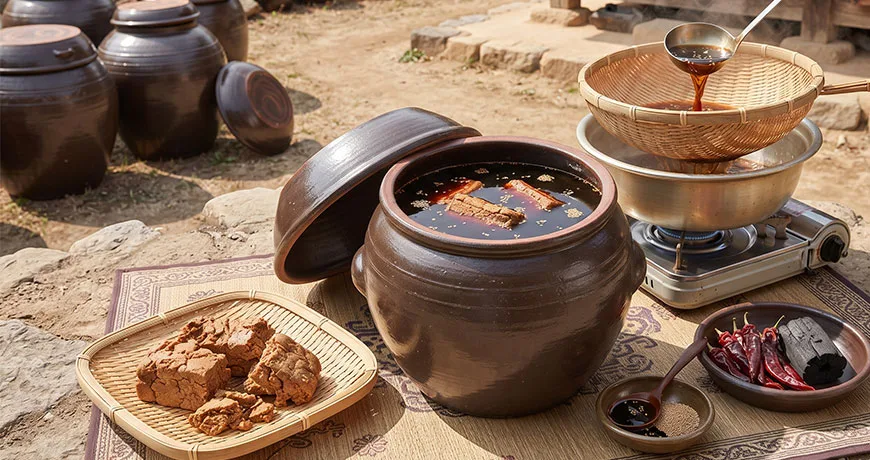
Traditional Joseon Ganjang is an extreme molecular gastronomy matrix achieved through the highly controlled enzymatic proteolysis of soybean proteins within a high-salt osmotic environment. Unlike commercial soy sauces that incorporate roasted wheat to produce sweet sugars, pure Hansik Ganjang relies exclusively on soybeans, water, and sea salt. This yields a liquid with zero carbohydrates and a razor-sharp, profound umami driven entirely by free glutamic acid and peptides. During the initial fermentation, the porous cellular structure of hardwood charcoal physically adsorbs foul volatile compounds, while capsaicin from red chilies inhibits putrefactive microbes. Over a maturation period of one to several years, continuous exposure to oxygen and solar ultraviolet rays drives non-enzymatic Maillard browning and moisture evaporation, concentrating the liquid into a dark, heavy, amino-acid-dense elixir.
- ⏱️ Total: 1+ Years | Prep: 40–60 days (Primary brining & extraction) | Cook: 1+ Years (Natural aging & Maillard maturation)
- 🍳 Difficulty: Extreme (Requires mastery of halophilic microbial environments, strict salinity calibration, and earthenware respiration control)
- 🌶️ Profile: Crystalline Salinity Pierced by Explosive, Pure Soybean Umami
- 🍚 Focus: Osmotic Extraction, Enzymatic Proteolysis, Activated Carbon Adsorption, & Long-Term Maillard Aging
Ingredients (Yields 1 Traditional Crock)
- Enzyme & Protein Matrix: 5kg Meju (Fermented Soybean Blocks – Must be sun-dried and heavily inoculated with beneficial Bacillus subtilis and Aspergillus molds)
- Osmotic Solvent: 20L Purified Water, 4–5kg Coarse Solar Sea Salt (Aged 3+ years to leach out bitter magnesium chloride; constructs an 18-20% salinity barrier against putrefaction)
- Antimicrobial & Purification Catalyst: 3–4 pieces Hardwood Charcoal (heated until glowing red hot), 5 Dried Red Chilies, 5 Dried Jujubes
Allergy Information Contains: Soy (Meju)
Equipment Microporous Traditional Earthenware Crock (Onggi), Salinity Meter (or a raw egg for density testing), Cheesecloth, Charcoal Brazier
Cooking Instructions
- Osmotic Solvent Construction: Dissolve the solar sea salt into the purified water to achieve an 18-20% salinity baseline. (Using traditional physics: when a raw egg is dropped in, the dense saline should force the egg to float, exposing a surface area roughly the size of a large coin.) Allow the brine to sit for 24 hours so heavy impurities settle, then strain the clear liquid through cheesecloth.
- Protein Matrix Submersion: Briefly rinse the Meju blocks, dry them completely in the sun, and stack them at the bottom of the Onggi crock. Pour the purified brine over them. As the Meju hydrates, osmotic pressure forces the water-soluble amino acids and peptides out of the soybeans and into the solvent.
- Purification & Antimicrobial Sealing: Instantly plunge the red-hot hardwood charcoal into the brine. The thermal shock expands the charcoal’s microporosity, turning it into a powerful natural filter that physically adsorbs toxic byproducts and foul off-odors. Float the red chilies and jujubes on the surface to establish a capsaicin antibacterial shield, then seal the crock.
- Primary Enzymatic Hydrolysis: Allow the crock to ferment in a sunny location for 40 to 60 days. During this critical window, the proteases generated by Bacillus subtilis aggressively hydrolyze the dense soybean proteins, transforming the clear brine into a deep, amber-brown amino acid solution.
- Liquid-Solid Separation (Jang-garugi): After 60 days, physically separate the dark liquid (raw Ganjang) from the swollen, macerated soybean solids (which will be mashed to become Doenjang). Pour the raw liquid into a cauldron and bring it to a rolling boil. This thermodynamic intervention neutralizes all enzymatic and microbial activity, sterilizing the liquid.
- Long-term Oxidation & Maillard Aging: Cool the sterilized soy sauce and return it to a clean Onggi. Allow it to age outdoors for at least one year. As moisture slowly evaporates through the microporous clay, the salinity and umami density skyrocket. Prolonged exposure to sunlight induces a slow Maillard reaction between the amino acids, darkening the liquid into the ultimate savory elixir.
💡 Professional Culinary Tips
- Fluid Dynamics of the Salinity Threshold: If the brine’s salinity drops below 18%, the osmotic barrier is breached, allowing lactic acid bacteria to hyper-proliferate and turn the soy sauce rancid and sour. Conversely, if the salt concentration is too high, it paralyzes the Bacillus proteases, halting umami extraction. The egg-floating density test is a flawless, ancient biochemical calibration to hit the exact operational threshold.
- Activated Carbon Adsorption Mechanics: Plunging glowing charcoal into the brine is not folklore; it is applied chemistry. The sudden kinetic thermal shock expands the carbon’s internal capillaries, radically increasing its surface area. It acts as a vacuum, physically trapping volatile amines and sulfurous off-notes generated during early fermentation.
- Microporous Respiration of Onggi: Aging traditional soy sauce in glass or plastic suffocates the matrix, leading to anaerobic putrefaction. Onggi clay is fired in a way that creates microscopic pores—acting as a semi-permeable membrane that blocks liquid from leaking out while allowing oxygen to pass in. This micro-oxygenation is mandatory for the aerobic yeasts to refine the final flavor profile.
🍶 Gastronomic Pairing
- Biochemical Palate Cleansing: The razor-sharp salinity and explosive glutamic acid of an aged Joseon Ganjang require no complex masking. Use this elixir to season a pristine, clear Muguk (Korean Beef and Radish Soup). The inosinate (IMP) extracted from the beef broth will violently collide with the glutamate of the Ganjang. This initiates a profound nucleotide-amino acid synergy (Umami Synergy), delivering a pure, crystalline consommé that stimulates your taste receptors to their absolute maximum threshold.
Nutrition Facts (Estimated)
Total Content : Approx. 15ml (1 tbsp)
Calories : 9 kcal (Highly concentrated amino acid liquid)
– Sodium : 1,050mg (Extreme salinity matrix designed for long-term preservation and osmotic extraction)
– Total Carbohydrate : 1.0g (Trace polysaccharides from soybeans)
– Sugar : 0.0g (Zero reducing sugars due to the complete absence of wheat)
– Total Fat : 0.0g
– Saturated Fat : 0.0g
– Cholesterol : 0.0mg (100% Plant-based fermented matrix)
– Protein : 1.5g (Highly bioavailable free amino acids and peptides from fully hydrolyzed soy protein)
– Dietary Fiber : 0.0g
*Daily Values are based on a 2,000 calorie diet and standard Korean nutritional reference values.
**Nutritional values are calculated based on original ingredients; substitutions may alter specific macronutrients.
Origins and Food Culture of Soy Sauce (Ganjang)
1. Ancient Foundations: The Samguk Sagi Royal Dowry and Sacred Fermentation Treatises
- Korea’s ancient fermentation culture traces back to the wild soybean homelands of Manchuria and the northern peninsula, documented as early as 683 CE in the Samguk Sagi (Chronicles of the Three Kingdoms), where King Sinmun of Silla presented “Jang (fermented paste) and Si (cured meju bricks)” as primary royal wedding gifts, proving its prestigious status as a sovereign treasure.
- Classical Joseon compendiums, including the 1554 famine relief manual Guhwang Chwaryo, the 18th-century agrarian encyclopedia Jeungbo Sallim Gyeongje, and Bingheogak Lady Yi’s 1809 Gyuhap Chongseo, document elaborate rituals surrounding the day of brewing (jang-damgeugi). Matriarchs selected auspicious calendar dates and underwent ritual purifications, as the quality of the household’s soy sauce was revered as an indicator of familial fortune, spiritual harmony, and culinary prestige.
2. Breathable Onggi Crocks, “Jang-Gareugi,” and the Sacred Lineage of “Ssi-Ganjang”
- The technical mastery of Korean soy sauce lies in non-thermal solar brewing within breathable earthenware crocks (onggi). Microscopic air pores in the unglazed pottery are smaller than water droplets yet larger than gas molecules, repelling rain while allowing oxygen circulation that fosters aerobic fermentation by beneficial microbes and halts spoilage.
- After 40 to 60 days of steeping, when the soy nutrients have fully dissolved into the brine, cooks perform Jang-Gareugi—separating the liquid (which becomes Ganjang) from the fermented solids (which become Doenjang). The liquid is gently boiled to fix the flavor profile before returning to the jars. In noble lineage households (jongga), a portion of mature aged sauce—known as Ssi-Ganjang (seed soy sauce)—is preserved at the bottom of the vat, replenished periodically with freshly brewed sauce (deot-ganjang), passing microbial strains and flavor compounds down through generations for centuries.
3. The Tripartite Aging Hierarchy and Global Recognition as Intangible Cultural Heritage
- Traditional culinary practice strictly categorizes Ganjang according to age: Cheongjang (or Guk-ganjang, aged 1–2 years), which is pale, sharp, and salty, is utilized for clear soups and delicate vegetable dishes to preserve natural colors; Jungganjang (aged 3–4 years) is used for braises and everyday stews; and Jinjang (aged 5 years or more), which is thick, dark, and naturally sweet, is reserved for royal banquet dishes like braised short ribs (galbi-jjim) and sweet rice (yaksik).
- Recognized domestically as a National Intangible Cultural Property, the communal tradition of “Knowledge and practices related to Jang making in the Republic of Korea” represents a profound social bond linking generations. Celebrated worldwide for its microbial purity and time-honored depth, Traditional Soy Sauce remains an immortal cultural monument to slow-food gastronomy, ancestral wisdom, and the living spirit of Korean hospitality.
The Amber-Black Elixir of Fermented Soybeans, the Breathing Terracotta Onggi, and the Proteolytic Alchemy of Time: A Refined Portrait of Traditional Korean Ganjang
Ganjang (Traditional Korean Soy Sauce, specifically Joseon Ganjang or soup soy sauce) stands as the profound, liquid soul and the invisible culinary architect of Korea’s entire tangban (soup and rice) gastronomy. Bypassing the wheat-heavy, sweetened iterations of mass-market soy sauces, this ancient condiment is born from an uncompromising trinity: soybeans, salt, and time. The monumental process begins in late autumn when soybeans are boiled, mashed, and shaped into blocks called meju, which are suspended with rice straw to capture wild Bacillus subtilis and ambient molds. Come early spring, these microbially active blocks are scrubbed, sun-dried, and submerged into high-salinity brine within a breathing terracotta crock (onggi). To purify and deodorize the infusion, glowing hardwood charcoal and fiery dried red chilies are floated on the surface before the crock is sealed. Across months of maturation beneath the warm sun and cool winds, the microbial proteases tirelessly dismantle the dense soybean proteins into a rich reservoir of free amino acids, slowly leaching into the brine. When fermentation peaks, the umami-dense liquid (ganjang) is painstakingly separated from the solid mash (doenjang) and transferred to a massive cast-iron cauldron. Boiled rigorously to halt microbial activity, sterilize the liquid, and concentrate its aromatics, this pristine amber-black elixir is born. Containing zero artificial sugars or additives, a single crystalline drop of traditional Joseon ganjang possesses the astonishing capacity to detonate the natural flavors of a clear broth without muddying its color, securing its place as the undisputed sovereign of Korean fermentation arts.
Approaching a steaming bowl of clear radish soup or delicate blanched greens seasoned with this ancient elixir releases an immediate, deeply resonating olfactory charge: the savory, roasted perfume of fermented soy peptides mingles seamlessly with a sharp, piercing saline clarity and a faint, smoky Maillard whisper forged during the cauldron boiling. Taking the first sip of a broth seasoned with Ganjang delivers an unadorned revelation across the oral mucosa: the sharp, initial strike of salinity rapidly gives way to a silken, engulfing wave of profound amino-acid umami that rounds out the palate. Because this traditional soup soy sauce is an ultra-low-viscosity aqueous solution, it penetrates the cellular matrices of vegetables and meats without resistance, uniting effortlessly with the inosine monophosphate (IMP) of beef or seafood to create an exponential flavor synergy. Cutting through the richness of animal lipids while breathing vibrant, multidimensional life into humble mountain greens, this dark elixir transcends mere seasoning, delivering an enduring gastronomic reward that warms the core and balances the digestive spirit.
The enduring majesty of Ganjang lies in its sacred domestic lineage—tracing back to the agrarian origins of the Three Kingdoms period, where the Jangdokdae (the elevated terrace housing the family’s fermentation crocks) was revered as the spiritual and culinary sanctum of the household. Refusing to compromise with the rapid, acid-hydrolyzed shortcuts of modern industrial condiments, a spoonful of traditional Korean soy sauce captures the breathtaking power of symbiotic microbiology, osmotic physics, and maternal patience. It remains an irreplaceable monument of ecological harmony, ancestral wisdom, and brilliant Korean culinary craftsmanship.
Editor’s Review
1. A Dynamic Harmony of Ultra-Low Viscosity Fluidity, Sharp Osmotic Penetration, and Frictionless Umami Resonance
The structural architecture of this ingredient delivers an extraordinary textural paradigm: it provides zero mechanical resistance but absolute flavor integration. Unlike sweetened, viscous reduction glazes, traditional Joseon Ganjang maintains an ultra-low-viscosity aqueous state. This translucent, amber-black fluid exhibits formidable osmotic penetration, infiltrating the cellular walls and myofibrillar gaps of other ingredients instantaneously. Upon contacting the tongue, it delivers a sharp, crystalline prick of salinity that is immediately followed by a frictionless, velvety coating of peptide-driven umami. This dynamic rheological profile ensures that the sauce never sits heavily on the surface of a dish but rather melds seamlessly into the broth or vegetable, ensuring an impeccably balanced, non-fatiguing mouthfeel from the first drop to the last.
2. Bacillus-Mediated Proteolysis, Glutamate Umami Synergism, Osmotic Pathogen Suppression, and Melanoidin Maillard Kinetics
Ganjang represents an exacting study in microbial proteomics, hyper-saline fluid dynamics, and pyrolytic flavor chemistry. Wild Bacillus subtilis and Aspergillus molds originating from the rice straw secrete potent protease enzymes that systematically hydrolyze insoluble soybean storage globulins (glycinin) into highly soluble peptides and free amino acids. The resulting explosion of free glutamic acid and aspartic acid dictates the liquid’s profound savory depth. The aggressive salinity of the brine (18–20%) exerts immense osmotic pressure, acting as an absolute barrier against pathogenic putrefaction while selectively permitting halotolerant lactic acid bacteria and yeasts to contribute subtle aromatic esters. During the final boiling phase (dal-i-gi), thermal energy catalyzes Maillard reactions between residual reducing sugars and amino acids, generating dark brown melanoidin polymers. These high-molecular-weight melanoidins possess potent antioxidant properties and function as powerful deodorizing agents, physically sequestering volatile off-notes (like fishy trimethylamine) and ensuring the resulting clear soups remain aromatically pristine.
3. The Ancestral Jangdokdae Heritage and the Sovereign Architect of Korean Tangban Gastronomy
Serving as the foundational culinary DNA of the Korean peninsula, traditional Ganjang stands as the ultimate archetype of minimalist, time-forged seasoning. By enhancing the innate identity of ingredients rather than masking them under heavy, cloying sweetness, this crystalline, umami-dense elixir captures the very soul of Korean culinary philosophy. It stands as an enduring sanctuary of ecological authenticity, microbial alchemy, and brilliant Korean gastronomic artistry.