
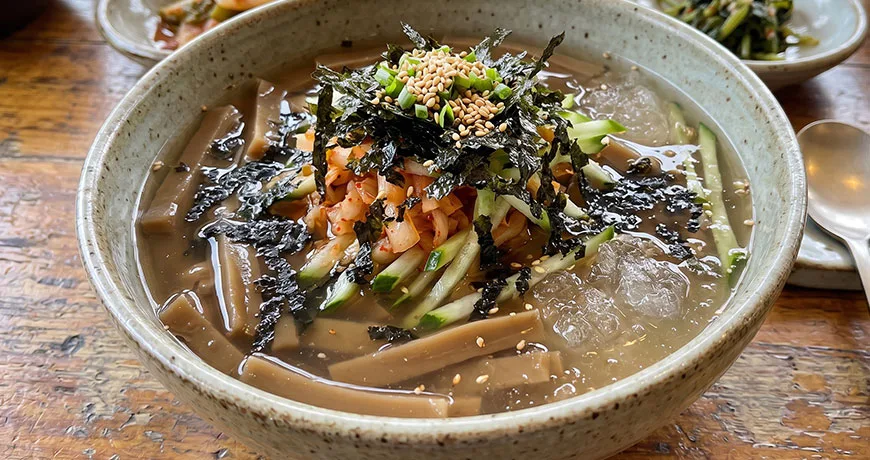
Dotorimuksabal is a thermodynamic chilled soup built upon a robust hydrocolloid gel matrix formed by the heating and cooling of acorn starch (amylose). The flawless, bouncy viscoelasticity of this gel is born from the exhausting labor of an artisan constantly stirring the heavy starch paste over a hot cauldron to prevent scorching. This plant-based gel is suspended in a supercooled, endothermic umami solvent (typically dongchimi radish brine or beef broth) that rapidly absorbs kinetic body heat upon ingestion. By introducing hypertonic, lactic acid-fermented Kimchi and fresh cucumbers brimming with cellular turgor pressure, the dish achieves an extraordinary rheological textural contrast. Furthermore, the subtle natural tannins inherent in the acorns biochemically stimulate the taste receptors, acting as a powerful appetite stimulant when combined with the sharp acidity of the icy broth.
⏱️ Total: 15 mins | Prep: 10 mins | Cook: 5 mins | 🍳 Difficulty: Low (Requires thermal starch restoration and temperature control) | 🌶️ Profile: Crisp, Tart, Mildly Astringent, and Deeply Refreshing | 🍚 Focus: Endothermic Cooling, Starch Retrogradation, & Tannin-Lactic Synergy | 🍶 Pairing: Tart and carbonated Omija (Five-flavor berry) Makgeolli
Ingredients (2 servings)
- Hydrocolloid Gel Matrix: 300g Dotori-muk (Acorn Jelly, mechanically cleaved into 5–6cm rectangular strips, 1cm thick)
- Endothermic Umami Solvent: 600ml Commercial Naengmyeon broth or Dongchimi brine (placed in the freezer for 2–3 hours beforehand to achieve a supercooled, slushy state)
- Lactic Acid & Osmotic Binder: 100g Well-fermented Kimchi (finely chopped), 0.5 tsp Gochujang (chili paste), 1 tsp toasted sesame oil, 0.5 tsp sugar
- Turgor Matrix: 1/2 Cucumber (julienned)
- Aromatic & Lipid Garnish: 1 handful roasted seaweed flakes (Gim), 1 tbsp toasted sesame seeds (physically crushed right before use)
Allergy Information Contains: Soy, Wheat (from Kimchi seasoning and Gochujang), Sesame
Equipment Cutting Board, Knife, Mixing Bowl, Pot (for blanching jelly), Slotted Spoon, Mortar and Pestle (for sesame seeds)
Cooking Instructions
- Thermal Restoration of Viscoelasticity: Refrigerated acorn jelly often undergoes starch retrogradation, turning hard, opaque, and brittle. Submerge the entire block in boiling water for 2–3 minutes, then immediately shock it in a cold water bath. The heat relaxes the crystallized amylose chains, completely restoring the jelly’s freshly-made, bouncy, and perfectly yielding viscoelasticity.
- Lactic Matrix & Lipid Coating: In a bowl, aggressively knead the chopped fermented Kimchi with sugar, Gochujang, and sesame oil. The osmotic pressure of the sugar biochemically masks the sharp lactic acid of the Kimchi, while the sesame lipids form a hydrophobic coating around the fibers, ensuring the intense flavors are not immediately washed away by the cold broth.
- Structural Assembly: Generously layer the thermally restored, bouncy acorn jelly at the bottom of a chilled bowl. Neatly arrange the turgid, crunchy julienned cucumbers and the seasoned Kimchi on top, creating a vibrant visual and textural contrast.
- Supercooled Solvent Injection: Carefully pour the icy, slushy cold broth around the inner edge of the bowl so as not to dismantle the assembled matrix.
- Aromatic Finish: Crown the assembly with roasted seaweed flakes and a heavy dusting of freshly crushed sesame seeds to maximize the release of volatile nutty aromas. Serve immediately.
💡 Professional Culinary Tips
- Physics of Starch Retrogradation: When starch molecules lose moisture in the cold and return to a hardened crystalline structure, it is called retrogradation. The artisan process of briefly “dancing” this hardened jelly in boiling water to revive its original elasticity is a testament to understanding physicochemical properties—ensuring a lively, yielding texture even within an ice-cold dish.
- Biochemical Synergy of Tannins & Lactic Acid: The natural astringency of acorn tannins can be off-putting on its own. However, when these tannins collide with the extreme cold of the supercooled broth and the aggressive lactic acid of fermented Kimchi, the bitterness is biochemically transformed into a highly pleasant, palate-cleansing stimulant that triggers explosive salivary responses.
- Volatile Aromatics of Crushed Sesame: Sprinkling whole sesame seeds is practically useless, as their hard husks prevent digestion and trap all aromas inside. Taking the manual, analog effort to physically crush the seeds in a mortar exactly seconds before serving violently ruptures the cellular walls, releasing highly concentrated, volatile lipid aerosols that form a perfect aromatic layer across the surface of the icy broth.
🍶 Gastronomic Pairing
- Biochemical Palate Cleansing: When the slightly astringent acorn tannins and heavy sesame lipids coat your palate, pair this icy bowl with Omija (Five-flavor berry) Saeng-Makgeolli. The sharp organic acids and lively natural carbonation of this pink, unpasteurized rice wine act as a perfect chemical astringent, washing away the oils and seamlessly matching the temperature and tartness of the cold soup to reset your sensory baseline.
Nutrition Facts (Estimated)
Total Content : Approx. 550g (1 serving)
Calories : 180 kcal – Sodium : 890mg (Variable depending on commercial broth and Kimchi)
– Total Carbohydrate : 32.0g
– Sugar : 8.0g
– Total Fat : 4.5g (Sesame oil and crushed seed lipids)
– Saturated Fat : 0.5g
– Cholesterol : 0.0mg
– Protein : 3.0g
– Dietary Fiber : 6.0g
*Daily Values are based on a 2,000 calorie diet and standard Korean nutritional reference values.
**Nutritional values are calculated based on original ingredients; substitutions may alter specific macronutrients.
Origins and Food Culture of Chilled Acorn Jelly Soup (Dotorimuksabal)
1. Historical Lineage: From Ancient Famine Food (Guhwang) to Aristocratic Delicacy
- Tracing its historical roots back to ancient famine-relief staples (guhwang singnyo) that saved countless lives across the Korean peninsula during harvest failures and harsh springs; classical Joseon medical treatises like Dongui Bogam and agricultural records like Guhwangbyeokgokbang documented that acorns (sangsil) strengthen the stomach and intestines, relieve hunger, and bestow physical lightness.
- Originally gathered by rural villagers from oak-forested mountain ridges, acorn jelly was later celebrated for its refined flavor and therapeutic purity, rising to royal banquets before establishing itself as a beloved roadside tavern (jumak) staple served with bowls of cold broth.
2. The Culinary Science of Tannin Leaching and Amylose Gelatinization
- The hallmark of authentic preparation lies in the labor-intensive processing of wild acorns: shelling, grinding, and repeatedly soaking the meal in cold water over several days to leach out bitter, harsh soluble tannins while retaining optimal polyphenol levels.
- Simmering the settled starch slurry with precise water ratios while stirring continuously over gentle heat triggers complete amylose starch gelatinization; resting and cooling the paste creates a delicate three-dimensional polymer network that yields an elastic, quivering jelly that never crumbles in liquid.
3. Rustic Tavern Nostalgia, Mountain Trail Dining, and All-Season Comfort
- Deeply rooted in regional culinary communities across Chungcheong-do (such as the famous Gujeuk Muk Village in Daejeon), Gangwon-do, and Gyeongsang-do, this dish evokes the nostalgic romance of weary travelers pausing at rustic mountain taverns for a chilled bowl of jelly and a bowl of fresh makgeolli.
- Remaining an iconic ritual food for weekend hikers descending forest trails today, Dotorimuksabal transitions effortlessly from a steaming, comforting broth bowl in the depths of winter (on-mukbap) to an ice-capped summer cooler (naeng-muksabal), representing an enduring monument of Korean slow food and botanical culinary resourcefulness.
The Supple Elasticity of Forest-Harvested Acorn Starch and the Chilled Radiance of Lactic Broth: A Refined Portrait of Dotorimuksabal
Dotorimuksabal (Chilled Acorn Jelly Soup) stands as the refreshing, ultra-hydrating, and restorative summit of Korea’s cold (tangban) gastronomy. Wild acorns collected from rugged oak mountain forests are ground, leached repeatedly in cold spring water to soften harsh astringency, and patient-simmered in heavy cauldrons into a firm, glistening, earth-brown jelly (dotorimuk). Sliced into slender, uniform ribbons and placed in a deep bowl, the jelly is topped with finely chopped, aged Napa cabbage kimchi tossed in toasted sesame oil, crisp julienned cucumbers, toasted seaweed flakes, and cracked sesame seeds, then crowned with a generous ladle of slushy, ice-cold broth made from dongchimi radish brine and rich beef or anchovy stock. Often enjoyed by steeping a bowl of warm cooked rice directly into the icy soup (mukbap), this dish deliberately casts aside heavy lipids, uniting the resilient, botanical slide of acorn starch with the electric acidity of fermented vegetables to instantly revive a heat-exhausted palate.
Drawing a generous spoonful brimming with trembling jelly ribbons, crushed ice, and vibrant toppings delivers an immediate, electrifying charge to the senses. The deep, nutty aroma of toasted sesame oil and roasted seaweed flakes cuts through the crisp, frosty vapor, harmonizing with the piquant, lactic perfume of mature kimchi and fresh cucumber. The first sip sends a wave of glacial clarity across the tongue: the bright organic acids of vinegar and fermented radish brine instantly awaken the salivary glands, followed smoothly by the savory depth of cold-extracted broth. Gliding into the oral cavity, the acorn jelly offers a playful, supple bounce (taenggeul) before dissolving effortlessly against the tongue, releasing an earthy, subtle bitterness characteristic of forest starch. The auditory crunch of fermented kimchi and the crisp hydration of cucumber ribbons punctuate the velvety jelly, while the nutty pop of whole sesame seeds frames the finish, delivering an invigorating, heat-banishing ritual of total physical restoration.
The enduring majesty of Dotorimuksabal lies in its historical transcendence—transforming an ancient famine-relief survival food (guhwang) into an iconic, health-restoring summer delicacy through patient artisanal leaching and thermal control. Originating from the bustling rural marketplace taverns of Chungcheong and Gangwon provinces, where it cooled the brows of weary agrarian laborers, a chilled bowl of acorn jelly soup remains an irreplaceable monument of ecological resilience, unpretentious hospitality, and revitalizing Korean culinary craftsmanship.
Editor’s Review
1. A Dynamic Harmony of Trembling Jelly Elasticity, Crisp Kimchi-Cucumber Snap, and Slushy Broth Fluidity
The textural landscape inside the bowl delivers an exhilarating contrast between low-temperature hydrogels and fresh plant structures. The acorn jelly ribbons offer an initial elastic resistance that yields smoothly without chewing, gliding like silk across the palate. This delicate glide is dynamically punctuated by the sharp, auditory crunch of diced fermented cabbage and the crisp, water-dense batons of cucumber. Toasted seaweed and cracked sesame seeds add delicate, savory micro-textures, while the addition of rice introduces a chewy starch contrast as the grains firm up slightly in the cold broth, ensuring a cohesive, non-fatiguing mouthfeel from the first spoonful to the last.
2. Amylose Retrogradation Gel Network Kinetics, Polyphenolic Tannin Astringency Control, and Low-Temperature Acid-Umami Dynamics
Dotorimuksabal represents an exacting study in polysaccharide physical chemistry, plant polyphenol mechanics, and low-temperature sensory biophysics. Acorn starch possesses a notably high amylose ratio (approximately 24–27%), which undergoes rapid retrogradation upon cooling, forming tight intermolecular hydrogen bonds that yield a stable, thermoirreversible 3D elastic gel network. The traditional cold-water leaching process extracts excess water-soluble gallotannins and ellagitannins; the retained trace polyphenols lightly cross-link with salivary proline-rich proteins, producing a pleasant, clean, and mildly astringent mouthfeel that cleanses lingering fats. At sub-zero slush temperatures (0–4°C), human sweet receptors are suppressed while sensitivity to volatile aromatics and organic acids (lactic and acetic acids) is heightened. These acids trigger robust salivary reflex responses, which interact synergistically with broth inosinates (IMP) and seaweed glutamates to amplify savory amplitude without requiring artificial additives.
3. The Agrarian Heritage of Famine-Relief Foraging and the Living Soul of Korean Summer Gastronomy
Born from the historical necessity of detoxifying wild acorns during severe agricultural famines, Dotorimuksabal captures the ingenuity of Korean culinary history. Elevating wild forest sustenance into an elegant, digestive-cleansing summer staple through patient thermal extraction and cold-broth engineering, this pristine classic serves as an enduring sanctuary of restorative wellness, seasonal adaptation, and brilliant culinary resilience.