
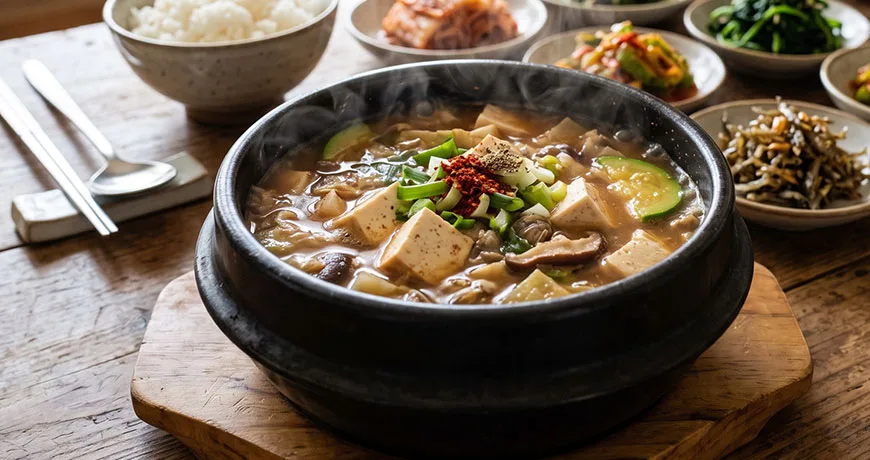
Doenjangguk is a perfectly stabilized colloidal suspension where fermented soybean protein paste (Doenjang) is finely dispersed within an aqueous, umami-dense anchovy broth. Through microbial metabolism, the high-molecular-weight soy proteins are cleaved into low-molecular peptides and isoflavones, transforming the paste into a matrix with maximized bioavailability. As the vegetable matrix (potato, zucchini, onion) undergoes thermodynamic breakdown, it releases cellular sap and reducing sugars. These natural plant sugars initiate an osmotic exchange with the hypertonic fermented broth, biochemically neutralizing the sharp salinity. Furthermore, the potassium ions abundantly leached from the vegetables perform a biochemical antagonism, binding with sodium in the bloodstream to facilitate its excretion, thereby perfectly balancing the electrolyte load of the high-sodium fermented broth within the human body.
⏱️ Total: 25 mins | Prep: 10 mins | Cook: 15 mins | 🍳 Difficulty: Low (Requires colloidal stability and sequential pectin hydrolysis) | 🌶️ Profile: Earthy, Savory, and Comfortingly Mild | 🍚 Focus: Colloidal Suspension, Pectin Hydrolysis, & Osmotic Exchange | 🍶 Pairing: Traditional raw rice-fermented Dongdongju
Ingredients (2–3 servings)
- Colloidal Umami Binder: 2–2.5 tbsp Doenjang (Korean fermented soybean paste, passed through a fine mesh to ensure uniform dispersion)
- Aqueous Umami Solvent: 1L Anchovy-Kelp Broth (or starchy rice water)
- Pectin & Starch Matrix: 1 Potato (cubed), 1/3 Zucchini (cut into quarter-moons), 1/4 Onion (sliced)
- Porous Protein Gel: 1/2 block Tofu (firm/soup style, diced into 1.5cm cubes)
- Aromatic Catalyst: 1/2 stalk Green Onion (sliced), 0.5 tbsp minced garlic, 1 Cheongyang green chili (optional)
Allergy Information Contains: Soy, Wheat (from Doenjang), Fish (Anchovy broth)
Equipment High Thermal Mass Pot or Ttukbaegi, Fine Mesh Strainer, Cutting Board, Knife
Cooking Instructions
- Colloidal Suspension Setup: Pour the anchovy broth into a pot. Use a fine mesh strainer to dissolve the Doenjang completely into the liquid. This ensures the fermented soybean proteins distribute evenly, creating a stable colloidal suspension without gritty sediment settling at the bottom.
- Sequential Thermal Hydrolysis: Turn the heat to high. Introduce the densest starch matrix first—the cubed potatoes. Once the potato’s rigid pectin bonds have degraded by roughly 50%, add the higher-moisture vegetables (zucchini and onion) along with the minced garlic.
- Stabilization & Gel Addition: As the broth reaches a rolling boil, gently drop in the cubed tofu. Here, relying on the artisan’s intuitive heat control—reading the kinetic ripples of the boiling broth to lower the flame at the exact moment a gentle simmer is reached—ensures the fragile colloidal suspension does not violently break apart.
- Osmotic Exchange: Simmer gently for 5–7 minutes. The hypertonic savory broth penetrates the porous tofu and vegetable cells via osmosis, while the sweet reducing sugars from the vegetables leach outward, achieving absolute flavor equilibrium.
- Aromatic Finish: Turn off the heat and instantly add the sliced green onions and green chilies. The residual radiant heat will bloom their volatile aromatics into the soup.
💡 Professional Culinary Tips
- Kinetics of Sequential Pectin Breakdown: Dumping all the vegetables in simultaneously is a structural flaw. Zucchini pectin hydrolyzes exponentially faster than potato starches. Adding the dense potatoes first (sequential addition) is fundamental food science to preserve the distinct rheological textures of each ingredient, preventing the zucchini from dissolving into an unpalatable mush.
- Boiling Point Control of Doenjang: The beneficial Bacillus subtilis bacteria and delicate, volatile fermentation aromas of Doenjang evaporate or are destroyed if subjected to a violent, prolonged 100°C boil. Unlike heavier stews (Jjigae), this soup requires only a brief, gentle simmer—just long enough to cook the vegetables—to maximize its profound enzymatic benefits and earthy fragrance.
- Porous Network & Osmosis of Tofu: When cubed tofu is introduced to boiling broth, the internal moisture expands and escapes, opening up a porous micro-network. The hypertonic Doenjang broth immediately rushes in via osmosis to fill the void. Adding the tofu too late leaves it bland on the inside; introducing it while the vegetables are still softening allows it to act as an “umami sponge,” an invisible timing technique that perfects the soup.
🍶 Gastronomic Pairing
- Biochemical Palate Cleansing: When the heavy, earthy colloidal suspension of fermented soybeans dominates your palate, pair it with Dongdongju, a traditional unpasteurized rice wine with floating rice grains. The lively organic acids produced by the active yeast, combined with its refreshing, slightly effervescent texture, effortlessly wash away the dense earthiness, brilliantly resetting your sensory baseline for the next bite.
Nutrition Facts (Estimated)
Total Content : Approx. 450g (1 serving)
Calories : 145 kcal
– Sodium : 850mg (Variable depending on Doenjang salinity)
– Total Carbohydrate : 20.0g
– Sugar : 4.5g
– Total Fat : 3.5g
– Saturated Fat : 0.5g
– Cholesterol : 5.0mg (From anchovy broth)
– Protein : 9.0g
– Dietary Fiber : 4.0g
*Daily Values are based on a 2,000 calorie diet and standard Korean nutritional reference values.
**Nutritional values are calculated based on original ingredients; substitutions may alter specific macronutrients.
Origins and Food Culture of Soybean Paste Soup (Doenjangguk)
1. Millennia of Fermentation: The Ancient Legacy of “Tojangguk”
- Tracing its roots back to the Three Kingdoms period and beyond, where historical records such as the 12th-century Samguk Sagi document fermented soybean pastes (jang and si), this dish represents the most direct, unbroken continuation of the ancient Tojangguk (clear soybean broth) recorded in classic Joseon agricultural texts like Sallim Gyeongje.
- Representing the bedrock of everyday Korean domestic dining (bapsang), rural households across millennia relied on crocks of home-brewed doenjang and wild greens plucked from kitchen borders to reliably nourish families through all four seasons.
2. The Culinary Science of Sieve-Straining and Starch Colloid Stabilization
- The hallmark of authentic preparation lies in sieving the fermented paste into simmering stock using a fine woven strainer, dissolving rich savory solubles while discarding coarse, gritty soybean hulls to yield a light, drinkable consistency.
- Using nutrient-dense rice-washing water (ssalddeumul) as the primary liquid allows suspended starch particles to buffer the bold saltiness of the bean paste, while long, gentle simmering coaxes natural plant sugars out of the greens to achieve an effortless, rounded umami without artificial additives.
3. Restorative Restraint: “Guk” (Soup) vs. “Jjigae” (Stew) and the Korean “Bapsim”
- Distinct from heavy, thick Doenjang-jjigae (which is reduced into a salty, communal stew meant for spooning over rice), Doenjangguk is served in individual bowls with a high liquid-to-solid ratio, designed to be sipped directly or enjoyed with rice folded into the bowl.
- Embodying the timeless Korean concept of bapsim—the foundational physical and spiritual strength drawn from rice and warm soup—Doenjangguk serves as the ultimate maternal comfort food, universally treasured across generations for its gentle ability to nourish the body with quiet, unpretentious grace.
The Ancient Resonance of Earthenware-Aged Soy and the Gentle Clarity of Coastal Stock: A Refined Portrait of Doenjangguk
Doenjangguk (Soybean Paste Soup) stands as the elemental, soothing, and maternal foundation of Korea’s everyday morning (tangban) gastronomy. Artisanal fermented soybean paste (doenjang)—crafted from sun-dried soybean blocks (meju) inoculated with wild straw microbes, fermented in brine, and aged across multiple seasons inside breathing earthenware crocks (onggi)—is gently sieved into a crystal-clear stock brewed from dried anchovies and kelp or starch-rich rice water. Enriched with seasonal garden greens such as young cabbage, spinach, curled mallow, or tender radish tops alongside cubes of silken tofu, this soup cooks gently until the vegetable fibers soften completely. Diverging decisively from the dense, heavily reduced, and intensely saline profile of stews (jjigae), Doenjangguk preserves a fluid, low-viscosity broth that embraces the natural cellular juices of seasonal produce, offering a clean, unburdened, and perpetually comforting morning nectar.
Drawing a warm ceramic spoon overflowing with golden-amber broth, tender cabbage ribbons, and silken tofu awakens the senses with an immediate, grounding calm. The deep, earthy bouquet of slow-fermented legumes mingles seamlessly with the clean, oceanic aroma of simmered dried fish and the sweet breath of garden greens. The first sip glides effortlessly across the tongue with zero friction, coating the palate in a delicate, bioavailable amino acid bath that soothes the esophagus and awakens a resting digestive tract. Sinking your teeth into the vegetables yields an extraordinarily tender chew, releasing bursts of sweet, cooling vegetable hydration that balance the savory depth of the aged paste. The melting softness of silken tofu provides a delicate textural cushion, while the light, clear broth permeates steamed white rice with frictionless ease, delivering an enduring, deeply satisfying finish of unpretentious gastronomic solace.
The enduring majesty of Doenjangguk lies in its functional simplicity—uniting the gut-nourishing probiotics, bioactive peptides, and minerals of aged soy with the hydrating vitamins and dietary fiber of garden greens to maintain daily systemic balance. Standing as the uninterrupted center of the Korean home dining table for millennia and serving as the foundational culinary baseline from which all complex soups evolved, a steaming bowl of soybean paste soup remains an irreplaceable monument of ancestral fermentation wisdom, domestic devotion, and timeless culinary purity.
Editor’s Review
1. A Dynamic Harmony of Silken Broth Fluidity, Yielding Botanical Softness, and Velvety Tofu Cushioning
The textural landscape inside the bowl delivers extraordinary lightness, comfort, and effortless digestion. Straining the bean paste through a fine sieve removes coarse residue, creating a light, low-viscosity fluid that acts as an optimal lubricant across oral tissues. The prolonged simmering of leafy vegetables softens their cell walls, allowing them to yield smoothly without fibrous resistance while releasing stored vegetal moisture. Cubes of silken tofu introduce a pillowy, custard-like smoothness that melts across the palate, ensuring that when rice is steeped into the bowl, every grain is enveloped in a cohesive, non-saturating harmony from the first sip to the last.
2. Bacillus Proteolytic Peptide Cleavage, IMP-Glutamate Receptor Synergism, and Colloidal Melanoidin Dispersion Dynamics
Doenjangguk represents an exacting study in microbial fermentation biochemistry, colloidal physics, and sensory physiology. During prolonged earthenware fermentation, endogenous proteases from Bacillus subtilis hydrolyze large soy globulins (glycinin) into low-molecular-weight oligopeptides and abundant free glutamic acid. When dissolved into broth, these free glutamates converge with nucleotide inosine monophosphate (IMP) derived from dried anchovies, triggering an exponential synergy across human T1R1/T1R3 umami receptors that generates profound savory satisfaction without heavy sodium additions. Concurrently, natural melanoidin polymers—formed via slow Maillard reactions between amino acids and reducing sugars during years of crock aging—remain stably dispersed in the aqueous medium, conferring antioxidant stability and free-radical scavenging capacity while stimulating digestive secretions to optimize morning metabolic efficiency.
3. The Living Heritage of Onggi Fermentation and the Timeless Hearthstone of Korean Daily Gastronomy
With a continuous heritage tracing back to the ancient Three Kingdoms era, where bean fermentation secured essential amino acids throughout changing seasons, Doenjangguk serves as the foundational culinary anchor of Korean food culture. Adaptable to whatever seasonal botanical harvest the land provides, this unadorned daily staple stands as a living testament to ecological harmony, restorative domestic nourishment, and brilliant culinary restraint.