
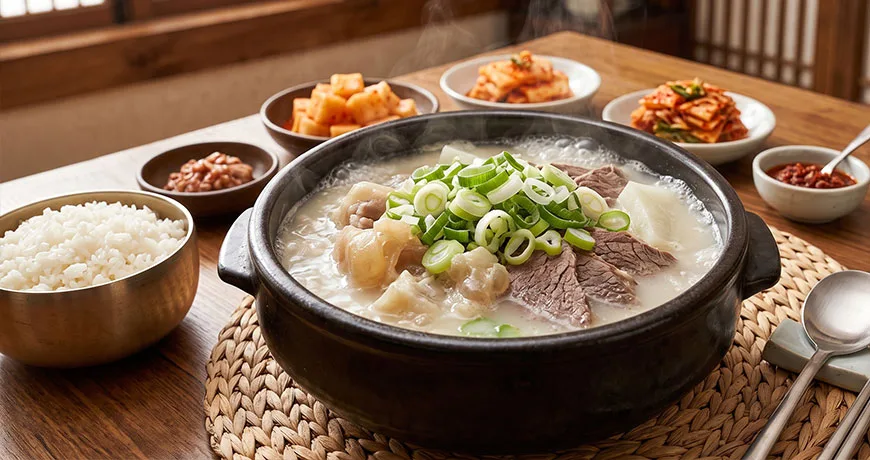
Dogani-tang is an extraordinary thermodynamic extraction utilizing prolonged wet-heat cooking to hydrolyze the dense collagen matrix found in ox knee joints and tendons. Over hours of simmering, the rigid triple-helix structure of the collagen unwinds into water-soluble gelatin, yielding a soup with a famously rich, lip-smacking viscosity. The marrow lipids emulsify into a milky, colloidal suspension, while the joint meat achieves a melt-in-the-mouth, chewy texture. Paired with the sharp, acidic bite of a mustard-soy dipping sauce and the volatile sulfur compounds of raw scallions, this dish provides a perfect biochemical balance, cutting through the heavy gelatin to refresh the palate. It is a revered cornerstone of Korean restorative cuisine.
⏱️ Total: 6–8 hrs (includes purging) | Prep: 40 mins | Cook: 5–7 hrs | 🍳 Difficulty: Moderate (Requires precise texture and emulsion control) | 🌶️ Profile: Deeply Rich, Sticky, and Savory | 🍚 Focus: Collagen Hydrolysis, Gelatinization, & Emulsification
Ingredients (4–5 servings)
- Collagen & Emulsion Base: 1kg ox knee with meat attached (dogani), 500g beef tendons (suji), 1kg beef leg bones (sagol), 6–7L water
- Aromatics (Masking Agents): 2 scallions, 1 onion, 10 cloves garlic, 1 thick slice ginger, 1 tbsp whole black peppercorns
- Garnish & Palate Cleansers: Plenty of finely chopped scallions, black pepper, coarse sea salt (to taste)
- Acidic Dipping Sauce: 3 tbsp soy sauce, 2 tbsp vinegar, 1 tbsp water, 0.5 tbsp Korean hot mustard (yeon-gyeoja), 0.5 tbsp agave syrup (or sugar)
Allergy Information Contains: Beef, Soy, Wheat (from soy sauce)
Equipment Very Large Heavy-Bottomed Stockpot, Cutting Board, Knife, Fine Mesh Skimmer, Tongs
Cooking Instructions
- Myoglobin Purging: Submerge the ox knees, tendons, and leg bones in large amounts of cold water for 4–6 hours to extract the water-soluble myoglobin (blood). Change the water 3–4 times. If not fully purged, the broth will develop a murky color and an oxidized, metallic off-flavor.
- Thermal Shock (Blanching): Bring a large pot of water to a rolling boil. Add all the bones and meat and boil vigorously for 10–15 minutes. This rapidly coagulates surface proteins and impurities. Discard this murky water and thoroughly scrub the bones under cold running water.
- Collagen Hydrolysis (Simmering): Place the clean bones, knees, tendons, and aromatics into a clean stockpot. Add 6–7L of fresh water. Bring to a boil, then lower the heat to a steady simmer. Cook for 3–4 hours. During this phase, the tough connective tissues biochemically unwind into tender gelatin.
- Differential Texture Control: After 3–4 hours, pierce the tendons and knee meat with a chopstick. Once they are soft yet retain a resilient chew, immediately remove only the knees and tendons from the pot. (If left longer, they will dissolve completely into the broth.) Let the meat cool, slice it into bite-sized pieces, and refrigerate briefly. The cooling process triggers gelatin retrogradation, firming up the meat to the perfect chewy texture.
- Maximum Emulsification: Continue boiling the remaining leg bones in the pot for another 2–3 hours. This extended thermodynamic process forces the marrow fats to emulsify completely, resulting in a dense, milky-white broth. Strain the finished broth to remove bones and aromatics.
- Assembly: Place a generous portion of the sliced, chewy knee meat and tendons into a traditional earthenware pot (ttukbaegi). Pour the boiling milky broth over the meat. Top with a mountain of chopped scallions and serve with salt, pepper, and the mustard-soy dipping sauce on the side.
💡 Professional Culinary Tips
- Thermodynamics of Collagen Transformation: Raw tendons and knee joints are essentially unchewable biological shock absorbers made of a tight collagen matrix. Sustained wet heat above 70°C (160°F) is scientifically required to break these molecular bonds, transforming the tough tissue into silken, water-soluble gelatin. This creates the soup’s signature “lip-sticking” mouthfeel.
- The Necessity of Differential Cooking: Bones require 6+ hours to fully release their marrow and emulsify the broth, but the delicate knee meat and tendons reach optimal texture at the 3–4 hour mark. Removing the meat halfway through the cooking process is a critical engineering step to prevent the proteins from disintegrating into mush.
- Biochemical Palate Cleansing: The heavy viscosity of gelatin and bone lipids can quickly fatigue the palate. The acetic acid (vinegar) and sinigrin (mustard) in the dipping sauce act as chemical surfactants. They temporarily break the lipid coating on your tongue, ensuring that every bite feels as rich and satisfying as the first.
Nutrition Facts (Estimated)
Total Content : Approx. 500g (1 serving, including meat and broth)
Calories : 380 kcal
– Sodium : 150mg (Unseasoned base / excludes dipping sauce)
– Total Carbohydrate : 2.0g
– Sugar : 0.0g
– Total Fat : 22.0g
– Saturated Fat : 8.5g
– Cholesterol : 85.0mg
– Protein : 36.0g
– Calcium : 120.0mg
*Daily Values are based on a 2,000 calorie diet and standard Korean nutritional reference values
**Nutritional values are calculated based on original ingredients; substitutions may alter specific macronutrients.
The Origins and Culture of Doganitang (Ox Knee Soup)
1. A Traditional Restorative Tonic Rooted in Bone and Joint Nourishment
- Dogani-tang is a traditional Korean nourishing soup made by simmering ox knee bones, surrounding cartilage, and adjacent tendons (sji) for hours to extract a rich, collagen-dense broth and tender meats.
- Historically believed to strengthen joints and bones while restoring vitality, it has long been cherished as a premium medicinal tonic for recovering patients and older adults.
2. Chewy Textures and Rich Collagen-Dense Milky Broth
- The standout charm of Dogani-tang is its exceptionally high concentration of collagen and gelatin, which yields a velvety, mouth-coating texture.
- Combining genuine dogani (knee joint cartilage and meat) with bouncy, chewy sji (tendons), it offers a uniquely satisfying bite. Simmered into a milky white broth and seasoned simply with green onions, salt, and pepper, it delivers deep, savory comfort.
3. A Masterpiece of Slow Food and Deep Comfort
- Preparing authentic Dogani-tang requires hours of soaking, boiling, and skimming excess fat, making it a true masterpiece of slow food.
- Served piping hot in an earthenware bowl with a scoop of rice, it provides soul-deep warmth and enduring culinary comfort.
The Velvety Cauldron of Simmered Ox Knee Marrow and the Springy Tenderness of Pure Gelatin: A Lyrical Masterpiece of Doganitang and Noble Restorative Solace
Doganitang (Ox Knee Bone and Tendon Soup) stands as the noble, time-honored, and deeply nourishing pinnacle of Korean earthen-pot (ttukbaegi) soup gastronomy, where rare ox knee cartilage (dogani) and springy tendons (seuji)—yielded in precious, limited quantities from each cattle—are patiently slow-simmered in rolling cauldrons for over half a day to extract an ivory-white, marrow-dense restorative broth. Rooted in the refined traditions of royal banquets and aristocratic (yangban) households as an esteemed natural remedy to reinforce bone density and revive depleted energy, this iconic masterpiece fills the dining space with a deeply fragrant, comforting steam that gently revitalizes every joint and cell from the very first spoonful.
The moment a steaming spoonful of the milky, bone-infused broth touches the palate, an immediate wave of pure, savory marrow depth and a luxurious, lip-coating gelatinous viscosity cascades across the senses. Lifting a translucent, jiggly piece of ox knee cartilage or tendon from the bubbling bowl and dipping it into tangy, piquant mustard-soy sauce delivers an exhilarating contrast between snappy, springy resistance and meltingly tender softness. Abundant fresh scallions infuse the broth with sweet, aromatic clarity, while a dusting of sharp black pepper cuts cleanly through the rich lipid base. Soaking warm white rice into the steaming broth delivers an unpretentious, soul-soothing solace that banishes chronic exhaustion.
True gastronomy does not rely on aggressive artificial flavorings; it flourishes in the ancestral wisdom of patient fire craft, breaking down dense connective tissues over gentle heat into a bioavailable elixir that calms the stomach, nurtures the joints, and restores physical vitality. Savoring an aromatic, bubbling bowl of ox knee bone soup today is an elegant and sacred ritual—clearing away everyday weariness through a wave of pristine warmth and filling the spirit with unpretentious nourishment, culinary heritage, and timeless solace.
Editor’s Review
1. An Exhilarating Cadence of Milky Bone-Marrow Umami, Springy Ox Knee Tendon Elasticity, and Piquant Mustard-Soy Harmony The moment a piping-hot spoonful of Doganitang coats the palate, an immediate wave of rich, slow-simmered bone marrow umami and lip-smacking gelatinous depth awakens the taste buds with gentle sophistication. This comforting baseline is swiftly energized by the unique, chewy-yet-tender bounce of the ox knee tendon dipped in sharp mustard-soy sauce, beautifully balanced by the crisp, refreshing bite of green scallions, orchestrating an endlessly soothing, multi-layered sensory thrill that nourishes to the very last drop.
2. High-Temperature Collagen-Chondroitin Gelatinization Kinetics and Scallion Allicin-Mustard Digestive Synergy Doganitang represents an exacting study in connective tissue thermodynamics and botanical digestive synergy. Extended gentle simmering hydrolyzes insoluble collagen fibers, chondroitin sulfate, and glucosamine from the joint matrix into bioavailable gelatin, forming a protective, non-irritating colloidal layer across the gastric mucosa while directly supporting articular cartilage health. Concurrently, organosulfur allicin from scallions and sinigrin from mustard stimulate gastric acid and enzyme secretion, accelerating systemic blood circulation and maximizing the metabolic absorption of high-density proteins, calcium, and magnesium.
3. The Joseon Royal Court Restorative Heritage and the Grounding Sanctuary of Historic Seoul Earthen-Pot Taverns Originating as a prized royal restorative feast and preserved through the historic culinary taverns of Seoul’s Jongno and Seodaemun alleys as an indispensable haven of hospitality, a modest bowl of ox knee bone soup serves as an enduring emotional haven against daily weariness. Revered for generations as an essential comfort staple that rebuilds physical stamina through pure, honest nourishment, enjoying this nutrient-dense delicacy washes away modern stress, granting a timeless sanctuary of stillness, culinary heritage, and grounded happiness.