
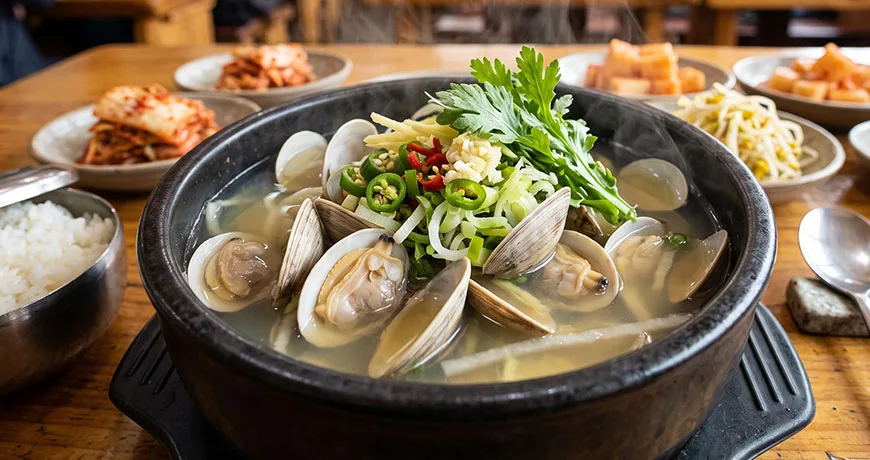
Daehaptang is a minimalist marine matrix engineered to instantaneously dissociate the dense concentrations of succinic acid and taurine trapped within the massive adductor muscles and mantles of the giant hard clam (Meretrix). Unlike smaller bivalves, the sheer size of the hard clam’s meat makes it hyper-susceptible to thermal syneresis; if subjected to a prolonged 100°C boil, the protein matrix violently contracts, expelling all internal moisture and turning into an unchewable rubber tire. Therefore, this dish demands extreme temporal precision. A base solvent is first constructed using kelp glutamate and radish reducing sugars. The clams are then introduced, and at the exact microscopic critical point when their thick calcium carbonate shells pop open—releasing their highly pressurized, umami-rich intra-valvular fluid into the broth—the kinetic heat must be instantly terminated. Seasoned exclusively with clear sea salt, sliced garlic, and fiery chilies to preserve its pearlescent optical clarity, this soup is a masterclass in thermodynamic restraint.
- ⏱️ Total: 3 hrs 20 mins | Prep: 3 hrs (3% isotonic saline dark purging) | Cook: 20 mins
- 🍳 Difficulty: Medium-High (Requires absolute thermodynamic termination the moment the clam shells open)
- 🌶️ Profile: Crystalline Clear, Deeply Refreshing Marine Umami Driven by Succinic Acid
- 🍚 Focus: Isotonic Dark Purging, Succinic Acid Flash-Extraction, & Syneresis Prevention
- 🍶 Pairing: Ice-cold Somaek (Soju + Beer bomb) engineered with a highly carbonated light lager like Terra
Ingredients (2–3 servings)
- Succinic Acid & Taurine Matrix: 1kg Live Fresh Hard Clams (Daehap or Baekhap – MUST be submerged in a 3% isotonic saline solution matching seawater, alongside a steel spoon, and covered with black plastic in a dark room for 3+ hours to forcibly purge internal mud and grit)
- Pectin & Reducing Sugar Matrix: 150g Daikon Radish (sliced into small squares)
- Aqueous Umami Solvent: 1.2L Purified Water, 1 piece Dried Kelp (Kombu)
- Aromatic & Allyl Catalyst: 1 white stalk of Green Onion (diagonally sliced), 1 Cheongyang green chili, 1/2 Red chili
- Ionized Sodium Binder: Coarse Sea Salt to taste (Soup Soy Sauce is strictly forbidden), 3 cloves Garlic (sliced, absolutely NOT minced)
Allergy Information Contains: Shellfish (Hard Clam)
Equipment High Thermal Mass Earthenware Pot (Ttukbaegi) or Wide Stew Pan, Mixing Bowl & Black Plastic Bag (for purging), Steel Spoon, Cutting Board, Knife
Cooking Instructions
- Isotonic Dark Purging: Dissolve 30g of coarse sea salt into 1L of water to create a 3% isotonic environment. Submerge the live hard clams along with a stainless steel spoon. Cover completely with a black plastic bag to simulate the pitch-black ocean floor. The metallic ions and dark environment trick the clams into vigorously breathing and expelling all trapped grit. After 3 hours, aggressively scrub the shells against each other under running water.
- Solvent Base Construction: In a pot, combine the purified water, dried kelp, and square-cut radish. Heat over medium. Just before it reaches a rolling boil (approx. 80°C), promptly remove the kelp to prevent the leaching of slimy alginic acid. Increase to high heat and boil until the radish pectin collapses, releasing its clear sweetness.
- Succinic Extraction & Critical Poaching: Once the clear broth is boiling violently, drop in the purged hard clams and sliced garlic. The thick shells will absorb the heat. The exact moment they pop open, they explosively release their concentrated succinic acid liquor into the solvent, instantly transforming the clear water into a milky, pearlescent emulsion.
- Thermodynamic Termination: As soon as the last shell opens, kill the heat immediately. Leaving the flame on for even one additional minute will cause massive protein syneresis, irreparably destroying the tender adductor muscles.
- Terpene Coating & Finish: Calibrate the final salinity strictly with sea salt to maintain visual clarity. While the residual heat remains, scatter the sliced scallions and chilies over the surface. The volatile allyl compounds and capsaicin will gracefully slice through the heavy marine minerality as it is served.
💡 Professional Culinary Tips
- Biochemical Value of Succinic Acid: The signature “refreshing” (Siwonhan-mat) depth of Daehaptang does not come from glutamate or inosinate, but from succinic acid, which is hyper-concentrated in bivalves. Because succinic acid is highly volatile and degrades under prolonged heat, instantly terminating the thermal extraction upon shell opening is the fundamental molecular law of this dish.
- Exclusion Logic of Soy Sauce & Minced Garlic: The visual and gustatory identity of Daehaptang relies on its pristine, pearlescent clarity. Introducing soy sauce not only darkens the broth but introduces fermented soybean notes that completely overpower the delicate clam aroma. Likewise, minced garlic releases microscopic particles that cloud the broth, while its aggressive allicin destroys the subtle sweetness of the succinic acid. Sliced garlic and pure sea salt are mandatory.
- Galvanic Dynamics of the Steel Spoon: Placing a steel spoon in the saltwater bath triggers a micro-galvanic corrosion reaction, releasing trace iron ions into the water. The clams detect this subtle metallic shift and perceive it as an environmental stressor or predator threat, which hyper-stimulates their respiration rate, forcing them to purge their internal mud far more rapidly and thoroughly.
🍶 Gastronomic Pairing
- Biochemical Palate Cleansing: When the plump, perfectly hydrated clam meat and the profoundly savory, milky succinic acid broth completely coat your oral mucosa, pair this crystalline matrix with an ice-cold Somaek (Soju and Beer bomb) engineered with an aggressively carbonated light lager like Terra. The violent effervescence of the beer and the highly refined ethanol of the Soju act as a precise surgical solvent. It dynamically shears through the heavy marine minerality on your tongue, instantly resetting your taste receptors and geometrically amplifying the refreshing umami of the very next spoonful.
Nutrition Facts (Estimated)
Total Content : Approx. 500g (1 serving, excluding shell weight)
Calories : 120 kcal (Excluding rice, ultra-low calorie matrix)
– Sodium : 1,150mg (Dependent on final sea salt calibration and natural marine salinity)
– Total Carbohydrate : 8.0g (Reducing sugars from radish and kelp polysaccharides)
– Sugar : 2.0g
– Total Fat : 1.5g (Trace unsaturated marine lipids)
– Saturated Fat : 0.2g
– Cholesterol : 45.0mg
– Protein : 18.0g (Highly bioavailable taurine and adductor myofibril complex)
– Dietary Fiber : 2.0g
*Daily Values are based on a 2,000 calorie diet and standard Korean nutritional reference values.
**Nutritional values are calculated based on original ingredients; substitutions may alter specific macronutrients.
Origins and Food Culture of Hard Clam Soup (Daehaptang)
1. Historical Lineage: Neolithic Shell Mounds, Dongui Bogam, and Jasanoebo
- The consumption of hard clams along the Korean peninsula dates back to prehistoric times, evidenced by massive shell mounds (paechong) excavated along the southern and western coastlines (such as Gimhae Sugari and the Buan coastal plains), proving that bivalves have anchored peninsular subsistence for millennia.
- Documented in Heo Jun’s 1613 medical compendium Dongui Bogam under the classical Hanja names Munhap (文蛤) or Baekhap (白蛤), hard clams were praised as “cold in nature, salty, and non-toxic; they eliminate heat in the chest (除煩熱), relieve thirst, dissolve alcohol toxicity, and dispel water swelling.” Furthermore, Jeong Yak-jeon’s 1814 marine treatise Jasanoebo lauded them because “their meat is white, firm, and clean; when simmered into soup, they produce a crystal-clear broth of unrivaled delicacy,” confirming centuries of prestigious therapeutic heritage as a prized seasonal tonic served to monarchs and scholar-noble families.
2. The Culinary Science of Osmotic Depuration (Haegam) and Valve-Opening Thermodynamics
- The quintessential technical foundation of hard clam cookery lies in thorough depuration (haegam): immersing live clams in clean, dark brine matching oceanic salinity (approx. 3.5%) alongside a metal spoon to stimulate bivalve respiration, coaxing them to naturally expel micro-sand grains and silt from their mantle cavities.
- Because clam proteins denature and tighten rapidly when overcooked—causing the flesh to turn dry and rubbery while leaking precious juices into the vapor—master cooks execute strict thermodynamic control. Sweet radish and kelp are simmered first to establish a pure base; the clams are added over high heat, and the flame is extinguished the precise moment the valves pop open (approx. 70–80°C). This delicate poaching locks intracellular moisture and natural glycogen inside the sweet clam meat.
3. Buan’s Byeonsan Peninsula Clam Heritage and the Soul of “White Hangover Relief”
- Deeply rooted in the expansive mudflats of Buan County, Jeollabuk-do—most notably the Byeonsan Peninsula and Gyehwa Island—where hard clams became celebrated as the premier regional delicacy, starring in festive banquets and wedding feasts as an auspicious symbol of fidelity, harmony, and prosperity due to the interlocking symmetry of their shells.
- In contemporary Korean food culture, simmering fresh clams in bubbling earthenware crocks (Ttukbaegi Jogae-tang) at roadside food stalls (pojangmacha) and late-night taverns represents the ultimate camaraderie of night dining. Forgoing red pepper pastes in favor of sea salt, garlic, and fresh chilies, Daehaptang highlights the pure, unmasked essence of the sea. Standing as the undisputed benchmark of “White Hangover Relief” (baeksaek haejang), it remains an immortal monument to Korean maritime gastronomy, physical detoxification, and restorative comfort dining.
The Crystalline Nectar of Tidal Hard Clam Liquor, the Resilient Snap of Bivalve Adductor Muscle, and the Pristine Simplicity of Oceanic Consommé: A Refined Portrait of Daehaptang
Daehaptang (Hard Clam Soup, celebrated historically as Baekhaptang) stands as the aristocratic, crystalline, and biologically immaculate summit of Korea’s bivalve clear-broth (cheongtang) gastronomy. Centered upon the regal Oriental hard clam (Meretrix lusoria or Daehap, reverently termed Baekhap—literally “the hundred-patterned shell” or the undisputed “Queen of Clams”), the preparation begins with delicate preparatory discipline. Enclosed within thick, porcelain-smooth valved shells, the live clams are steeped in cool, dark sea-salt brine for half a day to meticulously expel trapped sand and benthic silts (purging). After scrubbing the shell surfaces, the pristine bivalves are layered inside a heavy earthenware pot (ttukbaegi) or wide casserole alongside fresh spring water, paper-thin slices of sweet winter radish, a whisper of minced garlic, and a splash of refined rice wine before being brought to a swift, assertive boil. The moment the heat relaxes the adductor muscles and the shells spring open to discharge their milky intracellular nectar into the simmering water, the heat is promptly lowered to prevent protein toughening. Crowned at the final second with chopped fresh scallions, delicate enoki mushrooms, and a few rounds of sharp Cheongyang green chilies, the soup is served with virtually no added salt, relying entirely on the native oceanic salinity trapped within the shells. Completely bypassing red chili pastes, fermented bean mashes, or artificial flavorings, Daehaptang extracts the unmasked organic succinic acids and pristine minerals of the bivalve through sheer thermodynamic minimalism, delivering an austere masterclass that purifies the palate and soothes fatigued organs with radiant warmth.
Confronting the steaming earthenware pot as translucent, diamond-bright vapors curl upward to reveal gaping porcelain-white shells cradling plump, ivory clam flesh, lifting a deep spoonful of the broth releases an immediate, deeply calming olfactory charge: the brisk, iodine-clean perfume of an open sea breeze mingles seamlessly with the honeyed vegetable sweetness of simmered winter radish, the sharp sulfurous brightness of fresh scallions, and the delicate, crisp spark of green chili. Taking the first sip delivers an unadorned revelation across the oral mucosa: devoid of any greasy surface tension, the clarified amino acid broth floods the tongue with silk-like softness, gliding effortlessly down the esophagus to soothe alcohol-inflamed tissues in an exhilarating wave of what Korean gastronomy reveres as siwonhan mat—the sensation of profound, soul-cleansing lightness. Prying the succulent clam meat from its calcified shell reveals an extraordinary structural chew: having engorged under convective heat, the ruffled mantle and muscular foot resist tooth pressure with an energetic, springy bounce (taenggeul) before yielding to release concentrated torrents of sweet, briny clam liquor. In delightful contrast, the firm adductor muscle provides a dense, toothsome chew, while the broth-soaked radish yields with a succulent bite. Steeping a bowl of warm white rice into the crystalline broth and capping each spoonful with a crisp cube of aged radish kimchi (kkakdugi) completes an unforgettable ritual of physical rejuvenation, coastal solace, and quiet gastronomic transcendence.
The enduring majesty of Daehaptang lies in its historical lineage—codified in royal banquet records (Jinchan Uigwe) of the Joseon court and celebrated across noble banquets as the undisputed sovereign of shellfishes. This refined pedigree converges with the ancestral heritage of coastal mudflat villages along the Yellow Sea, notably Buan’s Gyehwa Island and Gomso Bay, where fishermen tossed freshly dug clams straight into bubbling dockside cauldrons of clear water to banish sea chills and recover physical vigor. Completely sealed until the moment of cooking to preserve pristine ecological purity, a steaming bowl of clear hard clam soup remains an irreplaceable monument of minimalist seafood cookery, coastal reverence, and brilliant Korean culinary craftsmanship.
Editor’s Review
1. A Dynamic Harmony of Elastic Mantle-Foot Bounce, Dense Adductor Muscle Resistance, Succulent Radish Give, and Frictionless Consommé Fluidity
The structural architecture inside the vessel delivers an extraordinary, three-tiered choreography between dense molluscan muscle tissues, hydrated root vegetable matrices, and an ultra-low-viscosity aqueous matrix. Cooked rapidly within its own shell, the clam’s muscular foot and undulating mantle retain their intracellular moisture, delivering an energetic, springy bounce (taenggeul) that gives way to tender, juicy mastication. Counterbalancing this, the thick posterior adductor muscle—composed of tightly packed, conical myofibrillar bundles—supplies a dense, toothsome chew that anchors the texture with pleasant masticatory resistance. Sliced winter radish absorbs the hot marine broth like an organic sponge, yielding with a soft, succulent crunch, while the defatted, clear broth forms a frictionless lubricating fluid layer across oral membranes, ensuring an impeccably balanced, non-fatiguing mouthfeel from the first steaming sip to the last.
2. Bivalve Succinic Acid Dominance, Glycine-Alanine-Betaine Natural Sweetness, Flash-Boiling Paramyosin Syneresis Mitigation, and Taurine-Zinc Hepatoprotective Kinetics
Daehaptang represents an exacting study in molluscan muscle biochemistry, organic acid flavor chemistry, and thermal denaturation kinetics. The absolute cornerstone of clam umami is succinic acid and its disodium salts. Leached abundantly into the clear broth, succinic acid provides a distinct, refreshing, and deeply resonant savory foundation; this converges with high physiological reserves of sweet free amino acids within the clam flesh—principally glycine, alanine, and betaine—to generate intense, rounded sweetness without the addition of refined sugars. The muscular tissues of the hard clam are heavily reinforced with paramyosin and actomyosin; prolonged exposure to aggressive boiling (>100°C) triggers hyper-contraction of these protein lattices, causing extensive cellular moisture expulsion (syneresis) that leaves the clam rubbery and shrunken. Lowering the flame or arresting heat immediately upon shell opening (the critical 80–85°C window where the hinge ligament expands) preserves myofibrillar Water Holding Capacity (WHC), locking in plump tenderness. Biologically, dense concentrations of bioavailable taurine and betaine protect hepatic cell membranes and stimulate bile acid secretion, while high reserves of zinc (Zn) and glycogen accelerate systemic alcohol metabolism, completing an immaculate, restorative recovery mechanism.
3. The Yellow Sea Tidal Flat Terroir, “Queen of Clams” Aristocratic Lore, and the Sovereign Apex of Marine Consommé Gastronomy
Harvested from the deep, nutrient-rich sand-mud flats of the Yellow Sea and revered across centuries as the centerpiece of aristocratic banquets and courtly convalescence, the hard clam occupies an unshakeable pedestal in Korean gastronomy. By extracting majestic savor entirely from the clam’s native liquor and pure water without the crutch of heavy seasonings, Daehaptang stands as the ultimate expression of culinary subtraction and ecological authenticity—an enduring sanctuary of minimalist beauty, coastal heritage, and brilliant Korean culinary artistry.