
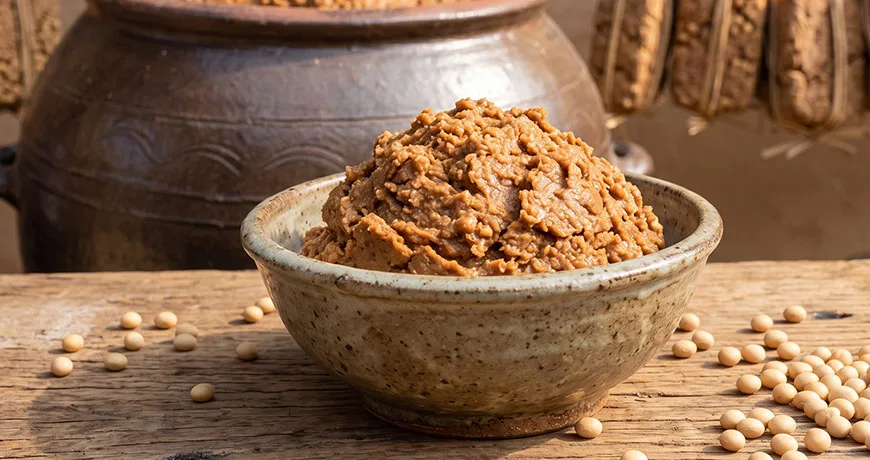
Doenjang is the ultimate solid-state fermentation matrix, engineered by physically macerating the swollen Meju (fermented soybean blocks) remaining after the liquid Ganjang (soy sauce) extraction. Operating in a high-salt, halophilic environment, Bacillus subtilis microbes aggressively hydrolyze the remaining soybean proteins into an immense concentration of peptides and free amino acids. This secondary fermentation demands the complete structural breakdown of the soybeans into a heterogeneous paste, followed by rigorous physical compacting into an earthenware crock (Onggi) to eliminate internal oxygen pockets and prevent anaerobic putrefaction. Sealed with an osmotic salt barrier and exposed to solar ultraviolet rays for over six months, the matrix undergoes slow, non-enzymatic Maillard browning, yielding a dense, earthy paste exploding with pure glutamic acid.
- ⏱️ Total: 6+ Months | Prep: 2 hrs (Liquid-solid separation & physical maceration) | Cook & Ferment: 6+ Months (Natural Aging)
- 🍳 Difficulty: Extreme (Requires prevention of anaerobic putrefaction via strict compaction and salinity control)
- 🌶️ Profile: Deeply Earthy, Funky, with an Unrivaled Peptide Umami and Saltiness
- 🍚 Focus: Liquid-Solid Separation, Solid-State Maceration, Anaerobic Compacting, & Halophilic Aging
Ingredients (Yields 1 Traditional Crock)
- Protein & Solid Fermentation Matrix: Entire volume of Macerated Meju (approx. 10kg) retrieved from the Ganjang crock after 40–60 days of initial brining
- Osmotic & Halophilic Matrix: 1–1.5kg Coarse Solar Sea Salt (Aged 3+ years; applied for internal salinity calibration and surface osmotic sealing)
- Amino Acid Seed Liquid: 1–2L Raw Ganjang (Extracted from the same batch, used to calibrate moisture and re-inoculate the mash)
- Optional Umami Catalyst: Boiled Barley water or additional dry Meju powder (Used optionally to tweak fermentation speed and trace sweetness)
Allergy Information Contains: Soy (Meju)
Equipment Microporous Earthenware Crock (Onggi), Large Mixing Basin, Heavy
Wooden Pestle or Spatula, Cheesecloth
Cooking Instructions
- Liquid-Solid Separation (Jang-garugi): From the fermented Ganjang crock, physically separate the dark liquid from the swollen, brine-soaked Meju blocks. Transfer the heavy, wet soybean blocks into a massive mixing basin.
- Maceration & Homogenization: Using your hands or a heavy wooden pestle, violently crush and knead the swollen Meju. Do not puree it into a perfectly smooth paste; preserving a heterogeneous matrix with roughly half the soybeans intact or partially crushed provides essential textural integrity.
- Moisture & Salinity Calibration: Gradually pour the raw Ganjang back into the crushed mash to adjust its viscoelasticity until it resembles dense mud. Simultaneously, fold in the coarse sea salt to recalibrate the salinity. (The paste must taste sharply salty; this sodium barrier is the only defense against rogue putrefactive bacteria during the long aging process.)
- Compacting & Anaerobic Core Formation: Form the heavy paste into large balls and forcefully hurl them into the bottom of a sterilized, dry Onggi. As you build the layers, press down with your fists and entire body weight to violently compact the paste, eliminating all microscopic air pockets. Any trapped oxygen deep inside will trigger anaerobic rotting and sour off-flavors.
- Osmotic Sealing & UV Aging: Once the crock is 80% full, smooth the surface completely flat. Blanket the entire exposed surface with a thick, white layer of coarse sea salt to create an impenetrable osmotic seal against insects and mold. Cover with a breathable lid and age in direct sunlight for a minimum of 6 months, allowing Maillard browning and proteolysis to finalize the paste.
💡 Professional Culinary Tips
- The Biochemistry of Separation Timing: The exact day you execute Jang-garugi dictates the destiny of the batch. Separating early (40 days) traps more amino acids in the solids, yielding a profoundly rich Doenjang but a weaker soy sauce. Waiting longer (60+ days) yields a phenomenal Ganjang, but leaves the Doenjang hollow and fibrous. Finding the optimal compromise is the hallmark of a master.
- Physics of Anaerobic Compacting: Casually spooning the paste into the crock leaves voids. Lactic acid bacteria and putrefactive microbes will hijack these air pockets, resulting in a sour, spoiled batch. Physical, bone-crushing compaction is mandatory to force the Bacillus microbes along the correct proteolytic pathway.
- Microporous Respiration of Onggi: Sealing Doenjang in airtight plastic causes fermentation gases to swell and rot the matrix. Traditional clay Onggi acts as a semi-permeable membrane, venting excess moisture and gases while allowing trace oxygen to nourish the aerobic yeasts near the surface, establishing a perfect microenvironment for maturation.
🍶 Gastronomic Pairing
- Biochemical Palate Cleansing: While spectacular when boiled into a stew (Jjigae), the ultimate way to experience the raw, living enzymes and uncut peptide power of aged Doenjang is unheated. Dip crisp, cold Fresh Vegetables (Cucumbers or Green Chilies) directly into the raw paste. Pair this with a chilled, completely dry Unpasteurized Makgeolli (Rice Wine). The cellular water of the vegetables balances the intense salinity, while the lactic acid of the wine slices through the heavy, earthy umami, delivering a primal gastronomic experience.
Nutrition Facts (Estimated)
Total Content : Approx. 20g (1 tbsp)
Calories : 35 kcal (High-density peptide & plant lipid matrix)
– Sodium : 750mg (High salinity required for osmotic preservation)
– Total Carbohydrate : 4.0g (Polysaccharides from broken-down soybeans)
– Sugar : 0.5g (Trace reducing sugars; contains no wheat)
– Total Fat : 1.0g (Natural unsaturated lipids from soybeans)
– Saturated Fat : 0.1g
– Cholesterol : 0.0mg (100% Vegan fermented matrix)
– Protein : 3.0g (Highly bioavailable peptides 100% hydrolyzed by Bacillus subtilis)
– Dietary Fiber : 1.5g (High-density cellulose from soybean hulls)
*Daily Values are based on a 2,000 calorie diet and standard Korean nutritional reference values.
**Nutritional values are calculated based on original ingredients; substitutions may alter specific macronutrients.
Origins and Food Culture of Soybean Paste (Doenjang)
1. Ancient Foundations: Manchurian Soybean Homelands, the Samguk Sagi, and Dongui Bogam Medicine
- Originating in the wild soybean habitats of Manchuria and the northern Korean peninsula, ancient peninsular ancestors pioneered the art of fermenting soybeans into cured bricks (meju / si, 豉) and paste (dujang, 豆醬). Ancient Chinese dynastic chronicles, such as the 3rd-century Records of the Three Kingdoms (Wei Zhi), noted with admiration that “the people of Goguryeo are exceptionally skilled in the brewing of fermented pastes (醬釀) and wines.”
- In 683 CE, the Samguk Sagi (Chronicles of the Three Kingdoms) recorded that King Sinmun of Silla presented “Jang (fermented paste) and Si (cured meju)” as sovereign bridal gifts, proving its elite standing as a sacred national treasure. In Heo Jun’s 1613 Joseon medical compendium Dongui Bogam, Doenjang was documented as “cold in nature, salty, and non-toxic; it expels all febrile heat poisons (除熱毒), neutralizes burns, treats bites from snakes, insects, and poisonous mushrooms, and comforts the five visceral organs,” affirming its centuries-old heritage as an indispensable therapeutic detoxifier.
2. The Dual Art of “Jang-Gareugi” and Breathable Onggi Thermodynamic Fermentation
- The culinary science of Korean Doenjang is distinguished by the ingenious practice of Jang-Gareugi—separating the fermented brine into liquid soy sauce (Ganjang) and solid mash (Doenjang). While neighboring East Asian traditions ferment grain-soy mashes into a single unified paste, traditional Korean craftsmanship ferments 100% pure soybeans to harvest both an aristocratic liquid seasoning and a dense, protein-rich solid paste from a single brewing crock.
- The unglazed micro-porous matrix of traditional breathable earthenware (onggi) acts as a biological incubator: its micropores allow gas exchange while keeping rainwater out, providing essential oxygen to aerobic Bacillus subtilis while suppressing putrefactive anaerobic bacteria. Over months and years of ambient solar aging, free amino acids and reducing sugars undergo non-enzymatic Maillard browning, synthesizing protective melanoidins and concentrating complex savory aromatic polymers.
3. The Sacred Jangdokdae Terrace, Familial Lineage, and UNESCO Cultural Heritage
- In traditional Korean homes, the earthenware terrace (Jangdokdae) was situated on the cleanest, highest ground in the courtyard to catch optimal sunlight and breezes. Matriarchs performed ritual cleansing, wiped the pots daily, and bound the jars with straw ropes (geumjul) and red chilies to ward off impurities. As expressed in the historic proverb, “The harmony and fortune of a household can be judged by the taste of its Jang,” the family paste was revered as the spiritual anchor of ancestral lineage and culinary pride.
- By replenishing the bottom of mature jars with freshly fermented paste (seed doenjang / ssi-doenjang), families preserved unbroken microbial lineages across generations for decades or even centuries. Designated as a National Intangible Cultural Property and inscribed on the UNESCO Representative List of the Intangible Cultural Heritage of Humanity under the collective tradition of “Knowledge and practices related to Jang making in the Republic of Korea,” Doenjang shines worldwide as an immortal cultural monument to slow-food sustainability, artisanal patience, and ancestral culinary wisdom.
The Patient Darkness of Salt-Steeped Legumes, the Seasonal Respiration of Terracotta Pores, and the Coarse Textural Density of Crushed Meju: A Refined Portrait of Traditional Doenjang
Doenjang (Traditional Korean Fermented Soybean Paste) is the unshakeable gravitational anchor of Korean home cooking and sovereign soup-and-rice (tangban) culture. Born from boiled soybeans mashed, dried, and microbially populated as winter blocks (meju), its journey begins when the liquid soy sauce (ganjang) is drawn off after initial spring brining. The softened, rehydrated soybean mash remaining at the bottom of the vessel is transferred to a dedicated earthenware crock (onggi), seasoned with coarse sea salt, crushed dry meju powder, and occasionally toasted chili seeds, then packed down by hand in a deliberate effort to eliminate trapped air pockets. Crowned with a dense layer of solar sea salt to create a physical barrier against airborne contaminants, the crock breathes through micro-capillary clay walls on sun-drenched stone terraces (jangdokdae), quietly absorbing the thermodynamic shifts of summer humidity and dry autumn chills. Unlike vibrant red gochujang, it relies neither on sharp capsaicin heat nor the sweet comfort of maltose syrups; nor does it strike the palate with the immediate saline clarity of aged soy sauce. As microbial enzymes systematically dismantle the dense legume proteins, the paste transitions from a light sandy hue into a profound, dark amber-brown, steadily accumulating a rustic, earthy bouquet of toasted straw, dried legumes, and sun-warmed earth.
When an earthenware pot of doenjang-jjigae bubbles briskly at the dining table, the first impression is comforting and grounded: a rich, roasted perfume of fermented peptides that rises alongside the natural sweetness of simmered squash and alliums. Taking a spoonful reveals a textured, satisfying presence across the oral mucosa. The saltiness hits first, but it is immediately followed by a deep wave of savory amino acid umami that provides immense culinary reassurance. The partially crushed soybean particles yield effortlessly between the tongue and palate without grit, releasing gentle nutty oils and concentrated protein sweetness. Simmered alongside tender spring greens like shepherd’s purse or wild chives, doenjang softens sharp, wild astringency; combined with rich brisket or firm whitefish, it quietly adsorbs volatile fishiness, stepping backward to let the natural qualities of the core ingredients shine. Spooned over hot white rice alongside a crisp, cold radish, this modest brown paste provides a stabilizing culinary baseline that nourishes the body and satisfies the appetite without sensory fatigue.
The cultural identity of doenjang traces back over a millennium, recorded as early as the Three Kingdoms period under the ancient term Si (豉) in the Samguk Sagi. Far from being a uniform, industrial product, traditional doenjang represents the unique microflora and seasonal discipline of each domestic terrace. Serving as an essential protein storehouse that sustained rural populations through harsh winters and food shortages, a seasoned crock of aged soybean paste remains the most honest, dependable foundation of everyday Korean sustenance.
Editor’s Review
1. A Dynamic Harmony of Coarsely Crushed Cotyledon Grains, Hydrated Protein Paste, and Low-Friction Fluid Suspension
Unlike fully homogenized Western sauces or the glossy, starch-thickened matrix of gochujang, doenjang displays the physical properties of a non-homogeneous colloidal dispersion. When scooped from the crock, it displays high plastic resistance due to the presence of partially crushed soybean cotyledon fragments bound within a dense, microbial hydrogel. When suspended in a simmering broth, these micro-particles disperse evenly into an aqueous suspension, creating a velvety, substantial body far richer than clear consommés. On the palate, the soft bean solids yield under minimal shear force, coating the oral cavity with a smooth, protective film that leaves a clean, comfortable finish.
2. Bacillus and Aspergillus Proteolytic Dynamics, Bitter Oligopeptide Degradation, Melanoidin Antioxidant Stabilization, and 12–14% Saline Buffering
The maturation of doenjang is governed by sequential enzymatic proteolysis and non-enzymatic browning kinetics:
- Enzymatic Proteolysis: Neutral and alkaline proteases secreted by wild Bacillus subtilis and Aspergillus oryzae systematically cleave high-molecular-weight soybean storage globulins (glycinin and beta-conglycinin) into short-chain peptides and free amino acids.
- Bitter Peptide Cleavage: In early fermentation stages, the release of hydrophobic oligopeptides with terminal leucine, isoleucine, or phenylalanine residues imparts an astringent, bitter undertone. Over prolonged aging inside the earthenware jar, microbial exopeptidases cleave these bitter fragments into free glutamic and aspartic acids, replacing harshness with a rich, rounded umami profile.
- Melanoidin Formation: Continuous, slow Maillard reactions between trace reducing sugars and free amino groups generate high-molecular-weight melanoidin pigments. Beyond bestowing a deep chestnut hue, these melanoidins function as potent natural antioxidants, effectively shielding residual soybean fatty acids from oxidative rancidity.
- Saline Buffering: An ambient salinity of 12–14% creates a reliable osmotic barrier against putrefactive pathogens while selectively supporting halophilic lactic acid bacteria (Tetragenococcus halophilus), which stabilize internal pH through the production of organic acids.
3. Functional Deodorization and the Modest Archival Backbone of Korean Cooking
Rather than dominating the palate, doenjang functions as a versatile culinary buffer. Its porous, insoluble soybean fibers physically adsorb and chemically sequester volatile off-notes—such as fishy trimethylamine (TMA) and gamey meat lipid volatiles like hexanal—preventing them from reaching the olfactory receptors. By supplying a dense, grounding umami floor that elevates supporting vegetables, broths, and braises, doenjang proves itself to be the most practical, hardworking culinary anchor in the Korean tradition.