
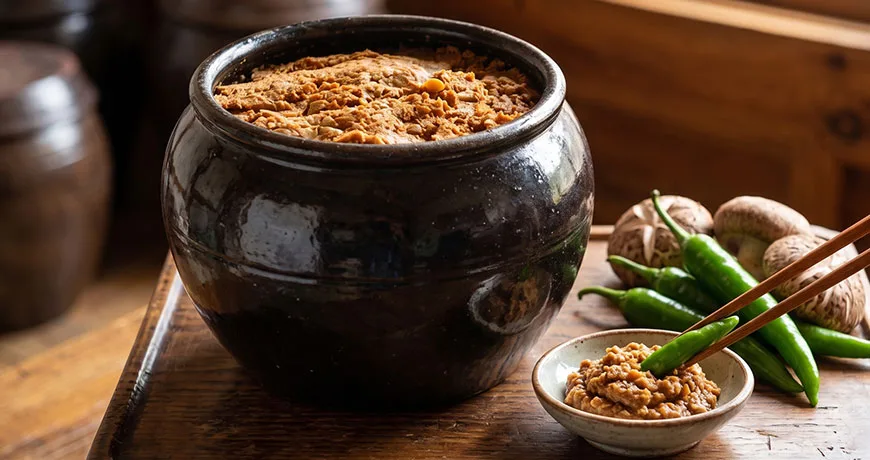
Dambukjang is an extreme short-term (quick-fermented) solid-state fermentation delicacy that compresses months of traditional aging into just 2 to 3 days. After thoroughly soaking and deeply boiling soybeans, Bacillus subtilis is explosively propagated using rice straw or a controlled thermal environment. Without the long-term process of making Meju, powerful proteolytic enzymes are instantly generated, breaking down cell walls to produce sticky poly-γ-glutamic acid mucilage and an abundance of free amino acids. It is a unique Korean fast-fermented heritage food characterized by an intense, funky aroma that blooms instantly when boiled and a smooth, comforting umami texture.
- ⏱️ Total: 2–3 Days | Prep: 12 Hours (Soybean soaking & thermal hydrolysis) | Cook & Ferment: 2–3 Days (Short-term rapid aging)
- 🍳 Difficulty: Medium-High (Requires precision thermal and humidity control during rapid incubation to prevent rogue bacterial contamination)
- 🌶️ Profile: Deeply savory amidst an aggressive funky punch, featuring a luscious, mucilaginous texture
- 🍚 Focus: Short-term Solid-State Fermentation, Polyglutamic Acid Mucilage Induction, Rapid Proteolysis
- 🍶 Pairing: Steaming hot rice, aged kimchi stew, and crisp green chili peppers with ssamjang
Physicochemical & Sensory Matrix
- Baseline Salinity: 3.0% ~ 5.0% (Targeted for short-term consumption due to low-salt rapid fermentation)
- pH Equilibrium: 6.0 ~ 6.5 (Neutral to mildly acidic buffer optimized for Bacillus proliferation)
- Viscosity Index: [■■■■□] (High-viscosity mucilaginous filaments / ropy texture)
- Umami Density (T1R1/T1R3 Synergy): 9.2 / 10 (Explosive surge of free amino acids and peptides)
- Aging Horizon: 48 ~ 72 Hours (Short-term thermophilic incubation)
- Aroma Profile: Controlled Funky Ammonia Notes | Flat Bean Nuttyness | Pyrazine Undertones
Ingredients (Yields 1 Medium Earthenware Pot)
- Primary Protein Matrix: 500g White Soybeans (Mejukong, soaked for 12+ hours)
- Fermentation Catalyst: A small bundle of clean rice straw (or 1 tbsp traditional Bacillus starter)
- Seasoning Matrix: 1 tbsp Coarse Sea Salt, 1 tbsp Minced Garlic, 2 tbsp Chili Powder, a splash of traditional Korean Soy Sauce (for post-fermentation adjustment)
Allergy Information
- Contains: Soy
Equipment Microporous Earthenware Crock (Onggi), Heavy Pestle or Heavy-duty Blender, Cheesecloth, Large Mixing Basin
Cooking Instructions
- Thermal Hydrolysis of Soybeans: Place the soaked soybeans in a pot with water and boil deeply for 2 to 3 hours until the beans easily mash between your fingers.
- Inoculation & Setup: Place the warm, boiled beans into a container or rice cooker lined with cheesecloth. Insert pieces of clean rice straw between the beans to introduce Bacillus spores.
- Controlled Thermophilic Fermentation: Utilize an electric rice cooker on the “Warm” setting or a fermenter maintaining 38°C–40°C for 48 to 72 hours. Success is indicated by fine white strings (mucilage) webbing across the beans.
- Mechanical Disintegration & Seasoning: Remove the rice straw and coarsely mash the beans using a pestle or masher, leaving some texture intact. Mix in the sea salt, chili powder, and minced garlic, kneading thoroughly to stabilize the fermentation.
- Short-term Stabilization: Use the freshly made Dambukjang immediately for stewing, or store it in an airtight container in the kimchi refrigerator for 3 to 5 days of aging to deepen the flavor matrix.
💡 Professional Culinary Tips
- Precision Thermal Control: Because Dambukjang is low-salt and highly susceptible to spoilage bacteria, maintaining a strict temperature around 40°C during early fermentation ensures that Bacillus subtilis swiftly dominates and suppresses rogue microbes.
- Differentiation from Meju: While standard Meju undergoes complex multi-mold fungal activity over months, Dambukjang relies purely on a single-strain Bacillus bloom, resulting in lower bitterness and a pure, explosive expression of sweet soybean umami.
🍶 Gastronomic Pairing
- Earthenware Stew Transformation: Rather than eating it raw, Dambukjang reveals its true potential when boiled vigorously in an earthenware pot (Ttukbaegi) with anchovy broth, sliced tofu, zucchini, onions, and aged Kimchi to make Dambukjang-jjigae. Spooning the rich, earthy broth over steaming rice creates the ultimate Korean culinary harmony.
Nutrition Facts (Estimated)
Total Content : Approx. 30g (1큰술 기준)
Calories : 40 kcal (High-protein plant-based fermented bean matrix)
– Sodium : 320mg (Controlled for low-salt rapid fermentation)
– Total Carbohydrate : 3.5g (Fermentation-converted polysaccharides)
– Sugar : 0.2g
– Total Fat : 1.8g (Unsaturated fatty acids derived from soy)
– Saturated Fat : 0.3g
– Cholesterol : 0.0mg (100% Vegan matrix)
– Protein : 4.0g (Bacillus-hydrolyzed free amino acids & peptides)
– Dietary Fiber : 1.5g
*Daily Values are based on a 2,000 calorie diet and standard Korean nutritional reference values.
**Nutritional values are calculated based on original ingredients; substitutions may alter specific macronutrients.
Origins and Food Culture of Quick-fermented Soybean Paste (Dambukjang)
1. Historical Lineage: The Evolution of Accelerated “Sokseong-jang” in Late Joseon Agrarian Texts
- Dambukjang originated as a practical culinary solution during the demanding transitional seasons of late winter and early spring, when household earthenware jars of aged soy sauce and soybean paste neared exhaustion. Instead of waiting months for a new batch of meju blocks to cure, rural households developed methods to rapidly ferment freshly boiled soybeans within days.
- Documented across various late Joseon agricultural and household economic compendiums (such as Jeungbo Sallim Gyeongje), these rapid fermentation techniques allowed farming families to maintain a steady supply of essential plant proteins and probiotics year-round, embodying the resourcefulness of peninsular domestic food culture.
2. The Biochemical Kinetics of Accelerated Bacillus Fermentation and Low-Sodium Optimization
- The technical mastery of Dambukjang relies upon precise thermal regulation within traditional floor-heating (ondol) environments to accelerate microbial activity.
- Freshly boiled soybeans are crushed and seasoned with mild saline solutions, garlic, and chili powder to establish an ideal moisture and nutrient balance for beneficial bacteria. Wild or straw-derived Bacillus subtilis spores proliferate rapidly within days, secreting powerful amylases and proteases that break down complex proteins into savory polyglutamic acid mucilage. This rapid microbial conversion successfully reduces required salt content while maximizing probiotic populations.
3. Regional Heritage across Gyeonggi and Chungcheong Valleys and Soul Stew Culture
- Dambukjang developed deep roots across the central inland regions of Gyeonggi Province (such as Anseong) and Chungcheong Province, where historic lineage families and rural villages preserved traditional brewing lineages.
- Enjoyed as a comforting everyday stew (jjigae) served with rice and seasonal garden produce, Dambukjang represents a cherished culinary symbol of domestic warmth and rural hospitality. Celebrated today as a brilliant low-sodium, high-probiotic heritage food, Quick-fermented Soybean Paste remains an immortal monument to Korean fermentation ingenuity and heartfelt comfort dining.
The Overnight Thermal Acceleration of Bacillus Fermentation, the Coarsely Crushed Protein Matrix, and the Rich Viscosity of Quick-Cured Soy Mash: A Refined Portrait of Dambukjang
Dambukjang (Quick-fermented Soybean Paste or Stew) stands as the fast-acting, deeply comforting, and biologically fascinating pinnacle of Korea’s rapid fermentation gastronomy. Diverging from traditional soybean pastes that require months of patient cellar aging, Dambukjang is a rustic, quick-cured legume paste brought to life within a mere 24 to 48 hours. The preparation begins with boiling high-protein soybeans until perfectly tender; half of the legumes are coarsely crushed in a stone mortar while the remaining beans are left whole. Seasoned minimally with crushed garlic, red chili powder, salt, and a whisper of malted barley flour or glutinous rice flour to encourage microbial activity, the mixture is packed tightly into an earthenware vessel. A clean bundle of dried rice straw is thrust directly into the center, and the container is sealed and placed in a warm room (araetmok) maintained at 40 to 45°C to ignite the explosive proliferation of wild Bacillus subtilis. Within a single day, rampant proteolytic activity breaks down the dense soybean structures, generating a deep, rustic aroma and dense strands of sticky, mucilaginous poly-glutamic acid that web the beans together into a cohesive, highly reactive paste. Scooped generously into a heavy earthenware pot (ttukbaegi) with rice-rinse water or anchovy stock, simmered alongside well-aged kimchi, firm tofu, zucchini, and hot green chilies, it transforms into a thick, bubbling stew designed to banish winter chills with immediate thermal authority.
Approaching the bubbling pot as thick, amber-brown vapors curl tableside, the rising steam delivers an olfactory profile distinct from aged bean pastes: a fresh, green-roasted soybean bouquet underscored by clean, toasted straw notes and a comforting, mild fermentation funk. Spooning a mouthful reveals an unadorned sensory revelation: despite bypassing months of maturation, the rapid enzymatic breakdown yields an immense concentration of free glutamic acid and amino-acid umami that coats the oral cavity with substantial density. The coarsely crushed bean fragments yield softly between the teeth, discharging earthy vegetable oils, while the sticky mucilage wraps the entire broth in a smooth, velvety body that thin clear soups can never replicate. The sharp acidity of aged kimchi and the silky yield of tender tofu provide an exquisite structural interplay against the heavy, savory background. Ladled thickly over steaming white rice and mixed thoroughly into a unified crimson-brown canvas, Dambukjang delivers an immediate, deeply restorative surge of physiological warmth and sensory contentment.
The true essence of Dambukjang lies in the resourceful survival science of rural communities who lacked the luxury of time during harsh winters. When waiting seasons for standard fermentation was an impossible luxury, turning a pot of boiled beans into a powerful, nutrient-dense protein source within hours represented a masterclass in domestic micro-engineering. Fusing the rustic depth of doenjang with the explosive speed of cheonggukjang, a hot pot of Dambukjang remains an enduring monument of culinary agility, microbial speed, and the practical genius of the Korean hearth.
Editor’s Review
1. A Multi-Phase Texture of Coarsely Crushed Cotyledons and Mucilaginous Poly-Glutamic Acid Emulsion
Dambukjang exhibits a distinctive, non-homogeneous colloidal fluidity that separates it from both long-aged pastes and clear broths. Following 24 to 48 hours of rapid Bacillus proliferation, the cellular pectin and storage proteins of the soybeans soften dramatically; when scooped, the paste displays stubborn plastic resistance, yet it dissolves smoothly into simmering broths to create a rich, semi-opaque suspension. Crucially, the high-molecular-weight poly-glutamic acid slime secreted by the bacteria binds aqueous moisture, forming a slippery, micro-viscous matrix that coats the palate with a luxurious, lubricating weight, ensuring zero abrasive graininess during oral transit.
2. Rapid Bacillus Proteolysis, Free Amino Acid Surges, and Rice-Water Starch Emulsification Dynamics
The flavor architecture and physical behavior of Dambukjang are governed by accelerated enzymatic kinetics:
- Accelerated Proteolytic Cleavage: Supplied with optimal warmth and moisture, wild Bacillus subtilis rapidly cleaves soybean glycinin globulins into short peptides and free glutamates within hours, securing an intense umami foundation despite the minimal aging timeline.
- Tempered Volatile Off-Notes: Because fermentation is halted before putrefactive or excessive ammonia-producing phases dominate, aggressive sulfurous off-notes (such as high levels of free trimethylamine) are successfully bypassed, favoring a cleaner, nuttier bouquet dominated by pyrazines and pleasant bean volatiles.
- Starch-Protein Emulsification: Utilizing nutrient-rich rice-rinse water as a simmering base introduces suspended micro-starches that undergo alpha-gelatinization during boiling, locking arms with the bacterial mucilage to form a stable oil-in-water (O/W) emulsion that anchors rich savory flavors directly to supporting vegetables and tofu.
3. The Practical Triumph of Accelerated Microbial Gastronomy
Challenging the dogma that fine fermentation demands prolonged waiting periods, Dambukjang stands as a masterwork of accelerated microbial engineering. By harnessing rapid bacterial proteolysis to extract maximum nutrition and profound umami from simple field beans in record time, this hearty, quick-cured stew captures the ultimate agility, resourcefulness, and pragmatic genius of traditional Korean fermentation science.