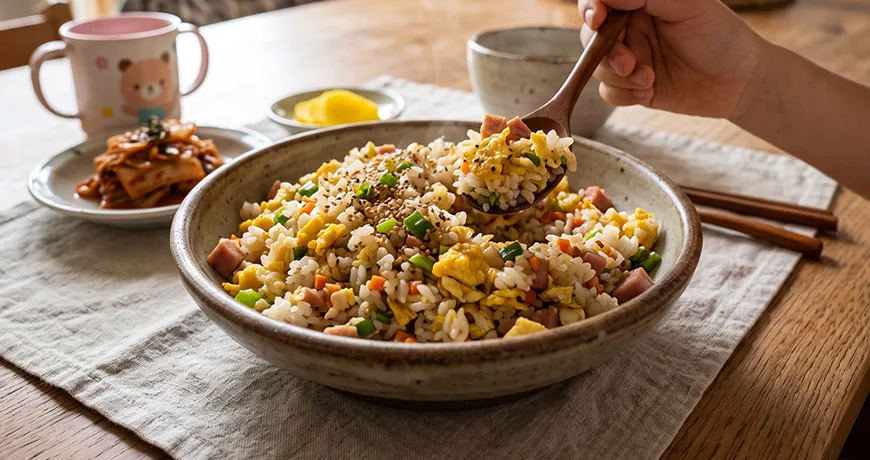
Dalgyalbokkeumbap is a high-kinetic molecular gastronomy dish that hinges entirely on managing starch retrogradation and the rapid thermal coagulation of egg proteins. By starting with a cold, retrograded starch matrix (day-old rice), the firm amylopectin structures resist absorbing excess moisture. The cooking process begins by extracting fat-soluble aromatic compounds from scallions into hot oil, followed by the flash-coagulation of egg proteins to create a porous, fluffy gel. Through intense mechanical agitation (tossing) in a high-thermal-mass wok, the lipids from the cooking oil and egg yolks form a hydrophobic microscopic barrier around every single grain of rice. Finally, soy sauce is flash-boiled directly on the exposed surface of the hot wok—bypassing the rice initially—to induce a violent Maillard browning. This imparts an explosive, smoky umami flavor (Wok Hei) without compromising the rheological, individual-grain texture of the dish.
⏱️ Total: 15 mins | Prep: 10 mins | Cook: 5 mins | 🍳 Difficulty: Low-Moderate (Requires heat management and flash evaporation control) | 🌶️ Profile: Deeply Savory, Smoky, and Nutty | 🍚 Focus: Starch Retrogradation, Thermal Coagulation, & Maillard Searing
Ingredients (2 servings)
- Retrograded Starch Matrix: 2 bowls of cold, day-old white rice (Stored in the fridge so the starches re-crystallize and harden, minimizing moisture)
- Protein & Emulsion Matrix: 3 fresh Eggs (lightly beaten into a liquid state)
- Fat-soluble Aromatics: 1 stalk Asian leek or green onion (finely chopped, mixing white and green parts)
- Lipid Solvent: 3 tbsp cooking oil (Neutral, high smoke-point oil like canola or grapeseed)
- Hypertonic Maillard Catalyst: 1 tbsp soy sauce, 0.5 tbsp oyster sauce (optional), salt to taste
- Aromatic Finish: 1 tsp toasted sesame oil, a pinch of white pepper
Allergy Information Contains: Egg, Soy, Wheat (from soy sauce)
Equipment High Thermal Mass Wok or Frying Pan, Stir-fry Spatula, Cutting Board, Knife
Cooking Instructions
- Aromatic Lipid Extraction: Add the cooking oil and chopped scallions to a cold wok. Heat gently over medium. This thermodynamic tempering process slowly breaks down the cellular walls of the scallions, allowing their fat-soluble allyl compounds to fully extract into the oil without burning, creating a highly aromatic lipid base.
- Thermal Coagulation (Scrambling): Once the scallions begin to crisp and their kinetic moisture evaporates, turn the heat to high. Pour in the beaten eggs. As the liquid proteins hit the 100°C+ oil, they rapidly expand and thermo-coagulate into a porous, soft gel network. Agitate immediately with a spatula to scramble.
- Starch Lipid Coating & Flash Evaporation: When the eggs are 70% coagulated, introduce the cold, retrograded rice. Use the edge of the spatula to mechanically cleave and break apart the clumps. The extreme heat flash-evaporates any residual moisture in the rice, while the hot lipids coat the hard amylopectin surface, ensuring the grains separate completely.
- Maillard Searing (Wok Hei): Push the coated rice to one side of the wok, exposing the blazing hot metal. Pour the soy sauce directly onto the bare metal. It will violently boil and evaporate within seconds. This rapid caramelization fractures the amino acid chains, creating intense smoky flavors. Instantly toss the rice into this bubbling soy reduction to coat the grains with Maillard compounds without making them wet. Adjust final salinity with a pinch of salt.
- Rheological Finish: Turn off the heat. Add a dash of white pepper and sesame oil, using the residual radiant heat to bloom their volatile aromatics. Plate immediately.
💡 Professional Culinary Tips
- The Necessity of Starch Retrogradation: If you introduce freshly cooked, steaming hot rice into a wok, its gelatinized, sticky surface will absorb the cooking oil and instantly turn into a gluey, disastrous mush. Refrigerating the rice causes the amylopectin molecules to retrograde (crystallize and push out moisture). This hard, dry exterior is mandatory—it acts as a physical shield against moisture, allowing the oil to coat rather than soak into the grain.
- Biochemistry of Burning Soy Sauce: Pouring soy sauce directly over the rice merely makes it salty and soggy. Pouring it onto the 200°C+ (400°F+) surface of the wok triggers rapid flash-evaporation and aggressive Maillard browning. This transforms a simple salty liquid into complex, volatile aromatic compounds that impart the legendary “breath of the wok” (Wok Hei) into the dish.
- Protein Sequencing (Curds vs. Golden Coating): There are two rheological schools of egg fried rice. Mixing raw egg yolks into cold rice before cooking creates “Golden Fried Rice,” yielding a uniform emulsion coating on every grain but lacking textural variance. Cooking the eggs first (as done here) builds distinct, fluffy thermo-coagulated protein curds. This mechanical contrast between the soft egg gel and the chewy rice grains dramatically amplifies the tactile pleasure of mastication.
Nutrition Facts (Estimated)
Total Content : Approx. 450g (1 serving)
Calories : 520 kcal
– Sodium : 650mg
– Total Carbohydrate : 65.0g
– Sugar : 1.0g
– Total Fat : 22.0g (Primarily from egg yolks and cooking oil)
– Saturated Fat : 4.0g
– Cholesterol : 270.0mg
– Protein : 14.0g
– Dietary Fiber : 2.0g
*Daily Values are based on a 2,000 calorie diet and standard Korean nutritional reference values.
**Nutritional values are calculated based on original ingredients; substitutions may alter specific macronutrients.
Origins and Food Culture of Egg Fried Rice (Dalgyalbokkeumbap)
1. Historical Lineage: From Ancient Pan-Fried Rice to Modern Korean Everyday Fare
- Rooted in ancient East Asian pan-fried rice traditions—such as the Sui Dynasty’s legendary Sui Jin Chuan (broken gold rice, where golden egg ribbons coated individual rice pearls).
- Popularized across the Korean peninsula during the 20th century through Korean-Chinese dining establishments (junghwa-yorijip), where fried rice was traditionally served alongside savory black bean sauce (jjajang) and spicy seafood broth (jjamppong-guk), it gradually transitioned into home kitchens as an indispensable, quick-service domestic soul food.
2. The Culinary Science of Scallion Infusion, Wok Searing, and Grain Separation
- The hallmark of authentic preparation lies in using slightly cooled or moisture-evaporated rice sautéed over fierce wok heat, allowing the whisked eggs to envelop each individual grain (goseul-goseul) rather than clumping into a soggy mass.
- Gently sizzling scallions to extract aromatic scallion oil provides the foundational flavor base, while ladling soy sauce directly onto the scorching-hot inner curve of the wok (ganjang nulleogi) produces immediate caramelization and savory wok fragrance (bulhyang).
3. The Universally Cherished Comfort Classic and Household Tabletop Traditions
- Requiring only rice, eggs, and basic seasonings, it stands as the ultimate foolproof comfort meal for busy professionals, students, and home cooks seeking instant, high-protein nourishment in minutes.
- Traditionally crowned with extra toasted sesame seeds and paired with crisp, tangy kimchi or pickled yellow radish (danmuji), Dalgyalbokkeumbap embodies the resourcefulness, warmth, and generous simplicity of Korean everyday comfort dining.
The Golden Alchemy of High-Heat Egg Glaze and the Scallion-Perfumed Luster of Wok-Tossed Grains: A Refined Portrait of Dalgyalbokkeumbap
Dalgyalbokkeumbap (Korean Egg Fried Rice) stands as the pure, comforting, and minimalist zenith of single-bowl pan-fried (bokkeumbap) gastronomy. Plump, slightly cooled short-grain rice is introduced to a scorching wok or skillet shimmering with hot oil, quickly folded together with freshly beaten eggs so that every individual kernel is enrobed in a micro-thin golden emulsion of egg protein and fragrant lipids. Masterfully seasoned with pure sea salt or a splash of naturally brewed soy sauce seared against the fiery perimeter of the pan, and finished with a pinch of freshly cracked black pepper and a drop of cold-pressed toasted sesame oil, this dish achieves culinary transcendence without reliance on complex garnishes. It celebrates the elemental harmony of sweet cereal carbohydrates, bioavailable whole-egg proteins, and the transformative physics of high-heat stir-frying in their most direct and honest form.
Lifting a steaming spoonful brimming with glistening golden rice and soft curds of egg awakens the senses with an immediate, heartwarming aroma: the nutty perfume of toasted egg protein mingles effortlessly with the sweet, savory breath of gently caramelized scallion oil. Sinking your teeth into the first mouthful reveals an exhilarating textural cadence: rather than clumping together, the distinct, springy grains dance lightly across the palate, encased in a delicate lipid sheen. The pillowy ribbons of softly scrambled egg dissolve across the tongue with zero resistance, releasing a surge of rich, comforting yolk richness and savory umami. The subtle, smoky perfume of wok-singed soy sauce and the sharp, piney bite of black pepper cut cleanly through the oil, while the intrinsic, slow-releasing sweetness of the rice starch completes an impeccably balanced, profoundly grounding culinary embrace.
The enduring brilliance of Dalgyalbokkeumbap lies in its domestic resourcefulness—orchestrating the most humble pantry essentials into a complete, restorative meal within a matter of minutes. From the cherished childhood memories of a mother rapidly tossing ingredients in an iron skillet to fuel hungry school children to the smoky woks of neighborhood diners and snack bars, a golden plate of egg fried rice remains a timeless cultural monument of unpretentious nourishment, maternal warmth, and heartwarming culinary comfort.
Editor’s Review
1. A Dynamic Harmony of Buoyant Separated Grains, Pillowy Egg Curds, and Aromatic Scallion Crispness
The textural equilibrium achieved in the pan delivers exceptional mouthfeel and lightness. Flash-cooking over high heat ensures that excess surface moisture evaporates rapidly, granting each rice kernel a firm, toothsome chew that never collapses into mush. Soft, velvety clouds of scrambled egg interlock seamlessly with the grains, offering a luxurious, pillowy contrast to the firm starch. The micro-crunch of finely chopped scallions and cracked pepper provides a delightful tactile accent, guaranteeing an endlessly appetizing, grease-free finish from the first spoonful to the last.
2. Ovalbumin Thermal Denaturation Kinetics, Lecithin-Mediated Starch Coating, and Scallion-Soy Pyrazine Maillard Engineering
Dalgyalbokkeumbap represents an exacting study in egg protein biophysics, colloidal surface chemistry, and high-heat aroma kinetics. The primary albumen proteins, ovalbumin and ovotransferrin, undergo rapid thermal unfolding and three-dimensional gel network formation between 62–80°C, trapping intracellular moisture while binding firmly to starch exteriors. Concurrently, natural phosphatidylcholine (lecithin) present in the egg yolk acts as an amphiphilic bio-surfactant, micro-emulsifying the cooking oil with surface starch hydration to form a hydrophobic barrier that prevents amylose leaching and grain clumping. High-heat oil extracts lipid-soluble allyl sulfides from Welsh onions to generate rich allium aromatics, while splashing soy sauce against the superheated perimeter (>150°C) drives rapid Maillard cross-linking between soy amino acids and reducing sugars, generating volatile pyrazines and furans that impart authentic wok aroma (bulmat) without artificial additives.
3. The Minimalist Zenith of Everyday Subsistence and the Soul of Korean Domestic Gastronomy
Elevating rice, eggs, and oil into a universally celebrated masterwork through nothing more than precise thermal control and rapid kinetic agitation, Dalgyalbokkeumbap embodies the resilient, practical genius of Korean home cooking. Requiring neither pretense nor elaborate preparation, this unassuming yet flawless staple serves as an enduring sanctuary of restorative warmth, pure culinary integrity, and heartfelt everyday hospitality.