
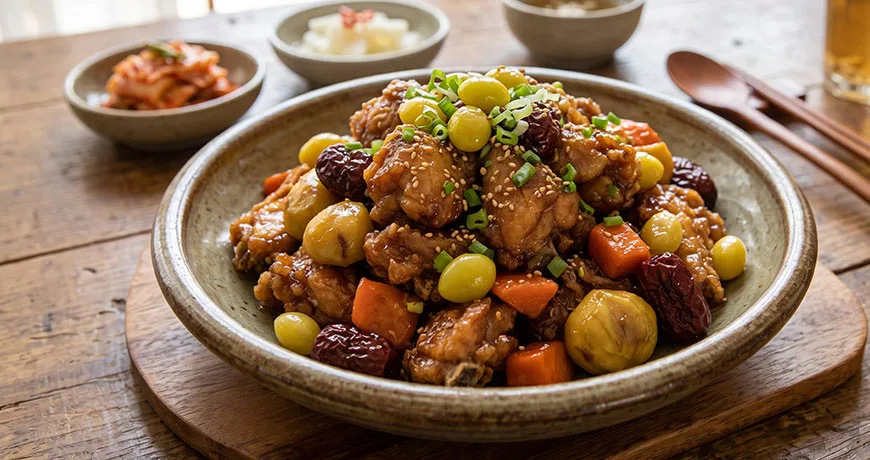
Dakgangjeong is the pinnacle of crispy texture engineering. It relies on a rigorous double-frying process to completely extract moisture from beneath a starch crust coating chicken thighs, followed by high-viscosity polysaccharide (malt syrup/sugar) glazing that transforms into an amorphous glassy state (sugar glass), ensuring the crust never turns soggy. The primary low-temperature fry cooks the interior proteins, while the secondary high-temperature flash-fry instantaneously vaporizes residual surface moisture to lock in a rigid, dehydrated shell. The crown jewel of this dish is its high-viscosity syrup binder. As the syrup cools, it hardens into a protective sugar glass shell that seals the crust, preventing sauce moisture from migrating inward. This guarantees an extreme, long-lasting crunch wrapped in a sweet-and-savory glaze.
- ⏱️ Total: 40 mins | Prep: 15 mins (Surface moisture purging & starch coating) | Cook: 25 mins
- 🍳 Difficulty: Medium-High (Requires precise double-fry temperature control and glass-transition syrup viscosity management)
- 🌶️ Profile: Shattering Glass Shell, Juicy Interior, and Deeply Savory Sweet-and-Spicy Maillard Glaze
- 🍚 Focus: Starch Barrier Formation, Double-Frying Dehydration, & High-Viscosity Glass Glazing
Ingredients (2–3 servings)
- Myofibrillar Protein Matrix: 600g Fresh Boneless Chicken Thighs (Cut into uniform bite-sized 3cm cubes for synchronized frying)
- Starch Crust Matrix: 1 cup Potato or Corn Starch (To build a thin, rigid dehydration barrier over the chicken)
- Aromatic Marinade: 1 tbsp Cheongju (Korean rice wine), 1/2 tsp Minced Ginger (to neutralize poultry odor), 1/2 tsp Salt, Pinch of Black Pepper
- Glass-Transition Syrup Binder: 4 tbsp Malt Syrup or Rice Syrup (Crucial for the shattering glass coat and gloss), 2.5 tbsp Brewed Soy Sauce, 1.5 tbsp Sugar, 1 tbsp Gochujang, 1 tbsp Minced Garlic, 1 tbsp Cooking Oil
- Lipid & Finish Matrix: 3+ cups Cooking Oil (for deep frying), 2 tbsp Crushed Roasted Peanuts, 1 Cheongyang/Red Chili (sliced for heat accents)
Allergy Information Contains: Soy, Wheat (Soy Sauce, Gochujang), Nuts (Peanuts – optional/removable)
Equipment Deep Frying Pot, Skimmer, Wide Pan or Wok, Mixing Bowl
Cooking Instructions
- Marination & Starch Barrier: Toss the cubed chicken thighs with rice wine, ginger, salt, and pepper, letting rest for 10 minutes. Lightly blot excess moisture, then dredge thoroughly in potato starch. Let the coated chicken rest for 5 minutes so the starch absorbs surface moisture to form a uniform starch film.
- Primary Convection Frying: Submerge the coated chicken in oil preheated to 160°C. Fry for 5–6 minutes to gently cook the interior while gelatinizing the surface starch into a pale yellow crust. Remove and rest for 3 minutes on a wire rack to allow internal steam to dissipate.
- Secondary Flash Frying: Boost the oil temperature to a blistering 190°C. Return the chicken to the oil for strictly 60 to 90 seconds. The micro-surface moisture will flash-evaporate, instantly locking in a rigid, ultra-crispy shell. Drain completely on a wire rack.
- High-Viscosity Syrup Construction: In a wide pan, combine 1 tbsp of cooking oil, malt syrup, soy sauce, sugar, Gochujang, and minced garlic over medium-low heat. Bring the syrup to a foaming, bubbling boil (approx. 150°C) until it reaches peak viscosity and forms thick, sticky threads.
- Glass Transition Glazing: Turn the heat completely off or to its lowest setting. Immediately introduce the double-fried chicken into the syrup pan and toss rapidly with a spatula. The syrup will penetrate the microscopic gaps of the starch crust and instantly solidify into a transparent, glassy state. Scatter crushed peanuts and chilies over top and serve.
💡 Professional Culinary Tips
- The Thermodynamic Necessity of Double-Frying: Frying chicken once at high heat will either burn the exterior while leaving the raw interior intact, or fail to vent internal moisture, causing the crust to rapidly soften. The two-stage fry—cooking the core at a moderate heat followed by a high-heat flash-dehydration—is the immutable law of Dakgangjeong’s crunch.
- Viscosity Control via Malt Syrup: The heavy reliance on malt or rice syrup is dictated by the principles of “glass transition.” High-sugar polysaccharide matrices cool into an amorphous solid rather than crystallizing, creating a hard, protective barrier that blocks the osmotic migration of sauce moisture into the crust.
- The Physics of Starch Resting Time: Frying chicken immediately after dredging causes excess loose powder to muddy the oil and prevent a clean crust. Allowing the dredged chicken to rest for 5 minutes ensures complete hydration of the starch layer, ensuring a seamless, durable shell upon contact with hot oil.
🍶 Gastronomic Pairing
- Biochemical Palate Cleansing: When the shattering starch crust, high-viscosity sugar glass glaze, and heavy frying lipids coat your oral mucosa, pair this masterpiece with a chilled, dry Sparkling Wine (Cava/Champagne) or a crisp, effervescent Draft Lager. The sharp carbonation bubbles and acidity physically shear through the sugar and oil barrier, offering a pristine palate reset for every piece.
Nutrition Facts (Estimated)
Total Content : Approx. 250g (1 serving)
Calories : 540 kcal (High-protein, high-carbohydrate fried matrix)
– Sodium : 950mg (Attributed to soy sauce and Gochujang)
– Total Carbohydrate : 48.0g (Starch coating and malt syrup/sugar polysaccharides)
– Sugar : 22.0g (Glass-transition syrup coating sugars)
– Total Fat : 24.0g (Absorbed frying lipids and pan coating oils)
– Saturated Fat : 4.5g
– Cholesterol : 95.0mg (Derived from chicken thigh myofibrillar tissue)
– Protein : 28.0g (Highly bioavailable chicken thigh myoglobin protein)
– Dietary Fiber : 1.5g (Peanut and starch cellulose)
*Daily Values are based on a 2,000 calorie diet and standard Korean nutritional reference values.
**Nutritional values are calculated based on original ingredients; substitutions may alter specific macronutrients.
Origins and Food Culture of Deep-fried and Braised Chicken (Dakgangjeong)
1. Historical Lineage: Traditional Gangjeong Confections and Modern Fried Poultry Evolution
- The etymological root of Dakgangjeong traces back to traditional Korean gangjeong—crisp, honey-coated puffed rice confections enjoyed during royal banquets and festive holidays—sharing a profound philosophical lineage with braising meats in sweet, viscous maltose syrups to achieve a preserved, crisp texture.
- As commercial frying oils and refined sugars became accessible during the post-war modernization era, regional cooks in coastal maritime hubs such as Sokcho and Incheon adapted traditional fried chicken by chopping the poultry into smaller, bone-in or boneless nuggets and tossing them in heavy maltose-soy reductions. This created a distinct culinary genre designed to remain crunchy even after hours of cooling, evolving into the legendary street market delicacy recognized today.
2. The Culinary Science of Double-Frying and Maltose Glaze Thermodynamics
- The technical mastery of authentic Dakgangjeong hinges upon controlling moisture evacuation through double-frying (double-frying mechanics) and managing the viscosity of the braising syrup.
- While conventional Korean yangnyeom-tongdak utilizes a softer batter designed to absorb wet chili sauces, Dakgangjeong employs a higher ratio of potato or corn starch to forge a dense, durable outer crust. Frying the chicken twice ensures that all residual water vapor escapes, preventing steam from softening the crust from within. Tossing the dry, ultra-crisp chicken into a rapidly boiling maltose-soy reduction allows the thick sugars to instantly encase the crust in a taut, glassy barrier that arrests moisture migration, yielding the iconic snappy crunch.
3. The Sokcho Market Phenomenon and the Global Triumph of K-Chicken
- During the late 1990s and 2000s, the bustling Dakgangjeong alley within Sokcho’s Tourist & Fishery Market (anchored by pioneering vendors like Manseok Dakgangjeong) transformed into a national culinary pilgrimage site, where visitors queued for hours to secure iconic red cardboard boxes filled with glistening, sweet-spicy chicken nuggets.
- Expanding nationwide via express delivery networks and department store pop-ups, Dakgangjeong became the ultimate travel souvenir and picnic favorite. Today, as a beloved crown jewel of global K-Food and Korean fried chicken culture, Dakgangjeong stands as an immortal monument to culinary innovation, working-class ingenuity, and irresistible gustatory pleasure.
The Shattering Glass-Like Crust of Twice-Fried Bite-Sized Chicken, the Sticky Molten Glaze of Reduced Syrup and Chili Paste, and the Nutty Crunch of Crushed Peanuts: A Refined Portrait of Dakgangjeong
Dakgangjeong (Deep-fried and Braised Chicken) stands as the shatteringly crisp, intensely sweet-and-spicy, and biologically fascinating summit of Korea’s modern poultry confectionery gastronomy. Centered upon boneless chicken thigh and breast meat chopped into uniform, bite-sized morsels—subtly marinated in refined rice wine, fresh ginger juice, crushed garlic, solar sea salt, and white pepper before being coated in a delicate, translucent veil of potato or corn starch—the preparation begins with rigorous double-frying (deobeul-peuraing) discipline. Submerged inside heavy iron cauldrons or deep fryers filled with clean vegetable oil heated between 170°C and 180°C, the morsels undergo a two-stage thermal immersion: the initial frying flash-vaporizes internal moisture to cook the interior to succulent tenderness while expanding the starch matrix, followed by a brief resting period where steam evacuation triggers initial crust contraction. The secondary high-heat immersion instantaneously strips away residual surface moisture, establishing a rigid, non-porous glass-like crust that repels oil absorption. Concurrently, a wide cast-iron wok is loaded with sun-dried red chili powder, artisanal gochujang, aged soup soy sauce, crushed garlic, and an abundant measure of high-maltose rice syrup (mulyeot); simmered rapidly alongside dried red chilies and scallions, it transforms into an ultra-viscous, translucent amber molasses glaze. With the flame dialed to a gentle whisper, the crisp, double-fried chicken morsels are plunged into the bubbling wok, tossing rapidly to encase every single piece in a gossamer-thin, brilliant vermilion lacquer. Crowned with an opulent blanket of finely chopped roasted peanuts and toasted sesame seeds, this dish represents a masterclass in thermal carbohydrate and protein coating. Bypassing the heavy, soggy batters and watery sauces typical of standard seasoned chicken, Dakgangjeong maximizes starch sealing and high-solids sugar physics to maintain extraordinary crispness and chew even after cooling, delivering an enduring gastronomic reward that defies the passage of time.
Approaching the deep vermilion platter as crushed peanuts catch the ambient light and a glossy, sweet-savory vapor curls upward, lifting a glistening piece of Dakgangjeong with chopsticks releases an immediate, electrifying olfactory charge: the rich, caramelizing aroma of heated maltose syrup and fermented chili paste mingles seamlessly with the deep, roasted Maillard perfume of crispy fried chicken and the nutty warmth of crushed peanuts. Sinking your teeth into a morsel delivers an extraordinary textural revelation: the rigid, sugary glass crust shatters with a crisp, audible snap (ppajik), giving way instantly to the succulent, juicy interior meat of the chicken thigh. The sweet-and-spicy molasses glaze coats the oral mucosa like liquid velvet, sparking immediate sensory excitement through capsaicin and maltose integration, while the brittle crunch of crushed peanuts provides essential masticatory contrast. Maintaining its signature shatter and chewy interior long after cooling, a box of Dakgangjeong captures the dynamic, on-the-go lifestyle of modern urban Korea, standing as an irreplaceable monument of confectionery poultry cookery, commercial innovation, and brilliant culinary craftsmanship.
The enduring majesty of Dakgangjeong lies in its brilliant socio-culinary lineage—fusing the ancient Korean confectionery philosophy of gangjeong (binding puffed grains or meats with boiled maltose syrup) with the post-war street-market vitality of coastal fishing ports and bustling urban emporiums (such as Incheon’s Sinpo Market and Sokcho’s Jungang Market). Transcending the massive, whole-bird format of traditional tongdak, this bite-sized, cold-stable masterpiece remains the definitive celebration of preservation science, street-food ingenuity, and brilliant Korean culinary artistry.
Editor’s Review
1. A Dynamic Harmony of Shattering Glass Crust, Succulent Interior Juiciness, and Nutty Peanut Crunch
The structural architecture inside the dish delivers an extraordinary, three-tiered choreography between a high-heat double-fried starch shell, a tempered amorphous glassy sugar surface coating, succulent high-lipid poultry meat, and brittle whole-seed friction. The exterior shell of Dakgangjeong consists of a thin, rigid glassy state achieved through rapid thermal tempering of high-solids maltose syrup over a porous starch matrix; under initial tooth pressure, it shatters like spun sugar with an audible, crisp snap (ppajik) that provides immediate masticatory excitement. As the glass shell fractures, the interior chicken thigh meat—having shed excess free water during double-frying—yields with succulent juiciness (juiciness) that moistens the palate. Interspersed crushed peanuts and sesame seeds supply a light, brittle crunch that punctuates oral transit, ensuring an impeccably balanced, non-fatiguing mouthfeel from the first sweet bite to the last.
2. Double-Frying Moisture Evacuation, Starch Crust Sealing, Low Water Activity (Aw) Molasses Glazing, and Pyrolytic Maillard Savor
Dakgangjeong represents an exacting study in poultry muscle biochemistry, sugar thermodynamics, and moisture-barrier physics. Coating the chicken morsels in pure potato or corn starch establishes a protective hydrophilic barrier that, upon 170–180°C double-frying, undergoes rapid structural dehydration, creating a rigid micro-porous matrix. The second high-heat immersion strips residual surface moisture, preparing the crust for optimal glaze adhesion. In the glazing phase, high-maltose rice syrup and gochujang undergo thermal concentration over 150°C, transforming into an ultra-viscous syrup characterized by an extremely low water activity ( ). Upon contacting the crisp chicken and cooling rapidly, this molasses glaze forms a continuous, moisture-impermeable molecular barrier that prevents atmospheric ambient humidity from penetrating the crust, thereby preventing staling and preserving structural crunch even at room temperature. Furthermore, micro-Maillard reactions between poultry amino acids and reducing sugars during frying generate trace volatile pyrazines and furans, amplifying the rich, savory baseline beneath the sweet-spicy shell.
3. The Traditional Gangjeong Confectionery Heritage and the Sovereign Apex of Cold-Stable Crispy Poultry
Marrying the ancient Korean confectionery tradition of binding proteins and grains with boiled maltose syrup with modern poultry frying physics, Dakgangjeong stands as the ultimate archetype of cold-stable crispy cookery in Korean food history. Proving that profound textural integrity and flavor brilliance can be preserved long after the flame has died, this glossy, shatteringly crisp classic captures the very soul of modern Korean street gastronomy, standing as an enduring sanctuary of commercial ingenuity, preservation science, and brilliant culinary artistry.