
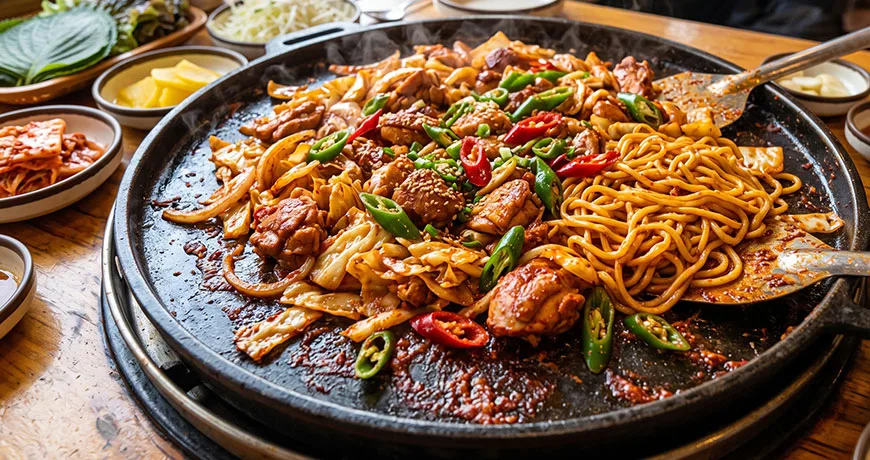
Dakgalbi is a high-heat cast-iron masterpiece engineered around the rendering of intramuscular animal fats and collagen from chicken thighs. As these fats melt into natural schmaltz under intense thermal energy, they fuse with vegetable reducing sugars and the fermented peptide binders of Gochujang and Gochugaru. To tenderize the dense myoglobin and muscle fibers of the chicken thighs, a preliminary marinade utilizing the proteolytic and sulfur compounds of brewed soy sauce and garlic is executed. The core engineering of this dish demands precise thermodynamic control to simultaneously synchronize high-heat Maillard reactions at the pan’s base with the starch gelatinization of sweet potatoes and rice cakes. In the final seconds, the volatile perillaldehyde terpenes of fresh perilla leaves are flash-activated by the residual heat, gracefully balancing the rich meat lipids.
- ⏱️ Total: 45 mins | Prep: 20 mins (Chicken marination & vegetable prep) | Cook: 25 mins
- 🍳 Difficulty: Medium-High (Requires thermal control of cast-iron heat retention and chicken fat rendering)
- 🌶️ Profile: Smoky Maillard Char and Rich Animal Fats Pierced by Fiery Capsaicin Heat
- 🍚 Focus: Chicken Fat Rendering (Schmaltz), Maillard Caramelization, Sweet Potato Gelatinization, & Perillaldehyde Sealing
- 🍶 Pairing: Chilled Draft Lager or High-Carbonation Makgeolli to slice through the heavy meat lipids
Ingredients (3–4 servings)
- Myofibrillar & Lipid Matrix: 700g Fresh Boneless Chicken Thighs (Cut into large, bite-sized pieces to preserve intramuscular fat and juicy myofibrils)
- Capsaicin-Peptide Binder: 3.5 tbsp Aged Gochujang (Chili Paste), 3 tbsp Coarse Gochugaru (Chili Flakes), 2 tbsp Brewed Soy Sauce, 2 tbsp Minced Garlic, 1 tsp Curry Powder (for subtle spice terpene enhancement and odor neutralization), 1.5 tbsp Sugar, 2 tbsp Corn Syrup (for surface gloss glazing)
- Reducing Sugar & Starch Matrix: 1/4 head Cabbage (coarsely chopped), 1 Sweet Potato (sliced into thin squares for starch gelatinization and sweetness), 12 Tteokbokki Rice Cakes
- Allyl & Terpene Catalyst: 1 stalk Green Onion (diagonally sliced), 1/2 Onion (julienned), 2 Cheongyang green chilies, 10 fresh Perilla Leaves (Sip-nip – coarsely julienned for perillaldehyde aroma)
- Lipid & Finish Matrix: 1 tbsp Cooking Oil (for initial pan conditioning), 1 tbsp Toasted Sesame Oil, 1 tbsp Roasted Sesame Seeds
Allergy Information Contains: Soy, Wheat (Gochujang, Soy Sauce, Curry Powder)
Equipment High Thermal Mass Cast-Iron Pan or Heavy-Duty Griddle, Spatula
Cooking Instructions
- Peptide Marination: Combine the prepped chicken thighs with Gochujang, Gochugaru, soy sauce, minced garlic, curry powder, sugar, and corn syrup in a mixing bowl. Massage thoroughly and let rest in the refrigerator for at least 30 minutes, allowing amino acids to penetrate deep into the muscle fibers via osmosis.
- Schmaltz Extraction: Heat a heavy cast-iron pan over medium-high heat and apply a micro-film of cooking oil. Lay the marinated chicken thighs flat across the surface, skin-side down. Simmer for 5–7 minutes as animal fats melt and pool at the base of the pan as natural schmaltz.
- Gelatinization & Reducing Sugar Fusion: Once the chicken exteriors turn golden, introduce the chopped cabbage, sweet potato slices, rice cakes, and onions around the rendered chicken fat. The amylopectin starches in the sweet potatoes will absorb heat and moisture, initiating gelatinization, while reducing sugars leach from the cabbage to mingle with the red sauce.
- High-Heat Maillard Caramelization: Turn the burner to maximum heat and stir continuously with a spatula. The sugars in the sauce and vegetables contacting the blazing hot iron will instantly caramelize, triggering a deep, smoky Maillard reaction. Stir-fry for 10–12 minutes until the sweet potatoes and rice cakes reach complete tenderness.
- Perillaldehyde Terpene Sealing: The moment the Dakgalbi achieves a glossy, perfect finish, right before turning off the heat, scatter the julienned perilla leaves, scallions, and chilies over the top. The residual heat will instantly liberate the perillaldehyde terpenes, laying a fragrant herbal seal over the rich meat lipids. Drizzle with sesame oil and sesame seeds, then serve directly from the pan.
💡 Professional Culinary Tips
- The Lubrication Mechanics of Schmaltz: Dumping excessive cooking oil into Dakgalbi results in a greasy, unpalatable failure. You must rely solely on the natural schmaltz rendering out of the chicken skin and intramuscular fat under heat. This natural animal lipid coats the sauce and vegetables, imparting an unmatched depth of body.
- Synchronized Cooking of Sweet Potatoes and Rice Cakes: Sweet potatoes require prolonged thermal energy to soften, whereas rice cakes easily turn to mush if overcooked. Slicing the sweet potatoes thinly increases their thermal conductivity, while introducing them alongside water-rich cabbage ensures both ingredients reach perfect gelatinization simultaneously.
- Thermodynamic Control of Perilla Terpenes: Introducing perilla leaves at the beginning of cooking destroys their delicate volatile compounds entirely. They must be introduced strictly in the final seconds (or residual heat phase) to ensure the volatile perillaldehyde locks into the lipid matrix before evaporating into the air.
🍶 Gastronomic Pairing
- Biochemical Palate Cleansing: When the rich animal lipids of the schmaltz, the heavy capsaicin emulsion, and the sweet starchy body of the sweet potatoes coat your oral mucosa, pair this masterpiece with an ice-cold Draft Lager or a live, sparkling traditional Makgeolli. The carbonation bubbles and refined ethanol molecules act as a precision surgical scalpel, cleanly shearing through the animal lipid barrier on your tongue to instantly reset your palate.
Nutrition Facts (Estimated)
Total Content : Approx. 400g (1 serving)
Calories : 520 kcal (High-protein, high-carbohydrate energy matrix)
– Sodium : 1,180mg (Attributed to Gochujang and Soy Sauce)
– Total Carbohydrate : 45.0g (Sweet potato starches, rice cakes, and cabbage reducing sugars)
– Sugar : 16.0g (Corn syrup and vegetable reducing sugars)
– Total Fat : 22.0g (Natural chicken thigh lipids and sesame oil)
– Saturated Fat : 6.5g
– Cholesterol : 110.0mg (Derived from poultry myofibrillar tissue)
– Protein : 32.0g (Highly bioavailable chicken thigh myoglobin protein)
– Dietary Fiber : 5.0g (Cabbage and perilla leaf cellulose)
*Daily Values are based on a 2,000 calorie diet and standard Korean nutritional reference values.
**Nutritional values are calculated based on original ingredients; substitutions may alter specific macronutrients.
Origins and Food Culture of Spicy Stir-fried Chicken (Dakgalbi)
1. Historical Lineage: 1960s Chuncheon Roots and the Evolution of “Working-Class Galbi”
- The culinary birthplace of Dakgalbi is Chuncheon, Gangwon Province, where it emerged in the early 1960s within local taverns and neighborhood eateries. During an era when beef and pork rib cuts (galbi) were scarce and expensive, clever cooks utilized abundant, affordable chicken meat, chopping it into strips and seasoning it like rib meat to be grilled over open wood charcoal.
- Initially skewered and grilled directly over charcoal like traditional galbi, the dish evolved in response to the demographics of Chuncheon—a city dense with military bases and university campuses. To provide hungry soldiers and students with a generous, satisfying meal at a modest price, cooks began tossing the chicken onto giant, circular cast-iron griddles (cheolpan) alongside mountains of inexpensive cabbage, sweet potatoes, and rice cakes, birthing the iconic griddle-seared version beloved today.
2. The Thermodynamic Mechanics of Cast-Iron Griddles and the Secret of Curry Powder
- The technical mastery of authentic Dakgalbi hinges upon the high thermal mass and radiant heat capacity of thick cast-iron griddles. Cast iron retains and distributes heat evenly across its wide surface, allowing high-moisture vegetables like cabbage and onions to release sweet vegetable stock while simultaneously driving the Maillard caramelization of the chicken proteins.
- The inclusion of a small measure of curry powder within traditional Chuncheon marinades serves as an ingenious culinary signature: curcumin and turmeric aromatics completely eliminate poultry gameyness while imparting a warm, lingering depth of flavor and enhancing the lustrous red-gold hue of the sauce.
3. The Chuncheon Dakgalbi Alley and the Global Ambassador of K-Food Griddle Culture
- Propelled during the 1970s and 1980s by youth travel culture—when university students boarded weekend train excursions to Chuncheon for mountain retreats—Dakgalbi blossomed into a cherished national institution.
- Gathering around a massive central griddle to watch the raw ingredients transform into a bubbling scarlet feast, sharing lively conversation, and scraping up the crispy fried rice (bokkeumbap) from the iron floor at the meal’s conclusion embodies the communal warmth and conviviality of Korean dining culture. Today, as a pillar of global K-BBQ and international street gastronomy, Dakgalbi stands as an immortal monument to Korean hospitality, working-class ingenuity, and restorative comfort dining.
The Sizzling Cast-Iron Symphony of Tender Chicken Thighs, the Fiery Amber Glaze of Gochujang and Curry Spices, and the Communal Drama of Griddle-Scorched Rice: A Refined Portrait of Dakgalbi
Dakgalbi (Spicy Stir-fried Chicken) stands as the dynamic, intensely convivial, and culturally beloved summit of Korea’s large-scale griddle (cheolpan) gastronomy. Centered upon succulent, bone-in or boneless chicken thigh and leg meat—marinated extensively in an assertive seasoning paste of sun-dried red chili powder (gochujang), garlic, ginger, soy sauce, maltose syrup, and a distinctive whisper of aromatic curry powder that introduces an unexpected, earthy warmth—the preparation begins with grand-scale theatricality. A massive, heavy cast-iron griddle spanning several feet across is heated to roaring thermal velocity over open gas burners. A light coating of clean oil is slicked across the surface before mounding the marinated chicken alongside towering heaps of shredded green cabbage, thick-cut sweet potato rounds, cylindrical rice cakes (tteok), scallions, and fragrant perilla leaves. Armed with long wooden spatulas, cooks toss and sweep the ingredients across the searing iron plate in rhythmic synchronization. As the relentless conductive heat breaks down the cellular turgor of the cabbage and renders the chicken’s subcutaneous fats, the melting lipids fuse with the chili paste to transform into a glossy, clingy, deep-vermilion emulsion sauce. Often enriched with chewy udon noodles or wheat noodles halfway through, the feast reaches its magnificent crescendo when leftover sauce and chicken bits are combined with chopped kimchi, toasted seaweed flakes, sesame oil, and white rice—flattened thinly against the griddle to forge an irresistible, crispy scorched rice (nurungji) base. Wholly replacing quiet, individual plating with active, communal gathering around a shared fire, Dakgalbi captures the unbridled energy and egalitarian spirit of Korean social dining.
Approaching the roaring cast-iron griddle as thick, savory vapors curl upward and ruby bubbles froth around plump, sauced chicken pieces, lifting a sizzling morsel of chicken thigh with metal chopsticks releases an immediate, electrifying olfactory charge: the pyrolytic Maillard aroma of seared meats mingling with the sharp heat of gochujang, the exotic spice notes of curry powder, and the herbal, anise-like freshness of wilted perilla leaves. Sinking your teeth into the chicken delivers an extraordinary textural revelation: having absorbed the direct heat of the iron plate, the outer surface achieves a savory crust while locking in abundant internal juices (juiciness), parting with an energetic, springy bounce (taenggeul). The fiery-sweet glaze coats the oral mucosa with intense capsaicin heat, instantly counterbalanced by the melting, mealy sweetness of the griddle-poached sweet potatoes. The chewy rice cakes and crisp cabbage ribbons provide vital masticatory contrast. Concluding the meal by scraping up the thin, golden-brown sheets of griddle-scorched rice (nurungji) completes an unforgettable ritual of culinary theater, communal bonding, and profound gastronomic catharsis.
The enduring majesty of Dakgalbi lies in its humble provincial heritage—born in the early 1960s within the narrow alleys of Chuncheon, Gangwon Province, where tavern owners served inexpensive, grilled chunks of poultry as an accessible substitute for beef or pork ribs (galbi) to feed hungry military servicemen and university students. Evolving from primitive charcoal-grill skewers into a massive, centralized iron-griddle stir-fry phenomenon that captured the national imagination during the post-war economic boom, a sizzling pan of Chuncheon spicy chicken remains an irreplaceable monument of communal generosity, working-class resilience, and brilliant Korean culinary craftsmanship.
Editor’s Review
1. A Dynamic Harmony of Bouncy Chicken Thigh Juiciness, Melting Sweet Potato Starch, Crisp Cabbage Turgor, and Scorched-Rice Nurungji Crunch
The structural architecture inside the griddle delivers an extraordinary, four-tiered choreography between high-fat poultry skeletal muscle bundles, heat-gelatinized root vegetable starches, crisp leafy brassicas, and compressed, toasted grain matrices. Because Chuncheon-style Dakgalbi relies primarily on chicken thigh and leg meat rich in intramuscular and subcutaneous lipids, searing across a roaring cast-iron griddle develops a savory outer crust while preserving interior moisture, delivering an energetic, springy chew (taenggeul). Interspersed sweet potatoes soften under prolonged griddle contact into a creamy, custard-like purée that melts across the tongue, contrasting the refreshing, audible snap of crisp cabbage and perilla leaves. At the grand finale, the leftover sauce and rice are compressed into a paper-thin layer against the hot iron, undergoing intense caramelization to form a crisp, brittle scorched-rice (nurungji) crust that provides an exhilarating textural climax, ensuring an impeccably balanced, non-fatiguing mouthfeel from the first sizzling bite to the last scraping.
2. Heavy Cast-Iron Conductive Maillard Kinetics, Poultry Lipid Emulsification, Capsaicin-Curry Spice Synergy, and Griddle-Scorched Rice Umami Maximization
Dakgalbi represents an exacting study in heavy-metal griddle thermodynamics, lipid colloid emulsification, and pyrolytic flavor chemistry. The thick, multi-millimeter cast-iron plate functions as an exceptional thermal reservoir, storing massive amounts of heat energy and preventing sudden temperature drops when cold ingredients are loaded, thereby securing sustained high-temperature (160–200°C) Maillard reactions across the meat surface. The inclusion of trace aromatic curry powder introduces curcumin and diverse volatile monoterpenes that chemically mask trace poultry off-notes while creating a complex flavor synergy with the gochujang capsaicin. Concurrently, rendering chicken lipids mix with evaporating vegetable moisture under continuous spatula agitation to establish a stable oil-in-water (O/W) micro-emulsion that coats every solid component in a glossy, clinging glaze. In the concluding fried-rice phase, grain carbohydrates and fermented glutamates converge with concentrated inosine monophosphate (IMP) residues from the chicken and sauce, triggering an exponential activation across human oral T1R1/T1R3 umami heterodimers to produce an intensely savory finish.
3. The Chuncheon Myeong-dong Alley Heritage and the Sovereign Apex of Communal Griddle Gastronomy
Forged out of the post-war taverns of Chuncheon and elevated into an enduring national institution of social dining, Dakgalbi stands as the ultimate archetype of communal griddle cookery in Korean food history. Transforming modest poultry cuts and field vegetables into an interactive, high-energy theatrical feast shared around a single roaring iron plate, this vibrant, crimson-glazed masterpiece captures the very soul of modern Korean togetherness, standing as an enduring sanctuary of domestic comfort, communal joy, and brilliant culinary artistry.