
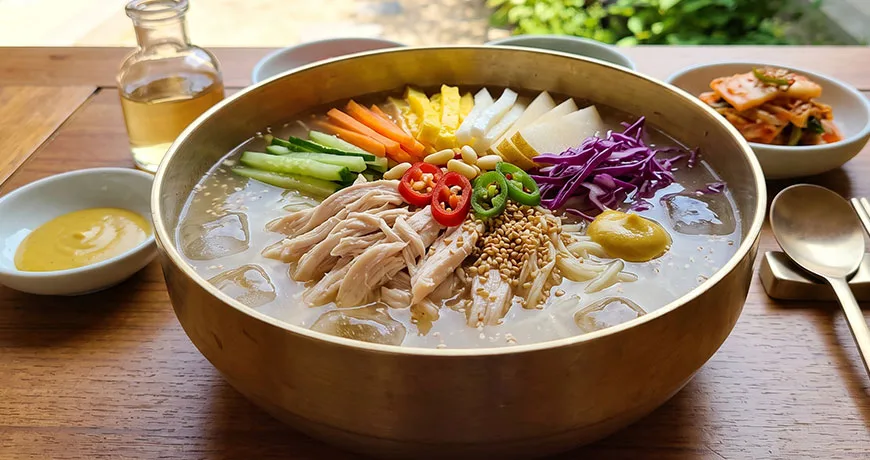
Chogyetang is a precision thermodynamic chilled soup that supercools a thermally hydrolyzed poultry broth and utilizes acetic acid (vinegar) and allyl isothiocyanate (mustard) as chemical catalysts to aggressively stimulate taste receptors even at freezing temperatures. After extracting deep inosinate and proteins from the chicken, the broth is thoroughly chilled. The artisan’s relentless dedication to repeatedly filtering the solidified terrestrial lipids through a fine muslin cloth is what yields this flawlessly clear, zero-fat aqueous solvent. Submerged in this pristine broth is a matrix of chilled chicken meat, meticulously shredded by hand along the muscle fibers despite the numbing cold. Because freezing temperatures naturally dull the human palate, the sharp organic acids of the vinegar awaken the tongue, while the volatile sulfur compounds of the mustard pierce the olfactory nerves. This creates the ultimate endothermic recovery dish, rapidly draining excess body heat during the oppressive summer heat.
⏱️ Total: 2 hrs 30 mins | Prep: 20 mins | Cook: 2 hrs 10 mins (including broth chilling) | 🍳 Difficulty: High (Requires flawless lipid skimming and acid-base flavor balancing) | 🌶️ Profile: Sharp, Tart, Piercingly Cold, and Refreshing | 🍚 Focus: Lipid Solidification, TRPA1 Stimulation, & Mechanical Cleavage | 🍶 Pairing: Chilled, mildly sweet traditional unpasteurized Yakju
Ingredients (2–3 servings)
- Protein & Inosinate Matrix: 1 Whole Chicken (approx. 800g, flash-boiled to purge blood proteins)
- Extraction Aromatics: 2.5L Water, 1/2 Onion, 1 stalk Green Onion, 5 whole Garlic cloves, 1 knob Ginger
- Acid & TRPA1 Binder (Per 4 cups of broth): 4 tbsp Vinegar, 1–1.5 tbsp Korean Mustard paste (Yeon-gyeoja), 1 tbsp Soup Soy Sauce, 2 tbsp Sugar, 0.5 tbsp Salt
- Turgor & Textural Matrix: 1/2 Cucumber (julienned), Red Cabbage or Bell Pepper (julienned), Egg Garnish (Jidan – yolks and whites separated, fried thin, and julienned)
- Lipid Garnish: 1 tbsp Pine Nuts, 1 tbsp Toasted Sesame Seeds
Allergy Information Contains: Chicken, Soy, Wheat (from soy sauce), Egg
Equipment High Thermal Mass Pot, Fine Muslin Cloth or Skimmer, Mixing Bowls, Cutting Board, Knife
Cooking Instructions
- Thermal Hydrolysis: Place the flash-boiled chicken, water, onion, green onion, garlic, and ginger into a large pot. Bring to a boil, then reduce to medium-low and simmer for 50 minutes to extract the water-soluble aminos and umami.
- Lipid Solidification & Filtration: Remove the chicken and strain the aromatics. Place the clear broth in the refrigerator or freezer until thoroughly chilled. Chicken fat solidifies at low temperatures, floating to the surface as a hard, white layer. Meticulously skim and filter this solidified lipid layer through a muslin cloth, leaving behind a 100% pristine, fat-free solvent.
- Mechanical Cleavage (Shredding): Once the chicken is cool, remove the bones. Enduring the freezing chill, shred the meat entirely by hand along the muscle grain. This manual labor maximizes the surface area, ensuring the microscopic mustard and vinegar particles penetrate deep into the protein via osmosis.
- Chemical Solvent Assembly: Into the perfectly fat-free, supercooled broth, vigorously whisk the vinegar, mustard, sugar, soy sauce, and salt. The acetic acid and allyl compounds dissolve into the liquid, forming a powerful endothermic and stimulating solution.
- Structural Assembly & Serve: In a chilled bowl, neatly arrange the shredded chicken, cucumber, bell pepper, and egg garnish. Carefully pour the icy, slushy mustard broth over the matrix. Crown with pine nuts and sesame seeds for a hint of richness, and serve immediately.
💡 Professional Culinary Tips
- Thermodynamics of Lipid Solidification: While chicken fat is liquid at room temperature, it solidifies below 10°C (50°F). If even a microscopic amount of fat remains in the chilled broth, it will congeal against the cold mucosal lining of the mouth and esophagus, creating a highly unpleasant, waxy mouthfeel. Filtering the chilled broth through muslin is the most critical physicochemical step for ensuring gastronomic purity.
- The Physics of Hand-Shredding: Slicing the chilled protein with a knife leaves a sheared surface that causes the acidic broth to slide right off. Tearing it by hand creates millions of microscopic fissures. Through capillary action, these frayed fibers absorb the tart, piercing mustard broth like a sponge, guaranteeing a flavor explosion with every mastication.
- TRPA1 Receptor Stimulation: Human taste receptors become significantly dulled at near-freezing temperatures. To overcome this biological limitation, the osmotic concentration of sugar and vinegar must be doubled compared to hot soups. Furthermore, utilizing the volatile sulfur compounds of the mustard physically triggers the TRPA1 pain receptors in the nasal cavity, transmitting a simultaneous sensation of extreme cold and exhilarating sharpness to the brain.
🍶 Gastronomic Pairing
- Biochemical Palate Cleansing: When the piercing allyl compounds of the mustard and the freezing broth send chills down your esophagus, pair this dish with a lightly chilled, traditional unpasteurized Yakju (Clear Rice Wine). The refined alcohol molecules flawlessly dissolve the cold chicken proteins, while the wine’s gentle natural sweetness and soft organic acids wrap around the sharp mustard sting, elegantly resetting your palate.
Nutrition Facts (Estimated)
Total Content : Approx. 600g (1 serving)
Calories : 290 kcal – Sodium : 1,150mg (Variable depending on soy sauce and mustard usage)
– Total Carbohydrate : 16.0g
– Sugar : 9.0g (From added sugar and vegetable reducing sugars)
– Total Fat : 7.0g (Unsaturated lipids from egg garnish, pine nuts, and sesame)
– Saturated Fat : 1.5g
– Cholesterol : 85.0mg (From poultry and egg)
– Protein : 38.0g (Ultra-high density lean protein)
– Dietary Fiber : 3.0g
*Daily Values are based on a 2,000 calorie diet and standard Korean nutritional reference values.
**Nutritional values are calculated based on original ingredients; substitutions may alter specific macronutrients.
Origins and Food Culture of Cold Chicken Soup (Chogyetang)
1. Northern Winter Delicacy and 18th-Century Royal Court Banquets
- Originating in the sub-zero winters of the northern provinces (Pyeongan-do and Hamgyong-do), where local households gathered in heated ondol rooms to enjoy cold broths with noodles, embodying the philosophy of I-naeng-chi-naeng (“fighting cold with cold”).
- Chronicled in royal banquet records such as the landmark 1795 Wonhaeng Eulmyo Jeongni Uigwe—documenting the 60th birthday banquet hosted by King Jeongjo for his mother, Lady Hyegyeong—under the name Chogye (醋鷄), establishing its elite status as an aristocratic court delicacy.
2. Linguistic Roots of “Cho” (Vinegar) and “Gye” (Mustard), and the Science of Defatting
- While often assumed to mean “chicken” (Gye / 鷄), historical etymology reveals that Cho refers to vinegar (醋) and Gye stems from gyeoja (mustard), which was called gyechae (芥菜) in the northern Pyeongan dialect, describing a broth seasoned with vinegar and mustard. Over generations, the ubiquitous inclusion of whole chicken naturally aligned the name with the Hanja for chicken (Gye / 鷄).
- The hallmark of authentic preparation lies in a rigorous defatting process: chilling the simmered chicken broth until the rendered poultry fat solidifies into a firm white cap on the surface, which is completely skimmed away with cheesecloth to produce a crystal-clear, jelly-like collagen consommé that stays clean and fluid even when iced.
3. Seasonal Transformation: From Frost-Bound Northern Feasts to Summer Stamina Icon
- Following the Korean War, displaced northern refugees who relocated to South Korea adapted this traditional winter delicacy by blending it with buckwheat noodles, transforming it into a premier hot-weather stamina tonic (bokdal-im).
- Offering an invigorating, cold, and piquant alternative to scalding bowls of summer Samgyetang, Chogyetang has evolved into a celebrated nationwide classic, universally treasured for its crisp, fat-free lightness and its power to instantly restore vigor during the dog days of summer.
The Crystalline Chill of Degreased Poultry Stock and the Piquant Radiance of Mustard and Vinegar: A Refined Portrait of Chogyetang
Chogyetang (Chilled Chicken Soup with Vinegar, Pungent Mustard, and Buckwheat Noodles) stands as the aristocratic, intellectually composed, and invigoratingly chilled summit of Korea’s cold (tangban) gastronomy. Native chicken is slowly simmered with alliums and aromatics until tender, after which the clear poultry stock is subjected to deep chilling; as the saturated and monounsaturated lipids solidify into a firm surface crust, they are completely removed, leaving behind a zero-fat, pristine aqueous broth dense in dissolved gelatin and natural amino acids. Seasoned cleanly with fermented vinegar (cho), stone-ground pungent yellow mustard (gye), and a rich puree of toasted sesame seeds or pine nuts, the broth is frozen into an icy slush. Layered over ribbons of delicately seasoned hand-shredded chicken meat, crisp cucumbers, pickled radishes, water parsley, mushrooms, and golden egg strips, and completed with rustic buckwheat noodles, this dish completely subverts the heavy, steaming paradigm of summer tonics, establishing an exquisite thermodynamic equilibrium of cold, acid, and pungent heat.
Presented in a frost-kissed porcelain bowl or traditional bronzeware, the sight of shimmering crushed ice, colorful concentric garnishes, and tender chicken ribbons delivers an immediate, electrifying charge to the senses. The sharp, volatile sinonasal perfume of fermented mustard mingles seamlessly with the clean, mouth-watering acidity of natural vinegar and the rich, nutty warmth of toasted sesame emulsion. The first spoonful delivers an invigorating thermal shock: the bone-chilling cold carries the clean, savory clarity of pure chicken stock across the palate with zero grease, instantly followed by an electric burst of organic acids that ignites the salivary glands. Sinking your teeth into the shredded chicken reveals an exceptionally taut, springy chew (jjolgit), resulting from cold-induced myofibrillar contraction that locks savory meat juices deep inside the fibers. Crisp cucumber and pickled radish batons provide a refreshing auditory snap, while the earthy, mineral-rich buckwheat noodles soften the mustard’s sharp edges, yielding an unforgettable, fatigue-banishing ritual of total sensory restoration.
The enduring brilliance of Chogyetang lies in its historical etymology—the character Gye derives not from the Hanja for chicken, but from the Pyongan dialect term for wild mustard (gyechae)—tracing its lineage from the freezing winter banquets of northern Pyongan and Hamgyong provinces to the royal court of the Joseon Dynasty, where it was documented in the 1795 Wonhaeng Eulmyo Jeongni Uigwe as an imperial tonic presented to Lady Hyegyeong. By eliminating the cloying heaviness of animal tallow and deploying cold extraction alongside bio-fermented pungent volatiles to revive weary digestive tracts, this aristocratic masterpiece represents one of the most sophisticated expressions of seasonal wellness and cold gastronomy in East Asian culinary history.
Editor’s Review
1. A Dynamic Harmony of Cold-Contracted Poultry Resilience, Crisp Vegetable Snap, Buckwheat Fluidity, and Slushy Broth Dispersion
The textural architecture inside the bowl delivers extraordinary lightness, structural contrast, and effortless digestion. The sub-zero temperature of the broth induces thermal contraction within the shredded chicken’s actin and myosin filaments, producing a firm, pleasantly elastic bite that resists becoming mushy. This taut resilience is dynamically offset by the crisp, moisture-rich snap of salt-pressed cucumbers and radish batons. The soft, porous glide of cold buckwheat noodles acts as an organic cushion that soaks up the icy stock, while the microscopic ice crystals melt rapidly against oral tissues, ensuring an impeccably balanced, non-fatiguing mouthfeel from the first sip to the last.
2. Low-Temperature Lipid Solid-Liquid Phase Separation, Sinigrin-Myrosinase TRPA1 Activation, and Organic Acid-Inosinate (IMP) Kinetics
Chogyetang represents an exacting study in lipid crystallization thermodynamics, plant volatile enzymology, and sensory neurobiology. Rapidly chilling the chicken broth to 0–4°C drives solid fat fractionation, causing high-melting-point lipids to crystallize and float to the surface; their total mechanical removal prevents lipid autoxidation and eliminates the greasy film that typically coats oral membranes at cold temperatures. The glucosinolate sinigrin present in the fermented mustard seed is enzymatically hydrolyzed by myrosinase into volatile allyl isothiocyanate, which binds directly to TRPA1 ion channels in the trigeminal and sinonasal pathways, generating an intense sensation of refreshing pungency that clears the sinuses. Furthermore, acetic acid lowers the solution pH to approximately 4.0–4.5, an acidic environment that sharpens sensory receptors against cold-induced numbness and stimulates robust reflex salivation. This acid framework pairs synergistically with nucleotide inosine monophosphate (IMP) extracted from the poultry muscle, sustaining profound umami perception despite the low temperature. The addition of sesame or pine nut lecithin creates a micro-scale oil-in-water (O/W) emulsion that forms a protective colloidal buffer across the tongue, softening the potential harshness of the vinegar and mustard.
3. The Northern Agrarian Winter Heritage, Joseon Royal Court Banquets, and the Zenith of Korean Cold Gastronomy
Originating as a rustic winter comfort food in northern Korea, where cold noodles were traditionally savored alongside icy game broths, Chogyetang underwent a remarkable elevation when incorporated into Joseon royal banquets as an aristocratic midsummer restorative. By mastering the physics of thermal subtraction, clear fat separation, and volatile spice balancing to restore metabolic vitality without relying on heavy tallows, this iconic classic stands as an enduring monument of scientific refinement, courtly elegance, and brilliant Korean gastronomic craftsmanship.