
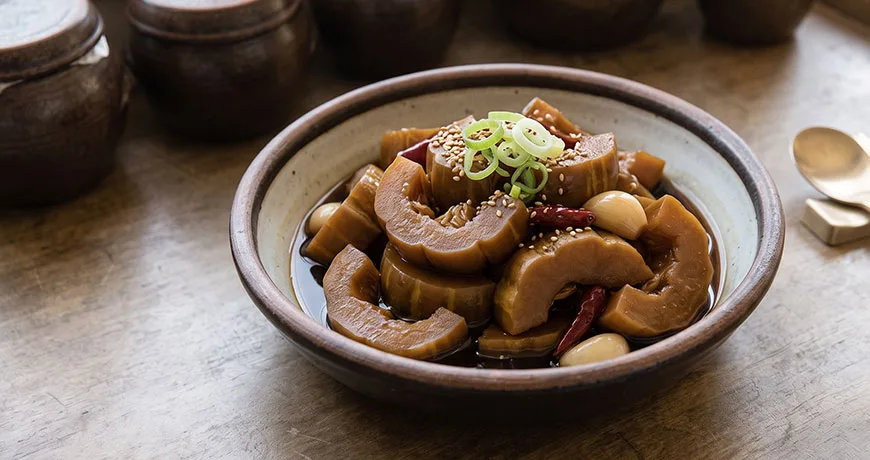
Chamoejangajji is a highly engineered Korean preserve that subjects the Oriental melon (Chamoe) to intense osmotic dehydration and thermal shock. By meticulously excavating the high-moisture placental tissue (seeds and jelly) and dry-curing the rind, the fruit’s water activity is drastically reduced. When a boiling, highly calibrated sweet-and-sour soy brine is poured over the melons, the intense heat instantly denatures degrading enzymes and violently shrinks the plant’s pectin cell walls. This physically locks the cellular structure, creating a devastating, percussive crunch (odok-odok) that endures for months. The vibrant melon esters inherent in the skin interlock with the deep umami of the soy sauce and the sharp acetic acid of the vinegar, forming an elite palate-cleanser designed to shear through heavy animal fats.
- ⏱️ Total: 3–5 Days | Prep: 1 Day (Placental removal and salt dehydration) | Cook & Ferment: 3–5 Days (Hot osmotic blanching and cold aging)
- 🍳 Difficulty: Medium-High (Requires extreme moisture control and precise pectin-locking execution)
- 🌶️ Profile: An overwhelmingly loud, percussive crunch cutting through a deeply savory soy matrix with bright acetic and melon notes
- 🍚 Focus: Placental Tissue Removal, Osmotic Dehydration, Hot Brine Blanching, Pectin Structural Locking
- 🍶 Pairing: Iced green tea rice bowls (Ochazuke style), savory Nurungji (scorched rice soup), and heavily marbled K-BBQ
Physicochemical & Sensory Matrix
- Baseline Salinity: 6.5% ~ 8.5% (Penetrative salinity threshold required to drop water activity for preservation)
- pH Equilibrium: 3.8 ~ 4.2 (Antimicrobial acetic buffer established by natural vinegar)
- Textural Crunch Index: [■■■■■] (Absolute maximum elasticity and crunch achieved via profound cellular dehydration)
- Umami Density (T1R1/T1R3 Synergy): 8.3 / 10 (3D molecular synthesis of soy peptides and fruit fructose)
- Shelf Stability: Optimal consumption begins at day 3; maintains elite textural integrity for 6+ months refrigerated
- Aroma Profile: Fresh Melon Esters | Fermented Soy Melanoidins | Sharp Acetic Punch
Ingredients (Yields 1 Medium Airtight Glass Container)
- Primary Plant Matrix: 3–4 Small, Firm Pesticide-free Oriental Melons (Chamoe). Must be rigorously scrubbed as the skin is consumed.
- Primary Dehydration Matrix: 2 tbsp Coarse Sea Salt
- Osmotic Pickling Brine: 1.5 Cups Naturally Brewed Soy Sauce, 1 Cup Purified Water, 1 Cup Naturally Fermented Vinegar (Apple/Brown Rice), 0.8 Cup Unrefined Sugar, 0.5 Cup Plum Extract (Maesil-cheong)
- Aromatic Catalyst: 2 Cheongyang Green Chilies, 1 Dried Red Chili, 3 Cloves Garlic (Sliced)
Allergy Information
- Contains: Soy, Wheat (inherent in brewed soy sauce matrix)
Equipment
Spoon (for aggressive scraping), Wire Rack, Large Stainless Steel Boiling Pot, Heat-resistant Glass Airtight Container, Heavy Pressing Stone
Cooking Instructions
- Placental Removal: Halve the washed melons lengthwise. Using a spoon, aggressively scrape out all seeds and the soft, jelly-like placenta. Even microscopic remnants of this high-moisture tissue will become a breeding ground for spoilage bacteria and destroy the final crunch.
- Initial Osmotic Dehydration: Sprinkle the coarse sea salt over the hollowed melon cavities and cure at room temperature for 2 to 3 hours. Once the melons have expelled enough water to flex slightly without snapping, rinse them quickly in cold water. Lay them on a wire rack in a well-ventilated area for half a day to air-dry and further contract the tissues.
- Brine Matrix Boiling: In a pot, combine the soy sauce, water, sugar, dried chili, and garlic slices. Bring to a violent rolling boil over high heat. Turn off the heat immediately and stir in the vinegar and plum extract to trap the volatile organic acids.
- Hot Osmotic Blanching: Tightly pack the semi-dried melons into the heat-resistant glass container. Pour the boiling hot brine directly over the fruit. Place a heavy stone directly on top of the melons to keep them entirely submerged and block ambient oxygen.
- Aging & Secondary Boiling: Let the container rest at room temperature for 24 hours. The brine will have been diluted by the residual water extracted from the melons. Drain only the liquid brine back into a pot and boil it a second time. Let this secondary brine cool completely to room temperature before pouring it back over the melons. Transfer to the refrigerator to finalize long-term structural stability.
💡 Professional Culinary Tips
- Biochemistry of Placental Removal: The seed cavity (placenta) holds the highest concentration of moisture and active enzymes, making it the primary target for rapid microbial spoilage. Physically shearing this tissue away is the immutable first law of preventing pectin breakdown.
- Pectin Locking via Thermal Shock: Pouring a near-100°C brine over the raw fruit induces an immediate thermal shock. This violent heat permanently denatures degrading enzymes while forcing the pectin structures to contract, permanently locking in the definitive odok-odok crunch.
- Water Activity (Aw) Optimization: The rigorous multi-stage dehydration—salt curing, air drying, and double brine boiling—is a calculated extraction process. Lowering the internal water activity (Aw) ensures pathogens cannot survive, extending shelf life without artificial preservatives.
🍶 Gastronomic Pairing
- Texture Shock and Lipid Shearing: Slice the pickled melon into thin matchsticks, toss lightly with sesame oil, and serve over a bowl of hot white rice submerged in ice-cold green tea. The explosive, percussive crunch of the melon contrasts violently against the soft, hydrated rice. Furthermore, when paired with rich, fatty cuts of pork belly or marbled beef, the sharp acetic acid and melon aromatics act as a rapid palate cleanser, cleanly slicing through heavy lipid coatings.
Nutrition Facts (Estimated)
Total Content : Approx. 20g (3-4 pieces)
Calories : 18.5 kcal (Fibrous fruit structure and osmotic sugars)
– Sodium : 415.2mg (Penetrative osmotic salinity barrier)
– Total Carbohydrate : 4.1g (Structural polysaccharides and dissolved fructose)
– Sugar : 2.6g (Natural melon sugars and plum extract)
– Total Fat : 0.04g (Trace plant lipids)
– Saturated Fat : 0.0g
– Cholesterol : 0.0mg (100% Vegan matrix)
– Protein : 0.6g (Soybean-derived peptide transfer)
– Dietary Fiber : 1.1g (Thermally contracted cellulose from the melon rind)
*Daily Values are based on a 2,000 calorie diet and standard Korean nutritional reference values.
**Nutritional values are calculated based on original ingredients; substitutions may alter specific macronutrients.
Origins and Food Culture of Pickled Oriental Melons (Chamoejangajji)
1. Historical Lineage: Three Kingdoms Antiquity, Goryeo Celadon, and Joseon Treatises
- Cultivated on the Korean peninsula since the Three Kingdoms period, the oriental melon (chamoe or jingwa, 眞瓜) has long occupied a cherished cultural standing, immortalized in relics such as the National Treasure 12th-century Goryeo Celadon Melon-shaped Bottle (Cheongja Chamoe-moyang Byeong).
- Because fresh melons spoil rapidly in high summer heat, Joseon agrarian scholars codified ingenious pickling techniques to extend their lifespan into the winter months. Classical compendiums—including Yu Jung-im’s Jeungbo Sallim Gyeongje (1766), Seo Yu-gu’s Imwon Gyeongjeji, and Lady Yi’s Gyuhap Chongseo (1809)—recorded recipes for Gwajang (瓜醬), detailing how green, unripened melons were hollowed out, salted to evacuate moisture, and buried in crocks of soy sauce, doenjang, or gochujang.
2. The Culinary Science of Hypertonic Osmosis and Pectin Condensation Thermodynamics
- The technical mastery of authentic Chamoejangajji hinges upon managing osmotic fluid evacuation without compromising cell wall structural integrity.
- With a natural water content exceeding 90%, steeping fresh melons directly in brine would dilute the pickling medium and provoke microbial spoilage. Ancestors resolved this by scooping out the hyper-hydrated seed cavity and burying the melon halves in solar sea salt or sugar for 24 to 48 hours. This hypertonic osmotic gradient draws out cellular moisture, forcing cell walls to collapse slightly and concentrating structural pectins. When subsequently steeped in boiling-hot soy marinades or dense fermented pastes, the melon absorbs savory umami deep into its fibers while permanently retaining a dense, snappy, and chewy viscoelastic texture.
3. Seongju County Heritage and the Zero-Waste Tradition of Thinned Green Melons
- The undisputed cultural and agricultural heartland of Chamoejangajji is Seongju County in Gyeongsangbuk-do, which produces over 70% of South Korea’s oriental melons. In Seongju’s farming villages, households historically practiced sustainable zero-waste agriculture by gathering the small, unripe green melons thinned out during early summer (jeokgwa-chamoe or gaettong-chamoe) to cure them into massive earthenware crocks of seasonal pickles.
- Transforming surplus young fruit into an elite, restorative table delicacy exemplifies the resourcefulness of Korean rural food culture. Today, recognized as an iconic regional slow-food specialty, Pickled Oriental Melons stand as an immortal cultural monument to ancestral agricultural sustainability, seasonal wisdom, and pristine culinary heritage.
The Pale Rind of Unripe Melons Plucked Ahead of the Monsoon, the Ruthless Excision of Perishable Placental Cores, and the Brutal Osmotic Compression of Stone and Salt: A Refined Portrait of Traditional Chamoejangajji
Chamoejangajji (Pickled Oriental Melons in Seasoned Soy Sauce or Chili Paste) stands as an astonishing, structurally defiant triumph of Korean summer fruit preservation. Crafted from firm, underripe green oriental melons (cheongchamoe) culled from the vines before summer rains dilute their substance, this pickled delicacy begins with an unsparing severance of the fruit’s sweet, perishable destiny. The melons are split lengthwise, and their moist, sugar-saturated seed pouches—the placental core—are hollowed out with a metal spoon. The resulting curved shells of white, dense flesh are coated in coarse sea salt and buried beneath heavy pressing stones for days, ruthlessly driving free intracellular moisture out of the parenchymal cells. As their smooth outer skin shrivels into a corrugated, leather-like lattice, the melons surrender their juicy softness, gaining instead a concentrated, elastic chew. Submerged into a seasoned bath of boiled soy sauce, vinegar, and grain syrup—or packed into earthen crocks of pungent doenjang or gochujang—the dark, savory liquor infuses the collapsed cellular matrix, turning transient summer fruit into an indestructible culinary sentinel.
Lifting a translucent, razor-thin slice of Chamoejangajji from a ceramic saucer reveals a luminous amber stained through the crisp melon flesh. Approaching the nose, the deep, malty perfume of aged soy sauce is instantly cut by a faint, refreshing breeze of fresh cucumber-melon esters—a fleeting reminder of the fruit’s botanical origins. Biting down between the molars triggers an audible, high-tension snap that echoes across the jaw. Far distinct from the watery give of cucumber pickles or the fibrous crunch of radishes, the compressed melon tissue offers a rubbery, dense elasticity that pushes back delightfully against dental shear. The concentrated salinity of the soy liquor floods the palate first, immediately followed by the bright flash of vinegar acidity that triggers active salivation. As mastication continues, the natural, faint fructose hidden within the fruit’s cellular walls releases a subtle sweetness that rounds off the sodium edge. Paired with rich grilled pork belly or eaten simply atop a spoonful of cold barley tea and rice on a sweltering afternoon, this wrinkly pickle sweeps away cloying palate fatigue with authoritative, rhythmic freshness.
The cultural identity of Chamoejangajji lies in the survival science of rural Korea, where sudden torrential monsoon rains could easily ruin an entire year’s melon harvest by waterlogging the soil and bursting ripe fruit. By stripping unripe melons of their fragile placenta and subjecting them to extreme osmotic dehydration, farming households transformed agricultural vulnerability into an enduring winter protein companion. Defying the assumption that melons belong solely on the dessert plate, Chamoejangajji remains an enduring monument of domestic thrift, cellular preservation, and the luminous craftsmanship of the Korean pantry.
Editor’s Review
1. Osmotically Densified Parenchymal Collapse, Wrinkly Epidermal Tension, and an Acoustic High-Frequency Snapping Texture
Chamoejangajji rejects the soft, watery dissolution typical of sweet fruits in favor of an intensely compressed, multi-layered texture:
- Parenchymal Densification: Intensive salting and mechanical stone-weight pressing drain the vacuolar water from the flesh, collapsing the intercellular air spaces. This turns loose cellular flesh into an ultra-dense, elastic tissue that offers firm, rubbery resistance rather than turning to mush.
- Cuticular Epidermal Wrinkling: The waxy outer cuticle of the melon rind resists breakdown during curing, gathering into fine microscopic folds as the fruit dehydrates. These ridges supply dynamic masticatory friction that enlivens each bite.
- Acoustic Snapping Feedback: The dehydrated, tightly compacted cell-wall fibrils release high-frequency acoustic snaps upon fracture, delivering an engaging, audible crunch that distinguishes it from common root vegetables.
2. Placenta Excision to Arrest Enzymatic Softening, Hypertonic Aw Depression, Calcium Pectate Cross-Linking, and Cucurbit Aldehyde Masking
The preservation and unique snap of Chamoejangajji are governed by applied plant biochemistry and osmotic mass transfer:
- Suppression of Pectolytic Enzymes: The soft placental tissue enclosing the melon seeds is exceptionally rich in endogenous endo-polygalacturonase (Endo-PG) and pectin methylesterase. Completely excising this core eliminates the biological trigger of pectin depolymerization, preventing structural rot and tissue collapse during prolonged soaking.
- Drastic Water Activity (Aw) Depression: Sustained immersion in hypertonic brines (exceeding 15% salinity) generates powerful chemical potential gradients that pull out free cytoplasmic water. This depresses the water activity (Aw) below 0.80, establishing an impenetrable barrier against foodborne bacterial proliferation.
- Calcium Pectate Network Preservation: Divalent cations (Ca2+, Mg2+) present in solar sea salt bind with free carboxyl groups on de-esterified pectin chains, forming robust calcium pectate cross-links. This egg-box structure anchors the primary cell walls against thermal and chemical degradation across months of room-temperature aging.
- Volatile Cucurbit Balancing: Green aldehydes such as (E,Z)-3,6-nonadien-1-ol and hexanal, responsible for the fruit’s raw grassy melon aroma, are buffered by the complex melanoidins in the brewed soy sauce and the lipid film of finishing sesame oils, leaving behind only a refined, pleasant fruity-mineral baseline.
3. Transcending Dessert Vulnerability for Culinary Permanence
Chamoejangajji demonstrates the radical genius of Korean fermentation and pickling: stripping a perishable summer fruit of its sugar and water to forge an indestructible, savory table anchor. By harnessing the physical mechanics of osmotic compression to harvest snap rather than softness, this unpretentious wrinkled pickle stands as an enduring benchmark of seasonal adaptation and texture crafting in traditional Korean food science.