
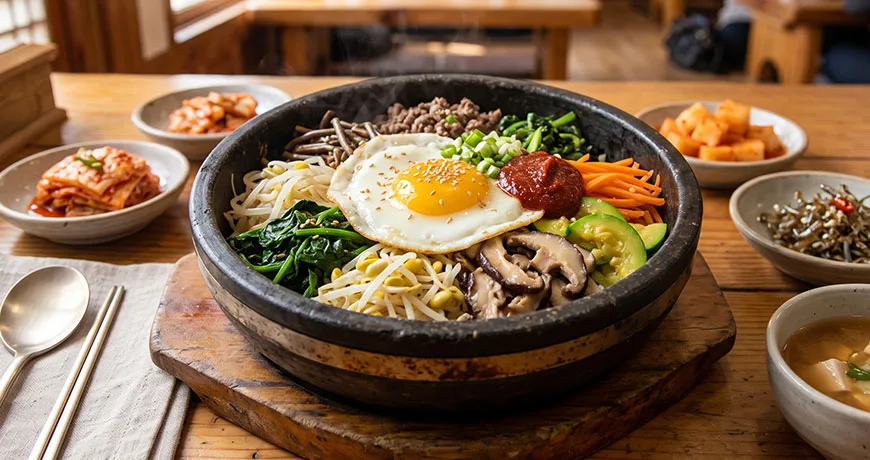
A legendary Korean classic featuring a harmonious bowl of warm rice topped with a colorful array of sautéed vegetables, seasoned beef, delicate mung bean jelly, and crispy fried kelp, all brought together with a sweet and savory seasoned gochujang sauce.
⏱️ Prep: 30 mins | Cook: 20 mins | 🍳 Moderate | 🌶️ Mild-Spicy | 🥩 High Protein
Ingredients (1 serving)
- Main Ingredients: 1 bowl cooked rice, 50g beef (thinly sliced), 50g bean sprouts, 50g zucchini, 50g bracken (gosari), 50g spinach, 3 shiitake mushrooms, 50g mung bean jelly (cheongpomuk), 10cm piece dried kelp (dashima), 1 egg, cooking oil as needed (optional: 30g bellflower root / doraji)
- Seasoned Gochujang Sauce: 2 tbsp gochujang (chili paste), 1 tsp sugar, 1 tbsp water, 1 tbsp cooking wine (cheongju/mirin), a dash of sesame oil
Allergy Information
- Contains: Beef, Egg, Soy (Soy sauce, Gochujang), Sesame
Equipment
- Frying Pan, Mixing Bowls, Knife, Cutting Board
Cooking Instructions
- Beef Prep & Sautéing: Finely slice the beef into thin strips, season with a pinch of soy sauce, garlic, sesame oil, and black pepper, then sauté in an oiled pan over medium heat until fully cooked.
- Bean Sprouts & Greens: Trim the bean sprout tails and blanch in salted boiling water. Drain, then lightly stir-fry with sesame oil. (If using spinach, blanch briefly, squeeze dry, and season).
- Doraji & Bracken (Gosari) Prep: Rub doraji (bellflower root) firmly with salt to remove bitterness, then toss with red pepper powder, sugar, vinegar, and salt. Trim tough stems from bracken, season with soy sauce and garlic, and stir-fry in an oiled pan.
- Zucchini, Mushrooms & Mung Bean Jelly: Slice zucchini into half-moons, salt for 5 minutes, squeeze out moisture, and sauté. Julienne shiitake mushrooms and stir-fry. Slice mung bean jelly (cheongpomuk) into thin strips and toss lightly with sesame oil.
- Egg Jidan & Crispy Kelp: Fry the egg into a thin omelet sheet (jidan) and slice into fine strips. Shallow-fry the dried kelp in oil until crisp and puffed, then break into tiny crushed pieces.
- Assembling & Serving: Place warm rice in a wide bowl. Artfully arrange each topping in a colorful circle over the rice. Serve with the prepared seasoned gochujang sauce on the side.
💡 Cooking & Pairing Tips
- Moisture Control for Clean Flavors: Squeezing out excess moisture from zucchini and blanched greens before sautéing prevents the rice from becoming watery and keeps each ingredient’s texture distinct.
- The Umami Crunch: The addition of crispy crushed kelp adds a delightful salty crunch and natural umami boost that elevates the soft textures of the rice and mung bean jelly.
- Perfect Food & Beverage Pairing: Pairs wonderfully with a light, clear soup such as soybean sprout soup (kongnamul-guk) or beef radish soup (muguk). For a drink, enjoy with chilled barley tea or a glass of traditional makgeolli.
Storage Instructions
- Prepare and store the seasoned vegetable toppings separately in airtight containers in the refrigerator for up to 2–3 days. Assemble with warm rice and sauce right before serving for optimal texture.
Nutrition Facts (Estimated)
- Total Content : Approx. 450g (1 serving total)
- Calories : 580 kcal total (approx. 129 kcal per 100g / 580 kcal per 1 serving)
– Sodium : 980mg (49%)
– Total Carbohydrate : 82g (25%)
– Sugar : 14g (14%)
– Total Fat : 18g (28%)
– Trans Fat : 0g
– Saturated Fat : 3.5g (18%)
– Cholesterol : 210mg (70%)
– Protein : 25g (45%)
– Calcium : 95mg (10%)
The Origins and Culture of Bibimbap
1. Born from Ancestral Rites and Agrarian Communal Feasts
- Bibimbap traces its origins to Korea’s traditional ancestral rites (jesa), where leftover offerings were mixed in a single bowl to share blessings, as well as agrarian customs where farmers mixed their meals in large communal bowls for convenience during busy harvests.
- Historically recorded as Goldongban or Bubuim-bap in late Joseon Dynasty cookbooks, it is a dish deeply woven into the everyday history and communal spirit of the Korean people.
2. The Philosophy of Obangsaek and Nutritional Harmony
- Visually striking, Bibimbap is topped with green vegetables, red chili paste and meat, a yellow egg yolk, black mushrooms or bracken, and white rice. This vibrant palette represents Obangsaek—the five cardinal colors of traditional East Asian philosophy symbolizing cosmic balance and harmony.
- It is widely celebrated as a masterpiece of wellness, offering a perfectly balanced nutritional profile of carbohydrates, proteins, and essential vitamins in a single bowl.
3. The Aesthetics of Mixing and the Ultimate Global K-Food Icon
- The act of mixing (bibim) the ingredients with gochujang (chili paste) and sesame oil reflects a cultural philosophy of harmony, where diverse elements unite to create a complex, unified flavor.
- Today, championed by famous regional variations like Jeonju Bibimbap, it stands as the ultimate global icon of Korean cuisine, beloved worldwide for its health benefits, vibrant aesthetics, and dynamic taste.
Editor’s Review
1. Fine Dining Perspective: Osmotic Moisture Extraction and Multidimensional Umami Binding: This legendary bowl demonstrates a masterclass in independent component preparation and structural moisture engineering. Salting the zucchini to extrude excess cell-bound water prevents the rice matrix from becoming waterlogged, while blanching and sautéing mountain flora like gosari (bracken) and doraji (bellflower root) tames natural bitterness and aligns plant fibers for optimal tenderness. The inclusion of shallow-fried dashima (kelp) introduces a hydrophobic, hyper-savory crunch that acts as a textural counterweight to the delicate, high-moisture cheongpomuk (mung bean jelly). Bound together by a seasoned gochujang glaze emulsified with toasted sesame oil, the dish achieves a flawless equilibrium where each ingredient retains its distinct structural integrity while contributing to a unified emulsion.
2. Sensory Exploration: A Polyphonic Symphony of Textures and Radiant Heat: The first spoon driven through the artfully arranged rosette yields a breathtaking mouthfeel contrast. The silky, cool glide of translucent cheongpomuk yields alongside the earthy chew of sautéed beef and gosari, punctuated by the shattered, salty crackle of puffed fried kelp and the crisp snap of zucchini and sprouts. On the palate, the seasoned gochujang unleashes a gentle, lingering warmth that amplifies the natural sugars of the rice without masking the delicate, woodsy aromatics of shiitake mushrooms and toasted sesame. Fine threads of egg jidan smooth out the finish, leaving a long, comforting, and multi-layered umami resonance.
3. Symbolic Praise: Obangsaek Harmony and Cosmic Unity in a Bowl: Deeply intertwined with Korean royal court heritage and the philosophy of Obangsaek (the five traditional colors representing the cardinal directions and natural elements), this dish is a living symbol of cosmic balance and holistic wellness (yaksikdongwon). By gathering the bounty of the mountains (gosari, doraji), fields (rice, zucchini, sprouts), livestock (beef, egg), and sea (dashima) into a single vessel, it honors the principle that true strength arises from diversity harmonized through care and community.
4. Poetic Imagery: A Living Mandala of Earth, Sea, and Sun: Presented in a wide ceramic bowl, the toppings form a breathtaking botanical mandala over a bed of steaming white rice. Ribbons of alabaster cheongpomuk shimmer alongside emerald spinach, warm orange carrots, deep chocolate bracken, and a glowing crimson heart of seasoned gochujang. Crowned with fine golden threads of egg jidan and dark, obsidian shards of crispy kelp, the bowl offers an ethereal visual feast that captures the tranquil beauty of a Korean landscape at golden hour.
5. The Critic’s Verdict: The Unrivaled Masterpiece of Culinary Harmony: True culinary brilliance lies not in blending ingredients into obscurity, but in elevating every distinct texture and flavor so they shine brightest together. This classic Bibimbap stands as an immortal triumph of Korean gastronomy, proving that when precise technique, vibrant color philosophy, and rustic comfort are united in a single bowl, the result is an enduring, soul-nourishing masterpiece.
목멱산방
#MICHELIN Guide
아침가리긴밭
#수요미식회
중앙회관
#수요미식회
한국집
#백년가게 #생방송오늘저녁 #생방송투데이 #수요미식회 #2TV생생정보