
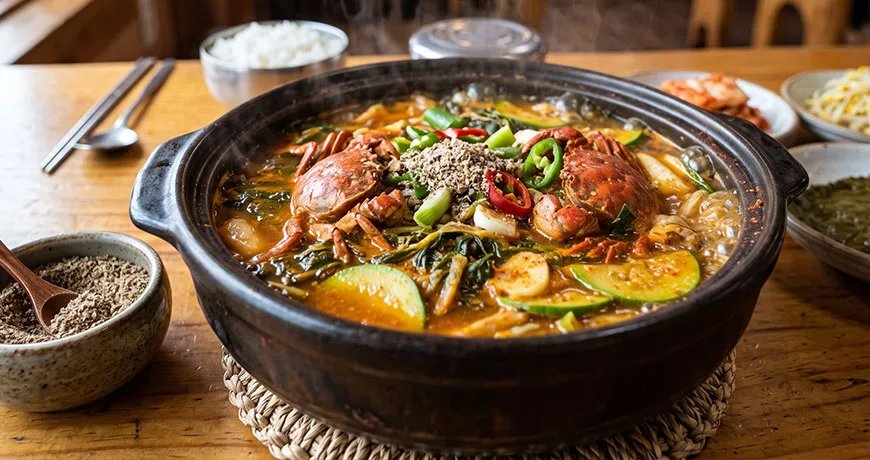
Chamgemaeuntang is the zenith of freshwater crustacean culinary matrixes. It is engineered to thermodynamically extract the ultra-dense lipids and free amino acids locked within the hepatopancreas (crab mustard/tomalley) and rigid chitin exoskeleton of the Korean freshwater hairy crab (Chamge). Unlike marine blue crabs, which are prized for their sweet, tender flesh, the Chamge has remarkably tough shells and less meat; its true value lies in the profound, bitter-sweet richness of its internal organs. Subjecting these crabs to a 100°C violent convection releases the red astaxanthin pigment bound to their shells, while the golden lipids from the hepatopancreas melt into the aqueous solvent, creating a heavy macro-emulsion. To combat the muddy geosmin inherent to benthic freshwater ecosystems, a precise chemical masking barrier of fermented Doenjang peptides and capsaicin is deployed. Finally, wheat dough (Sujebi) is introduced, leaching amylopectin that sharply increases the rheological viscosity of the broth. This ensures the heavy crustacean lipids remain flawlessly suspended throughout the stew rather than sinking, delivering an uncompromising, fiercely savory experience.
- ⏱️ Total: 1 hr 10 mins | Prep: 30 mins (Live crab mechanical scrubbing & purging) | Cook: 40 mins
- 🍳 Difficulty: Extreme (Requires mastering the physical restraint of live crabs, meticulous mucin purging, and precise lipid extraction)
- 🌶️ Profile: Profoundly Heavy, Earthy Crustacean Umami, and Fiery Capsaicin Heat
- 🍚 Focus: Hepatopancreas Emulsion, Chitin-Astaxanthin Dissociation, & Geosmin Chemical Masking
- 🍶 Pairing: Ice-cold Somaek (Soju + Beer bomb) engineered with a highly carbonated light lager like Terra
Ingredients (3–4 servings)
- High-Density Lipid & Chitin Matrix: 4–5 Live Fresh Hairy Crabs (Chamge – submerged in ice water to induce torpor, then violently scrubbed with a brush between the hairy legs and joints to remove biofilm and mud. The apron must be opened to squeeze out the digestive tract waste)
- Porous Gel & Starch Matrix: 200g Daikon Radish (sliced into squares), 1/3 Zucchini, 100g Wheat Flour Dough (Sujebi – critical for starch gelatinization and increasing viscosity)
- Geosmin-Masking Solvent: 1.2L Anchovy-Kelp Broth
- Peptide & Capsaicin Binder: 2 tbsp Traditional Doenjang (Soybean Paste – the core molecule for neutralizing muddy odors), 1 tbsp Gochujang, 3 tbsp Gochugaru (Chili Flakes), 2 tbsp Soup Soy Sauce, 2 tbsp minced garlic, 1 tsp minced ginger
- Aromatic Botanical Catalyst: 10 Perilla Leaves (Kkaennip – torn into large pieces), 1 large handful Water Dropwort (Minari), 1 stalk Green Onion, 2 Cheongyang green chilies
Allergy Information Contains: Crustacean (Crab), Soy, Wheat (from Doenjang, Gochujang, Soy Sauce, Sujebi Dough)
Equipment Massive High Thermal Mass Cast Iron Pot or Earthenware, Firm Bristle Brush (for scrubbing crabs), Cutting Board, Knife
Cooking Instructions
- Physical Restraint & Abrasion: Submerge the live hairy crabs in ice water for 10 minutes to safely stun them. Using a stiff brush, aggressively scrub the carapace, the hairy joints of the legs, and the mouthparts to mechanically strip away mud and bacterial biofilm. Pry open the bottom flap (apron) and squeeze out the black digestive waste. Skipping this step will irreparably pollute the broth with literal mud.
- Solvent & Peptide Base Construction: In a heavy pot, bring the broth and square-cut radish to a boil. Dissolve the Doenjang, Gochujang, Gochugaru, garlic, and ginger into the solvent. Before the crabs even enter, this boiling mixture establishes a preemptive chemical peptide barrier designed to immediately neutralize incoming geosmin.
- Chitin Hydrolysis & Astaxanthin Release: Once the red peptide broth hits a violent rolling boil, introduce the whole (or halved) prepared crabs. Upon contacting the thermal energy, the chitin-protein complexes denature, releasing a vivid red astaxanthin pigment into the broth. Leave the lid open and boil aggressively over medium-high heat for 15 minutes to allow volatile muddy off-odors to vaporize.
- Hepatopancreas Emulsion & Gelatinization: As the rigid carapaces open, the golden hepatopancreas (crab mustard) melts directly into the boiling liquid, forming a profound, heavy animal emulsion. At this stage, tear thin, bite-sized pieces of the Sujebi dough into the pot, along with the zucchini. The amylopectin leaching from the dough undergoes rapid gelatinization, thickening the broth. This mechanical viscosity acts as a stabilizing agent, preventing the heavy crab lipids from separating and ensuring they coat the palate uniformly.
- Perillaldehyde Finish: Just as the Sujebi turns translucent, immediately prior to cutting the heat, crown the matrix heavily with chopped scallions, chilies, Minari, and the torn Perilla leaves. The perillaldehyde from the leaves reacts instantly with the radiant heat, releasing a dense, botanical aroma that flawlessly overrides any residual freshwater scent.
💡 Professional Culinary Tips
- Biochemical Difference: Freshwater vs. Marine Crabs: Marine blue crab (Kkotge) soups are engineered to highlight sweet, delicate meat in a clean broth. Chamge (freshwater crab) engineering is entirely different. Their shells are rock-hard, and they yield very little meat. However, the density of lipids and amino acids inside their hepatopancreas and roe is astronomically high. The sole purpose of this stew is to kinetically smash that concentrated internal fat into the broth. You are not eating crab meat; you are drinking the liquefied essence of the crab’s organs.
- Geosmin Masking Dynamics: The muddy aroma (geosmin) embedded in benthic freshwater creatures cannot be destroyed by chili heat alone. It requires a dual-masking system: the fermented peptide structures of Doenjang to chemically bind and trap the odor molecules in the broth, followed by a massive final aromatic strike of perillaldehyde (perilla leaves) to overwhelm the olfactory receptors.
- The Fluid Dynamics of Starch (Sujebi): Introducing starch into a clear marine soup is culinary sabotage, but in a freshwater stew, it is a thermodynamic necessity. The heavy lipids melting out of the Chamge will naturally phase-separate from the water, floating as a greasy slick. The amylopectin from the boiling Sujebi dough acts as a physical thickening agent, increasing the fluid’s viscosity so the fat droplets remain suspended (dispersion) evenly throughout the entire matrix.
🍶 Gastronomic Pairing
- Biochemical Palate Cleansing: When the heavy, viscous emulsion of the crab’s hepatopancreas, the sticky starch of the dough, and the intense, earthy capsaicin matrix coat your oral mucosa, pair this overwhelming dish with an ice-cold Somaek (Soju and Beer bomb) engineered with a highly carbonated light lager like Terra. The coarse, explosive effervescence of the beer, combined with the refined ethanol of the Soju, acts as a precision surgical solvent. It violently shears through the dense crustacean lipids and spicy starch clinging to your tongue, instantly resetting your taste receptors and providing a brilliant fluid-dynamic contrast to the heavy stew.
Nutrition Facts (Estimated)
Total Content : Approx. 650g (1 serving, excluding shell weight)
Calories : 310 kcal (Excluding rice, including Sujebi)
– Sodium : 1,550mg (Elevated due to the absolute necessity of Doenjang/Gochujang masking)
– Total Carbohydrate : 26.0g (Wheat starch from Sujebi and radish polysaccharides)
– Sugar : 4.5g
– Total Fat : 7.0g (Ultra-concentrated, high-quality unsaturated lipids derived entirely from the hepatopancreas and roe)
– Saturated Fat : 1.5g
– Cholesterol : 145.0mg (Inherently high due to the concentration of crustacean organ fats)
– Protein : 32.0g (Crustacean myofibrils and amino acid complexes)
– Dietary Fiber : 6.0g
*Daily Values are based on a 2,000 calorie diet and standard Korean nutritional reference values.
**Nutritional values are calculated based on original ingredients; substitutions may alter specific macronutrients.
Origins and Food Culture of Spicy Hairy Crab Stew (Chamgemaeuntang)
1. Historical Roots: Classical Treatises (Dongui Bogam, Gyuhap Chongseo) and River Migrations
- Korean mitten crabs (chamge) are catadromous freshwater crustaceans that hatch in brackish coastal waters, migrate up inland river systems to mature, and journey back downriver toward the sea during the autumn months (lunar August through October) to reproduce; this seasonal migration made them a celebrated autumn delicacy since antiquity.
- Documented in Heo Jun’s 1613 Dongui Bogam, crab (Hae, 蟹) was described as “cold in nature, salty, and slightly toxic; it resolves internal heat in the chest, disperses blood stasis caused by emotional grief, and alleviates postpartum abdominal pain.” Furthermore, late Joseon treatises such as Lady Bingheogak Yi’s 1809 encyclopedia Gyuhap Chongseo and Seo Yu-gu’s Nanho Eomok detail elaborate recipes for crab preserves (chamgejang) and stews harvested from the Imjin, Han, and Seomjin rivers, confirming their status as treasured seasonal tributes presented to royal palaces and scholar-noble tables.
2. The Culinary Science of Exoskeleton Extraction and “Doenjang-Shrimp” Synergy
- Because freshwater crabs possess significantly denser, more calcified carapaces than marine blue crabs, authentic cooks do not simply extract the meat; they chop the crab in half to allow prolonged hydrothermal extraction of chitin, calcium, and astaxanthin from the shell directly into the stew.
- To completely eliminate the muddy river aroma (geosmin), traditional master kitchens employ a foundation of aged fermented soybean paste (doenjang), pairing it with dried freshwater shrimp (toha). The shrimp’s glycine-rich sweetness harmonizes with the crab’s succinic acid, while gentle simmering allows the rich hepatopancreatic lipids and golden roe to partially emulsify into the broth, producing an unctuous, thick body without heavy flour thickeners.
3. The River Bastions of Paju, Gokseong, and the Soul of Autumn River Foraging (Cheonlyeop)
- Deeply anchored along scenic river estuaries—most notably the lower Imjin River in Paju and Yeoncheon, the Seomjin River in Gokseong and Gurye, and the Geum River in Buyeo—where local fishermen set submerged basket traps (tongbal) among riverside reeds to intercept autumn “downstream crabs” (naerim-chamge).
- A beloved peninsular folk proverb declared that “a single autumn mitten crab is worth more than a whole ox,” reflecting its concentrated nutrient density and prized sweetness. Boiling freshly trapped crabs in giant cauldrons right at riverside taverns, dropping in rustic hand-torn wheat flakes (sujebi), and sharing the bubbling pot over bowls of local rice wine (makgeolli) embodies the warmest, most convivial traditions of Korean river foraging heritage.
The Unctuous Velvet of Riverine Mitten Crab Roe, the Chitinous Essence of Simmered Shells, and the Incandescent Heat of Fermented Chili Broth: A Refined Portrait of Chamgemaeuntang
Chamgemaeuntang (Spicy Freshwater Mitten Crab Stew) stands as the primal, biologically dense, and deeply unctuous summit of Korea’s riverine crustacean (tangban) gastronomy. Centered upon the indigenous mitten crab (Eriocheir sinensis or Eriocheir japonica, celebrated colloquially as Chamge) migrating down the rocky currents of the Imjin and Seomjin Rivers toward coastal estuaries in late autumn, the preparation begins with meticulous sanitation. Using a stiff brush, the crab’s calcified carapace and densely furred chelae (claws) are thoroughly scrubbed to remove river silts and biofilms. The carapace is pried open to excise the bitter gastric mill and pulmonary branchiae (gills), leaving the halves densely packed with golden hepatopancreas (hwangjang) and scarlet egg masses (roes). Layered inside a shallow casserole or heavy earthenware cauldron over a generous foundation of thinly sliced winter radish, braised radish greens (siraegi), and handfuls of lively freshwater ditch shrimp (toha), the pot establishes an extraordinary terrestrial-aquatic bedrock. Bathed in a foundational dried anchovy and kelp stock dissolved with an assertive seasoning paste of sun-dried red chili powder (gochugaru), aged rustic soybean paste (doenjang), a touch of red chili paste (gochujang), minced garlic, fresh ginger, and aged soup soy sauce, the stew is brought to an aggressive, rolling tableside boil. As the golden crab fat liquefies into the bubbling crimson broth, paper-thin hand-pulled wheat dough flakes (sujebi), wild water parsley (minari), aromatic crown daisy (ssukgat), and sliced Cheongyang chilies are mounded over the surface, creating an intoxicating harmony between freshwater crustacean potency and fermented Korean seasoning craft.
Confronting the boiling cauldron tableside as terracotta-colored bubbles froth vigorously around halved mitten crabs and emerald wild greens releases an immediate, deeply comforting olfactory charge: the rich, buttery perfume of slow-simmered crab roe mingles seamlessly with the deep, bready savor of fermented doenjang, the sweet aroma of poaching river shrimp, and the brisk, pine-fresh fragrance of wild crown daisy and water parsley. Lifting a deep metal spoon for the first sip delivers a revelation across the tongue: the rich broth, fortified with the natural asparagine of braised greens, sweet succinic acids from the radish, and micro-emulsified lipids from the crab’s hepatopancreas, coats the palate with an unctuous, velvet-like viscosity. Gliding down the throat, it dispels internal chills and awakens dormant perspiration in an exhilarating wave of deep metabolic warmth. Biting into a halved crab reveals meat whose muscle fibers, forged in turbulent river currents, are exceptionally dense and toothsome, releasing concentrated streams of clean, mineral-rich sweetness. In luxurious contrast, the golden hepatopancreas and dense roe clinging to the carapace melt across the palate like rich sea butter, delivering an intense wave of roasted nuttiness and savory lipid richness. The whole freshwater ditch shrimp burst between the teeth with a delightful, brittle crunch, while the hand-torn sujebi dough flakes provide a buoyant, viscoelastic chew that drinks in the seasoned stock. Steeping a bowl of warm white rice into the reduced crimson broth and crowning each spoonful with extracted crab meat and crisp kimchi completes an unforgettable ritual of physical rejuvenation, riverbank nostalgia, and profound gastronomic catharsis.
The enduring majesty of Chamgemaeuntang lies in its historical and dynastic pedigree—recorded in Joseon dynastic records as a treasured tribute fish harvested from the cold, rocky rapids of the Imjin River in Paju for the royal palace. Celebrated in Heo Jun’s 17th-century medical text Dongui Bogam as a cooling, restorative tonic capable of unblocking internal meridians and restoring vitality, mitten crabs were prized above all for the profound depth of their internal pastes. Uniting this seasonal river creature with the microbial depth of fermented soybean paste, sweet river shrimp, and sun-dried greens, a steaming cauldron of spicy mitten crab stew remains an irreplaceable monument of sustainable freshwater stewardship, autumnal comfort, and brilliant Korean culinary craftsmanship.
Editor’s Review
1. A Dynamic Harmony of Compacted Crustacean Muscle, Melting Hepatopancreatic Velvet, Brittle Shrimp Snap, and Viscoelastic Sujebi Elasticity
The structural architecture inside the vessel delivers an extraordinary, four-tiered choreography between dense arthropod muscle bundles, lipid-rich organ pastes, brittle whole-carcass shrimp carapaces, and a hydrated wheat gluten matrix. Because mitten crabs inhabit turbulent riverbeds, their striated white muscle fibers are far more compact than marine blue crabs, resisting hydrothermal flaking and parting under tooth pressure with a firm, energetic chew. This density is cushioned by the crab’s internal hepatopancreas and ovarian roe, which melt across oral tissues at body temperature to form a luxurious, unctuous lipid coating. The tiny, whole freshwater ditch shrimp add an audible, brittle crunch (kadeudeuk) that diversifies oral friction, while the hand-pulled sujebi flakes supply a slippery, viscoelastic give that absorbs the savory stock like an organic sponge, ensuring an impeccably balanced, non-fatiguing mouthfeel from the first steaming sip to the last.
2. Hepatopancreatic Lipid O/W Micro-Emulsification, Thermal Astaxanthin Dissociation, Arginine-Glycine-IMP-Glutamate Umami Synergism, and Melanoidin Geosmin Adsorption Thermodynamics
Chamgemaeuntang represents an exacting study in freshwater invertebrate biochemistry, lipid colloid thermodynamics, and flavor volatile mitigation. The crab’s internal hepatopancreas (hwangjang) is a dense matrix of neutral triglycerides, phospholipids (lecithin), and free fatty acids; under the convective shear forces of a rolling boil, these lipids disperse into the continuous aqueous broth to form a stable oil-in-water (O/W) micro-emulsion that elevates dynamic fluid viscosity and creates a velvety mouthfeel. Concurrently, the red carotenoid pigment astaxanthin, thermally cleaved from its native crustacyanin protein complexes within the chitinous shell, oxidizes and floats as a brilliant orange-crimson surface film. Broth savor is driven by an exponential multi-pathway biochemical synergy: high physiological concentrations of sweet free amino acids within the crab meat—principally glycine, alanine, and arginine—converge with muscle-derived inosine monophosphate (IMP) from the freshwater shrimp and free glutamic acid (Glutamate) leached from aged doenjang, triggering an intense activation across human oral T1R1/T1R3 umami heterodimers. Furthermore, muddy terpene compounds endemic to benthic river crabs—principally geosmin and 2-methylisoborneol (2-MIB)—are physically adsorbed and bound by the colloidal soy protein matrices and high-molecular-weight melanoidin polymers of fermented doenjang. Simultaneously, active gingerols from ginger, allicin from garlic, and volatile monoterpenes from water parsley chemically mask trace off-volatiles, securing an immaculate, deeply roasted aromatic profile.
3. Imjin River Royal Tribute Pedigree and the Sovereign Apex of Inland Crustacean Gastronomy
Distinguished in Joseon historical records as an exalted royal tribute and lauded in classical medicine for its restorative properties, the freshwater mitten crab occupies an unshakeable pedestal in Korean gastronomy. Moving beyond the lighter sweetness of marine crab stews by marrying dense riverine fat with artisanal soybean paste, wild river shrimp, and dried greens, Chamgemaeuntang stands as the ultimate expression of Korean freshwater cookery—an enduring sanctuary of environmental authenticity, seasonal discipline, and brilliant culinary artistry.