
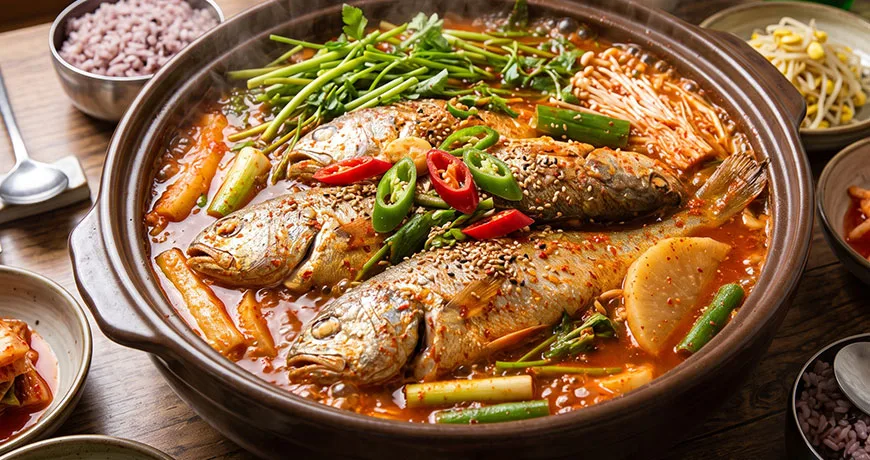
Jogimaeuntang is an intense, capsaicin-driven emulsion soup engineered by subjecting the delicate white muscle fibers and subcutaneous animal lipids of the Yellow Croaker to rigorous thermal hydrolysis. This extracts a massive payload of inosinic acid (IMP) and amino acids directly into the boiling aqueous solvent. As the kinetic convective energy forms a fiery red matrix—dissolving the capsaicin of the red chili flakes and the refreshing organic acids from the radish—the yellow croaker is introduced, triggering instant thermal denaturation of its proteins. The rich marrow lipids extracted from the fish bones violently collide with the water, forging a heavy, opaque colloidal broth. Finally, the volatile terpene compounds of water dropwort (Minari) and the pungent allyl sulfides of green onions surgically strike and biochemically mask any trace of marine trimethylamine (TMA). Fusing the incredibly tender, flaky texture of the denatured fish proteins with a searing, spicy umami, this is a thermodynamically perfect seafood stew.
- ⏱️ Total: 45 mins | Prep: 20 mins (Scaling & Osmotic curing) | Cook: 25 mins
- 🍳 Difficulty: Medium (Requires thermal control to prevent protein disintegration and strict odor masking)
- 🌶️ Profile: Fiery, Capsaicin-Heavy Umami with a Bright Terpene Finish
- 🍚 Focus: Thermal Hydrolysis, IMP Extraction, & Volatile Terpene Masking
- 🍶 Pairing: Crisp, highly carbonated ice-cold Light Lager or chilled Soju
Ingredients (3–4 servings)
- Protein & IMP Matrix: 4 Cleaned Yellow Croakers (Approx. 600g total; scaled, fins removed, lightly cured with sea salt for 15 minutes to induce muscle contraction)
- Aqueous Solvent & Base: 1.2L Anchovy-Kelp Stock (or Purified Water), 150g Korean Radish (sliced flat to maximize organic acid extraction)
- Seasoning Matrix (Capsaicin & Amino Acid Binder): 3 tbsp Gochugaru (Korean chili flakes), 1 tbsp Gochujang, 2 tbsp Soup Soy Sauce (Guk-ganjang), 2 tbsp minced garlic, 0.5 tsp minced ginger, 2 tbsp cooking wine (Mirim)
- Aromatic & Terpene Finish: 1 handful Minari (Water Dropwort) or Crown Daisy (Ssookgat), 1 stalk Green Onion (diagonally sliced), 2 Cheongyang green chilies, 1 Red chili
Allergy Information
- Contains: Fish (Yellow Croaker, Anchovy), Soy, Wheat (from Gochujang and soy sauce)
Equipment
- High thermal conductivity wide shallow pot (Jeongol pan), Cutting Board, Knife, Mixing Bowl
Cooking Instructions
- Organic Acid Extraction: Place the stock and sliced radish into a wide pot and bring to a high boil. Allow the intense kinetic heat to collapse the radish’s cellular walls, bleeding its refreshing organic acids and natural sugars into the aqueous solvent for about 10 minutes.
- Capsaicin & Amino Acid Integration: Once the radish turns translucent, introduce the seasoning matrix (Gochugaru, Gochujang, soy sauce, garlic, ginger) into the boiling liquid. Vigorously dissolve the paste, raising the osmotic pressure of the broth with capsaicin lipids and fermented amino acids.
- Thermal Hydrolysis: Submerge the osmotically cured yellow croakers into the violently boiling red broth. Keep the lid off and boil aggressively over medium-high heat for 10–15 minutes. This rapidly forces the fish’s moisture and inosinic acid (IMP) into the broth while venting the marine trimethylamine (TMA) odors into the atmosphere.
- Terpene Strike & Aromatic Serving: Once the fish’s eyes turn opaque white and the flesh is fully firm (indicating 100% thermal denaturation), introduce the green onions and chilies. Right before turning off the heat, lay the Minari (or Crown Daisy) on top to prevent the catastrophic heat degradation of its terpene compounds. Serve immediately to capture the volatile aromatics.
💡 Professional Culinary Tips
- Preservation via Osmotic Curing: Yellow croaker possesses incredibly fragile white muscle fibers. By applying a light coating of coarse sea salt 15 minutes before cooking, you induce a hypertonic osmotic reaction that extracts surface moisture and physically tightens the muscle matrix. This structural firming prevents the fish from disintegrating into mush amidst the violent convective boiling.
- Thermodynamic Venting for TMA: If you cover the pot immediately after introducing the fish, the vaporized trimethylamine (TMA) gases will condense on the lid and drip right back into the broth (re-contamination). You must leave the lid off during the intense boiling phase to physically vent the fishy odors into the atmosphere.
- Critical Point of Minari Terpenes: The bright, sharp aromatics of Minari and Crown Daisy are derived from highly volatile terpene compounds, which are brutally destroyed by prolonged heat. Simmering them for even a minute will annihilate their olfactory payload. They must be added strictly at the end, using only residual heat to wilt them slightly, flawlessly masking the heavy seafood lipids.
🍶 Gastronomic Pairing
- Biochemical Palate Cleansing: When the heavy croaker lipids and piercing capsaicin trigger your pain receptors, pair the stew with a highly carbonated, ice-cold Light Lager or a chilled shot of Soju. The refined ethanol and CO2 bubbles act as a physical abrasive, effectively scrubbing the heavy capsaicin-lipid molecules off your palate and flawlessly resetting your taste receptors.
Nutrition Facts (Estimated)
Total Content : Approx. 600g (1 serving, excluding bone weight)
Calories : 384 kcal
– Sodium : 2274.0mg
– Total Carbohydrate : 17.3g
– Sugar : 4.3g
– Total Fat : 19.4g
– Saturated Fat : 4.8g
– Cholesterol : 274.2mg
– Protein : 35.1g
– Dietary Fiber : 12.0g
*Daily Values are based on a 2,000 calorie diet and standard Korean nutritional reference values.
**Nutritional values are calculated based on original ingredients; substitutions may alter specific macronutrients.
Origins and Food Culture of Spicy Yellow Croaker Stew (Jogimaeuntang)
1. The Golden Waters of the Chilsan Sea and the Classical Lore of “Seoksu-eo”
- Rooted in the legendary marine heritage of the Yellow Sea—specifically the Chilsan Sea off Beopseongpo in Yeonggwang, Yeonpyeong Island, and Wido—where vast shoals of yellow croakers migrated northward every spring to spawn, giving rise to bustling seasonal fish markets known as Pasi (wave markets).
- Recorded in Jeong Yak-jeon’s 1814 marine treatise Jasanoebo under the Hanja name Seoksu-eo (石首魚, “stone-head fish”) due to the two calcified white otolith ear-stones inside its skull; the text praised it as “mild, sweet, exceptionally tender, and profoundly beneficial to the human body.” Similarly, Heo Jun’s 1613 Dongui Bogam noted that it “nourishes the five internal viscera, harmonizes stomach qi, and resolves undigested food stagnation,” giving rise to the folk name Jo-gi (助氣) as an emblem of vitality restoration.
2. The Culinary Science of Osmotic Pre-Salting (Sal-gut-higi) and Gentle Simmering
- Because yellow croaker possesses delicate muscle fibers with high moisture content, dropping fresh raw fish directly into a boiling stew causes the meat to disintegrate into mush. Authentic kitchens practice the ancestral technique of sal-gut-higi: sprinkling coarse solar sea salt over the dressed fish for thirty to sixty minutes prior to cooking.
- This light osmotic cure draws out excess surface moisture and tightens the myofibrillar protein matrix, allowing the croaker to maintain its structural integrity and flakiness during simmering. Furthermore, the radish and aromatics are simmered first to extract deep botanical sweetness before the fish is introduced over medium-low heat, preserving its succulent internal juices.
3. From Royal Banquets to Mother’s Healing Stew: Peninsular Soul Comfort
- Occupying a revered position across Korean gastronomic history, yellow croaker was an indispensable fixture on the royal table (Surasang) and ancestral memorial tables (Jesasang), while also reigning as the nation’s most beloved domestic comfort fish alongside wind-dried Gulbi.
- Most intimately, Jogimaeuntang represents the quintessential “maternal healing bowl” prepared whenever family members suffered from fever, seasonal chills, or exhaustion. Combining tender, easily digestible protein with the purifying heat of a spiced broth, it remains an enduring cultural monument to Korean therapeutic gastronomy, familial care, and coastal culinary heritage.
The Silken Flakes of Pristine Yellow Sea Croakers, the Refreshing Depths of Simmered Winter Radish, and the Incandescent Allium Harmony of Red Chili Broth: A Refined Portrait of Jogimaeuntang
Jogimaeuntang (Spicy Yellow Croaker Stew) stands as the elegant, pristine, and comforting summit of Korea’s white-fleshed fish (tangban) gastronomy. Fresh, wild yellow croakers (Larimichthys polyactis)—famed for their gleaming silver bodies, golden bellies, and sweet delicate meat as they migrate northward past Heuksan Island and the Chilbal Sea toward Yeonpyeong Island—are meticulously scaled, trimmed, and gutted. Placed upon a bed of thickly sliced winter radish within a heavy earthenware pot or wide casserole, the fish are bathed in a foundation of rice-washing water (tteumul) or a delicate dried kelp broth. Seasoned assertively with sun-dried red pepper powder (gochugaru), a whisper of aged rustic soybean paste (doenjang), aged soup soy sauce, crushed garlic, and fresh ginger, the stew is brought to a rapid, fragrant boil and crowned at the final crest with wild water parsley (minari), aromatic crown daisy (ssukgat), scallions, and sliced green chilies. Bypassing the heavy, oily saturation characteristic of pelagic red-fleshed fish stews, this creation preserves the cloud-like, low-collagen delicacy of prime white fish, harmonizing fiery capsaicin heat with crisp vegetable sugars in absolute thermodynamic balance.
Confronting the boiling terracotta vessel as vibrant crimson bubbles froth around the tender white fillets of the croaker releases an immediate, deeply comforting sensory charge: the spicy, roasted heat of chili and alliums mingles effortlessly with the clean, sweet perfume of poached ocean fish and the brisk, pine-herbal freshness of wild crown daisy and water parsley. Lifting a deep metal spoon for the first sip reveals an unadorned revelation: the crystalline broth, illuminated by the natural succinic acids of slow-braised radish and sea minerals leached from the fish bones, washes over the palate with zero greasiness. It delivers immediate, soothing heat down the esophagus, loosening tight chest muscles and unlocking deep, restorative perspiration. Gently parting the croaker’s flesh with a spoon yields snowy, gossamer flakes that dissolve instantly across the tongue like warm cream, releasing streams of clean, fat-free marine savor and sweet amino acids. The translucent, broth-soaked radish yields with a succulent, melting chew, while the crisp herbs provide refreshing botanical friction, framing a finish that leaves the palate revitalized, serene, and completely purified.
The enduring brilliance of Jogimaeuntang lies in its maritime heritage—rooted in the legendary seasonal floating fish markets (pasi) of the Yellow Sea that historically animated coastal ports like Yeonggwang and Yeonpyeongdo. Revered across centuries as Jogi (助氣—literally “the fish that assists vital energy”), this staple bridged the gap between royal ancestral banquets and humble fishermen’s hearths. Uniting the delicate biological wealth of Yellow Sea white fish with the soul-cleansing clarity of fermented pepper seasonings, a steaming cauldron of spicy croaker stew remains an irreplaceable monument of coastal terroir, maternal comfort, and the brilliant restraint of Korean marine gastronomy.
Editor’s Review
1. A Dynamic Harmony of Gossamer Croaker Flaking, Melting Radish Tenderness, and Crisp Herb Snap
The structural architecture inside the vessel delivers an extraordinary, tactile choreography between fragile marine muscle fibers and hydrated vegetable matrices. Possessing minimal connective tissue, the croaker’s white flesh separates along natural myotome boundaries with cloud-like ease, melting across the palate without dense, fibrous chew. Cushioning this softness, the thickly sliced radish—having absorbed the savory stock like an organic sponge—yields with a gentle, tooth-yielding give that floods the oral cavity with sweet vegetable hydration. This is framed by the crisp, auditory snap of briefly wilted crown daisy and water parsley, which maintains cellular turgor to ensure an impeccably balanced, non-fatiguing mouthfeel from the first steaming spoonful to the last.
2. White Fish Actomyosin Thermal Disruption Control, Starch Colloid TMA Adsorption, Nucleotide IMP-Glutamate-Succinate Synergy, and Gingerol Deodorization Kinetics
Jogimaeuntang represents an exacting study in teleost fish muscle histology, colloidal interfacial physics, and nucleotide umami biochemistry. Unlike dense pelagic species, Larimichthys polyactis possesses an exceptionally low stroma (collagen) content of under 3%; sustained violent boiling above 95°C rapidly degrades structural myosepta, causing the delicate fillets to disintegrate into an unappealing slurry. Bedding the pot with thick radish slices acts as a conductive thermal buffer, converting aggressive bottom heat into gentle, sustained convective simmering (85–90°C) that cooks the fish through while preserving structural integrity. The use of rice-washing water (tteumul) introduces suspended sub-micron starch granules that form porous colloidal complexes, chemically and physically adsorbing volatile basic amines—principally trimethylamine (TMA)—to eliminate fishy off-notes at the source. Muscle-derived inosine monophosphate (IMP) converges with natural succinic acid from the braised radish and free glutamates from fermented soy seasonings, triggering an exponential triple synergy across oral T1R1/T1R3 umami heterodimers. Furthermore, active gingerols and shogaols from fresh ginger, paired with volatile monoterpenes (limonene, pinene) from crown daisy and water parsley, stimulate oral trigeminal pathways while chemically masking trace lipid aldehydes, yielding an exquisitely clean, elevated aromatic finish.
3. The Yellow Sea Pasi (Floating Market) Lineage and the Sovereign Summit of Korean White-Flesh Fish Stews
Once the lifeblood of springtime maritime trade along the western littoral, the yellow croaker occupies a sacred pedestal in Korean culinary anthropology. By avoiding the heavy masking spices often applied to gamier catches and relying instead on the synergistic balance of pure radish broth and gentle soybean paste buffering, Jogimaeuntang exemplifies the ultimate sophistication of Korean fish cookery. Translating the bounty of the Yellow Sea into an enduring, restorative tonic, this unmasked masterpiece stands as an enduring sanctuary of domestic comfort, marine stewardship, and brilliant Korean culinary craftsmanship.