
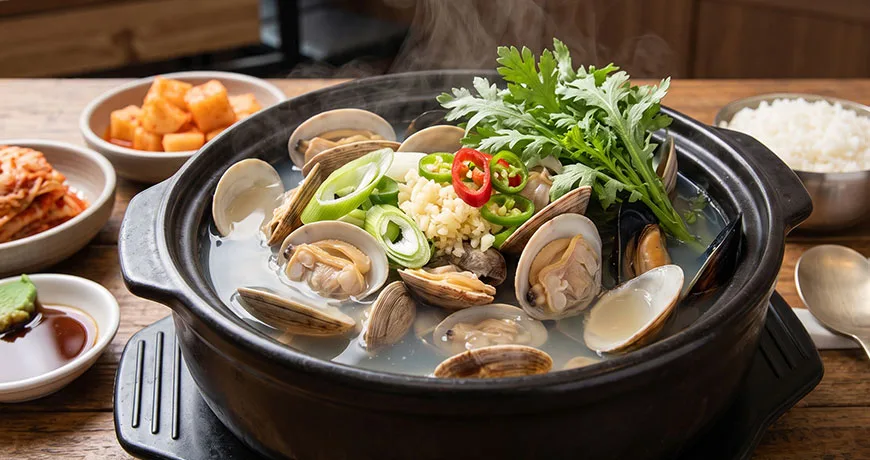
Jogaetang is a precision biochemical aqueous extraction soup engineered to rapidly draw out the highly concentrated organic acids (succinic acid) and free amino acids trapped within the muscle tissues and viscera of bivalve mollusks (such as littleneck or hard clams) via short-duration high heat. As the bivalves are introduced to the aqueous solvent and reach critical temperature, the protein molecules of the adductor muscle, which clamps the shell shut, undergo thermal denaturation. This physically triggers the shell to pop open. At this precise moment, the internal hypertonic saline and concentrated glutamate aggressively burst into the water, forging a flawless, isotonic umami broth. Prolonged kinetic heat will cause catastrophic textural failure, turning the tender proteins into rubber. Thus, the moment the proteins denature, the heat must be cut, and the sharp volatile allyl sulfides of crushed garlic and the biting capsaicin of Cheongyang chilies are introduced to surgically strike and mask any trace of marine trimethylamine (TMA). Massively dense in liver-detoxifying taurine, this soup is the ultimate liquid matrix for rapidly neutralizing alcohol metabolites.
- ⏱️ Total: 2 hrs 15 mins | Prep: 2 hrs (Hypertonic osmotic purging) | Cook: 15 mins
- 🍳 Difficulty: Medium (Requires precise adductor muscle thermal denaturation timing)
- 🌶️ Profile: Piercingly Clear Umami with a Sharp Capsaicin Strike
- 🍚 Focus: Succinic Acid Extraction, Osmotic Purging, & Protein Texture Control
- 🍶 Pairing: Crisp, dry, minerality-forward traditional Cheongju
Ingredients (3–4 servings)
- Succinic Acid & Taurine Matrix: 1kg Live Littleneck or Hard Clams (submerged in hypertonic seawater-level saline, completely blocked from light for over 2 hours for osmotic purging)
- Aqueous Solvent: 1.2L – 1.5L Purified Water
- Aromatic & Allyl Strike: 3 Whole Garlic Cloves (roughly crushed with the flat of a knife to maximize allicin release), 2 Cheongyang green chilies, 1 Red chili (diagonally sliced), 10cm White stalk of Green Onion (chopped)
- Ionized Sodium: Coarse Sea Salt (NaCl) to taste (for final ionic calibration)
Allergy Information
- Contains: Shellfish (Clams/Bivalves)
Equipment
- High thermal conductivity Stainless Steel Pot, Mixing Bowl, Black plastic bag or opaque cover for purging
Cooking Instructions
- Hypertonic Osmotic Purging: Submerge the clams in a hypertonic saline solution matching seawater (2–3 tbsp salt per 1L water). Drop in a stainless-steel spoon and cover tightly with a black bag to block all photons. Over 2 hours, the clams’ osmotic and respiratory mechanics will violently expel trapped sand and impurities. Afterward, aggressively rub the shells together under running water to physically obliterate exterior debris.
- Aqueous Umami Extraction: Place the purged clams into a pot filled with cold purified water and begin heating over medium heat. Gradually raising the temperature ensures the muscle tissues slowly expand, systematically bleeding their maximum payload of water-soluble amino acids and succinic acid into the solvent.
- Thermal Denaturation & Aromatic Strike: As the water reaches a rolling boil, the bivalves’ adductor muscles will thermally collapse, physically forcing the shells open. Swiftly skim off any coagulated protein foam. Instantly introduce the crushed garlic and chilies. These sharp volatile compounds will surgically mask any residual marine odors.
- Osmotic Ion Calibration & Serving: Once all shells have popped open, immediately terminate the thermal energy within 1–2 minutes. Taste the broth and introduce coarse sea salt (NaCl) to calibrate the sodium ion concentration. Garnish with chopped green onions and serve immediately.
💡 Professional Culinary Tips
- Thermodynamics of Succinic Acid Extraction: Dropping live clams directly into boiling water causes their exterior proteins to violently contract, locking the succinic acid umami payload inside the tissue. You must start from a cold aqueous solvent and gradually raise the thermal energy, allowing the proteins to relax and release their biochemical flavors into the broth.
- Textural Failure of Adductor Muscle: If you continue to boil the clams after the shells have opened, the protein contraction exceeds the critical threshold, expelling all moisture and resulting in an irreversible, rubbery texture. The open shell is the mechanical indicator that chemical extraction is complete; kill the heat immediately.
- Allicin Release Kinetics: For this specific clear broth, roughly crushed garlic is scientifically superior to finely minced garlic. The brutal mechanical crushing fractures the cell walls, instantly releasing volatile allicin, but preventing micro-particles from clouding the broth, thus preserving both visual and gustatory clarity.
🍶 Gastronomic Pairing
- Biochemical Palate Cleansing: When the transparent, sharp salinity of the succinic acid and the fiery capsaicin stimulate your tongue, pair it with a 14–15% ABV Dry Cheongju (traditional refined rice wine). The volatile ethanol exponentially expands the marine minerality (iodine notes) within the oral cavity, establishing a flawless chemical synergy that perfectly frames the elastic texture of the clam muscles.
Nutrition Facts (Estimated)
Total Content : Approx. 550g (1 serving, excluding shell weight)
Calories : 29 kcal
– Sodium : 290.0mg
– Total Carbohydrate : 1.8g
– Sugar : 0.2g
– Total Fat : 0.6g
– Saturated Fat : 0.1g
– Cholesterol : 16.3mg
– Protein : 4.0g
– Dietary Fiber : 1.5g
*Daily Values are based on a 2,000 calorie diet and standard Korean nutritional reference values.
**Nutritional values are calculated based on original ingredients; substitutions may alter specific macronutrients.
Origins and Food Culture of Clam Soup (Jogaetang)
1. Prehistoric Shell Mounds (Paechong) and Classical Maritime Records
- Rooted in the ancient foraging heritage of the Korean peninsula, where extensive Neolithic and Bronze Age shell mounds (paechong) scattered across the southern and western coastlines prove that bivalves have sustained peninsular inhabitants as a primary protein staple since prehistoric antiquity.
- Historically documented in Jeong Yak-jeon’s 1814 marine encyclopedia Jasanoebo, where hard clams and Manila clams are classified under the Hanja name Hap (蛤) and Hap-ri (蛤蜊), praised as “sweet, tender, and producing an incomparably savory broth,” while Heo Jun’s 1613 Dongui Bogam records that clam meat is “cool in nature, non-toxic, effectively dispelling alcohol poisoning, quenching parching thirst, and clarifying ocular vision,” solidifying centuries of medicinal culinary heritage.
2. The Culinary Science of Osmotic Depuration (Haegam) and Cold-Start Poaching
- The cornerstone of authentic preparation lies in the delicate biochemical process of depuration (haegam): submerging live clams in a 3.0–3.5% saltwater solution mimicking natural ocean salinity, dropping in a metal spoon to generate mild galvanic stimulation, and covering the vessel in darkness so the bivalves relax and expel trapped mud and grit.
- If dropped directly into boiling water, the abrupt thermal shock causes the adductor muscles to lock shut while muscular proteins violently contract, resulting in rubbery meat and trapped flavor compounds. Authentic kitchens practice cold-start simmering: placing the purged clams into cold water and bringing the heat up gradually. This controlled thermodynamic curve coaxes the clams to pop open naturally, extracting concentrated succinic acids and minerals into the broth while preserving a supple, melt-in-the-mouth chew.
3. The Icon of “Pojangmacha” Nightlife and the Culture of “White Hangover Relief”
- Emerging as the undisputed emblem of 1970s and 1980s working-class street taverns (pojangmacha) across Seoul and industrial port cities, served bubbling in lightweight aluminum pots or earthen crocks as an affordable late-night accompaniment to soju.
- Celebrated for its unique property of sobering up patrons even as they drink, Jogaetang perfectly embodies the paradoxical Korean exclamation “Eou, siwonhada!” (an expression of deep internal clarity upon drinking scalding soup), standing as a timeless monument to Korean minimalism, working-class comfort, and maritime restorative dining.
The Crystalline Clarity of Intertidal Bivalves, the Razor-Sharp Succinic Umami of Ocean Brine, and the Incandescent Piquancy of Korean Green Chilies: A Refined Portrait of Jogaetang
Jogaetang (Clear Simmered Clam Soup) stands as the pristine, razor-sharp, and biologically revitalizing summit of Korea’s marine clear-broth (cheongtang) gastronomy. Fresh, seasonal bivalves—such as Manila clams (baji-rak), orient clams (dongjuk), hard clams (baekhap), and blue mussels—harvested from the vast intertidal mudflats of the Yellow Sea and the clean currents of the southern coastline, are purged thoroughly in dark, sea-salted water to expel microscopic sands and tidal silt. Plunged into cold spring water or a gossamer sheet-kelp infusion alongside whole peeled garlic cloves, diagonally sliced scallions, and fiery red and green Cheongyang chili peppers, the soup is brought to a rapid, explosive boil over roaring heat. Seasoned transparently with a whisper of solar sea salt and refined rice wine, this dish deliberately avoids thick bean pastes, fiery red pepper gochujang, and heavy animal lipids. Instead, it captures the raw, unmasked cellular nectar and trace sea minerals released the exact instant the clam shells snap open, delivering an austere masterclass in culinary minimalism that washes over the palate with crystalline, invigorating purity.
Confronting the boiling earthenware bowl or rustic aluminum pot as translucent white bubbles erupt and the gleaming clam shells blossom wide to reveal their tender meat, lifting a deep spoonful of the pristine broth releases an immediate, electrifying sensory charge: the cool, iodine-rich perfume of fresh tidal mudflats mingles seamlessly with the brisk, vaporous sting of sliced green chilies and the sweet, sulfurous warmth of simmering alliums. The first sip delivers a revelation across the tongue: an unadorned, razor-sharp rush of natural succinic umami floods the oral cavity with zero resistance, gliding down the esophagus to soothe alcohol-inflamed tissues and awaken dormant perspiration in an exhilarating wave of what Korean gastronomy reveres as siwonhan mat—the sensation of refreshing, soul-cleansing clarity. Plucking a clam from its shell with chopsticks and biting into it delivers an intoxicating tactile contrast: the plump mantle and adductor muscle resist tooth pressure with a springy, toothsome pop (taenggeul) before dissolving tenderly, discharging captured ocean brine and sweet amino acids. The brisk, auditory crunch of crisp Cheongyang peppers cleanses lingering sea notes, transforming the simple act of finishing the broth and mounding empty shells into an unforgettable ritual of metabolic restoration and profound gastronomic catharsis.
The enduring brilliance of Jogaetang lies in its coastal, working-class lineage—originating in the windswept fishing settlements and harbor quays of the archipelago, where mariners tossed freshly raked bivalves into cauldrons of sea-brine to ward off the freezing chill. Evolving from a pragmatic dockside restorative into the undisputed sovereign of late-night street tent taverns (pojangmacha) and morning hangover sanctums across the nation, a steaming pot of clear clam soup remains an irreplaceable cultural monument of tidal resourcefulness, minimalist elegance, and the timeless restorative genius of Korean culinary craftsmanship.
Editor’s Review
1. A Dynamic Harmony of Plump Bivalve Mantle Elasticity, Crisp Capsicum Snap, and Frictionless Crystalline Broth Fluidity
The structural landscape inside the vessel delivers an extraordinary, high-contrast interplay between invertebrate muscular tissue, crisp botanical cell walls, and an ultra-low-viscosity aqueous solution. Rapid hydrothermal exposure prevents the delicate clam meats from over-contracting, allowing them to retain a plump, buoyant chew that bursts cleanly against the palate without tough, rubbery resistance. This toothsome yield is framed by the sharp, auditory crunch of flash-wilted Cheongyang peppers and scallions, which supply refreshing physical friction. Devoid of heavy starches and emulsified fats, the crystalline broth glides across oral tissues with zero friction, ensuring an impeccably balanced, non-fatiguing mouthfeel from the first steaming sip to the last.
2. Bivalve Succinate-Glycine-Betaine Umami Synergy, Abductin Ligament Heat Relaxation and Shell-Opening Kinetics, Actomyosin Syneresis Mitigation (80–85°C), and Taurine-Capsaicin Hepatic Clearance Mechanics
Jogaetang represents an exacting study in marine invertebrate physiology, protein thermal kinetics, and sensory neurochemistry. The soup’s distinctive savor is governed by the high concentration of succinic acid (succinate, a dicarboxylic organic acid) in bivalve tissues, which converges with free glycine, alanine, and betaine in the presence of natural sodium and chloride ions to activate human oral T1R1/T1R3 umami heterodimers with razor-sharp intensity. The bivalve shell hinge is governed by the rubber-like elastic protein abductin; during thermal transfer, the adductor muscles denature and relax their contractile hold while the resilient internal energy of the hinge ligament snaps the calcified valves open. Crucially, bivalve actomyosin and interstitial collagen undergo rapid cross-linking and severe fluid expulsion (syneresis) if sustained above 90°C, transforming succulent meat into a shrunken, rubbery mass. Cutting the heat the moment the shells open—holding the core temperature at 80–85°C—is the essential thermodynamic principle that preserves cellular hydration and springy tenderness. Furthermore, dense reserves of taurine and betaine in the clam organs stimulate bile acid secretion and upregulate hepatic aldehyde dehydrogenase pathways to accelerate acetaldehyde clearance, while lipophilic capsaicin from the Cheongyang chilies excites oral TRPV1 receptors, promoting peripheral vasodilation, gentle perspiration, and comprehensive physiological recovery.
3. Intertidal Foraging Heritage and the Sovereign Zenith of Korean Clear-Broth (Cheongtang) Gastronomy
Rejecting the crutch of heavy sauces and rich fats to place absolute trust in the mineral-rich cellular fluids of pristine bivalves, Jogaetang stands as the ultimate expression of Korean culinary subtraction. Elevating humble tidal harvests into a therapeutic tonic through precise, flash-simmer thermal management, this unadorned classic stands as an enduring sanctuary of environmental authenticity, physical rejuvenation, and brilliant culinary restraint.