
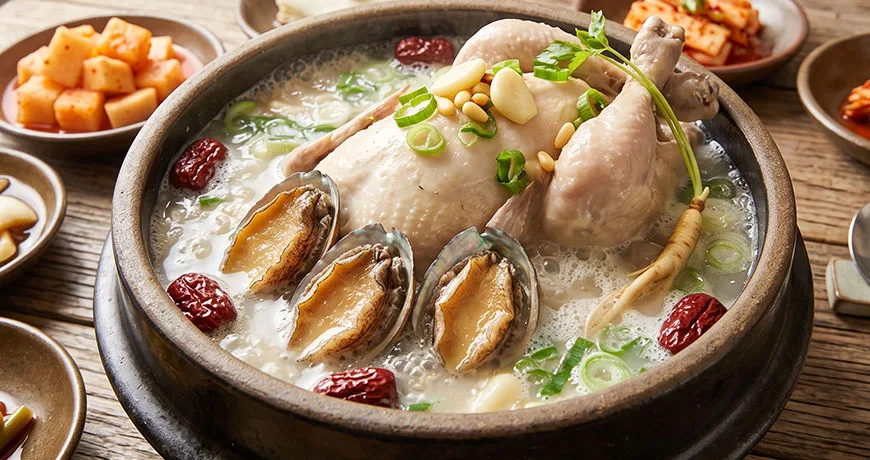
Jeonboksamgyetang is an extreme dual-matrix thermal hydrolysis extraction that fuses the animal protein and lipid emulsion yielded from the tender connective tissues of a young chicken with the high-concentration taurine and marine minerals of a marine mollusk (abalone). As the thermodynamic energy of the 100°C water boils, the osmotic pressure forces the ginsenosides from the ginseng and allicin compounds from the garlic directly through the poultry’s muscle fibers and cavity, biochemically masking any gamey poultry odors. Simultaneously, the live abalones introduced during the heating process undergo protein chain contraction, forging a highly elastic texture while discharging massive amounts of glutamic acid and glycogen into the broth. This detonates the broth’s rheological viscosity and umami profile. Designed to combat severe internal heat and exhaustion, this is a meticulously engineered biochemical energy payload that rapidly replenishes lost electrolytes and muscle glycogen, intentionally elevating core body temperature to induce homeostasis.
- ⏱️ Total: 1 hr 40 mins | Prep: 30 mins | Cook: 1 hr 10 mins
- 🍳 Difficulty: High (Requires cavity stuffing mechanics and cross-heating control of heterogeneous proteins)
- 🌶️ Profile: Profoundly Savory, Earthy Ginseng, and Marine Umami
- 🍚 Focus: Dual-Matrix Hydrolysis, Protein Denaturation, & Saponin Extraction
- 🍶 Pairing: Chilled Ginseng Liquor (Insamju) or refined Cheongju
Ingredients (2 servings)
- Poultry Matrix: 2 Young Chickens (Size 5 or 6 for Samgyetang – fully gutted, blood purged)
- Marine Taurine Catalyst: 4 Live Abalones (shells and meat physically scrubbed, teeth removed)
- Complex Carbohydrate Binder: 1 cup Soaked Sweet Rice (Glutinous rice – inserted into the cavity for gelatinization)
- Aromatic & Saponin Extractors: 2 roots Fresh Ginseng, 10 Whole Garlic Cloves, 4 Jujubes (Korean dates), 4 Ginkgo Nuts, 2 roots Astragalus (Hwanggi)
- Aqueous Solvent: 2.5L Purified Water
- Ionization & Allyl Finish: Coarse Sea Salt (individual serving), Black Pepper, Chopped Green Onions (introduced at serving)
Allergy Information
- Contains: Poultry, Shellfish (Abalone)
Equipment
- Massive High Thermal Mass Earthenware Pot (Ttukbaegi) or Cast Iron Pot, Culinary Twine (Optional), Abalone Scrub Brush, Cutting Board, Knife
Cooking Instructions
- Cavity Stuffing & Sealing: Compress the soaked sweet rice, 2 garlic cloves, 1 jujube, and ginkgo nuts deep inside the thoroughly washed abdominal cavity of the young chicken. Cross the chicken’s legs (or tie with culinary twine) to physically seal the cavity, preventing the carbohydrates from escaping into the broth during heating.
- Botanical Extraction: In a large pot, combine 2.5L of purified water with the astragalus, fresh ginseng, remaining garlic, and jujubes. Boil aggressively for 20 minutes to pre-extract the phytochemicals into the aqueous solvent.
- Primary Thermal Hydrolysis: Once the botanical broth is established, remove the astragalus and introduce the stuffed chickens. Cover and heat over medium heat for 40 minutes. The convective energy systematically breaks down the poultry’s connective tissues, emulsifying the animal lipids and amino acids into the liquid.
- Secondary Marine Protein Impact: Just as the poultry muscle tissue yields to tenderness (10-15 minutes before the end of cooking), introduce the physically scrubbed live abalones, shell and all. The marine taurine and minerals fuse into the broth. By strictly controlling the heat exposure, the abalone meat retains its supreme, bouncy elasticity.
- Aromatic Impact & Ionic Serving: Transfer the chicken, abalones, and dense broth into an earthenware pot and bring to a final aggressive boil. Immediately before serving, introduce the chopped green onions to open the aromatics via volatile allyl compounds. The diner must manually introduce sea salt (NaCl) to adjust the sodium ion concentration, chemically detonating the amino acid umami payload.
💡 Professional Culinary Tips
- Time-Temperature Control for Heterogeneous Proteins: Poultry and abalone have drastically different denaturation thresholds. If you subject the abalone to the prolonged boiling required for the chicken, its marine protein chains will over-contract, resulting in catastrophic textural failure (turning into a rubbery, dehydrated mass). They must be introduced in the final 10–15 minutes to perfectly preserve their elasticity and cellular juices.
- Cavity Pressure & Gelatinization Kinetics: Stuffing the chicken with sweet rice and crossing its legs is not merely for presentation. As heat increases the pressure inside the abdominal cavity, the rendering marrow and poultry juices are forced to penetrate the sweet rice rather than leaking out. This ensures the rice undergoes flawless gelatinization while absorbing a highly concentrated chicken emulsion, rather than just watery broth.
🍶 Gastronomic Pairing
- Biochemical Palate Cleansing: When the ultra-dense extraction of poultry lipids and the heavy starch matrix of the sweet rice weigh heavily on your tongue, pair this dish with a shot of Ginseng Liquor (Insamju). The high concentration of saponins extracted in the alcohol acts as a surgical solvent, sharply cutting through the lipid coating, while its bitter, earthy notes perfectly contrast the deep marine umami of the abalone.
Nutrition Facts (Estimated)
Total Content : Approx. 1,000g (1 serving, excluding bone and shell weight)
Calories : 990 kcal
– Sodium : 850mg
– Total Carbohydrate : 38.0g
– Sugar : 4.5g
– Total Fat : 43.5g
– Saturated Fat : 11.5g
– Cholesterol : 535.0mg
– Protein : 112.0g
– Dietary Fiber : 12.0g
*Daily Values are based on a 2,000 calorie diet and standard Korean nutritional reference values.
**Nutritional values are calculated based on original ingredients; substitutions may alter specific macronutrients.
Origins and Food Culture of Abalone and Ginseng Chicken Soup (Jeonboksamgyetang)
1. The Royal Heritage of “Gyesamtang” and the Tribute Treasures of Wando Abalone
- Tracing its roots to the historic Gyesamtang (young chicken simmered with wild ginseng) documented in royal court and noble scholar (yangban) culinary archives of the Joseon Dynasty as the premier restorative tonic for surviving the sweltering heat waves of midsummer.
- The elite evolution of this dish occurred by incorporating fresh abalone—historically harvested by southern divers and presented as a prized tribute delicacy reserved exclusively for the royal dining table—uniting the two most prestigious terrestrial and marine stamina tonics of peninsular gastronomy.
- Grounded in Heo Jun’s 1613 Dongui Bogam, where chicken is praised for its ability to “warm the internal organs, replenish bone marrow, and harmonize vital qi,” while abalone is lauded for “cooling liver fire and clarifying vision,” creating an immaculate Yin-Yang equilibrium that harmonizes blood and vital energy (gi-hyeol).
2. The Pharmacological Lore of “Seokgyeolmyeong” and Thermal Staging Science
- In classical Eastern pharmacology, the mother-of-pearl shell of the abalone is prized as Seokgyeolmyeong (石決明), an herbal stone known to dispel cranial heat and improve visual acuity; authentic kitchens meticulously scrub the natural iridescent shells with horsehair brushes and simmer the abalone whole inside the pot to extract trace marine minerals directly into the broth.
- The culinary preparation requires precise thermodynamic staging: the stuffed chicken is simmered with ginseng, milkvetch root, and garlic for 40 to 50 minutes to fully extract the rich bone marrow essence and soften the muscular fibers; the fresh abalone is folded into the bubbling broth during the final ten to fifteen minutes, utilizing the latent heat of the earthenware pot to cook it through while preventing protein shriveling, ensuring a supple, buttery bite.
3. The Pinnacle of “Iyeol-chiyeol” (Fighting Heat with Heat) and Global Premium K-Wellness
- Embodying Korea’s celebrated culinary philosophy of Iyeol-chiyeol (以熱治熱)—restoring bodily equilibrium by consuming scalding, nutrient-dense soups during the hottest dog days of midsummer (Sambok: Chobok, Jungbok, and Malbok) to replenish fluids, electrolytes, and core heat lost through profuse sweating.
- Evolving from an aristocratic restorative delicacy into modern Korea’s ultimate luxury summer comfort food, the dramatic visual presentation of a whole abalone resting atop a golden chicken inside an earthen crock has captured the imagination of global food connoisseurs, reigning worldwide as a magnificent emblem of Korean therapeutic gastronomy and noble hospitality.
The Pristine Extraction of Young Avian Collagen, the Resilient Saline Buoyancy of Southern Abalone, and the Herbal Saponin Brilliance of Korean Ginseng: A Refined Portrait of Jeonboksamgyetang
Jeonboksamgyetang (Abalone and Ginseng Chicken Soup) stands as the opulent, visually magnificent, and biologically complete summit of Korea’s seasonal medicinal (tangban) gastronomy. A young, tender spring chicken (ungchu or yeonggye—typically 40 to 50 days of age) is meticulously cleaned and hollowed, then stuffed with soaked glutinous rice, plump garlic cloves, dried jujubes, gingko nuts, and sweet licorice before its legs are cross-trussed to seal the cavity. Submerged in an earthenware pot (ttukbaegi) filled with a clear medicinal herbal stock brewed from whole fresh Korean ginseng (Panax ginseng), milkvetch root (hwanggi), and Siberian ginseng bark, the bird is coaxed through a gentle hydrothermal simmer. At the rolling climax of cooking, a live, whole Pacific abalone (Haliotis discus hannai) freshly harvested from the pristine kelp beds of Wando is crowned shell-on over the bird, allowing residual heat to cook its delicate foot muscle into tender submission. Transcending the rustic simplicity of ordinary village chicken soups, this dish unites the sweet, bioavailable proteins of terrestrial poultry with the noble minerals and restorative taurine of sovereign marine gastropods in absolute thermodynamic and nutritional equilibrium.
Confronting the boiling earthenware vessel as clouds of rich white steam erupt across its surface releases an immediate, intoxicating olfactory charge: the savory, comforting perfume of slow-simmered chicken marrow mingles seamlessly with the bittersweet, earthy bloom of ginseng saponins, the pungent sweetness of braised garlic, and the brisk, mineral-rich sea breeze whispering from the abalone shell. The first sip coats the palate in a velvety, lip-clinging broth; laden with dissolved avian gelatin, marine glycogen, and leached amylopectin, the stock glides effortlessly down the esophagus, delivering deep, restorative warmth to internal organs exhausted by sweltering summer humidity. Sinking your teeth into the poached abalone delivers an exhilarating tactile sensation: the thick, muscular foot yields with an elastic, buoyant bounce (jjondeuk), flooding the oral cavity with captured oceanic juices and concentrated amino acids. In dramatic contrast, the young chicken meat collapses with delicate, fall-apart tenderness along its grain, releasing streams of clean, fat-free poultry savor. Piercing the bird’s belly allows the infused glutinous rice to spill into the soup, forming a soothing, starch-rich porridge that tempers the herbal intensity and leaves the diner in a state of profound, fatigue-banishing gastronomic catharsis.
The enduring brilliance of Jeonboksamgyetang lies in its historical integration of Iyeolchiyeol (以熱治熱—”fighting internal heat with external heat”) and Yaksikdongwon (藥食同源—”food and medicine share the same ancestral root”). Conceived to protect the body’s internal vital energy (qi) against seasonal exhaustion during the three hottest dog days of summer (Sambok), this dish elevates traditional courtly ginseng chicken soup (Gyesamtang) by incorporating wild abalone—once a treasured tribute reserved for monarchs and an ancient emblem of longevity. Uniting the restorative terroir of inland ginseng farms with the cold marine riches of the southern archipelago inside a humble earthenware bowl, Jeonboksamgyetang remains an irreplaceable monument of restorative physiology, maternal generosity, and brilliant Korean culinary craftsmanship.
Editor’s Review
1. A Dynamic Harmony of Silken Avian Muscle Flakes, Buoyant Abalone Foot Elasticity, and Creamy Glutinous Starch Cushioning
The textural landscape inside the vessel delivers an extraordinary, three-tiered choreography between delicate avian muscle tissue, resilient gastropod muscle bundles, and a gelatinized cereal hydrogel. The young spring chicken, gently relaxed by steady thermal conduction, separates along individual myotomes with cloud-like tenderness, requiring minimal chewing. In stark contrast, the whole poached abalone exhibits an energetic, springy rebound against the teeth, providing a firm, satisfying chew without rubbery resistance. Within the bird’s cavity, the steeped glutinous rice expands and releases its amylopectin polymers into the broth, creating an unctuous, fluid-like cushion across oral tissues that ensures an impeccably balanced, non-fatiguing mouthfeel from the first steaming sip to the last.
2. Avian Type I/II Collagen Hydrothermal Gelatinization, Abalone Paramyosin Thermal Shrinkage Mitigation (80–85°C), IMP-Succinate-Taurine-Glutamate Quadruple Umami Synergy, and Ginsenoside-Mediated O/W Lipid Micro-Emulsification
Jeonboksamgyetang represents an exacting study in poultry muscle biochemistry, marine invertebrate thermal physics, and botanical surfactant dynamics. Insoluble Type I and Type II collagen, heavily concentrated within the young chicken’s joints, skin, and sternal cartilage, undergoes thermal denaturation above 85°C, cleaving its triple-helix hydrogen bonds into water-soluble gelatin polypeptides that elevate the broth’s dynamic viscosity. In contrast, the abalone’s primary motor muscle is dominated by thick paramyosin filaments and dense, heat-resistant collagen networks; prolonged exposure to temperatures above 90°C triggers severe cross-linking and aggressive water expulsion (syneresis), transforming tender seafood into a dense, rubbery mass. Introducing the abalone in the final minutes of cooking ensures its core temperature stays precisely between 80°C and 85°C, preserving structural turgor and velvety tenderness. Skeletal-derived inosine monophosphate (IMP) from the chicken converges with the abalone’s rich reserves of succinic acid (succinate), taurine, and glycine, alongside free glutamic acid leached from fresh garlic, triggering an exponential quadruple synergy across human oral T1R1/T1R3 umami heterodimers. Furthermore, ginsenosides (steroidal saponins like Rb1 and Rg1) extracted from the Korean ginseng root function as potent amphiphilic surfactants; their dual hydrophilic-lipophilic molecular structure breaks down liberated chicken tallow into microscopic sub-micron droplets, stabilizing a durable oil-in-water (O/W) micro-emulsion that eliminates greasy surface separation and yields a smooth, digestible, milk-white body.
3. The Sambok Iyeolchiyeol Heritage, Imperial Tribute Fusion, and the Living Zenith of Korean Medicinal Gastronomy
By synthesizing the noble, court-level restorative heritage of ginseng chicken soup with the maritime prestige of fresh southern abalone, Jeonboksamgyetang captures the pinnacle of Korean seasonal tonic cookery. Translating ancient humoral medicine into an exquisite, multi-textural harmony of terrestrial fowl and marine bounty, this radiant earthenware centerpiece stands as an enduring sanctuary of environmental respect, restorative vitality, and brilliant Korean culinary artistry.