
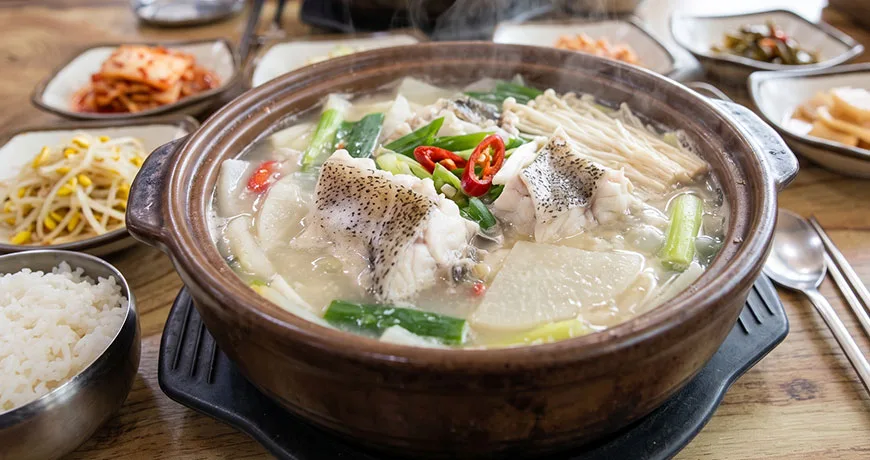
Mineotang is a high-end restorative marine matrix engineered to extract the ultra-dense collagen structure found in the skeletal frame and the highly prized swim bladder (Bure) of the giant croaker through precise thermal hydrolysis. Unlike standard fish, the croaker’s swim bladder is a concentrated sac of pure collagen. Upon heating, this anatomical structure melts, exponentially elevating the rheological viscosity of the broth to create a lip-smacking, sticky gelatinous consommé. This heavy collagen matrix fuses perfectly with the cooling reducing sugars leached from the breaking pectin walls of daikon radish. Because the white myofibrillar protein of the croaker contains almost no connective tissue, it is exceptionally vulnerable to physical kinetic friction. Thus, the fillets must be carefully poached at a critical temperature threshold of 80–85°C to prevent thermal structural collapse. Crafted as a pristine clear broth (Jiri) to avoid masking its molecular purity with heavy spice, this soup is the ultimate minimalist expression of marine viscoelasticity and umami.
- ⏱️ Total: 50 mins | Prep: 20 mins (Purging viscera and bloodlines) | Cook: 30 mins
- 🍳 Difficulty: Extreme (Requires strict thermodynamic control to gelatinize the swim bladder while preventing the physical disintegration of the delicate white flesh)
- 🌶️ Profile: Deeply Savory, Profoundly Viscous, and Ocean-Clear
- 🍚 Focus: Swim Bladder Thermal Hydrolysis, Critical Poaching Control, & Pectin Breakdown
- 🍶 Pairing: Crisp, high-acidity Brut Champagne or thoroughly chilled, refined traditional Cheongju
Ingredients (3–4 servings)
- Collagen & Protein Matrix: 1 Fresh Giant Croaker (Mineo, approx. 1.5kg – scales and gills removed, separated into head, bones, and fillets. Swim Bladder (Bure) is absolutely mandatory)
- Pectin & Reducing Sugar Matrix: 200g Daikon Radish (sliced into squares), 1/4 Zucchini (sliced into half-moons for turgor and subtle sweetness)
- Aqueous Umami Solvent: 1.5L Purified Water, 1 piece Dried Kelp (Dashima – for glutamic acid extraction)
- Ionized Sodium Binder: Coarse Sea Salt to taste, 1 tsp Soup Soy Sauce (Guk-ganjang – used sparingly to prevent discoloration)
- Aromatic & Allyl Catalyst: 1 stalk Green Onion (diagonally sliced), 3 cloves Garlic (sliced, not minced, to preserve broth clarity), 1 Cheongyang green chili, 1 handful Water Dropwort (Minari)
Allergy Information Contains: Fish (Croaker), Soy, Wheat (from Soy Sauce)
Equipment Wide High Thermal Mass Pot, Skimmer, Cutting Board, Knife, Tweezers (for pin bone removal)
Cooking Instructions
- Initial Coagulation & Purging: Flash-blanch the separated fish head and heavy skeletal bones in boiling water for 1 minute to thermally coagulate surface myoglobin and impurities. Rinse them vigorously under cold water. This physical purging is the absolute prerequisite for a crystal-clear broth.
- Swim Bladder & Bone Hydrolysis: In a wide pot, combine the cleaned bones, head, 1.5L of purified water, kelp, and square-cut radish. Heat over a high flame. Right before the water reaches a full boil (approx. 80°C), remove the kelp to prevent slimy alginic acid extraction. Introduce the swim bladder and simmer gently over medium heat for 20 minutes. The high-density collagen in the bladder and bones will thermodynamically collapse, infusing the broth with massive gelatinous body.
- Critical Thermal Coagulation: Once the broth turns milky and highly viscous, meticulously skim away any surface foam. Establish the baseline osmotic pressure with sea salt and a touch of soup soy sauce. Introduce the pristine croaker fillets, sliced garlic, and zucchini. Immediately reduce the heat to maintain a gentle 80–85°C poaching environment. Allowing the water to reach a rolling boil will hydrodynamically destroy the delicate flesh. Poach gently for 5–7 minutes until the proteins have fully coagulated into a viscoelastic state.
- Aromatic Finish & Serving: Turn off the heat once the flesh turns opaque white. Top the matrix with green onions, chili, and Minari, allowing the pot’s radiant heat to activate their volatile terpenes. Serve the sticky swim bladder and hyper-tender fillets suspended in the rich broth.
💡 Professional Culinary Tips
- Chemistry of Bure (Swim Bladder) Gelatinization: The zenith of Mineo gastronomy lies not in the flesh, but in the swim bladder. It is an anatomical pouch of pure collagen. When subjected to thermal kinetic energy, its triple-helix protein structure unwinds and binds with water molecules to form a high-viscosity gelatin. This biomolecule coats the entire soup, leaving a distinct, sticky residue on the lips. A croaker stew without the swim bladder is biochemically incomplete.
- Hydrodynamic Protection of Myofibrils: Because the croaker’s muscle fibers lack connective tissue, they melt in the mouth but are highly susceptible to the violent kinetic friction of boiling water. Dropping the fillets into a 100°C rolling boil will disintegrate them into a cloudy mush. Extracting a deep stock from the bones first, then carefully poaching the fillets in a calm 85°C solvent at the very end, is the absolute law for preserving structural integrity.
- Garlic Slicing Logic: To fully appreciate the pristine clarity and smooth viscosity of the collagenous broth, microscopic particles of minced garlic must not be allowed to cloud the solvent. Using thinly sliced garlic effectively leaches water-soluble allyl sulfides into the broth without compromising its optical purity or textural smoothness.
🍶 Gastronomic Pairing
- Biochemical Palate Cleansing: When the hyper-concentrated gelatin from the swim bladder and the deep umami thickly coat your oral mucosa, pair this dish with a glass of crisp Brut Champagne or highly refined, chilled traditional Cheongju. The sharp acidity and effervescence act as a surgical scalpel, slicing cleanly through the sticky collagen barrier on your tongue. This perfectly resets your taste receptors, ensuring the deep marine umami of the next spoonful hits with maximum geometric impact.
Nutrition Facts (Estimated)
Total Content : Approx. 650g (1 serving, excluding bone weight)
Calories : 240 kcal (Excluding rice) – Sodium : 1,100mg (Variable based on sea salt calibration)
– Total Carbohydrate : 8.0g (Reducing sugars from radish and zucchini)
– Sugar : 3.0g
– Total Fat : 3.5g (Unsaturated fats native to croaker)
– Saturated Fat : 0.8g
– Cholesterol : 85.0mg
– Protein : 42.0g (Ultra-dense swim bladder collagen peptides and high bioavailability myofibrillar protein)
– Dietary Fiber : 2.5g
*Daily Values are based on a 2,000 calorie diet and standard Korean nutritional reference values.
**Nutritional values are calculated based on original ingredients; substitutions may alter specific macronutrients.
Origins and Food Culture of Croaker Stew (Mineotang)
1. Joseon Aristocratic “Sambok” Prestige: “First Mineo, Second Domi, Third Boshintang”
- While commoners historically sought relief from the sweltering heat of the three dog days of midsummer (Sambok) by consuming dog meat stew (boshintang) or young chicken (samgyetang), royal princes and noble scholar (yangban) households in Hanyang revered Mineo as the absolute pinnacle of summer restorative gastronomy.
- Classical culinary folklore codified this elite hierarchy into an immortal adage: “First rank is Croaker Stew (Mineotang), second rank is Steamed Sea Bream (Domijjim), and third rank is Dog Meat Soup (Boshintang).” Recorded in Jeong Yak-jeon’s landmark 1814 marine treatise Jasanoebo under the Hanja name Myeon-eo (鮸魚), the fish was praised because “in late summer prior to spawning, its flesh is exceedingly sweet and rich, yielding an incomparable delicacy when simmered into soup.” Similarly, Heo Jun’s 1613 Dongui Bogam noted that it “replenishes deficiency in the five viscera, resolves indigestion, and invigorates vital energy,” confirming centuries of prestigious medicinal heritage.
2. The Culinary Science of Bone and Air-Bladder Emulsification (Gomgukhwa)
- Unlike standard fish stews that are cooked briefly to preserve delicate flesh, Mineotang demands an arduous cooking technique known as “fish-bone marrow decoction” (eogol gomguk): simmering the dense cartilaginous head, spine frames, and collagen-rich swim bladder over regulated heat for hours until the broth turns as opaque and milky as beef bone broth.
- Master kitchens prepare it in two distinct styles: the pristine Jiri (clear broth), seasoned purely with solar sea salt, garlic, and scallions to highlight the pristine oceanic sweetness; and the rustic Maeuntang, spiked with aged fermented soybean paste (doenjang) and red chili flakes. The broth is so concentrated with soluble collagen that leftover soup solidifies into firm gelatin when chilled, giving rise to the famous Korean epicurean maxim: “You haven’t truly eaten croaker unless you have savored the swim bladder.”
3. Shinan Imjado’s “Tari Pasi” and the Royal Ice Boats (Bingsun) of the Han River
- Deeply rooted in the maritime history of the southwest coast—particularly the waters surrounding Imjado and Chilbaldo in Shinan-gun, Jeollanam-do—where hundreds of commercial fishing vessels gathered in the sixth and seventh lunar months to form dynamic floating fish markets known as Tari Pasi.
- To supply fresh, unspoiled croakers to royal banquets and aristocratic estates in the capital during the scorching summer months, fast transport vessels known as “ice boats” (bingsun) packed the fish in deep blocks of river ice carved from royal storage vaults (Seobinggo and Dongbinggo) and sailed swiftly up the Yellow Sea into Hanyang’s Mapo and Yongsan ports. Today, celebrated through century-old dining bastions across Seoul and Mokpo, Mineotang remains an enduring cultural monument to Korean imperial gastronomy, slow-food patience, and peninsular maritime pride.
The Sovereign Flakes of Prime Summer Croaker, the Lip-Clinging Gelatin of Oceanic Swim Bladders, and the Resonant Depths of Simmered Bone Essence: A Refined Portrait of Mineotang
Mineotang (Simmered Brown Croaker Stew) stands as the majestic, aristocratic, and biologically restorative summit of Korea’s coastal summer (tangban) gastronomy. Centered upon the prized brown croaker (Miichthys miiuy or Min-eo)—a colossal, silver-scaled marine treasure that fattens itself along the turbulent tidal channels of Sinan’s Imja Island and the Chilbal Sea ahead of its midsummer spawning—the dish begins with an exhaustive bone extraction. The massive head, collagenous vertebrae, and fins are simmered over sustained heat in heavy cauldrons until the structural tissues surrender an opaque, ivory-rich fish bone stock. Layered with thick, pristine fillets of snowy white meat, the precious swim bladder (bure—celebrated in Korean tradition as maritime ginseng for its pure collagen), and rich croaker liver, the stew is assembled alongside thinly sliced summer radish, zucchini, and scallions. Submerged in a foundational anchovy-kelp stock dissolved with an assertive seasoning paste of sun-dried red chili powder (gochugaru), a touch of aged soybean paste (doenjang), minced garlic, fresh ginger, and aged soup soy sauce, the broth is coaxed through a watchful simmer before being crowned with wild water parsley (minari) and aromatic crown daisy (ssukgat). Whether prepared as an invigorating spicy stew or a crystal-clear restorative soup (jiri), Mineotang transcends the sharp lightness of ordinary fish broths; the copious gelatin liberated from the bones and swim bladder endows the broth with a lip-coating richness that delivers profound physiological comfort.
Confronting the boiling earthenware vessel (ttukbaegi) as terracotta bubbles froth across its surface releases an immediate, deeply comforting olfactory charge: the buttery perfume of slow-simmered fish marrow and rendered liver mingles seamlessly with the brisk, pine-fresh fragrance of water parsley and the sweet, sulfurous warmth of simmering alliums. Taking the first sip delivers a luxurious revelation across the tongue: the velvety broth, dense with dissolved gelatin and free amino acids, glides over the palate with zero fishy grease, washing down the esophagus to infuse an exhausted body with deep, restorative warmth. Gently parting the croaker’s flesh with a spoon yields snowy flakes that dissolve instantly across the tongue like warm cream, releasing streams of clean, fat-free marine sweetness. In dramatic contrast, the poached swim bladder provides a lively, viscoelastic chew (jjondeuk) that yields with a springy rebound under tooth pressure, discharging concentrated oceanic juices. The broth-soaked radish yields with a succulent, juicy chew, while the crisp snap of wild herbs provides refreshing botanical friction, transforming the meal into an unforgettable ritual of metabolic restoration, seasonal resilience, and profound gastronomic catharsis.
The enduring majesty of Mineotang lies in its historical pedestal within the Joseon Dynasty’s literati and courtly food culture—immortalized in the venerable adage: “First rank is croaker soup, second rank is seabream soup, and third rank is dog meat stew,” declaring it the supreme restorative of the three hottest dog days of summer (Sambok). Sourced from the historic seasonal floating markets (pasi) of Sinan and hauled to the royal banquets of Hanyang to replenish depleted vital energy (qi), a steaming bowl of croaker stew remains an irreplaceable monument of zero-waste marine stewardship, aristocratic indulgence, and brilliant Korean culinary craftsmanship.
Editor’s Review
1. A Dynamic Harmony of Silken Croaker Myotome Flaking, Resilient Swim Bladder Viscoelasticity, Melting Radish Sponginess, and Herbaceous Crunch
The structural architecture inside the vessel delivers an extraordinary, high-contrast choreography between delicate marine muscle fibers, a hyper-dense collagenous organ (the swim bladder), hydrated root matrices, and a high-viscosity colloidal stock. Gentle hydrothermal cooking allows the croaker’s white flesh to separate along natural myotome boundaries with cloud-like ease, melting across the palate without fibrous stringiness. In stark contrast, the simmered swim bladder exhibits a buoyant, elastic chew that resists the teeth with an unctuous spring before collapsing cleanly. Cushioning these textures, the thinly sliced radish—having absorbed the savory stock like an organic sponge—yields with a tender give, while fresh water parsley introduces a brisk, auditory snap that cleanses lingering rich notes, ensuring an impeccably balanced, non-fatiguing mouthfeel from the first steaming sip to the last.
2. Swim Bladder and Skeletal Type I Collagen Gelatinization, Actomyosin Syneresis Mitigation (85-90°C), Nucleotide IMP-Glutamate Umami Synergy, and Terpene-Driven TMA Sequestration
Mineotang represents an exacting study in teleost fish histology, macromolecular thermodynamics, and flavor volatile mitigation. The swim bladder, skin, cranial cartilage, and spinal column of Miichthys miiuy are dominated by insoluble Type I collagen; the dried swim bladder alone is composed of over 80% pure structural collagen. Sustained heating between 85°C and 95°C cleaves the triple-helical hydrogen bonds of these collagen fibers, hydrolyzing them into water-soluble gelatin polypeptides that elevate the broth’s dynamic viscosity and create its signature lip-clinging tackiness. Conversely, the croaker’s delicate white myofibrillar actomyosin contracts aggressively if subjected to violent boiling above 95°C, resulting in fluid syneresis and a tough, dry texture. Simmering the skeletal frame first to extract bone marrow gelatin, followed by staging the delicate fillets into a moderate simmering zone (85-90°C), preserves myofibrillar Water Holding Capacity (WHC). Muscle-derived inosine monophosphate (IMP) converges with natural succinic acid from the braised radish and free glutamic acid (Glutamate) leached from fermented doenjang, triggering an exponential synergy across oral T1R1/T1R3 umami heterodimers. Furthermore, volatile monoterpenes (limonene, pinene) from water parsley and crown daisy, alongside allicin from garlic, chemically sequester and mask trace trimethylamine (TMA) and lipid aldehydes, yielding an exquisitely clean, elevated aromatic profile.
3. The Joseon Sambok Bokdalim Lineage, Imjado Island Terroir, and the Sovereign Apex of Korean Marine Restorative Gastronomy
Elevated by Joseon scholars above all terrestrial meats as the ultimate antidote to summer exhaustion, Mineotang represents the absolute zenith of Korean marine food therapy (sikchi). By extracting the total vitality of a sovereign fish—uniting bone marrow, tender flesh, precious liver, and the structural wonder of the swim bladder within a single earthenware cauldron—this iconic dish exemplifies the heights of sustainable whole-carcass cookery. Standing as an enduring sanctuary of domestic comfort, ecological intelligence, and aristocratic refinement, Mineotang remains one of the greatest masterpieces in Korean gastronomic history.